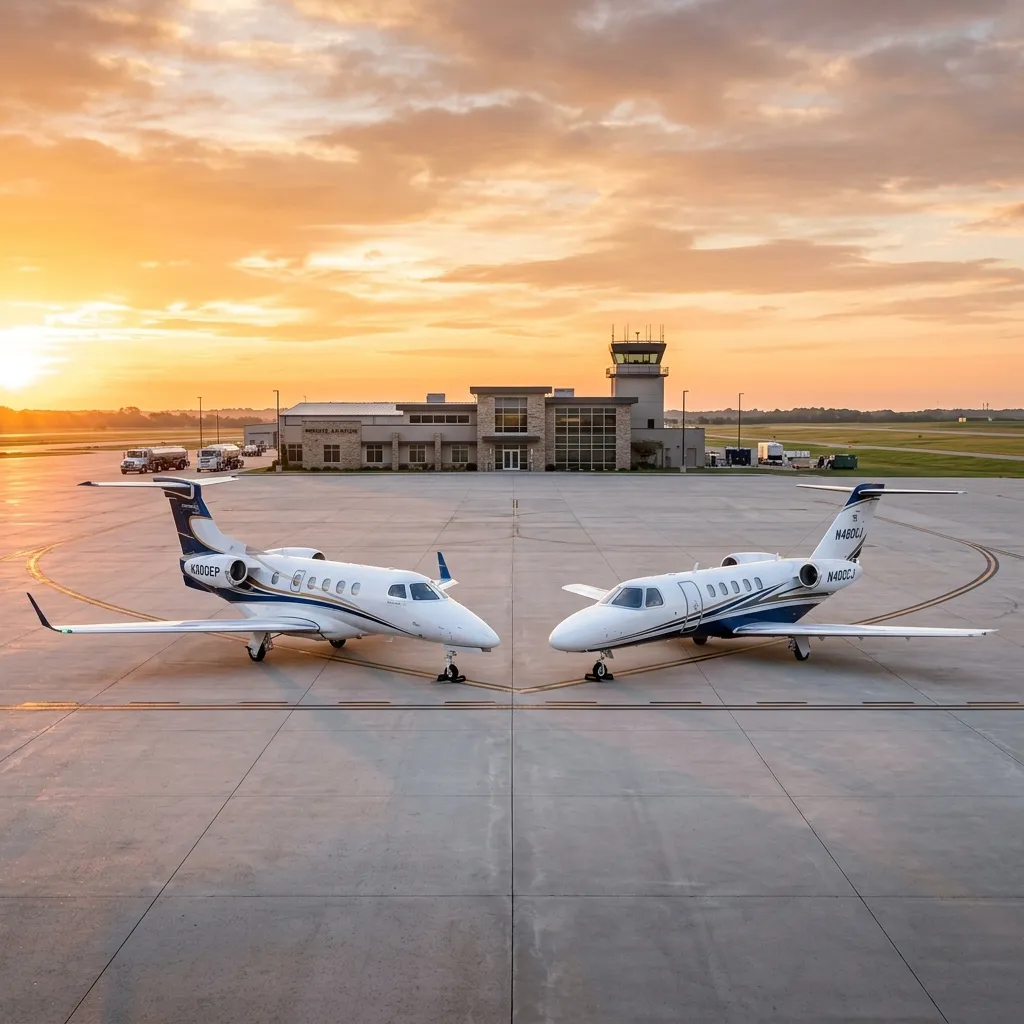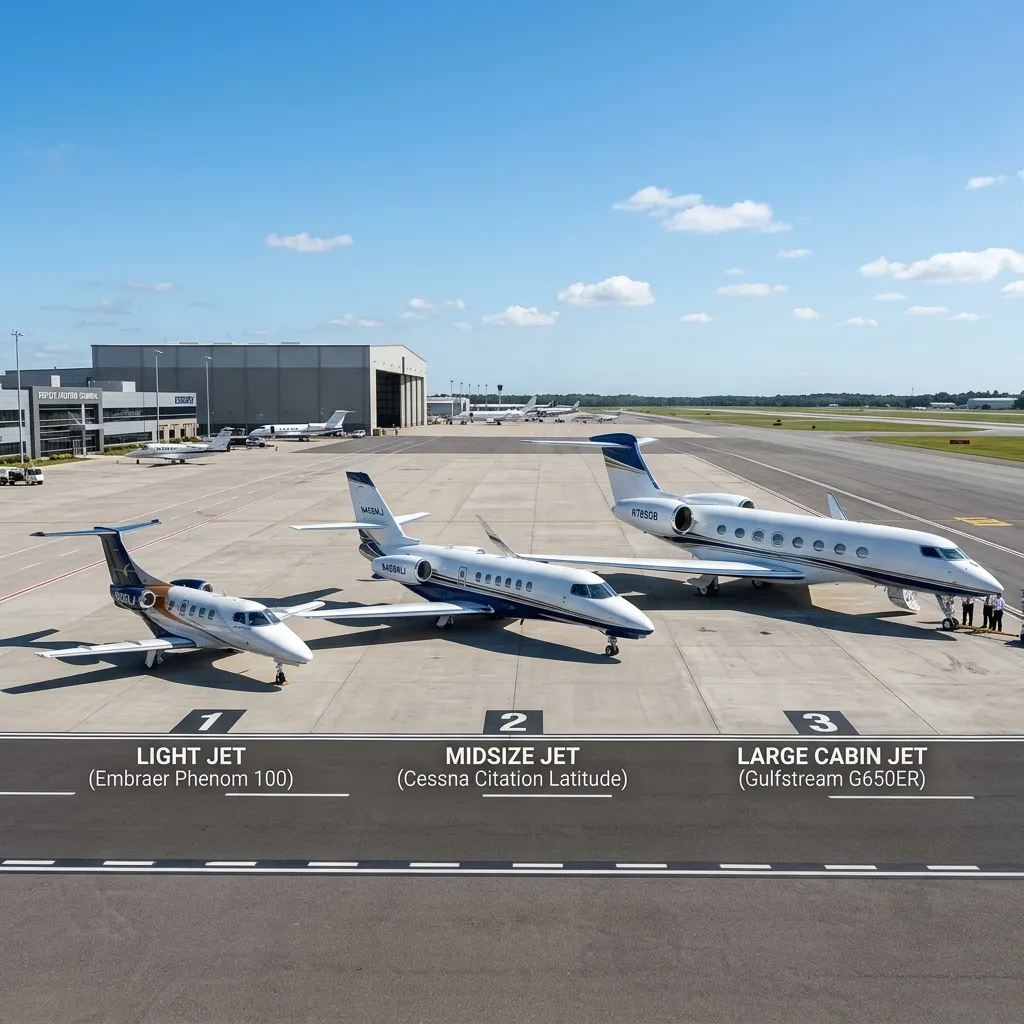
Lineup of business jets from very light to ultra long range on an FBO ramp showing size comparison

How to Choose the Right Private Jet Size: A Decision Framework

The difference between a $3,000 charter and a $30,000 charter is usually the aircraft category. Passengers, distance, and baggage determine the right jet size. Overshoot and you pay for cabin you do not need. Undershoot and four hours in a cramped fuselage erases the reason you went private in the first place.

In This Article

Three Questions That Determine Your Aircraft Very Light Jets and Light Jets: 2-7 Passengers, Under 2,000 nm Midsize and Super-Midsize: 6-10 Passengers, Coast to Coast Heavy and Ultra-Long-Range: 10-18 Passengers, International The Decision Matrix: Match Your Mission Four Mistakes That Cost Charter Clients Money Frequently Asked Questions

Three Questions That Determine Your Aircraft

Private jet categories range from very light jets (4 passengers, 1,200 nm range, $1,400/hr) to ultra-long-range jets (16 passengers, 7,500 nm range, $8,000/hr). The spread is wide enough that choosing the wrong category either wastes $5,000 in unnecessary cabin space or traps six adults in a tube designed for three. Three variables narrow the field.

7
Jet Size Categories
$1,400-$8,000
Hourly Rate Range
4-18
Passenger Capacity Span
1,200-7,500 nm
Range Spectrum
  • How many passengers? This eliminates categories immediately. Five or more passengers rules out VLJs. Nine or more rules out light jets. Thirteen or more requires a heavy or ultra-long-range cabin.
  • How far are you going? A 500 nm hop does not require a jet with 3,000 nm range. But a coast-to-coast flight at 2,400 nm eliminates every VLJ and most light jets from consideration.
  • How much baggage? Golf clubs, ski equipment, trade show materials, or a week's luggage for eight people changes the aircraft requirement. Baggage volume is the most commonly underestimated variable in jet selection.

Very Light Jets and Light Jets: 2-7 Passengers, Under 2,000 nm

Very Light Jets ($1,400-$2,000/hr)

VLJs carry 4 passengers in cabins approximately 4.8-5.1 feet wide and 4.5-4.9 feet tall. The Embraer Phenom 100, Citation Mustang, and HondaJet define this category. Range tops out at 1,200-1,400 nm, which covers regional hops: New York to Nantucket, Dallas to Houston, Chicago to Nashville. Passengers over 5'10" will hunch in the aisle. There is no flight attendant. The lavatory is functional but compact.

VLJs make sense when two to three passengers need to cover 500-1,000 nm on a day trip. The hourly rate is the lowest in private aviation. The total trip cost for a two-hour mission runs $3,500-$5,500, competing with first-class airline tickets when time savings and schedule flexibility are factored in.

Light Jets ($2,000-$3,300/hr)

Light jets seat 6-8 passengers in slightly larger cabins (5.1-5.4 feet wide, 4.9 feet tall) with ranges of 1,500-2,100 nm. The Citation CJ3, CJ4, and Phenom 300 anchor this segment. A CJ4 covers New York to Miami (1,095 nm) in 2.5 hours. A Phenom 300 stretches to New York to Cancun (1,570 nm) nonstop. Light jets are the most commonly chartered category in the U.S. and represent the best balance of cost, comfort, and capability for domestic trips.

Midsize and Super-Midsize: 6-10 Passengers, Coast to Coast

Midsize Jets ($3,000-$4,000/hr)

Midsize jets unlock the first real step up in passenger comfort: stand-up cabins (5.7-5.9 feet tall), fully enclosed lavatories, and cabin widths of 5.7-6.0 feet that allow passengers to sit side by side without shoulder contact. The Citation XLS, Hawker 800XP, and Learjet 60 cover ranges of 2,000-2,800 nm. A Citation XLS handles Los Angeles to Chicago (1,740 nm) nonstop with eight passengers.

Super-Midsize Jets ($3,800-$5,200/hr)

Super-midsize jets push cabin width to 6.4-7.2 feet, range to 3,000-3,600 nm, and speed to 450-480 ktas. The Challenger 350, Citation Latitude, and Gulfstream G280 own this segment. These aircraft cover Teterboro to Van Nuys (2,440 nm) without a fuel stop, carry 8-10 passengers in genuine comfort, and offer enough baggage volume (100-106 cubic feet) for week-long trips.

Super-midsize is where charter economics and passenger expectations meet. You get 80% of a heavy jet cabin at 60% of the price. For most domestic missions, it is enough.

Not Sure Which Jet You Need?

Tell us the route, passenger count, and dates. We will match the right aircraft.

Get Matched

Heavy and Ultra-Long-Range: 10-18 Passengers, International

Heavy Jets ($5,500-$8,000/hr)

Heavy jets are the first category where international routing becomes routine. Cabin lengths of 40-45 feet allow three-zone configurations: forward club, mid-cabin conference, and aft divan. The Gulfstream G550, Challenger 604/650, and Falcon 900 define this space. A G550 covers New York to London (3,450 nm) nonstop with 12 passengers and still has 3,300 nm of fuel remaining. The cabin is wide enough (7.0-7.7 feet) for passengers to work, dine, and sleep across an 8-hour transatlantic crossing.

Ultra-Long-Range ($7,000-$10,000/hr)

ULR jets exist for a single purpose: nonstop intercontinental travel. The Global 7500 (7,700 nm), G650ER (7,500 nm), and Falcon 8X (6,450 nm) cover routes that no other business jet category can reach without stopping. New York to Tokyo, London to Singapore, São Paulo to Dubai. Cabins on ULR jets typically feature four distinct zones, including a private stateroom with a closing door on the Global 7500. These aircraft are the most expensive to charter and the least efficient for domestic trips.

Chartering a G650 for a two-hour domestic flight costs $14,000-$16,000. The same mission on a Challenger 350 costs $7,600-$10,400. If your mission does not require intercontinental range, the heavy/ULR premium buys cabin space you will not use on a 2-hour domestic hop.

The Decision Matrix: Match Your Mission

Jet selection is a function of four inputs: passengers, range, baggage, and budget. The following matrix resolves most scenarios in under 30 seconds.

When two categories both serve the mission, default to the smaller one. The smaller jet will be easier to source on short notice, less expensive to position, and available at more airports. Step up only when passenger count, range, or baggage physically requires the larger cabin.

Four Mistakes That Cost Charter Clients Money

  • Choosing heavy for domestic: A G550 from Teterboro to Palm Beach costs $14,000-$20,000. A CJ4 covers the same route for $5,500-$8,000 with four passengers in comfort. Unless you need the cabin for a meeting or are traveling with 10+ people, the heavy jet premium is wasted on a 2.5-hour domestic flight.
  • Underestimating baggage: Four passengers with golf clubs and a week of luggage can exceed a light jet's 60-cubic-foot baggage compartment. A midsize jet's 80+ cubic feet solves the problem for $800 more per hour. Discovering the limitation at the FBO creates a last-minute aircraft swap that costs more than the upgrade would have.
  • Ignoring runway requirements: A passenger who books a Challenger 350 to Aspen does not have a problem. A passenger who books a Gulfstream G550 to Aspen during summer months may face payload restrictions. Always confirm that your chosen aircraft type is approved and operationally viable at your destination airport.
  • Overpaying for range: A client who books a G650 for Chicago to Scottsdale (1,440 nm) is paying $7,000+/hr for an aircraft designed for 7,000 nm missions. A Citation XLS or Challenger 350 covers the same route at half the cost. Range capability only matters when you need it.
Brian Galvan

Written By

Brian Galvan

Founder, The Jet Finder · Private Aviation Operations & Technology

Former Director of Technology at FlyUSA (Inc. 5000 fastest-growing private jet company). Decade of hands-on experience across Part 135 operations, charter sales, fleet management, and aviation data systems.

LinkedInRead Full Profile →
Common Questions

Frequently Asked Questions


7 questions about choosing the right private jet size

A light jet (CJ4 or Phenom 300) can technically seat 6 passengers on the 2,440 nm route, but cabin comfort degrades significantly beyond four passengers on a 5-hour flight. A super-midsize jet (Challenger 350 or Citation Latitude) is the practical minimum for six passengers on a coast-to-coast flight, providing stand-up cabin height, wider seats, and enough baggage volume for a week's luggage.

Most VLJs cannot cover the 1,095 nm distance from Teterboro to Fort Lauderdale nonstop. The Phenom 100 (1,178 nm range) can make it under ideal wind conditions with four passengers, but with limited fuel reserves. The Citation Mustang (1,150 nm range) is marginal. For a guaranteed nonstop trip, step up to a light jet with 1,500+ nm range like the CJ3 or Phenom 300.

A useful rule of thumb: each passenger generates 30-40 pounds and 2-3 cubic feet of luggage per day of travel. A four-passenger weekend trip produces roughly 12-15 cubic feet of baggage, well within a VLJ's 57-60 cubic foot compartment. A six-passenger week-long trip generates 36-54 cubic feet, requiring a midsize jet's 80+ cubic foot capacity. Golf clubs add 15 cubic feet per bag; ski equipment adds 10-12 cubic feet per set.

Rarely. Two light jets cost $4,000-$6,600 per hour combined versus $5,500-$8,000 for a single heavy jet. The math appears competitive until you factor in two sets of positioning fees, two landing fee invoices, two crew overnight charges, and the logistical complexity of coordinating two aircraft. A single larger jet is almost always cheaper and simpler for groups that exceed a smaller jet's capacity.

Yes, on trips under 500 nm. A King Air 350 or Pilatus PC-12 charters for $1,600-$2,400 per hour with cabins that seat 8-9 passengers, significantly more room than a VLJ. The trade-off is speed: turboprops cruise at 280-330 ktas versus a VLJ's 370-400 ktas. On a 400 nm route, that speed difference adds 20-25 minutes. On a 200 nm route, it is barely noticeable.

Most charter operators allow aircraft substitution up to 24-48 hours before departure without cancellation penalties, provided the replacement aircraft is available. If your group grows from 4 to 7, the operator will source a midsize or super-mid replacement at the revised rate. Shrinking the group rarely results in a downgrade because the originally quoted aircraft is already committed to your flight.

Neither. Choose based on passenger count and distance to destination. Speed differences between jets in the same category are marginal, typically 10-30 knots, which translates to 5-15 minutes saved over a 3-hour flight. Range matters only when it determines whether you can make the trip nonstop. A 100-knot speed advantage that costs $2,000 more per hour is rarely worth it on domestic flights.

Continue Reading

Related Articles


Your Next Mission

Ready to Fly?


Whether you need a charter quote or want to explore aircraft options, our team is here.

Contact Us