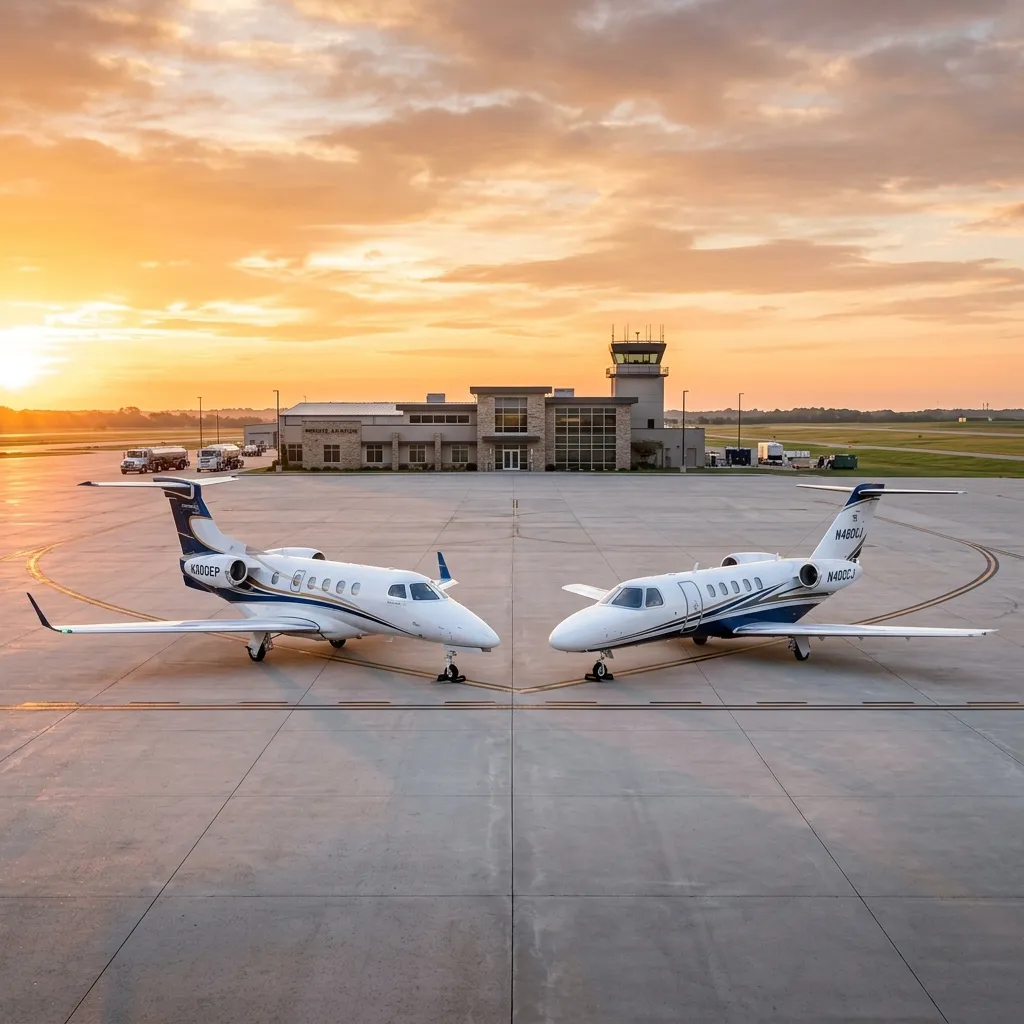
Step 1: Requesting a Quote (5 Minutes)
A charter quote requires four pieces of information: departure city, destination city, date and approximate time, and passenger count. In 2025, the average lead time from first contact to wheels-up was 18 hours for domestic Part 135 on-demand flights. You do not need to know aircraft types, operator names, or FBO preferences. The broker or operator handles those decisions based on your routing.
Contact a charter broker or operator by phone, email, or web form. Expect a response within 30-90 minutes during business hours, faster for same-day requests. The initial quote will include aircraft type, estimated flight time, total cost (broken into flight time, fuel surcharges if applicable, landing fees, and taxes), and available departure windows. Most brokers present 2-3 aircraft options at different price points.
A one-way flight from New York (Teterboro) to Miami on a Phenom 300 light jet costs approximately $8,400-$10,200 for the 2.5-hour flight. A round-trip on the same day doubles the flight cost but eliminates the positioning fee that one-way trips sometimes include. Federal Excise Tax of 7.5% applies to domestic charter flights, adding $630-$765 to a $10,000 flight.
4-24 hrs
Typical Lead Time
15 min
Arrive Before Departure
Step 2: Confirming and Paying (10 Minutes)
Once you select an aircraft and confirm the routing, the broker sends a charter agreement. This is a 2-4 page document covering flight details, cancellation terms, passenger liability waiver, and payment terms. Read the cancellation policy carefully: most agreements allow free cancellation 48-72 hours before departure. Cancellations within 24 hours typically forfeit 50-100% of the flight cost.
Payment is due before departure. Most operators accept wire transfer, ACH, credit card (with a 3-4% surcharge), or check. Some brokers offer net-30 terms for established clients. For first-time charters, expect to pay in full before the flight departs. There is no fare class selection, no seat assignment, no bag fee structure. You are renting the entire aircraft.
The charter agreement is a contract between you and the operator (or the broker acting as agent). The operator holds the FAA Part 135 certificate and carries the liability insurance. The broker arranges the match. Know who holds the certificate. If the broker cannot name the operator and provide their certificate number, find a different broker.
Step 3: Arriving at the FBO (The Part Nobody Explains)
You will not enter a commercial airport terminal. Private charter flights depart from Fixed Base Operators (FBOs), which are separate facilities on the airport property with their own entrances, parking, and ramp access. Your broker or operator will provide the FBO name and address. Navigate to it by car the same way you would navigate to any business address.
Arrive 15-20 minutes before your scheduled departure time. There is no security checkpoint, no boarding pass, no gate. Walk into the FBO lobby, identify yourself to the front desk, and a line service representative will escort you and your luggage directly to the aircraft on the ramp. Your bags are loaded into the cargo hold while you board. The entire process from car to seated-in-the-aircraft takes 5-10 minutes.
- Parking: Most FBOs offer complimentary passenger parking. Some charge $15-$25/day for extended stays. Valet parking is available at high-volume FBOs like Signature Teterboro and Atlantic Fort Lauderdale.
- Passenger lounge: Every FBO has a waiting area with seating, Wi-Fi, coffee, and restrooms. Higher-end FBOs (Signature, Atlantic, Jet Aviation) offer private suites, conference rooms, and concierge services.
- Ground transportation: The FBO coordinates car service pickup and drop-off directly at the facility entrance. If you are being picked up by a car service at your destination, the FBO there will stage the vehicle on the ramp.
- Catering: If you requested catering, it will be loaded onto the aircraft before your arrival. Standard charter catering ranges from light snacks and beverages ($50-$150) to full meal service ($200-$600 per person).
Ready for Your First Flight?
Tell us where you need to go, when, and how many passengers. We handle everything from there.
Request a Quote →Step 4: The Flight Itself
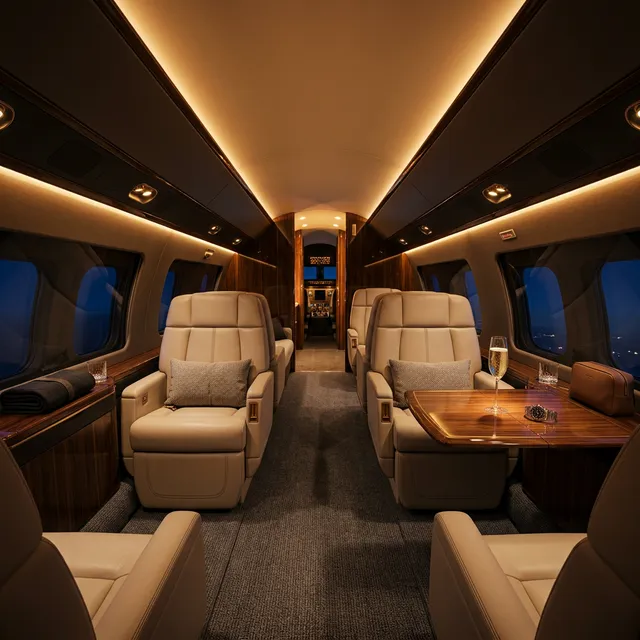
The pilots will introduce themselves before departure and brief you on safety procedures, lavatory location, emergency exits, and any expected weather or turbulence. You choose your seat. No assignment. No middle seat. On a light jet with club seating, the four forward-facing and aft-facing seats in the club configuration are the primary positions. On larger aircraft, any seat in the cabin is available.
Wi-Fi availability depends on the aircraft. Most midsize and heavy jets (Challenger 350, Gulfstream G650, Global 7500) have onboard Wi-Fi. Light jets (Phenom 300, CJ3, CJ4) increasingly offer Wi-Fi, but coverage and speed vary by system and route. Ask your broker about connectivity when booking if Wi-Fi is critical to your trip.
The cabin is yours. Adjust the temperature. Lower the window shades. Use the lavatory without asking permission. Make phone calls after reaching cruise altitude on Wi-Fi-equipped aircraft. The pilots manage the flight from the cockpit. The cabin is your space for the duration.
What happens during weather delays
Private jets are subject to the same ATC and weather delays as commercial flights. If thunderstorms close your departure airport or destination, the flight holds on the ground until conditions clear. The difference is communication: your pilots will update you directly with estimated delay times, and the FBO provides a comfortable waiting environment. If a delay exceeds 2-3 hours, your broker may offer to reposition to a nearby airport or adjust the routing to avoid the weather.
Step 5: Arriving at Your Destination
The aircraft taxis to the destination FBO ramp. The pilots shut down the engines. The door opens. You walk down the stairs directly to the ramp, where your ground transportation is staged within 50 feet of the aircraft. Your luggage is unloaded and placed in the vehicle within 3-5 minutes of door opening. Total time from wheels-stop to seated-in-your-car: under 10 minutes.
There is no baggage carousel. No customs line (for domestic flights). No terminal walk. No ride-share pickup area. The FBO experience at your destination mirrors the departure experience: a direct transition between aircraft and ground vehicle with zero public-facing infrastructure in between.
The first thing every first-time charter passenger says when they arrive at the destination FBO: 'That's it?' Yes. That is it. The private aviation experience is defined by the absence of friction, not the presence of amenities. The amenities exist, but what passengers remember is what they did not have to do.
Six Mistakes First-Time Charter Clients Make
After facilitating thousands of first-time charter bookings, certain errors repeat:
- Booking the wrong size aircraft. A group of 3 does not need a 10-passenger Challenger 350. A Citation CJ3 covers the same route at 40% lower cost. Match the aircraft to the mission, not to the perception of what a private jet should look like.
- Ignoring positioning fees. One-way trips may include a charge for the empty aircraft to reposition to your departure city or return to its home base. Ask the broker if the quoted price includes positioning. Some operators absorb it; others pass it through.
- Arriving too early. A 60-minute pre-departure arrival at an FBO produces 45 minutes of waiting in a lobby. Fifteen to twenty minutes before departure is sufficient. The pilots cannot depart earlier than the filed departure time regardless of how early you arrive.
- Not specifying luggage volume. A golf trip for 6 with clubs, bags, and equipment may exceed the baggage capacity of a light jet. Inform the broker of any oversized or heavy luggage so they can select an aircraft with adequate cargo volume.
- Assuming all aircraft have Wi-Fi. Older light jets and some turboprops do not have Wi-Fi installed. If connectivity matters, confirm it during the booking process. The broker can filter aircraft options by Wi-Fi availability.
- Comparing charter pricing to first-class airline tickets. Private aviation is not a premium version of commercial flying. It is a different product category. The value proposition is time savings, schedule flexibility, airport access, and privacy. If you are evaluating it purely on cost-per-seat-mile, commercial first class will always be cheaper.