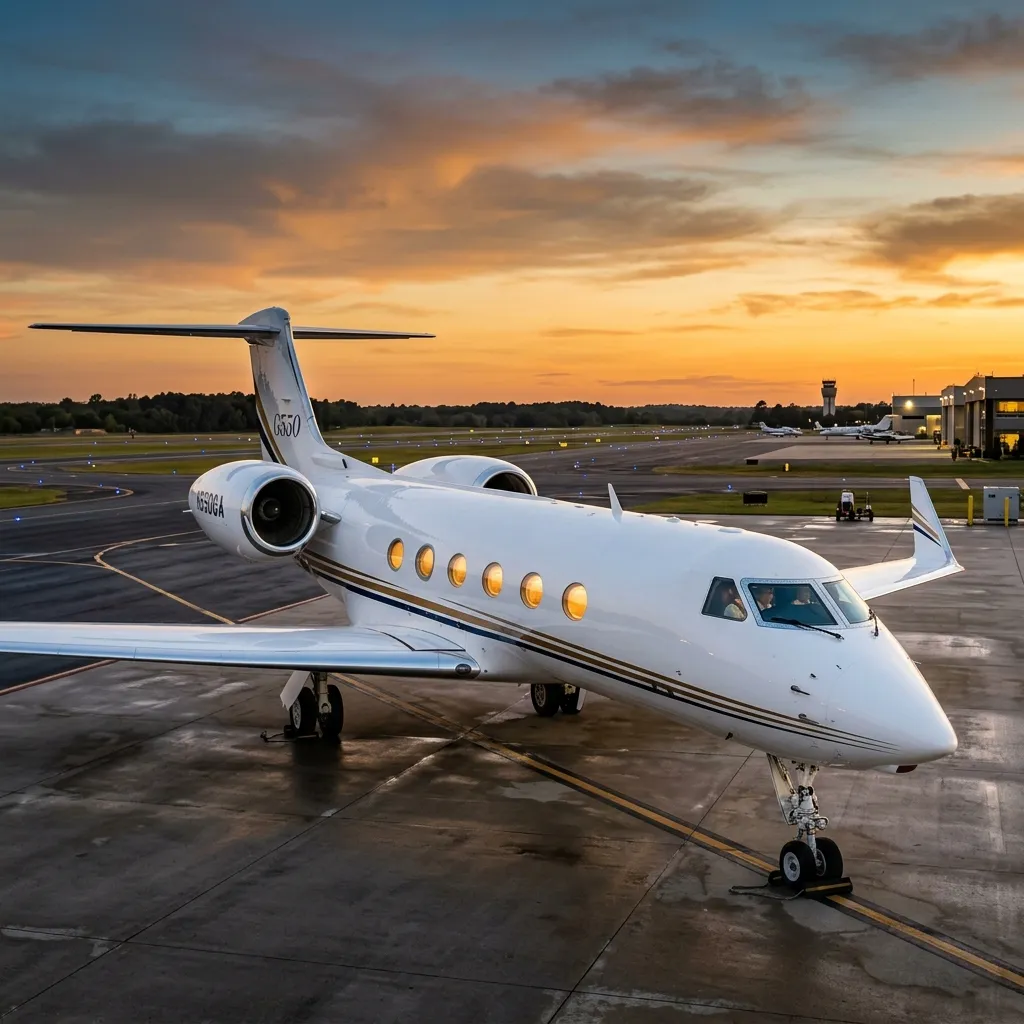
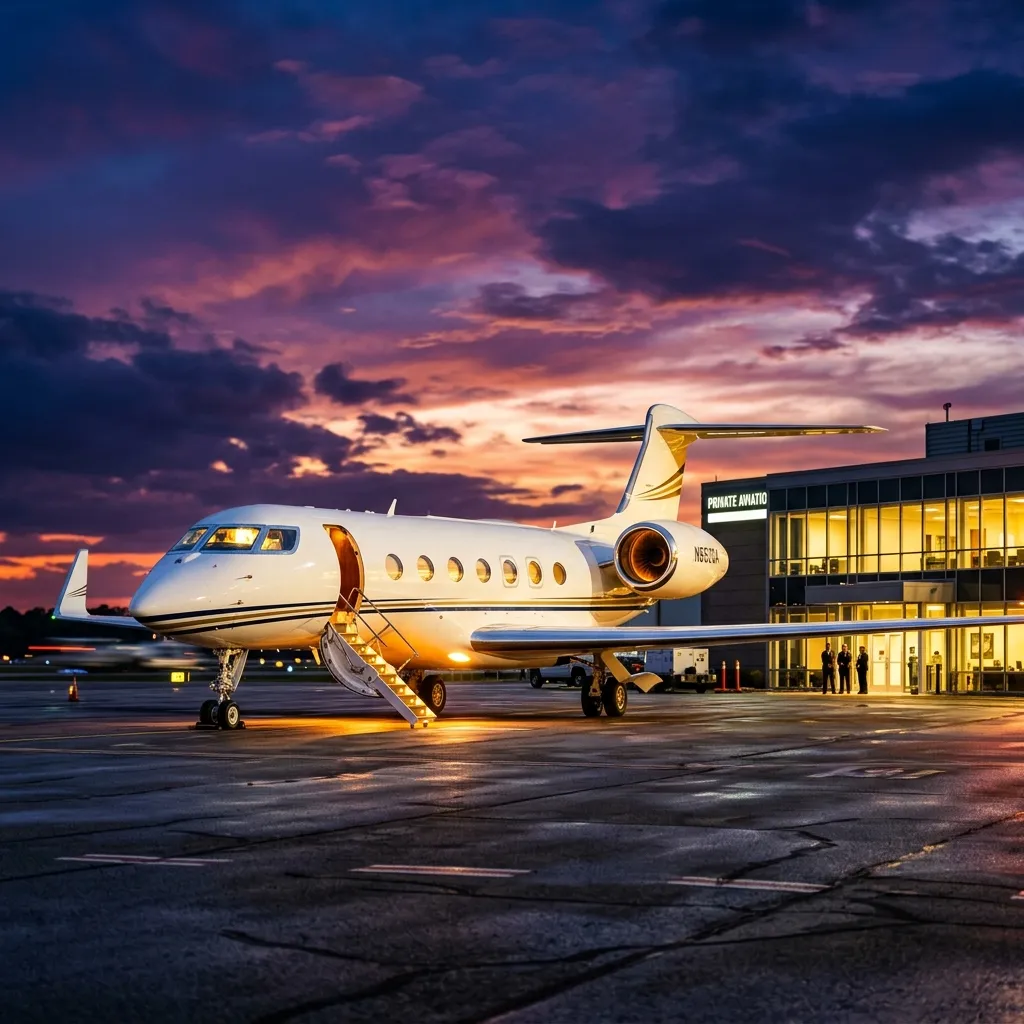
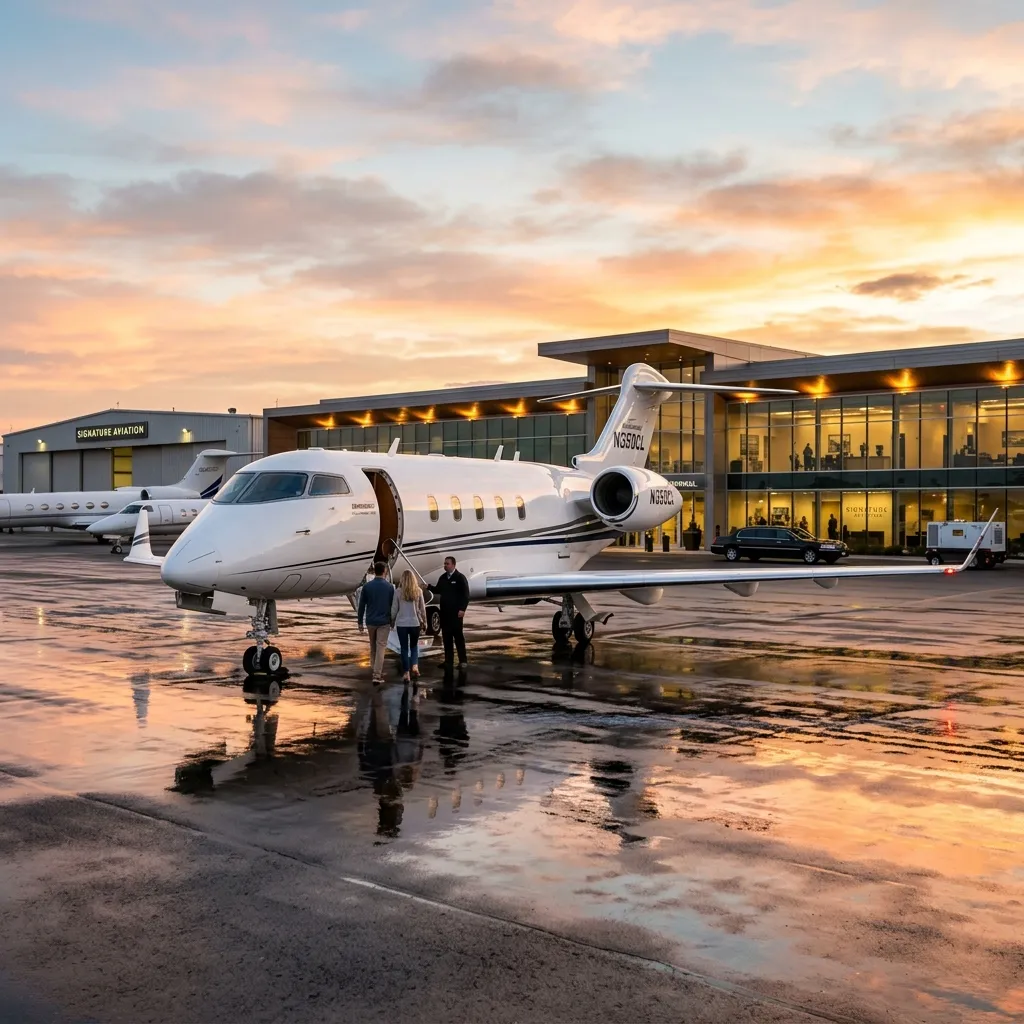
G550 Charter Rates in 2026
A Gulfstream G550 charters for $5,500 to $8,000 per flight hour in 2026. That range places it $2,000-$3,000 below the G650 and $1,500-$2,500 above the Challenger 350. On a 5-hour transatlantic crossing from Teterboro to Shannon, the total charter bill runs $27,500 to $40,000 before Federal Excise Tax (7.5%) on domestic segments, international overflight fees, and handling charges at the destination.
The two Rolls-Royce BR710 A1-10 engines consume approximately 280 gallons per hour combined at long-range cruise. At $5.75 per gallon, fuel cost is roughly $1,610 per flight hour. That makes fuel 20-29% of the total charter rate. The balance covers crew (two pilots plus optional cabin attendant), maintenance reserves on an airframe that costs $18M-$35M pre-owned, insurance on a $35M-$50M hull (for newer examples), and the operator's fixed infrastructure.
6,750 Nautical Miles: Where the G550 Goes That Others Cannot
The G550's defining characteristic is range. At 6,750 nm with 8 passengers and NBAA IFR reserves, it connects city pairs that super-midsize jets simply cannot reach nonstop. Teterboro to London Luton (3,459 nm), Los Angeles to Tokyo Narita (4,730 nm), Miami to Geneva (4,542 nm), and New York to Dubai (5,835 nm) are all single-leg missions in the G550. The Challenger 350 tops out at 3,200 nm. Even the Challenger 604/605, the previous generation's heavy-jet workhorse, maxes at 4,000 nm.
For domestic charter clients, the range advantage is less about reaching distant airports and more about payload flexibility. A G550 can fly New York to Los Angeles (2,145 nm) with 14 passengers, full bags, and catering without touching its weight limits. The same mission in a Challenger 350 requires passenger count discipline at 8 or fewer. That difference matters for corporate shuttle missions, sports team charters, and family travel where headcount is not negotiable.
Note: Range is not about how far you can fly. It is about how much you can carry and still fly far. The G550 does both simultaneously, which is why it replaced the GV in every serious operator's hangar.
43 Feet of Cabin: Three Zones, Real Privacy
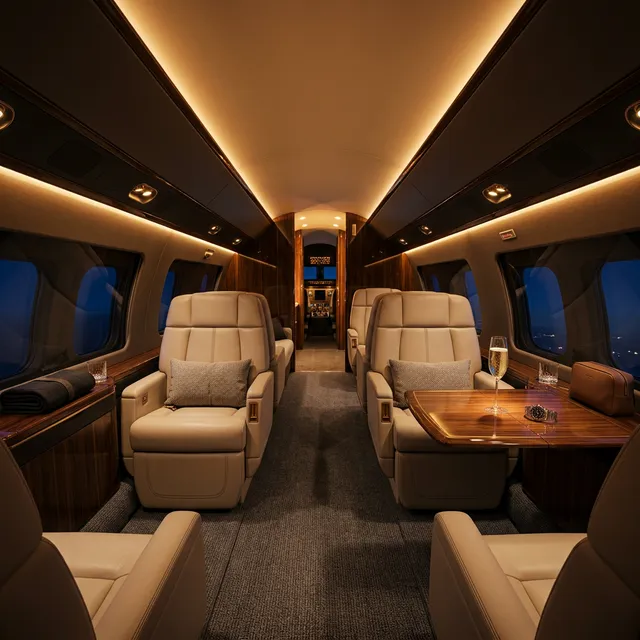
The G550 cabin is 43.8 feet long, 7.3 feet wide, and 6.2 feet tall. Those dimensions create three distinct cabin zones, a configuration that super-midsize jets cannot replicate. A typical charter layout includes a forward 4-seat club, a mid-cabin conference group or divan, and an aft private suite with a berthing divan. Passengers in the forward zone cannot see or hear passengers in the aft zone. On an 8-hour transatlantic flight, that separation is not optional.
Baggage capacity is 170 cubic feet across two external compartments. For context, that is 60% more volume than the Challenger 350 (106 cu ft) and roughly equivalent to a large SUV's cargo area. Golf bags, skis, large presentation cases, and full wardrobes for extended trips fit without the crew making weight-balance compromises. On international missions where passengers carry 3-4 bags each, the G550's baggage volume prevents the payload trade-offs that smaller jets force.
Cabin altitude at FL510
The G550 maintains a 6,000-foot cabin altitude at its FL510 service ceiling. That is lower than the Challenger 350 at FL450 (5,800 ft) but far better than many older heavy jets. More importantly, the G550 routinely cruises at FL470-FL490 on long-range missions, where cabin altitude drops to 5,200-5,600 feet. Passengers on 10-hour flights notice the difference between 6,000 feet and 8,000 feet by the time they land, and the G550 sits on the right side of that divide.
Get a G550 Quote
Whether your mission is transatlantic or domestic, we match you with the right heavy jet and operator.
Request a Quote →G550 vs. G650: When the Predecessor Is the Smarter Charter
The G650 replaced the G550 as Gulfstream's flagship in 2012. But 'replaced' does not mean 'made obsolete.' On the charter market, the G550 covers 90% of the same missions at 70-80% of the G650's cost. The critical comparison:
| Specification | Gulfstream G550 | Gulfstream G650 |
|---|
| Charter Rate (2026) | $5,500-$8,000/hr | $6,500-$10,000/hr |
| Max Passengers | 16 | 19 |
| Range (8 pax, NBAA IFR) | 6,750 nm | 7,000 nm |
| Max Cruise Speed | 488 kts (Mach 0.885) | 516 kts (Mach 0.925) |
| Cabin Length | 43.8 ft | 46.8 ft |
| Cabin Width | 7.3 ft | 8.2 ft |
| Cabin Height | 6.2 ft | 6.4 ft |
| Baggage Volume | 170 cu ft | 195 cu ft |
| Service Ceiling | 51,000 ft | 51,000 ft |
| Pre-Owned Price | $18M-$35M | $35M-$60M |
The G650 wins on speed (Mach 0.925 vs. Mach 0.885), cabin width (8.2 ft vs. 7.3 ft), and range at high speed (7,000 nm at Mach 0.85). The G550 wins on price, both hourly and total trip cost. For a New York to London mission, the G550 saves $4,000-$8,000 in charter cost compared to the G650 on the same route. Both aircraft make it nonstop. Both offer three-zone cabins. Both maintain low cabin altitude.
The G650 becomes the necessary choice only on ultra-long-range missions (5,500+ nm nonstop) or when cabin width is a stated priority. For Teterboro to London, Miami to Paris, Chicago to Geneva, or Los Angeles to Honolulu, the G550 delivers an equivalent experience for $2,000-$4,000 less per flight hour. Charter clients who default to 'get me a G650' without evaluating the mission are often paying a $15,000-$25,000 premium for no operational benefit.
Operator Economics: Why the G550 Fleet Stays on Charter Certificates
Gulfstream delivered 503 G550 aircraft between 2003 and 2021. As the G650 and G700 attract new buyers, G550s are migrating from owner-flown Part 91 operations to managed Part 135 charter certificates. That fleet transition is expanding charter supply and putting downward pressure on rates, which benefits charter clients.
- Acquisition cost: $18M-$35M pre-owned. A 2008 G550 with 6,000 hours trades for $18M-$22M. A 2017 model with 2,000 hours trades for $30M-$35M. Operators finance at 60-70% LTV with 15-year terms, producing monthly debt service of $90,000-$150,000.
- Annual fixed costs: $1.2M-$1.8M. Covers crew salaries ($450K-$600K for two full-time pilots), insurance ($200K-$350K), hangar ($120K-$240K), training ($60K-$80K), and subscriptions/management fees ($300K-$500K).
- Direct operating cost: $3,200-$4,500/hr. Fuel ($1,610/hr), maintenance reserves ($1,000-$1,400/hr), crew variable ($200-$350/hr), and navigation/handling ($150-$250/hr). The Rolls-Royce BR710 engines are mature and well-supported, keeping maintenance predictable.
- Break-even utilization: 350-450 hours/year. At $6,500/hr average charter rate and 400 hours of annual utilization, gross revenue is $2.6M against total costs of $2.5M-$3.2M. The margin is thin, which is why most G550 charter operations are owner-subsidized rather than purely commercial.
The owner-subsidy model dominates the G550 charter fleet. An owner flies 150-200 hours per year and places the aircraft on charter for an additional 200-300 hours. The charter revenue offsets 40-60% of the fixed carrying costs. Operators benefit from a fleet aircraft they do not have to finance. Charter clients benefit from access to a $25M jet at rates that pure economics would not support.
Booking Strategy: Getting the Best G550 Rate
G550 charter rates vary more than any other aircraft type in the fleet because of the wide range in aircraft age, owner arrangements, and operator positioning. A 2007 G550 on an owner-managed certificate prices $1,500-$2,500 less per flight hour than a 2019 G550 on a commercial fleet operator's certificate. Both fly the same mission at the same speed.
Repositioning arbitrage
G550s frequently reposition between major metro areas for owner trips. A jet returning empty from Palm Beach to Teterboro, or from Aspen to Los Angeles, creates empty-leg opportunities at 40-60% below standard charter rates. Because the G550 fleet is concentrated in the Northeast, Florida, Texas, and California, these corridors produce consistent repositioning inventory. Monitor broker platforms for G550 empty legs on Sunday evenings (Florida to Northeast) and Monday mornings (Northeast to Midwest/South).
When to avoid the G550
For missions under 1,500 nm with 6 or fewer passengers, the G550 delivers cabin space and range you will not use. A Challenger 350 at $3,800-$5,200/hr covers New York to Miami, Chicago to Aspen, and Dallas to Seattle nonstop. Paying $5,500-$8,000/hr for the G550 on those routes purchases 43 feet of cabin that 6 passengers cannot fill and 6,750 nm of range that a 1,000 nm flight does not require. Match the aircraft to the mission.