How Wedding Group Charter Works
Wedding charter differs from standard private jet charter in one fundamental way: the passengers are not the decision-makers. Approximately 3,200 group charter flights are booked annually for weddings in the U.S., with average group sizes of 30 to 80 passengers across 3 to 6 aircraft. The couple (or their families) book the aircraft, set the schedule, and coordinate the logistics. The guests show up. That inversion creates planning complexity that does not exist when a business traveler books a jet for themselves.
A typical destination wedding with 80 guests departing from 2 to 3 origin cities requires 4 to 6 aircraft, coordinated departure times within a 2-hour window, synchronized arrival at the destination airport, and ground transportation staged for sequential aircraft arrivals at 15 to 20-minute intervals. The charter operator or broker manages the fleet coordination, but the couple's wedding planner must integrate the aviation schedule into the broader event timeline.
Planning Timeline: 6 to 12 Months Before the Wedding
12 Months Out: Initial Scoping
Contact 2 to 3 charter brokers specializing in group travel. Provide the guest count estimate, origin cities, destination, and travel dates. The broker will return preliminary aircraft options and pricing. At this stage, the couple determines whether private charter is logistically and financially viable. Key decision: will the charter be offered to all guests, or only to the bridal party, family, and VIP guests? Offering charter to 30 guests is manageable. Offering it to 120 requires a dedicated logistics coordinator.
6 to 9 Months Out: Aircraft Selection and Deposit
Select the aircraft types and fleet configuration. Heavy jets (Challenger 650, Legacy 600, Global Express) seat 12 to 16 passengers per aircraft. Super-midsize jets (Challenger 350, Praetor 600) seat 8 to 10. Light jets (Phenom 300E, CJ4) seat 6 to 8. The mix depends on total guest count, origin city distribution, and budget. Deposits of 25 to 50 percent secure the aircraft for the dates. Peak wedding season (May-June, September-October) aircraft availability tightens 4 to 6 months before the date.
3 to 4 Months Out: Manifest and Logistics
Collect passenger names, contact information, and baggage requirements. Create the manifest (passenger assignment to specific aircraft). Coordinate with ground transportation at both origin and destination airports. Determine catering preferences for each aircraft. Set the departure schedule: stagger departures by 15 to 20 minutes to allow sequential FBO processing. Communicate the itinerary to guests with clear instructions on arrival time, FBO location, parking, and what to bring.
1 Month Out: Final Coordination
Finalize the manifest. Last-minute additions or cancellations may require aircraft swaps (upgrading or downsizing). Confirm catering orders. Distribute final itineraries with FBO addresses, parking instructions, and contact numbers. Brief the wedding planner on the arrival sequence at the destination airport so ground transportation is staged correctly. Confirm hotel check-in timing aligns with estimated arrival.
Need a Charter Quote?
Contact our team for a personalized quote.
Get a Quote →Logistics That Most Couples Miss
- Baggage capacity: Wedding guests travel with more luggage than typical charter passengers. Garment bags, gift bags, and resort clothing for multi-day events consume more baggage space. Heavy jets have 150+ cubic feet of baggage capacity. Light jets have 60 to 80 cubic feet. Assume 2 bags per guest plus a carry-on. If the math does not work, either upsize the aircraft or arrange separate luggage logistics.
- Alcohol on board: Charter operators permit alcohol on private flights, but consumption is at the crew's discretion. The pilot-in-command can restrict or terminate alcohol service if passenger behavior affects safety. For wedding flights where celebration is expected, brief the guests on expectations: the crew is accommodating but responsible. Excessive intoxication prior to boarding can result in a passenger being denied boarding, which creates a wedding-day crisis.
- Children and car seats: FAA regulations do not require car seats on Part 135 flights for children over 2 years old, but they are strongly recommended for children under 40 pounds. Bring your own car seat; charter operators do not supply them. Infants under 2 may be held on a parent's lap during takeoff and landing.
- Timing buffers: Build 60 to 90 minutes of buffer between planned arrival at the destination and the first wedding event. Weather delays, ATC delays, and FBO processing times are unpredictable. A group of 80 guests arriving 45 minutes late to a welcome dinner creates cascading schedule problems.
- Return flights: The return flight logistics often receive less attention than the outbound. Sunday-morning departures after a Saturday wedding mean hangovers, lost items, and late arrivals at the FBO. Stagger return departures by 30 minutes and communicate the firm departure time in writing. Aircraft will depart on schedule.
- Cost allocation: Some couples cover the full charter cost. Others split it among guests (reducing per-person cost to $500 to $1,500 versus $400-$800 for commercial flights). If splitting costs, communicate the per-person cost early and collect payment before the final manifest deadline.
The Bride-and-Groom Flight: Making It Special
The couple's flight is the one aircraft that warrants the premium treatment. Options include:
- Dedicated aircraft: Book a separate light or midsize jet for the couple and bridal party (4 to 6 passengers). This provides privacy, schedule flexibility, and the opportunity for custom catering and cabin decoration without affecting the group flights.
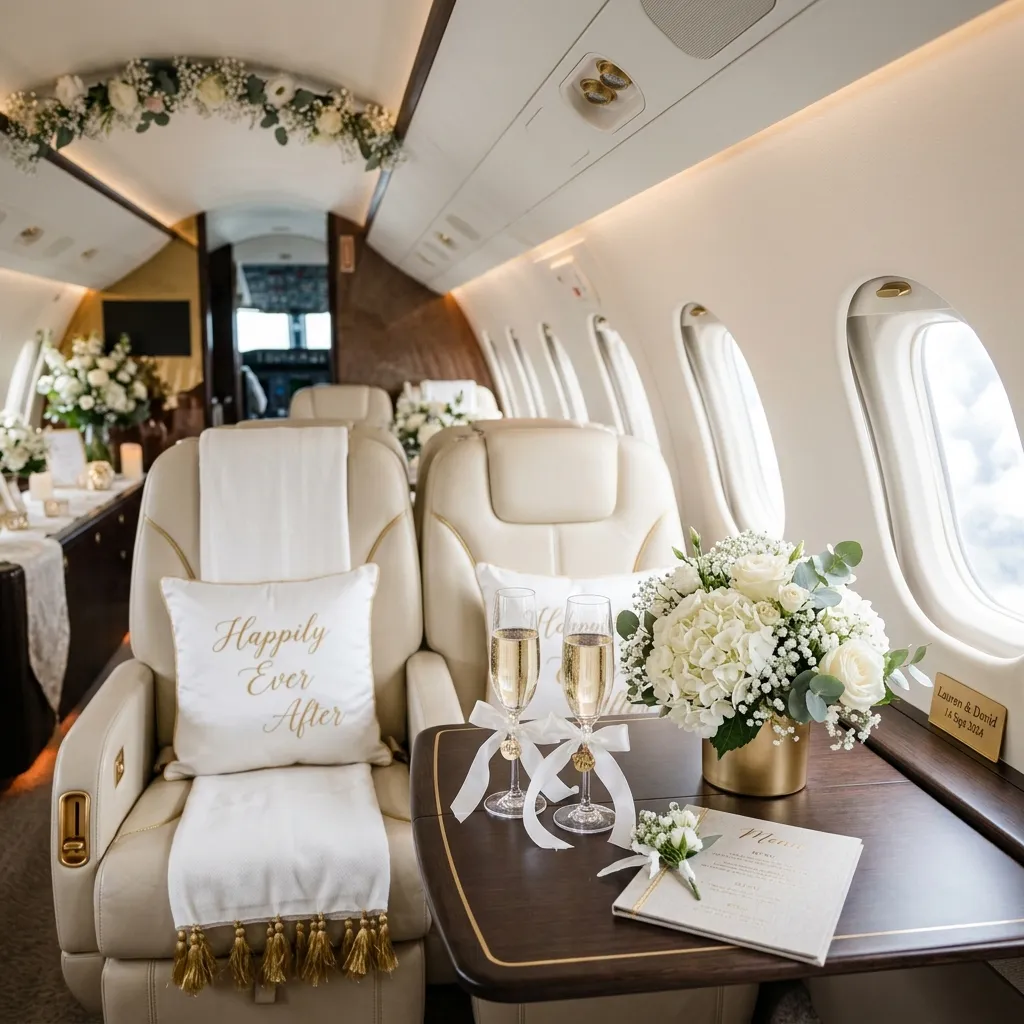
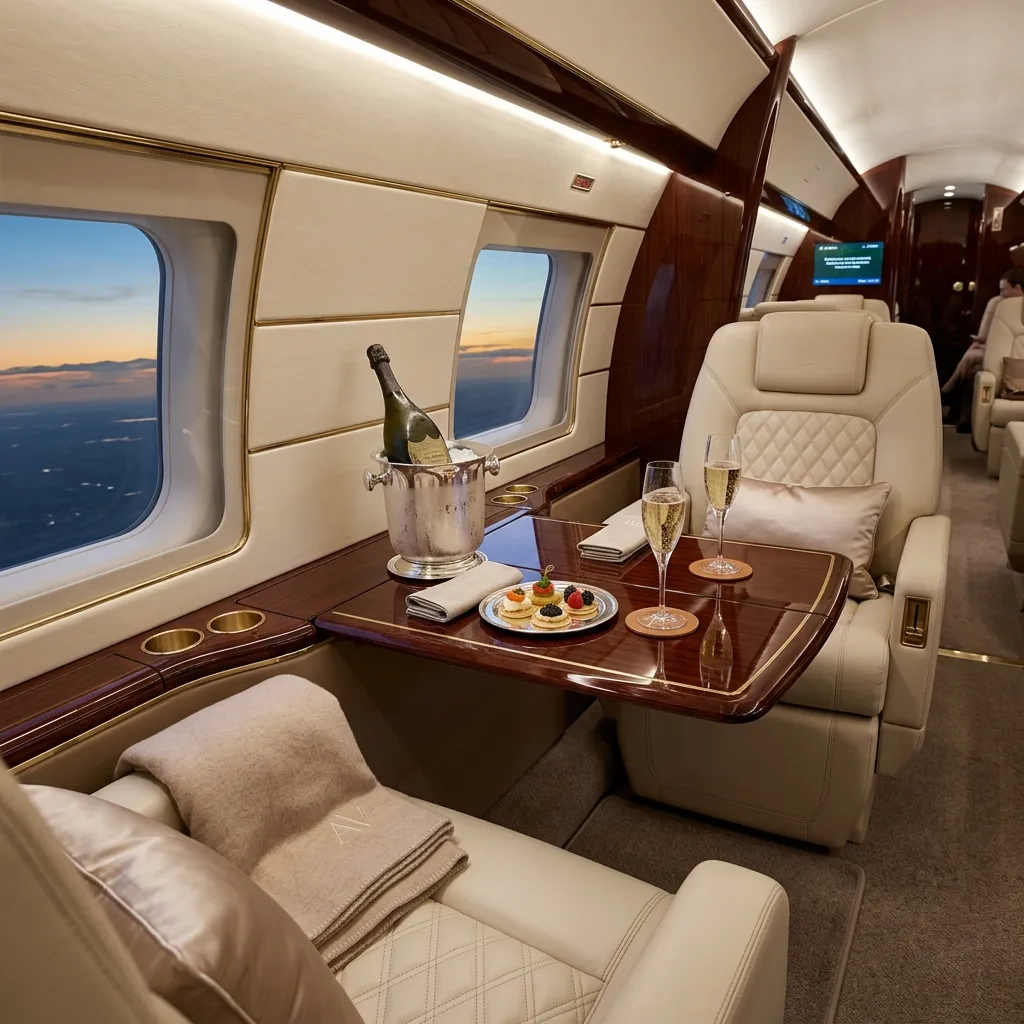
- Cabin decoration: Charter operators accommodate floral arrangements, customized napkins, champagne presentations, and gift placement in the cabin. Coordinate directly with the FBO and the operator's concierge team. Real flowers must be secured to prevent movement during turbulence; the operator will specify how decorations should be arranged.
- Departure timing: The couple often departs after the guests (arriving at the destination with the group already in place for a greeting). Alternatively, the couple departs first to be at the destination welcoming guests as they arrive. Either approach works; the decision depends on the couple's preference for the first impression.
- Photography: A photographer aboard the couple's aircraft captures the departure. Coordinate with the FBO for ramp access (photographers may need to sign a liability waiver). Some FBOs allow drone photography on the ramp; others prohibit it due to FAA airspace restrictions. Ask in advance.
The wedding flight is not about speed. It is about the transition from the everyday to the event. The couple walks through an FBO terminal, boards an aircraft that has been prepared for them specifically, and arrives at the destination with the wedding already in motion. That 2-hour flight is the first moment of the weekend where nothing else matters.