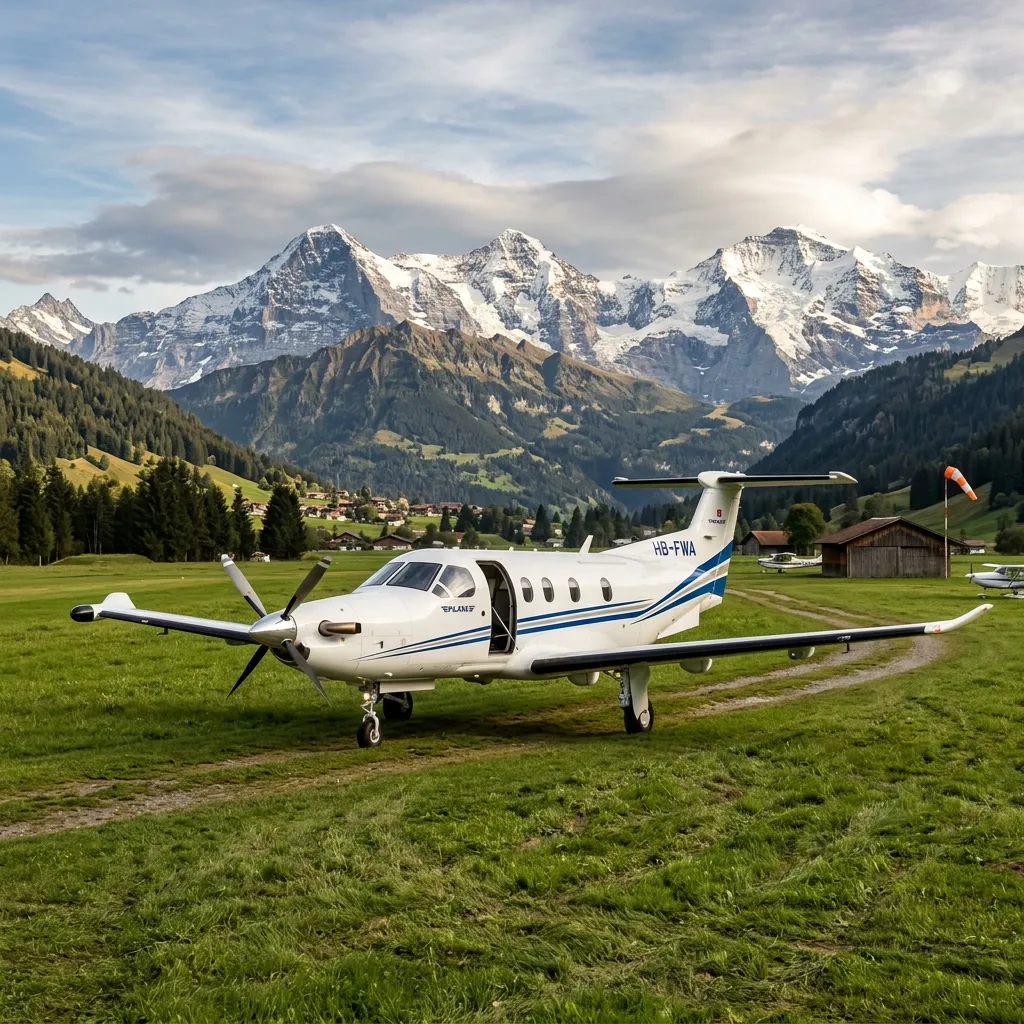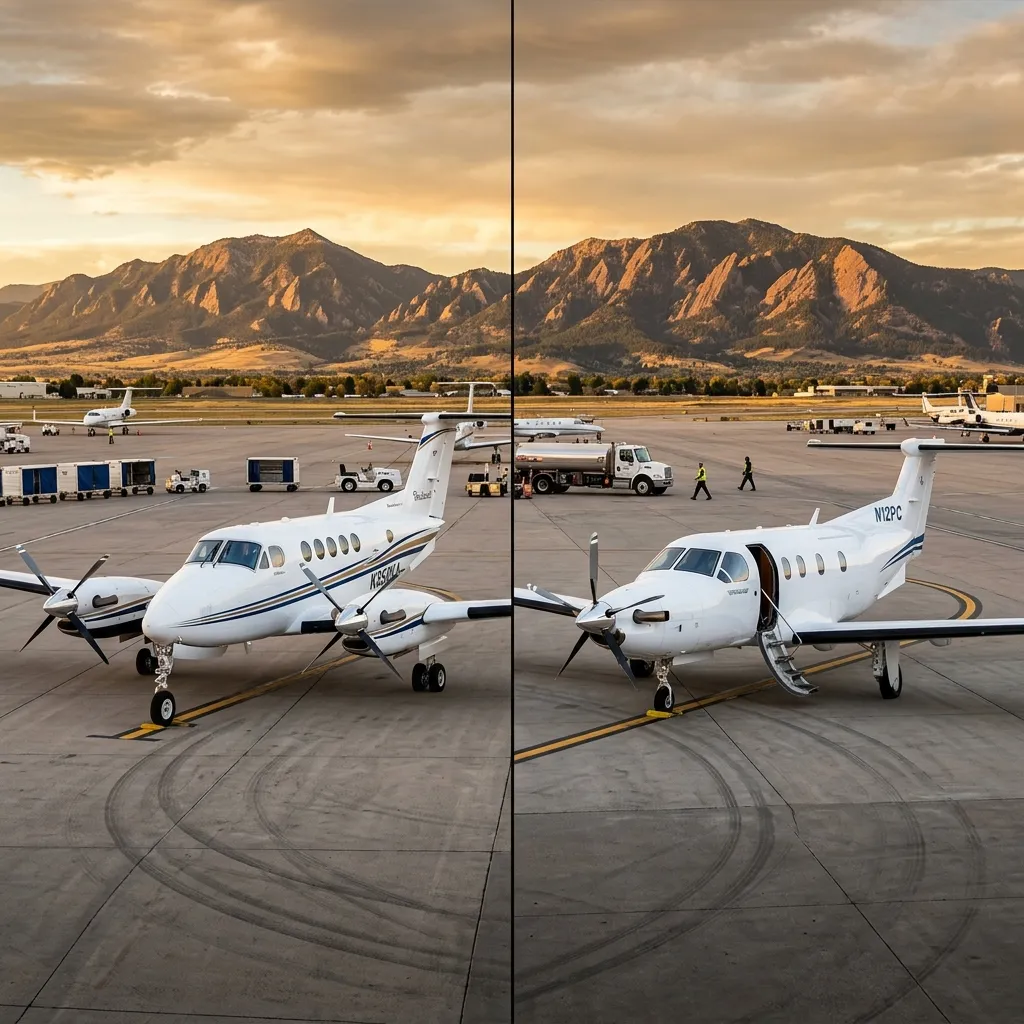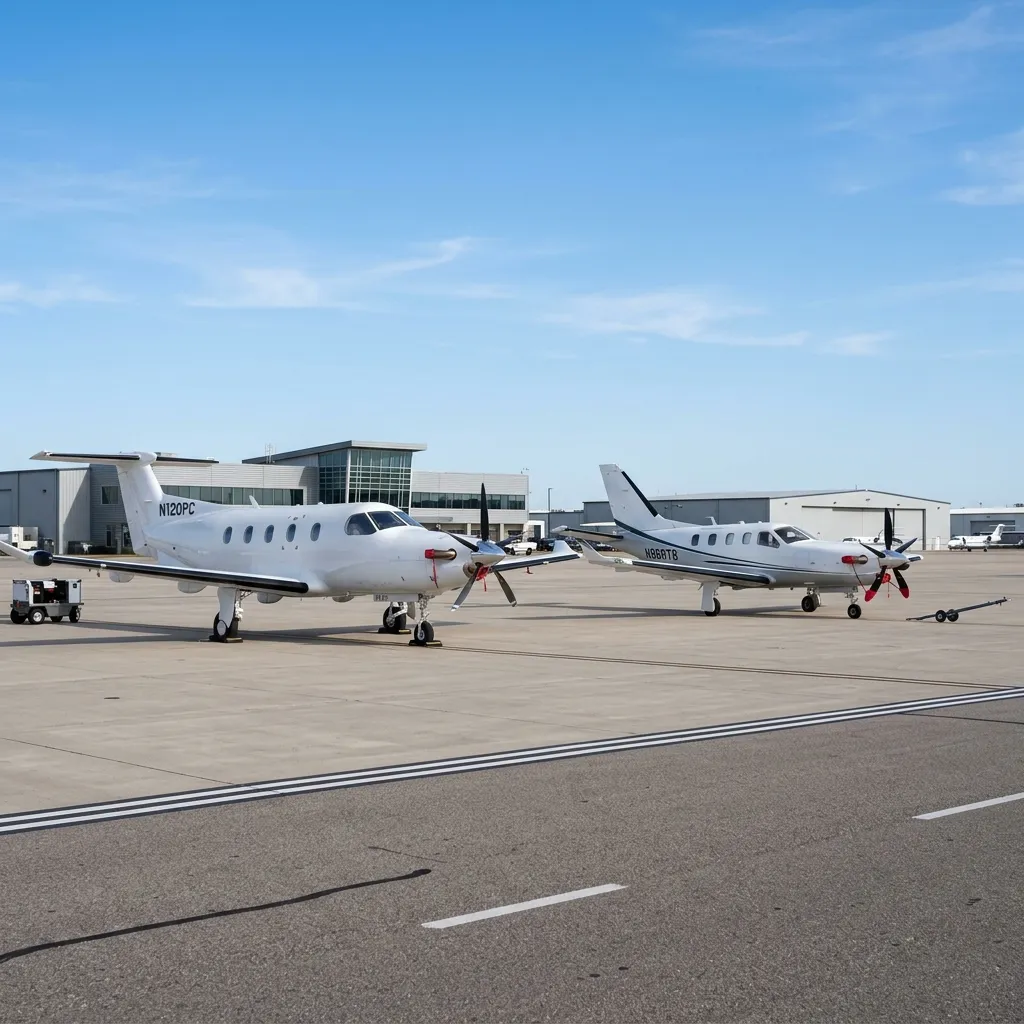
Pilatus PC-12 NGX and Daher TBM 960 parked side by side on a grass strip

Pilatus PC-12 vs Daher TBM 960: Two Turboprops, Two Philosophies

One carries nine passengers and lands on dirt. The other is the fastest single-engine turboprop ever certified. They compete on paper but rarely in practice.

In This Article

The Fundamental Split: Utility vs Speed Specs Compared: Side by Side Speed: Where 45 Knots Changes the Math The Cargo Door: Why Operators Choose the PC-12 Charter Rates and the Cost Per Seat Short-Field and Unpaved Operations When to Book Each Aircraft Frequently Asked Questions

The Fundamental Split: Utility vs Speed

The PC-12 and TBM 960 share a single Pratt & Whitney PT6A engine, a pressurized cabin, and a price tag well below any jet on the charter market. The similarities end there. Pilatus built the PC-12 around a 53-inch cargo door and a cabin wide enough for a stretcher. Daher built the TBM around raw speed. These are different aircraft for different missions, and understanding which one fits comes down to what you actually need on the day.

The PC-12 has been in production since 1994. Over 1,900 have been delivered. The TBM line started in 1990 with the TBM 700; the current TBM 960 entered service in 2022 with autothrottle and auto-icing protection. Both aircraft are single-pilot certified, both are IFR-capable to FL310, and both can operate into strips that would send any jet back to the FBO for a different airplane.

Specs Compared: Side by Side

The TBM 960 wins on speed, fuel economy, and price. The PC-12 wins on cabin volume, range, payload, and versatility. Neither is better in absolute terms. The question is which set of advantages matters for the trip you are booking.

Speed: Where 45 Knots Changes the Math

The TBM 960 cruises at 330 knots at FL280. That is 45 knots faster than the PC-12 at the same altitude. On a 600 NM trip, that speed difference saves approximately 15 minutes. On a 1,200 NM trip, it saves 30 minutes. For a single businessperson flying ATL to TEB who values time at $500/hour, that 30 minutes is worth $250. The TBM's hourly charter rate is already $400-$600 cheaper. The math compounds.

The TBM 960 is the fastest certified single-engine turboprop in the world. It is not the fastest by a small margin. At 330 knots, it cruises within 50-70 knots of light jets like the Citation Mustang (340 kts) and HondaJet (422 kts), at roughly half the hourly operating cost.

The speed advantage disappears below 1,000 feet AGL. Both aircraft face the same ATC constraints in terminal airspace, the same taxi times, and the same FBO processing. A 400 NM trip with 30 minutes of ground handling on each end shows a total time difference of about 8 minutes. On short legs, speed is noise.

The Cargo Door: Why Operators Choose the PC-12

The PC-12's 53-inch-wide, 52-inch-tall aft cargo door is the single feature that separates it from everything else in its class. It loads stretchers for air ambulance operations. It loads palletized freight. It loads oversized sporting equipment that would require disassembly to fit through the TBM's cabin entry. Roughly 25% of all PC-12s worldwide fly cargo, medevac, or government utility missions. The TBM serves exactly zero of those markets.

Cabin Volume in Practice

The PC-12's cabin is 16.9 feet long and 5.0 feet wide. Six adults sit in club seating with room to cross their legs. Add a seventh in the belted lavatory seat and two more on a forward bench, and the aircraft technically carries nine. The TBM 960's cabin is 13.0 feet long and 3.9 feet wide. Four adults fit comfortably in the club configuration. Six fit with zero personal space. The TBM is a four-seat airplane that tolerates six.

For charter, this matters when the passenger count changes. A family of five with ski gear fits the PC-12 without discussion. The same family in a TBM 960 faces a choice: leave a bag behind or book a larger aircraft. The PC-12 absorbs mission creep. The TBM does not.

Need a Charter Quote?

Contact our team for a personalized quote.

Get a Quote

Charter Rates and the Cost Per Seat

The PC-12 charters for $1,200 to $1,800 per flight hour. The TBM 960 runs $800 to $1,200. That gap narrows fast when passenger count rises. With six passengers on a PC-12 at $1,500/hr, the per-seat cost is $250 per hour. With four passengers on a TBM at $1,000/hr, the per-seat cost is also $250 per hour. The PC-12 costs more per aircraft but the same per seat.

9 vs 6
Passenger Capacity
285 vs 330 kts
Max Cruise Speed
1,845 vs 1,730 NM
Max Range
$1.2-1.8 vs $0.8-1.2K
Hourly Charter Rate

Solo travelers and two-person trips favor the TBM. Groups of five or more favor the PC-12. The breakeven is right around four passengers, where both aircraft deliver similar per-seat economics but the PC-12 adds a significantly more comfortable cabin and more baggage capacity.

Short-Field and Unpaved Operations

Both the PC-12 and TBM 960 were designed for short-field operations. The TBM needs 2,380 feet of runway at sea level. The PC-12 needs 2,650 feet but carries FAA approval for unpaved surfaces, including grass, gravel, and packed dirt strips. The PC-12's trailing-link landing gear and low-pressure tires absorb rough surfaces that would ground the TBM.

  • PC-12 lands on grass strips, gravel runways, and packed dirt. TBM requires paved or well-maintained turf at minimum.
  • Both operate comfortably into mountain airports like Sun Valley (SUN, 5,318 ft MSL) and Telluride (TEX, 9,070 ft MSL) with appropriate weight restrictions.
  • The PC-12's higher engine power (1,200 SHP vs 850 SHP) provides better climb performance at high density altitudes, a real advantage departing mountain strips at max weight.
  • For backcountry operations in Idaho, Montana, and Alaska, the PC-12 is often the only charter aircraft available. The TBM fleet does not serve that market.

If the strip is paved and longer than 2,500 feet, both aircraft access it without issue. If the destination is Sulphur Creek in the Idaho backcountry or a ranch strip in Montana, the PC-12 is the only option.

When to Book Each Aircraft

Book the TBM 960 When

  • Traveling solo or with 2-3 passengers and minimal luggage
  • Speed matters more than cabin comfort on legs under 2 hours
  • Budget is the primary constraint and you want turboprop economics at near-jet speeds
  • The route is point-to-point between paved airports under 1,500 NM

Book the PC-12 When

  • Group size is 5-9 passengers
  • Luggage includes oversized items (golf bags, skis, hunting gear)
  • The destination has an unpaved or remote strip
  • The trip requires a comfortable cabin for legs over 2.5 hours
  • Medical transport or stretcher configuration is needed

Neither aircraft is wrong for a domestic trip under 1,500 NM. The choice is about fit. The TBM is a scalpel. The PC-12 is a Swiss Army knife. Most charter clients need the knife.

Brian Galvan

Written By

Brian Galvan

Founder, The Jet Finder ยท Private Aviation Operations & Technology

Former Director of Technology at FlyUSA (Inc. 5000 fastest-growing private jet company). Decade of hands-on experience across Part 135 operations, charter sales, fleet management, and aviation data systems.

LinkedInRead Full Profile →
Common Questions

Frequently Asked Questions


8 questions about comparing the Pilatus PC-12 and Daher TBM 960

Under Part 91, both aircraft are single-pilot certified. Under Part 135 charter operations, the answer depends on the operator's OpSpecs. Many Part 135 operators voluntarily require two pilots for all turboprop charter flights regardless of certification, particularly for IFR operations and flights over mountainous terrain. Check with the specific operator before assuming single-pilot availability on charter.

Yes, and the gap is significant. A 10-year-old PC-12 NG typically trades at 55-60% of its original list price. A 10-year-old TBM 900 trades at 45-50%. The PC-12 benefits from demand across cargo, medevac, and government sectors that create a price floor independent of the passenger charter market. The TBM's owner-flown demographic means more units come to market when owners upgrade, which adds supply pressure that the PC-12's diversified operator base absorbs more easily.

The TBM 960 measures approximately 78-80 dB at cruise, which is loud enough that sustained conversation across the aisle requires raised voices. The PC-12 NGX comes in at approximately 76-78 dB with its acoustic insulation package. Neither approaches the 54-56 dB of a midsize jet. Noise-canceling headsets are standard on both aircraft for charter. On flights over 2 hours, the noise differential between the two is noticeable and favors the PC-12.

The TBM 960's autothrottle (introduced as standard on the 960 variant) reduces pilot workload during climb, cruise, and descent by automatically managing engine power settings. For passengers, the practical effect is smoother power transitions and more consistent speed management during approach. It does not change the ride quality in turbulence or the overall flight experience dramatically, but it does contribute to a slightly more polished final approach and landing sequence.

The TBM 960 burns approximately 55 gallons per hour at high cruise versus the PC-12's 70 GPH, but the TBM also covers ground faster at 330 knots versus 285 knots. Per nautical mile, the TBM burns roughly 0.17 gallons/NM versus the PC-12's 0.25 gallons/NM. That makes the TBM approximately 32% more fuel-efficient per mile traveled. On a 1,000 NM trip, the TBM consumes roughly 170 gallons versus the PC-12's 250 gallons. At $6.50/gallon, that is $520 in fuel savings on a single leg.

Both the PC-12 NGX and TBM 960 carry full FIKI (Flight Into Known Icing) certification. The PC-12 uses pneumatic deice boots on the wings and horizontal stabilizer with an electric prop deice system that the pilot activates manually or via an automatic cycle timer. The TBM 960 introduced an automatic ice protection system on the 960 variant that activates deicing without pilot input once ice is detected. Both aircraft handle typical icing encounters in the FL180-FL280 range, though severe icing prompts a diversion or altitude change on either platform.

PlaneSense operates the largest fractional PC-12 program in the United States with approximately 50 PC-12s in their fleet. A 1/16 share provides 50 guaranteed hours per year with 8-hour call-out availability. Share acquisition costs range from $400,000-$500,000 depending on aircraft age, with monthly management fees of approximately $6,000-$8,000. There is no comparable fractional program for the TBM, which is almost exclusively owner-flown or operated by small single-aircraft charter operators.

Annual hull and liability insurance for a PC-12 on Part 135 charter runs approximately $35,000-$50,000 depending on fleet size, pilot experience, and claims history. The TBM 960 typically costs $25,000-$35,000 for similar coverage. The PC-12 commands higher premiums partly because of its higher hull value and partly because it serves higher-risk mission profiles including medevac and unpaved strip operations that underwriters price accordingly.

Continue Reading

Related Articles


Your Next Mission

Ready to Fly?


Whether you need a charter quote or want to explore aircraft options, our team is here.

Contact Us