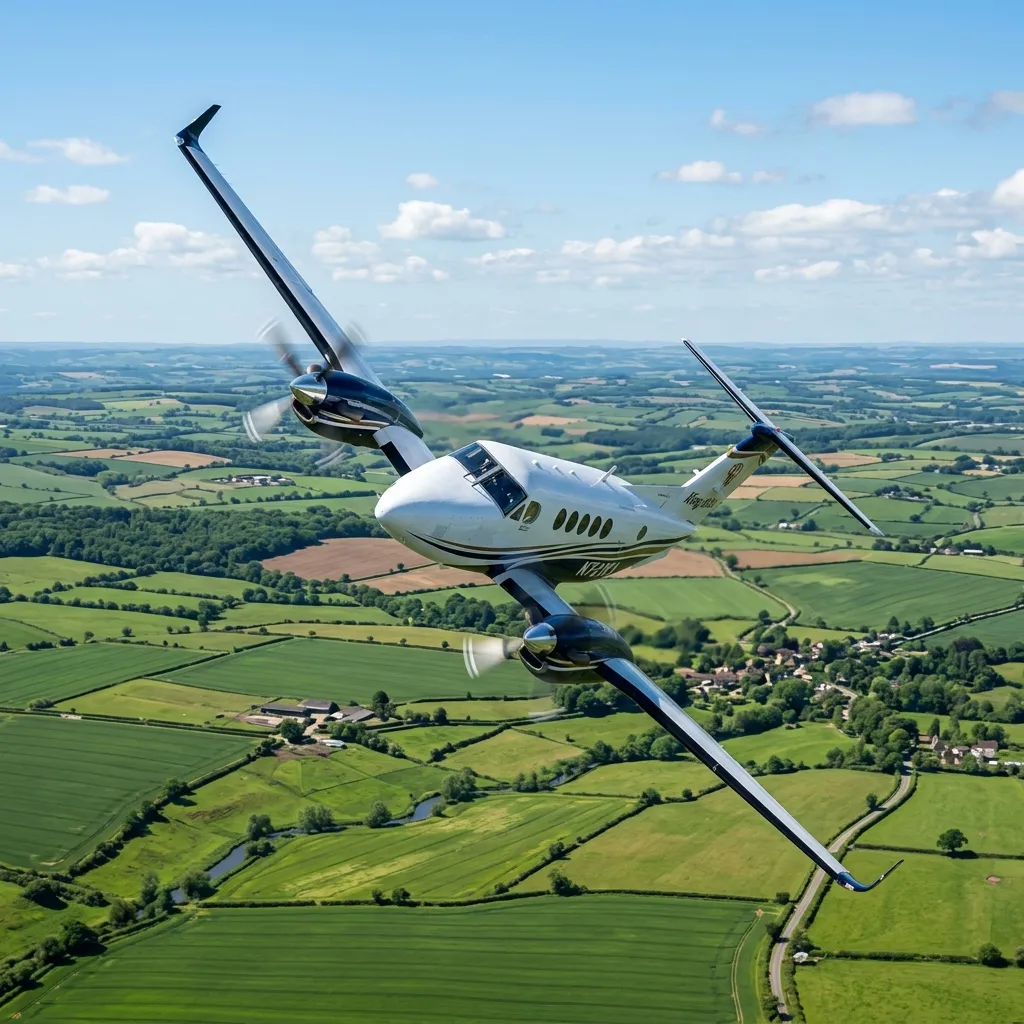
King Air 350 banking over green farmland with propellers visible in motion

The Complete Guide to Turboprops: Why Propellers Still Win

They are slower than jets, louder in the cabin, and driven by propellers. They also cost half as much per hour, access airports jets cannot reach, and fly 45% of all charter missions under $3,000 per hour.

In This Article

What Makes a Turboprop Different from a Jet The Major Turboprop Models in Business Aviation Where Turboprops Win Over Jets Where Jets Win Over Turboprops The PT6A Engine: Why Turboprops Are So Reliable Charter Passenger's Guide: When to Book a Turboprop Frequently Asked Questions

What Makes a Turboprop Different from a Jet

A turboprop and a turbofan jet use the same basic engine technology: a gas turbine that compresses air, mixes it with fuel, ignites the mixture, and extracts energy from the exhaust. The difference is how that energy reaches the air. In a jet, the turbine spins a fan that accelerates air rearward. In a turboprop, the turbine spins a propeller through a reduction gearbox. The propeller moves a larger volume of air at a lower velocity, which is more efficient at slower speeds (below 350 knots) but less efficient at higher speeds where aerodynamic drag on the propeller blades increases.

This engineering difference creates the turboprop's defining trade-off: 30-40% slower than a light jet, but 40-60% less fuel burn per hour. On a 500-mile trip, a King Air 350 takes approximately 1 hour 45 minutes versus 1 hour 10 minutes for a Citation CJ4. The King Air burns approximately 100 gallons of fuel. The CJ4 burns approximately 165 gallons. At $6.50 per gallon, the fuel difference is $422 per trip. Multiply that across 400 annual flight hours and the savings exceed $160,000 per year.

The Major Turboprop Models in Business Aviation

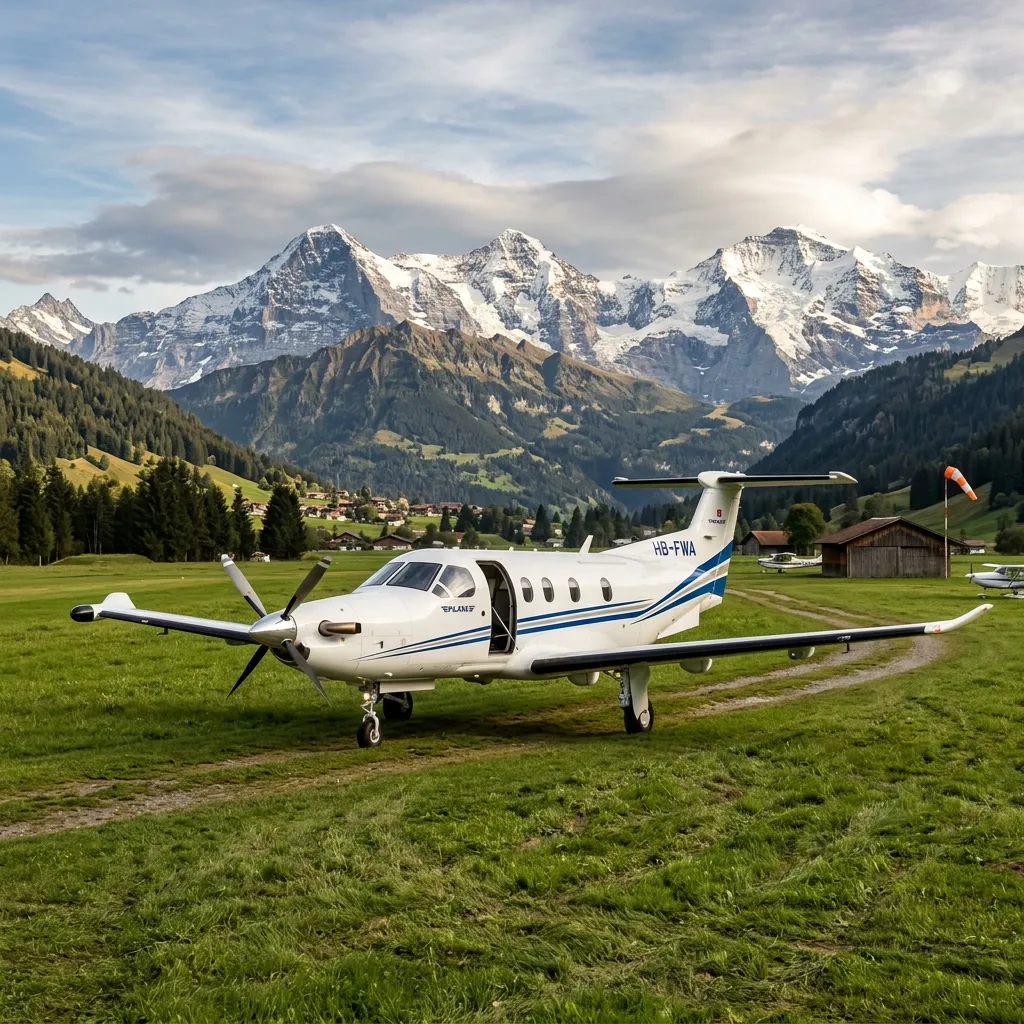
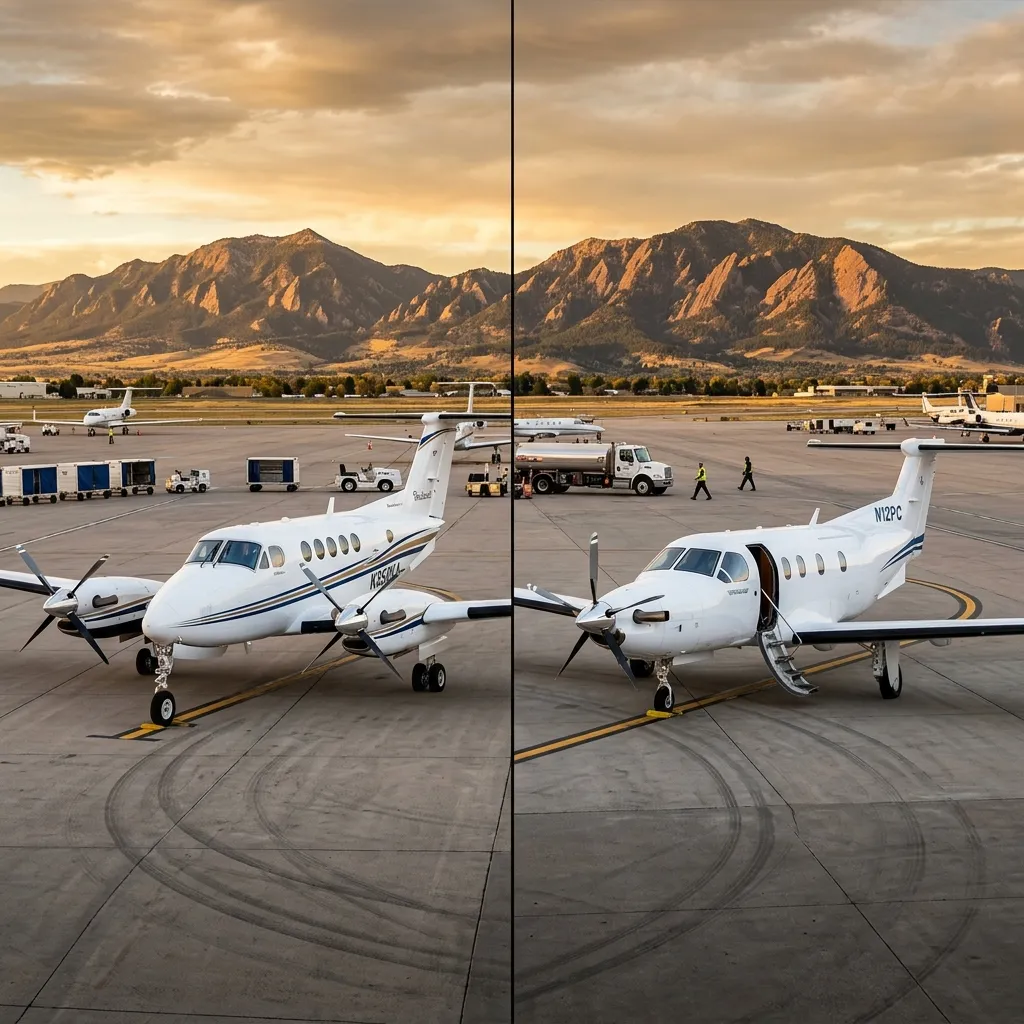
The King Air 350 and Pilatus PC-12 dominate business aviation turboprop operations. Together, they account for approximately 75% of all turboprop charter hours in the United States. The King Air 350 is the twin-engine standard, offering redundancy and cabin space that make it the workhorse of corporate shuttle, air ambulance, and regional charter operations. The PC-12 is the single-engine benchmark, offering jet-like cabin width in a turboprop with the lowest operating cost per seat-mile in pressurized aviation.

Where Turboprops Win Over Jets

The turboprop advantage extends beyond fuel economics. Four mission profiles consistently favor turboprops over light jets, regardless of the time difference:

1. Short-Field and Remote Airport Access

Turboprops require 25-40% less runway than comparable jets. A PC-12 departs in 2,650 feet; a Citation CJ3 needs 3,180. A King Air 350 departs in 3,300 feet; a Citation XLS needs 3,590. At airports with runways under 4,000 feet, turboprops may be the only powered option. This opens access to hundreds of airports that jets cannot serve, including mountain strips in Colorado, island runways in the Caribbean, and rural airports near resort destinations.

2. Trips Under 600 Nautical Miles

On routes under 600 NM, the time penalty for choosing a turboprop over a jet shrinks to 15-25 minutes. A Dallas to San Antonio trip (250 NM) takes 55 minutes on a King Air 350 and 40 minutes on a CJ4. The King Air costs approximately $2,500 all-in. The CJ4 costs approximately $4,500. For 15 minutes of time difference, the passenger saves $2,000.

3. High-Frequency Corporate Shuttles

Companies operating daily shuttle routes between facilities (Houston to Midland, Atlanta to Savannah, Minneapolis to Duluth) find that turboprop economics compound rapidly. At 800+ annual flight hours, the operating cost advantage of a King Air 350 versus a Citation XLS exceeds $600,000 per year. Over a 10-year fleet plan, that savings funds the acquisition of an additional aircraft.

4. Special Mission Operations

Air ambulance, cargo feeder, aerial survey, and law enforcement surveillance operations overwhelmingly favor turboprops. The PC-12's large cargo door (4.25 × 4.25 feet) accommodates medical stretchers, palletized cargo, and equipment that light jets cannot carry. The King Air 350's twin-engine reliability and unpressurized belly cargo pod make it the standard platform for time-critical medical transport.

Need a Charter Quote?

Contact our team for a personalized quote.

Get a Quote

Where Jets Win Over Turboprops

Jets retain decisive advantages on three mission profiles:

  • Routes over 1,200 NM: The time penalty compounds to 45-90 minutes, which matters for business travelers with tight schedules. A New York to Miami flight takes 3 hours 20 minutes on a King Air 350 versus 2 hours 40 minutes on a CJ4.
  • Passenger comfort sensitivity: Turboprop cabins are 8-10 dB louder than jet cabins due to propeller proximity. Active noise cancellation headsets help, but the noise floor is perceptible. Passengers accustomed to jet-quiet cabins notice the difference immediately.
  • Image and perception: For some corporate and UHNWI passengers, the turboprop's propeller-driven appearance does not match their expectations of private aviation. This is a perception issue, not a capability issue, but it influences booking decisions in the charter market.

The crossover point between turboprop and jet viability is approximately 800-1,000 nautical miles for most passengers. Below that range, the turboprop's cost advantage exceeds the jet's speed advantage. Above that range, the speed advantage justifies the premium.

The PT6A Engine: Why Turboprops Are So Reliable

The Pratt & Whitney Canada PT6A is the most produced turbine engine in aviation history, with over 60,000 units delivered and more than 400 million flight hours accumulated. Every turboprop on the business aviation market except the Cessna Grand Caravan EX (which uses a PT6A variant anyway) is powered by a PT6A or its descendant. This engine family's reliability is not theoretical; it is backed by six decades of operational data across every climate and operating environment on Earth.

45%
Charter Missions Under $3K/hr
8
Major Models in Service
$800-$2,800
Hourly Rate Range
250-330 kts
Cruise Speed Range

PT6A overhaul costs ($250,000-$350,000) are roughly half the cost of light jet engine overhauls ($400,000-$500,000 for the Williams FJ44). Overhaul intervals of 3,500-5,000 hours, combined with hot-section inspection intervals at 1,800-2,500 hours, create a predictable maintenance cost structure that operators budget with high confidence. The engine's reverse-flow design (air enters at the rear, compresses forward, and exhausts through the front) provides excellent FOD resistance, which is why turboprops operate safely on unpaved runways.

Charter Passenger's Guide: When to Book a Turboprop

For charter passengers evaluating turboprop versus jet options, the decision matrix is straightforward:

  • Under 500 NM with 4-8 passengers: Book a King Air 350 or PC-12. You save 30-50% versus a light jet and arrive 15-20 minutes later.
  • Mountain or island destinations: Book a turboprop if the destination airport has a runway under 4,500 feet or elevation above 7,000 feet. The turboprop's performance margins are wider.
  • Budget-sensitive trips: If cost is the primary driver and the route is under 800 NM, the turboprop delivers 80% of the jet experience at 50-60% of the cost.
  • Groups of 9+: The King Air 350 (11 seats) and Grand Caravan (14 seats) carry more passengers than any light jet in a single aircraft.
  • Over 1,000 NM or time-critical: Book a jet. The turboprop's time penalty exceeds 45 minutes and compounds on longer routes.

The turboprop is not a compromise. It is a tool designed for a specific mission envelope, and within that envelope, it performs better than a jet by every metric except speed. Charter passengers who understand this distinction make smarter booking decisions and save meaningful money on trips where the turboprop is the right answer.

Brian Galvan

Written By

Brian Galvan

Founder, The Jet Finder · Private Aviation Operations & Technology

Former Director of Technology at FlyUSA (Inc. 5000 fastest-growing private jet company). Decade of hands-on experience across Part 135 operations, charter sales, fleet management, and aviation data systems.

LinkedInRead Full Profile →
Common Questions

Frequently Asked Questions


7 questions about turboprop aircraft

The King Air 350 (twin-engine turboprop) provides engine-out redundancy comparable to any twin-engine jet. The PC-12 (single-engine turboprop) has a safety record statistically equivalent to twin-engine light jets. The PT6A engine's in-flight shutdown rate of 0.5 per 100,000 hours is among the lowest in aviation. Safety comparisons between turboprops and jets show no meaningful difference when both are operated under Part 135 standards.

The King Air 350 cabin measures approximately 80-84 dB at cruise, compared to 72-76 dB for a typical light jet. The PC-12 measures approximately 78-82 dB. The 8-10 dB difference is noticeable: a turboprop cabin sounds like a moderately busy restaurant, while a jet cabin is closer to a quiet office. Noise-canceling headsets reduce perceived cabin noise by 15-20 dB, making turboprop cabins comfortable for extended flights.

Yes. All business turboprops in the charter fleet (King Air 350, PC-12, TBM 960) are certified for flight into known icing conditions (FIKI). They carry pneumatic de-ice boots on wing and tail surfaces, heated propeller boots, and windshield anti-ice systems. The PT6A engine's reverse-flow design is inherently resistant to ice ingestion. Turboprops routinely operate year-round in winter weather across the northern United States and Canada.

The King Air 350 has a service ceiling of 35,000 feet. The PC-12 NGX reaches 30,000 feet. The TBM 960 tops out at 31,000 feet. These altitudes are sufficient to fly above most weather systems and take advantage of favorable winds aloft, though jets flying at 41,000-51,000 feet have access to smoother air and stronger tailwinds. The turboprop's lower ceiling is a minor factor on trips under 1,000 NM.

Three factors: fuel burn (turboprops burn 40-60% less fuel per hour), engine maintenance (PT6A overhauls cost half the price of jet engine overhauls), and aircraft acquisition cost (a new PC-12 NGX costs $5.6 million versus $9.5 million for a Citation CJ4 Gen2). Lower fixed and variable costs translate directly to lower hourly charter rates. Operators do not discount turboprop rates out of generosity; the economics genuinely cost less to produce.

The King Air 350's cabin has a flat floor throughout its 19.2-foot length. The PC-12's cabin has a flat floor with no step-overs. However, neither aircraft has a flat floor at standing height: the King Air cabin height is 4.8 feet and the PC-12 is 4.6 feet. No current turboprop offers true stand-up cabin height comparable to midsize jets. Passengers crouching during entry and exit is the standard turboprop experience.

Yes. King Air 350s and PC-12s regularly fly to Canada, Mexico, the Caribbean, and Central America from U.S. bases. The King Air 350's 1,806 NM range covers most Caribbean destinations from the southeastern United States. Transatlantic crossings are theoretically possible with ferry tanks but are not practical for passenger service. For international destinations beyond the Caribbean and Central America, jets are the appropriate choice.

Continue Reading

Related Articles


Your Next Mission

Ready to Fly?


Whether you need a charter quote or want to explore aircraft options, our team is here.

Contact Us