Why the PC-12 Outsells Every Other Turboprop
Pilatus has delivered more than 1,900 PC-12s to operators in 70 countries. PlaneSense, Surf Air, and Wheels Up built charter networks around the aircraft. Royal Flying Doctor Service of Australia operates PC-12s across the outback. The Swiss Air Force flies the type for VIP transport and surveillance. That range of operators tells the story: the PC-12 is not specialized. It is a platform that adapts.
The aircraft's cargo door is the single feature that most differentiates it from competitors. Measuring 53 inches wide by 52 inches tall, it opens the entire aft cabin for bulky cargo, medical stretchers, or equipment that no other aircraft in the class can accommodate. Reconfiguration between passenger and cargo modes takes under an hour. An operator can fly six passengers to a job site in the morning and haul 2,800 pounds of equipment back in the afternoon.
The PT6A-67P Engine: Proven Beyond Argument
The PC-12 runs on a single Pratt & Whitney Canada PT6A-67P turboprop engine producing 1,200 shaft horsepower (derated from the engine's 1,605 shp capability in the PC-12 NG and NGX variants). The PT6A family has accumulated over 400 million flight hours across military, commercial, and business aviation applications. That is not marketing copy. It is a statistical safety record unmatched by any other turbine engine in aviation.
The single-engine configuration concerns some passengers unfamiliar with turboprop operations. The data does not support that concern. The PT6A-67P has a published in-flight shutdown rate of approximately 0.003 per 1,000 flight hours. For context, the probability of both engines failing simultaneously on a twin-engine jet is comparable. Single-engine turboprop operations under Part 135 are approved by the FAA, and operators like PlaneSense have accumulated over 1.5 million passenger miles without an engine-related incident.
The PT6A does not fail. That is not hyperbole. Across 400 million flight hours, uncontained engine failures are statistically negligible. The single-engine debate is a perception issue, not a safety issue.
Short-Field Performance: Where the PC-12 Earns Its Keep
The PC-12 requires 2,602 feet of runway for takeoff and 1,675 feet for landing at standard conditions. That unlocks thousands of airports that jets cannot reach. Telluride (TEX) at 9,078 feet elevation with a 6,870-foot runway. Stol Field in the Bahamas at 2,400 feet of pavement. Grass strips in the Midwest that serve agricultural communities. The PC-12 accesses all of them without restriction.
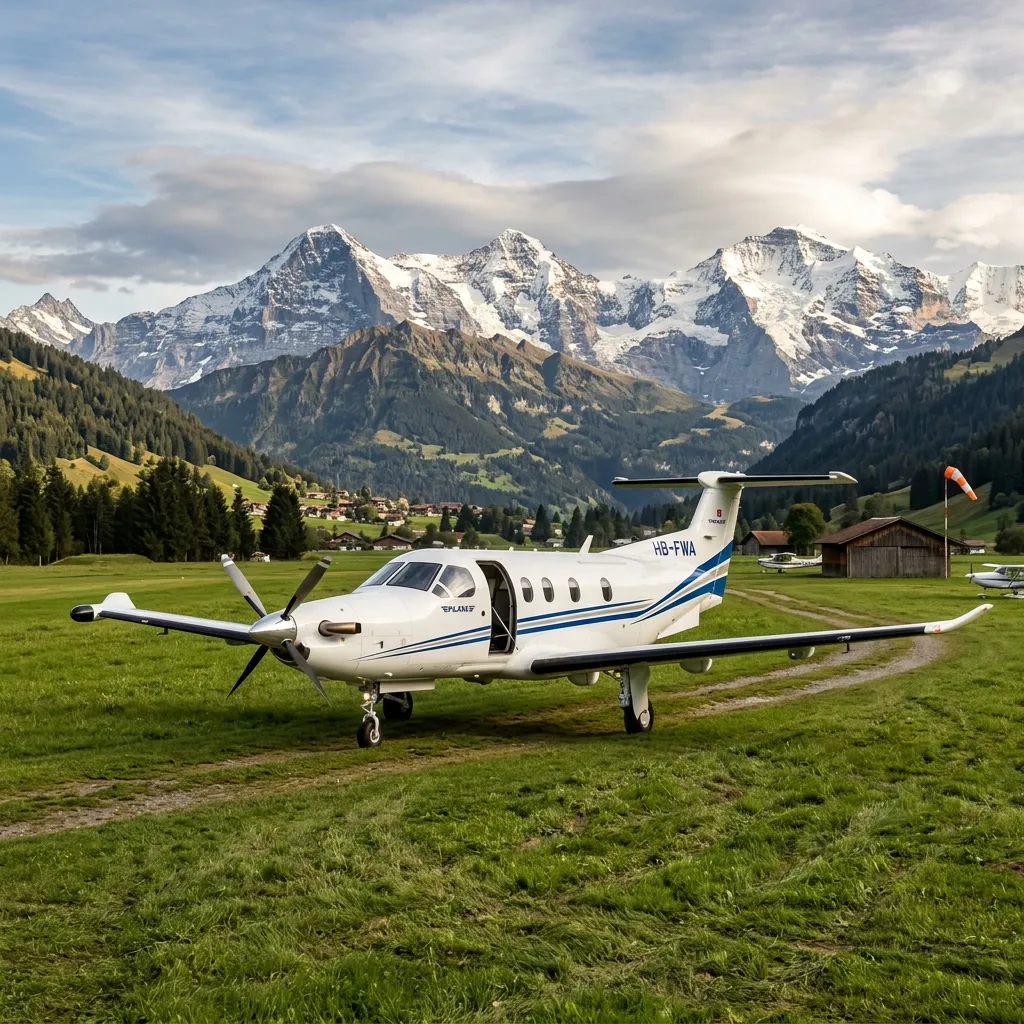
The trailing-link main landing gear, low-pressure tires, and robust anti-skid braking system allow operations on unprepared surfaces. PC-12s routinely operate from gravel strips in Alaska, grass fields in Africa, and packed dirt in Australia. No jet offers this capability at any price.
Cabin Configuration and Passenger Experience
The executive cabin seats up to 9 passengers in various configurations. The standard layout features four club seats facing each other with a center aisle, two forward-facing seats behind the cockpit, and three aft seats or a belted divan. Cabin width is 5.0 feet, cabin height is 4.8 feet, and the pressurized cabin maintains 10,000-foot equivalent at FL 300.
The PC-12 NGX (current production) introduced a new interior with electrically adjustable seats, LED ambient lighting, a redesigned refreshment center, and USB-A/C power at every seat. Noise levels at cruise are comparable to a light jet at 78-80 dBA. The wing-mounted engine placement keeps the cabin quieter than rear-mounted configurations on the Cessna Caravan.
The onboard lavatory is enclosed but compact. For flights under three hours, it is adequate. Larger passengers may find it restrictive. The refreshment center handles cold meals, beverages, and basic catering. Hot meal service requires insulated catering bags loaded before departure.