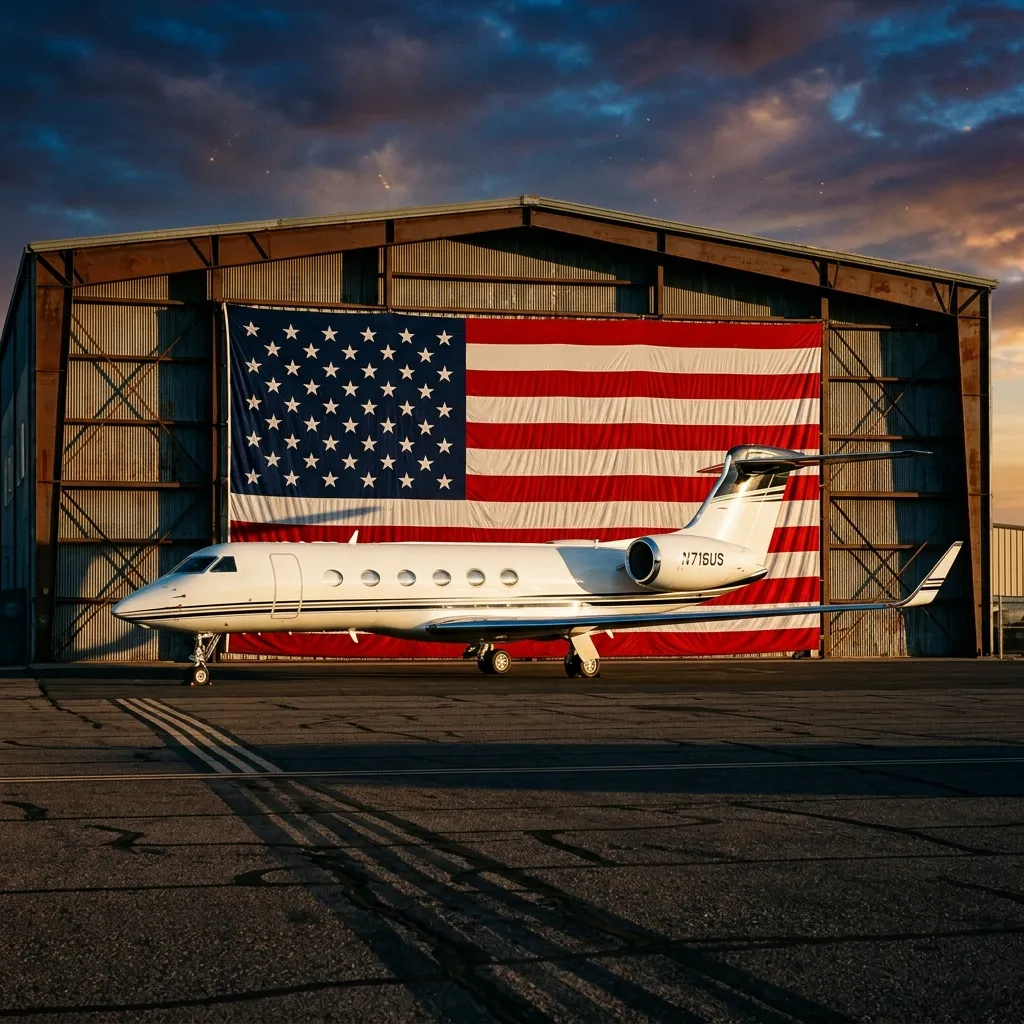
Business jet in a maintenance hangar undergoing inspection with FAA certification documents on a table

Importing a Business Jet to the United States: FAA Certification, CBP Duties, and Registration Requirements

undefined

In This Article

Why Buyers Import Foreign-Registered Jets Step 1: FAA Airworthiness Validation Step 2: CBP Import Duties and Entry Step 3: FAA Registration and N-Number Assignment Total Cost and Timeline Summary Frequently Asked Questions

Why Buyers Import Foreign-Registered Jets

Approximately 200-400 business jets are imported to the U.S. registry annually. Buyers pursue foreign-registered aircraft for several reasons: better pricing (pre-owned jets on European, Brazilian, or Canadian registries sometimes trade 5-15% below equivalent U.S.-registered examples), access to specific low-time airframes not available domestically, fleet consolidation by multinational corporations, and repatriation of aircraft that were exported by previous owners for tax or operational reasons.

The import process involves three independent regulatory systems: the FAA (airworthiness certification and registration), U.S. Customs and Border Protection (duty assessment and import clearance), and the exporting country's civil aviation authority (export certificate of airworthiness). Each system has its own timeline, documentation requirements, and potential complications. The process typically takes 3-6 months from purchase agreement to N-number registration, though complex cases (older aircraft, extensive modification history, non-standard configurations) can extend to 12 months.

Step 1: FAA Airworthiness Validation

The aircraft's type certificate must be validated by the FAA. Most business jets from Gulfstream, Bombardier, Cessna/Textron, Dassault, and Embraer hold both FAA and EASA type certificates, meaning the aircraft type is already approved for U.S. registration. The specific airframe must then receive an FAA Standard Airworthiness Certificate, which requires a conformity inspection by an FAA-authorized designee or an FAA Aviation Safety Inspector.

The conformity inspection verifies that the aircraft matches the FAA type design: all modifications, STCs (Supplemental Type Certificates), and repairs comply with FAA-approved data. Modifications performed under EASA or other foreign authority approval must be validated against FAA standards. If the aircraft has EASA-only STCs (for example, an interior modification approved by EASA but not the FAA), those modifications must either be removed, replaced with FAA-approved equivalents, or validated through a separate FAA approval process.

  • Verify FAA type certificate exists for the aircraft model (most business jets have dual FAA/EASA TC)
  • Obtain Export Certificate of Airworthiness (Form 8130-4 or EASA Form 1) from the exporting authority
  • Schedule conformity inspection with FAA designee or FSDO inspector
  • Resolve any non-FAA modifications: obtain FAA STCs or remove non-compliant modifications
  • Receive FAA Standard Airworthiness Certificate (Form 8100-2)
  • Complete FAA registration (N-number assignment via AC Form 8050-1)

Step 2: CBP Import Duties and Entry

U.S. Customs and Border Protection assesses import duties based on the aircraft's classification under the Harmonized Tariff Schedule. Business jets classified under HTSUS 8802.40 (aircraft exceeding 15,000 kg MTOW) enter duty-free. Lighter aircraft under 8802.30 (2,000-15,000 kg MTOW, covering most light and midsize jets) carry a duty rate of 0-2.6% depending on country of origin and applicable trade agreements. Aircraft components, engines, and avionics may be classified separately with different duty rates.

CBP requires a formal entry filing within 15 days of the aircraft arriving in the U.S. A licensed customs broker handles the entry documentation, duty calculation, and payment. The declared value for duty purposes is the transaction value (purchase price) plus certain costs of transport. Duty payment is due within 10 working days of entry. For a $15 million midsize jet at 2.6% duty, the import duty is $390,000. For a $50 million heavy jet, the duty is zero.

Foreign Trade Zones (FTZ) provide a legal mechanism to defer or reduce import duties. An aircraft can be brought into an FTZ, undergo maintenance, modification, or storage, and duty is assessed only when the aircraft formally enters U.S. commerce. Some buyers use FTZ designation to time their duty payment strategically. Aircraft maintenance facilities at several U.S. airports hold FTZ designation. Consult a customs attorney before structuring an FTZ-based import.


Need a Charter Quote?

Contact our team for a personalized quote.

Get a Quote

Step 3: FAA Registration and N-Number Assignment

Once the aircraft has received its FAA airworthiness certificate and cleared customs, the buyer applies for FAA registration. The aircraft receives an N-number (U.S. registration identifier). The registration process requires: completed AC Form 8050-1 (Aircraft Registration Application), evidence of ownership (bill of sale, AC Form 8050-2), and a $5 registration fee. The FAA Aircraft Registration Branch in Oklahoma City processes applications in 2-4 weeks for standard submissions.

Ownership structures affect registration eligibility. The FAA requires that registered aircraft be owned by U.S. citizens, permanent residents, or U.S.-organized corporations with U.S. citizen control. Foreign nationals can register aircraft through voting trust arrangements or LLC structures that satisfy the citizenship requirement. The legal structure must be in place before registration. Aviation attorneys (typically the same counsel handling the purchase agreement) draft the trust or LLC documents.

  • Apply for N-number reservation: $10 fee, valid for 1 year, renewable
  • Submit AC Form 8050-1 (Registration Application) with supporting documents
  • Provide evidence of ownership: bill of sale, trust agreement, or LLC operating agreement
  • Pay $5 registration fee (nominal, but must accompany the application)
  • Wait 2-4 weeks for FAA processing and issuance of Certificate of Aircraft Registration
  • Affix N-number to the aircraft per 14 CFR Part 45 marking requirements

Total Cost and Timeline Summary

Total import costs (excluding the aircraft purchase price) range from $50,000 to $200,000 for typical transactions, plus duty if applicable. The timeline from signed purchase agreement to FAA-registered, N-numbered aircraft is 3-6 months. The longest delays typically occur in STC resolution (obtaining FAA approval for foreign-approved modifications) and ferry flight scheduling. Engaging an experienced aviation attorney and import specialist before signing the purchase agreement prevents most delays.

Brian Galvan

Written By

Brian Galvan

Founder, The Jet Finder ยท Private Aviation Operations & Technology

Former Director of Technology at FlyUSA (Inc. 5000 fastest-growing private jet company). Decade of hands-on experience across Part 135 operations, charter sales, fleet management, and aviation data systems.

LinkedInRead Full Profile →
Common Questions

Frequently Asked Questions


8 questions about chartering this aircraft

The FAA has Bilateral Aviation Safety Agreements (BASAs) with EASA (European Union), Transport Canada (TCCA), ANAC (Brazil), and several other authorities. Aircraft type-certificated under EASA or TCCA validation agreements generally have streamlined FAA validation paths. Gulfstream, Bombardier, Dassault, Embraer, and Textron aircraft hold dual FAA/EASA type certificates, making imports from EASA-member states straightforward. Aircraft from countries without BASAs (Russia, China, some Asian registries) face significantly more complex validation processes.

Each non-FAA modification must be resolved before the aircraft can receive an FAA airworthiness certificate. Three resolution paths exist: (1) the modification holder obtains an FAA STC (costly, time-consuming, $20,000-$100,000+), (2) the buyer removes the modification and returns the aircraft to the FAA type design, or (3) the modification is validated through an FAA field approval (Form 337, limited to minor alterations). Common problem areas include EASA-only interior modifications, avionics installations, and supplemental fuel systems. Identify all non-FAA modifications during pre-buy before closing the purchase.

CBP assesses duties on the transaction value, which is the actual purchase price paid by the buyer, plus certain adjustments (assists, royalties, transportation costs to the U.S.). If CBP determines that the transaction price does not reflect the aircraft's true value (for example, a related-party transaction at below-market price), CBP can adjust the declared value upward. In practice, arm's-length transactions between unrelated parties are accepted at the stated purchase price. A customs broker prepares the entry documentation and defends the declared value.

Not directly. FAA registration requires U.S. citizenship, permanent residency, or a U.S.-organized entity with U.S. citizen control. Foreign nationals typically use a voting trust arrangement: the aircraft is owned by a trust with a U.S. citizen trustee who holds voting control, while the foreign national is the beneficial owner. Several banks and specialized trustees (Wells Fargo, TVPX, Citadel Completions) offer aircraft trust services. Fees run $3,000-$8,000 per year. The trust satisfies FAA citizenship requirements while allowing the foreign owner to retain economic ownership.

The Export Certificate of Airworthiness (Export C of A) is issued by the civil aviation authority of the country where the aircraft is currently registered. For EASA-member states, this is EASA Form 1 or the national authority's equivalent. For Canada, Transport Canada issues the export certificate. The document certifies that the aircraft conforms to the importing country's (FAA's) type design and is in an airworthy condition at the time of export. The Export C of A is a prerequisite for the FAA conformity inspection. Without it, the FAA will not issue a U.S. airworthiness certificate.

The physical inspection takes 3-10 business days depending on aircraft size and modification complexity. A clean late-model Gulfstream with all FAA-approved modifications might complete in 3-4 days. An older Bombardier with multiple EASA-only STCs and extensive modification history could require 2-3 weeks as each modification is individually verified. Schedule the inspection at an MRO with experience in import conformity work (West Star Aviation, Duncan Aviation, and Elliott Aviation handle these regularly). The FAA designee's availability adds 2-6 weeks of scheduling lead time.

Import duty (0-2.6%) is separate from state sales and use tax. When the imported aircraft is placed on the U.S. registry and based in a U.S. state, the state may assess sales or use tax on the full purchase price, just as it would for a domestically purchased aircraft. State tax rates range from 0% (Montana, Oregon, Delaware) to 6-7% (California, New York). Tax planning strategies (temporary basing in favorable states, fly-away exemptions, like-kind exchanges) apply equally to imported and domestic purchases. Engage a tax advisor before closing.

Not immediately. After receiving the FAA airworthiness certificate and N-number registration, the aircraft must be added to a Part 135 operator's certificate through their Principal Operations Inspector (POI). This requires: the aircraft's maintenance program approved by the POI, all required equipment installed and operational (per the operator's OpSpecs), crew training completed on the specific tail number, and an acceptance inspection by the operator's maintenance team. Adding an imported aircraft to a Part 135 certificate typically takes 30-90 days after registration, depending on the operator's relationship with their POI and any outstanding maintenance items.

Continue Reading

Related Articles


Your Next Mission

Ready to Fly?


Whether you need a charter quote or want to explore aircraft options, our team is here.

Contact Us