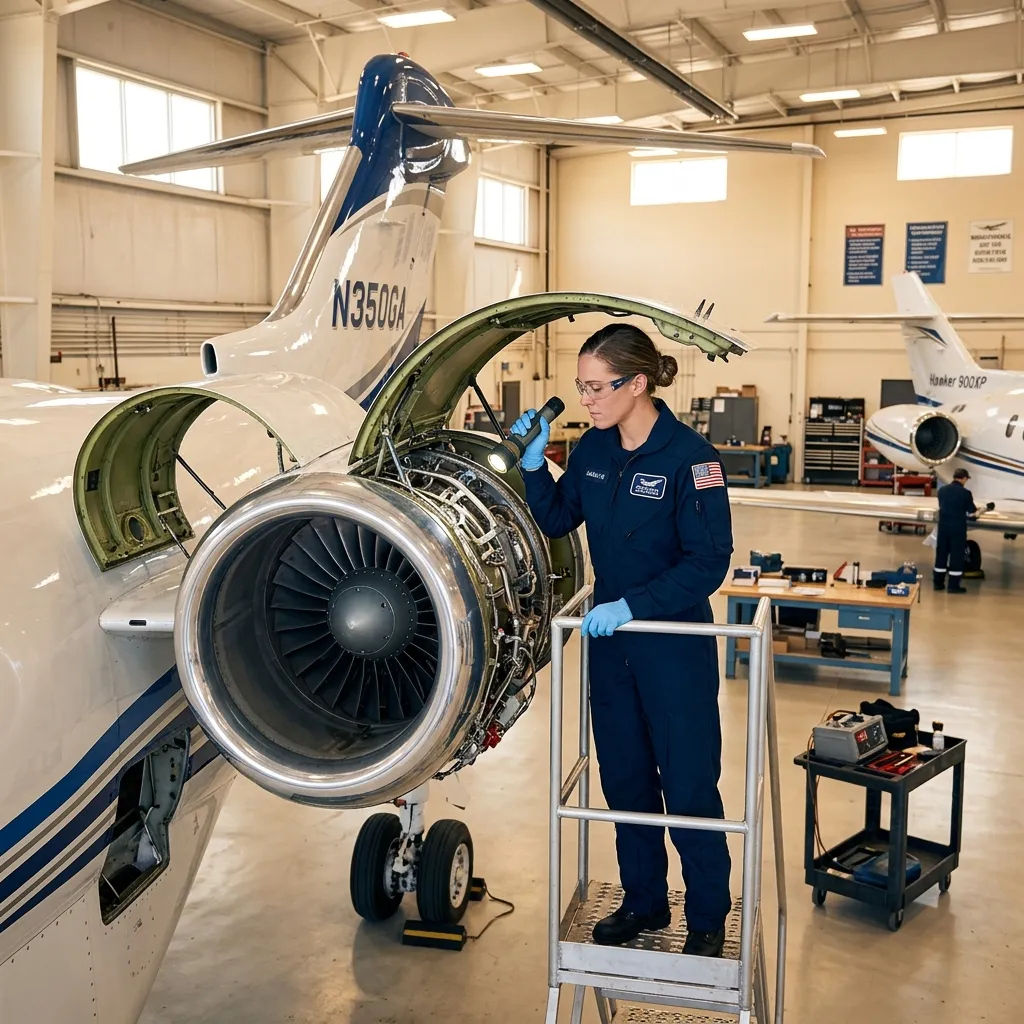
Aircraft maintenance technician with flashlight inspecting landing gear well of a business jet in a hangar

Aircraft Pre-Buy Inspection: Scope, Cost, and What Your MRO Will Find

undefined

In This Article

The $35,000 Inspection That Saves You $2 Million What the Pre-Buy Inspection Covers Pre-Buy Inspection Costs by Aircraft Category Choosing the Right MRO Facility What Happens When the Inspection Finds Problems Frequently Asked Questions

The $35,000 Inspection That Saves You $2 Million

Approximately 60% of pre-buy inspections reveal discrepancies that were not disclosed in the aircraft listing or sales package. The findings range from minor cosmetic damage ($5,000 fixes) to corrosion requiring structural repair ($150,000-$500,000), undisclosed damage history that reduces residual value by $1 million or more, and engine conditions approaching limits that trigger $800,000 hot section inspections within months of purchase. The pre-buy inspection is the buyer's last opportunity to identify these issues before ownership transfers.

A pre-buy inspection is not a regulatory event. The FAA does not require it. Neither the seller nor the broker is obligated to permit one. But no informed buyer closes on a business jet without one, and no reputable seller refuses to allow one. The inspection is performed by a maintenance facility (MRO) selected by the buyer, at the buyer's expense, at a location typically chosen by mutual agreement. It produces a written report that documents the aircraft's mechanical, structural, and records condition at the time of sale.

What the Pre-Buy Inspection Covers

Phase 1: Records Review

The records audit typically takes 2-3 days and occurs before any wrench touches the aircraft. Technicians review the aircraft's maintenance logbooks, airworthiness directives (AD) compliance records, service bulletin status, engine trend monitoring data, modification records, and weight-and-balance data. They verify the aircraft's pedigree: serial number consistency, registration history, any damage history entries, insurance claims, and major repair documentation. Records gaps are red flags. A 15-year-old jet should have continuous, unbroken maintenance records from delivery to present.

Phase 2: Airframe Inspection

The physical airframe inspection follows the aircraft manufacturer's inspection program (typically aligned with an upcoming annual or phase inspection). Technicians open access panels, inspect structural members, examine control surfaces, check hydraulic and pneumatic systems, test electrical systems, evaluate avionics, and examine the pressurization system. Landing gear is inspected for corrosion, seal condition, and remaining service life. The paint and exterior are evaluated for condition, prior repair evidence, and UV degradation.

Phase 3: Engine and APU

Engine inspection includes borescope examination of all compressor and turbine stages, oil analysis review, trend monitoring data analysis, and documentation of time since new (TSN), time since overhaul (TSO), and cycles since new (CSN). Borescope images reveal blade erosion, cracking, hot section distress, and foreign object damage that ground-based inspections cannot detect. The APU receives similar scrutiny: borescope, oil analysis, and remaining time to overhaul.

  • Records audit: 2-3 days, verifies complete maintenance history from delivery to present
  • Airframe: open panels, structural inspection, landing gear, pressurization, paint evaluation
  • Engines: borescope all stages, oil analysis, trend monitoring, time tracking (TSN/TSO/CSN)
  • Avionics: functional check of all installed equipment, software currency verification
  • APU: borescope, oil analysis, remaining service life calculation
  • Flight test: post-inspection verification flight (optional but recommended for complex aircraft)

Pre-Buy Inspection Costs by Aircraft Category

These costs cover labor, parts for access panel removal and reinstallation, borescope rental (if not owned by the facility), and the written report. They do not include ferrying the aircraft to the inspection facility (the buyer or seller pays for positioning flights separately). Additional costs arise if the inspection reveals squawks requiring further investigation: a corroded structural member may require NDT (non-destructive testing) at $2,000-$5,000 per area, for example.

Buyers often ask whether the pre-buy inspection cost is negotiable. It is not. The inspection protects you. Cutting corners on the pre-buy to save $10,000 on a $15 million aircraft is the definition of false economy. If the inspection reveals $300,000 in unscheduled maintenance, you renegotiate the purchase price or walk away. Without the inspection, you discover the $300,000 problem after you own it.


Need a Charter Quote?

Contact our team for a personalized quote.

Get a Quote

Choosing the Right MRO Facility

The buyer selects the inspection facility, not the seller. This is non-negotiable. Choose an MRO that is an authorized service center for the aircraft's manufacturer: Textron Aviation Service Centers for Citations, Bombardier Service Centers for Challengers and Globals, Gulfstream for G-series, StandardAero or West Star Aviation for multi-platform work. Manufacturer-authorized facilities have access to proprietary inspection tools, current service bulletin libraries, and factory-trained technicians.

Independent MROs like West Star Aviation (East Alton, IL; Grand Junction, CO; Chattanooga, TN), Duncan Aviation (Lincoln, NE; Battle Creek, MI), and Elliott Aviation (Moline, IL; Des Moines, IA) handle multi-manufacturer pre-buys and are well-regarded for thoroughness and impartiality. These facilities see hundreds of pre-buys annually and know what to look for on specific models. The facility's familiarity with your aircraft type matters more than its geographic proximity.

  • Always choose the facility yourself. Never use the seller's preferred MRO
  • Verify the MRO is an authorized service center for the specific aircraft type
  • Request references from recent pre-buy clients on the same aircraft model
  • Confirm borescope capability for the specific engine type installed
  • Ask for a written scope of work before committing, including estimated hours and completion timeline
  • Ensure the facility will provide a written, photographic final report (not just verbal findings)

What Happens When the Inspection Finds Problems

The pre-buy report categorizes findings as airworthiness items (must be corrected before the aircraft can legally fly), scheduled maintenance due (items approaching calendar or time-based limits), and cosmetic or discretionary items (paint condition, interior wear, avionics software updates). The buyer and seller then negotiate: the seller corrects the airworthiness items (standard), the parties split scheduled maintenance costs or adjust the price, and cosmetic items typically remain the buyer's responsibility post-close.

On average, pre-buy negotiations result in a purchase price adjustment of $50,000-$400,000 on light and midsize jets, and $200,000-$1.5 million on heavy jets. In approximately 10-15% of transactions, the pre-buy findings are severe enough that the buyer walks away entirely: hidden damage history, corrosion beyond economical repair, or engine conditions requiring immediate overhaul that the seller refuses to address.

The pre-buy's most valuable finding is often in the records, not on the aircraft. A gap in logbook entries, a missing AD compliance record, or an undocumented repair can indicate prior unreported damage or maintenance performed by unqualified personnel. These records issues can reduce the aircraft's value by $500,000-$2 million and, in some cases, render the aircraft ineligible for operation under Part 135 charter certificates.

Brian Galvan

Written By

Brian Galvan

Founder, The Jet Finder ยท Private Aviation Operations & Technology

Former Director of Technology at FlyUSA (Inc. 5000 fastest-growing private jet company). Decade of hands-on experience across Part 135 operations, charter sales, fleet management, and aviation data systems.

LinkedInRead Full Profile →
Common Questions

Frequently Asked Questions


8 questions about chartering this aircraft

Thirty days provides enough time to position the aircraft, complete the records audit (2-3 days), perform the physical inspection (5-14 days), receive the written report (2-3 days), and negotiate findings with the seller. Shorter contingency windows (10-15 days) create pressure to rush the inspection or accept findings without adequate review. The contingency clause also protects the buyer's deposit: if findings are unacceptable, the buyer terminates the agreement and receives a full deposit refund. Without this clause, the buyer forfeits the deposit if they walk away.

The threshold depends on the engine program. For engines not enrolled in CorporateCare, MSP, or JSSI, buyers typically demand price adjustments when engines have fewer than 50% of their interval remaining to the next hot section inspection (HSI) or overhaul. For example, a Williams FJ44 with an HSI interval of 3,500 hours and 1,200 hours remaining would trigger a pro-rata price reduction of approximately $180,000-$250,000 per engine. Enrolled engines are valued differently: the hourly program covers the event regardless of time remaining, so enrollment status matters more than raw hours.

Yes. Experienced inspectors identify signs of prior undocumented repair: mismatched rivet patterns, paint thickness variations (indicating repainted areas over body filler), structural members with non-OEM fasteners, and skin panels with evidence of straightening or welding. NDT (non-destructive testing) using eddy current, ultrasonic, or X-ray inspection can reveal subsurface repairs that visual inspection misses. Approximately 5-8% of pre-buy inspections uncover damage history that was not recorded in the maintenance logs, which is grounds for immediate price renegotiation or deal termination.

Four primary NDT methods are used in pre-buy inspections: eddy current testing (detects surface and near-surface cracking in aluminum and steel, $150-$300 per test area), ultrasonic testing (measures material thickness and detects internal flaws, $200-$400 per area), dye penetrant inspection (reveals surface cracks invisible to the naked eye, $100-$200 per area), and radiographic/X-ray inspection (images internal structural conditions, $500-$1,500 per exposure). NDT is not standard in every pre-buy; it is triggered by visual findings that suggest deeper investigation is warranted.

Part 135 operators must demonstrate to their Principal Operations Inspector (POI) that every maintenance action, AD compliance, service bulletin status, and repair is documented in continuous, traceable records from aircraft delivery to present. Gaps in the logbook chain, missing AD compliance entries, or undocumented repairs can cause the POI to refuse placement of the aircraft on the operator's certificate. For buyers planning to place their acquisition on a Part 135 charter certificate, records completeness is an absolute requirement. A pre-buy records audit verifies this eligibility before purchase.

Landing gear inspection covers: strut servicing and extension measurements, brake wear (remaining pad/lining thickness), tire condition and tread depth, wheel bearing inspection, retraction mechanism and actuator function, squat switch operation, gear door condition, trunnion and pivot point wear, hydraulic seal integrity, and corrosion in the wheel wells. Landing gear overhaul is calendar- and cycle-limited (typically 10-12 years or 15,000-20,000 cycles). If the gear is within 2 years of overhaul, the buyer should factor $200,000-$600,000 per aircraft into the acquisition budget.

Oil analysis (spectrographic oil analysis program, SOAP) measures metallic wear particles in the engine oil in parts per million. Elevated iron indicates bearing or gear wear. Elevated silver signals bearing cage deterioration. Elevated chromium suggests cylinder or valve issues. Trend data is more valuable than a single sample: a steady increase in any metal over 5-10 samples indicates accelerating internal wear. The pre-buy team reviews the last 12-24 SOAP samples alongside borescope findings to assess overall engine health. A clean borescope with rising metal trends can indicate problems that have not yet become visible internally.

The buyer deposits 5-10% of the purchase price ($250,000-$1.5 million on most jets) into an escrow account managed by a neutral third party (typically an aviation escrow company or title company such as AOPA Title Services or Insured Aircraft Title Service). The escrow agent holds funds until both parties fulfill their contractual obligations: the seller completes agreed-upon repairs, the buyer accepts the pre-buy findings, title search confirms clean ownership, and all liens are cleared. If the buyer terminates under the pre-buy contingency, the escrow agent refunds the deposit. If both parties close, the escrow agent releases funds to the seller and records the bill of sale.

Continue Reading

Related Articles


Your Next Mission

Ready to Fly?


Whether you need a charter quote or want to explore aircraft options, our team is here.

Contact Us