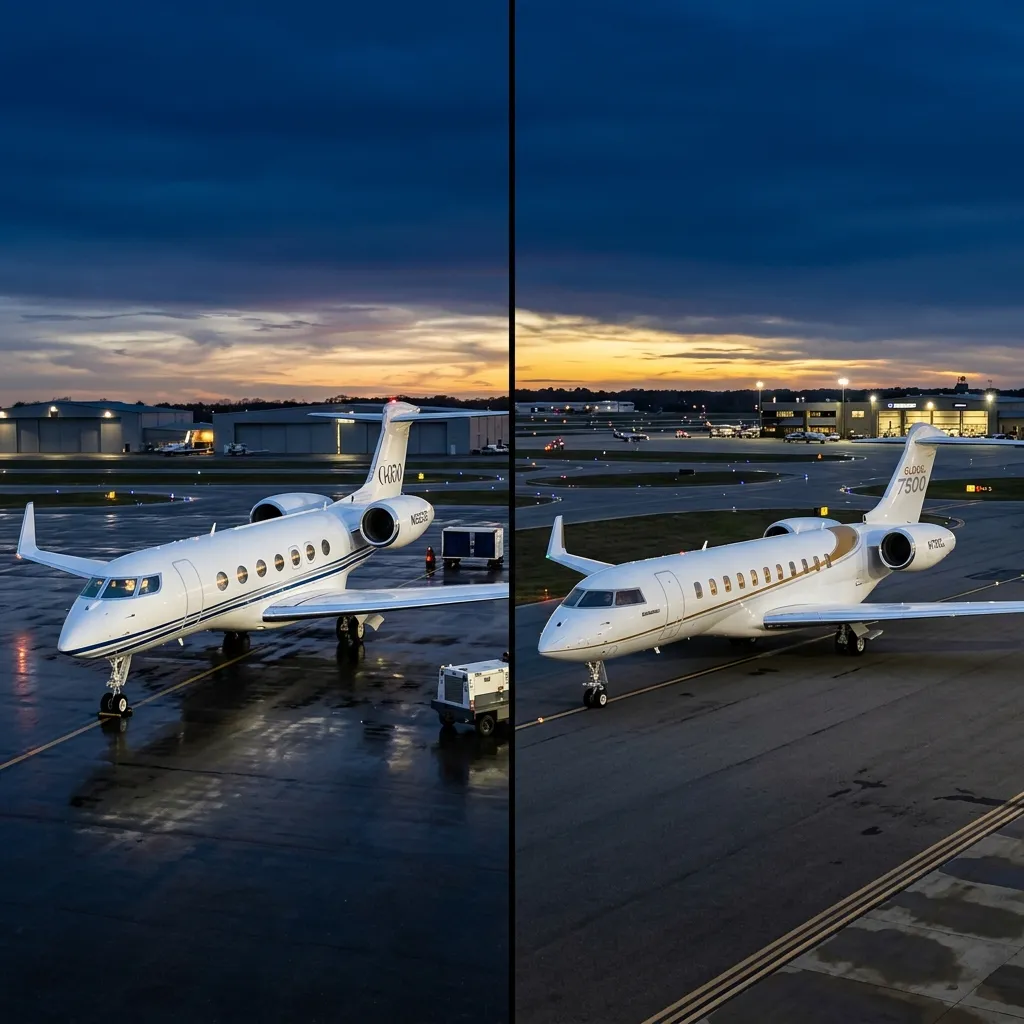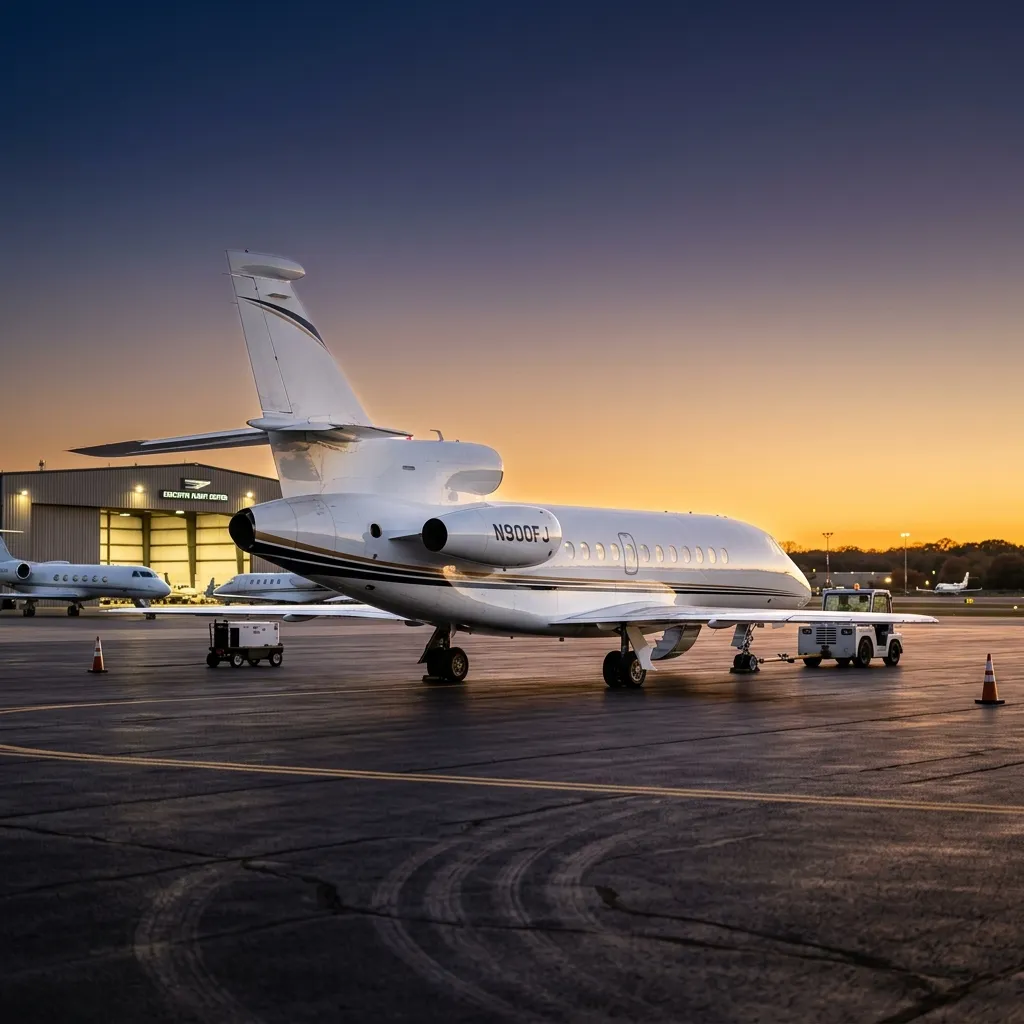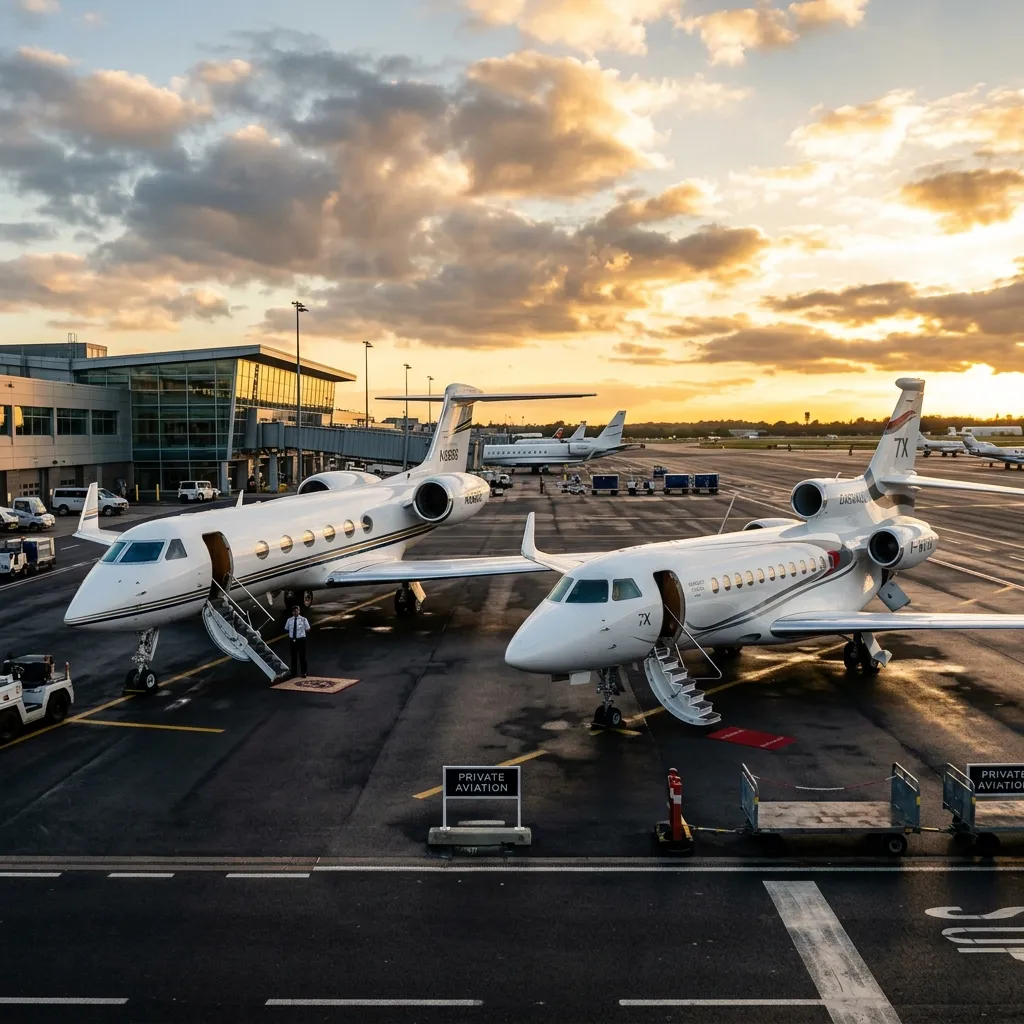
Gulfstream G550 and Dassault Falcon 7X parked on an international FBO ramp

Gulfstream G550 vs Dassault Falcon 7X: Two Engines or Three?

The G550 has 800 nautical miles more range. The Falcon 7X lands on 2,070 fewer feet of runway. One is a straight-line intercontinental machine; the other goes places the G550 cannot reach. The tri-engine question is really an airport question.

In This Article

Spec Sheet: Two Philosophies, One Mission Three Engines: Redundancy and Short Fields Where the G550's 800 Extra Nautical Miles Matter The Cabin: G550 Length vs Falcon 7X Width Charter Costs and Operating Economics Fly-By-Wire: The Falcon 7X's Hidden Edge Which One Should You Charter? Frequently Asked Questions

Spec Sheet: Two Philosophies, One Mission

The Gulfstream G550 carries 16 passengers at Mach 0.885 for 6,750 nautical miles on two Rolls-Royce BR710 engines producing 15,385 pounds of thrust each. The Dassault Falcon 7X carries 16 passengers at Mach 0.90 for 5,950 nautical miles on three Pratt & Whitney Canada PW307A engines producing 6,402 pounds of thrust each. The G550 wins on range. The Falcon 7X wins on runway access. Everything else is a question of priorities.

6,750 nm
G550 Max Range
5,950 nm
Falcon 7X Range
3 Engines
Falcon 7X Powerplant
$5,500-$8,000
Hourly Rate Range

Three Engines: Redundancy and Short Fields

The Falcon 7X's third engine is not about speed. It is about geometry. With three engines, the Falcon 7X produces balanced thrust symmetry even after losing one engine on takeoff. A twin-engine jet that loses an engine at V1 must yaw-correct against asymmetric thrust while climbing on reduced power. The Falcon 7X loses one-third of its thrust but retains symmetric directional control, which translates directly into shorter accelerate-stop distances and steeper climb gradients.

This matters at airports like London City (LCY), where the Falcon 7X is approved for the steep 5.5-degree glide slope approach and the G550 is not. It matters at Lugano, at Saint-Tropez (La Mole), and at dozens of European and South American airports where runway length, approach angle, or obstacle clearance requirements exclude large-cabin twins.

Dassault did not add the third engine for marketing. They added it because the airports their customers wanted to reach demanded it.

Where the G550's 800 Extra Nautical Miles Matter

The G550's 6,750 nm range covers New York to Tokyo (5,850 nm), Teterboro to Dubai (5,990 nm), and Los Angeles to London (5,440 nm) nonstop. The Falcon 7X's 5,950 nm range handles New York to London, New York to Riyadh, and Los Angeles to Paris. But Tokyo from the U.S. East Coast? That requires a fuel stop in Anchorage or Honolulu on the Falcon 7X.

Real-World Range With Passengers

Published ranges assume maximum fuel with four passengers. Add eight passengers and catering for an overnight transatlantic crossing, and both aircraft lose 300-400 nm of real-world range. The G550's range cushion absorbs that reduction and still covers most intercontinental city pairs nonstop. The Falcon 7X starts requiring routing decisions on the longest missions.

  • TEB to London Luton (EGGW): G550: nonstop. 7X: nonstop. Both with full passenger loads.
  • TEB to Dubai (OMDW): G550: nonstop with reserves. 7X: marginal with 8+ passengers; may require Shannon fuel stop.
  • LAX to Tokyo (RJTT): G550: nonstop westbound, fuel stop eastbound (headwinds). 7X: fuel stop required both directions.
  • Miami to São Paulo (SBGR): G550: nonstop. 7X: nonstop. Distance is 4,100 nm; both aircraft carry full fuel with room to spare.

The Cabin: G550 Length vs Falcon 7X Width

The G550's cabin stretches 43.8 feet long and 7.3 feet wide. The Falcon 7X cabin measures 39.1 feet long and 7.7 feet wide. That 4.7-foot length difference gives the G550 room for a third seating zone, typically configured as a divan or additional club seating. The Falcon 7X's 0.4-foot width advantage creates noticeably wider seats and a more open cross-section.

Both cabins are configured in three-zone layouts for charter: forward club four, mid-cabin conference group, and aft divan with entertainment. The G550's extra length makes the aft zone more usable as a sleeping area on transatlantic flights. The Falcon 7X's flat floor (a Dassault signature across the Falcon family) runs the full cabin length without steps, which simplifies catering service and passenger movement.

Baggage capacity: the G550 offers 170 cubic feet, the Falcon 7X provides 140 cubic feet. For eight passengers on a week-long international trip, both aircraft accommodate full-size luggage without compromise. The G550's advantage becomes relevant when the passenger manifest reaches 12-14 and each traveler brings multiple bags.

Charter a Heavy Jet

We source G550, Falcon 7X, and other large-cabin availability from operators across the U.S. and internationally.

Request a Quote

Charter Costs and Operating Economics

The G550 charters for $5,500 to $8,000 per flight hour. The Falcon 7X ranges from $5,500 to $7,500 per hour. The G550's higher ceiling reflects its larger installed fleet (over 500 delivered) and stronger brand recognition in the U.S. charter market. European operators tend to favor the Falcon 7X for its airport flexibility, and rates in the European charter market reflect that preference.

The Third Engine's Cost Impact

Three engines mean three hot section inspections, three overhaul intervals, and 50% more engine maintenance reserve accruals. The Falcon 7X's total fuel burn is approximately 280 gallons per hour versus the G550's 260 gallons per hour. Over a 10-hour transatlantic crossing, that 200-gallon difference costs roughly $1,300 at current fuel prices. Annualized across 400 flight hours, the Falcon 7X's third engine adds approximately $250,000-$350,000 in direct operating costs compared to the G550.

For charter passengers, this cost difference is already embedded in the hourly rate. It explains why the Falcon 7X, despite being a newer design with fly-by-wire controls, does not command a consistent premium over the older G550.

Fly-By-Wire: The Falcon 7X's Hidden Edge

The Falcon 7X was the first business jet with digital fly-by-wire flight controls, inherited from Dassault's Rafale fighter program. The G550 uses a conventional hydro-mechanical flight control system. For passengers, the difference manifests as a smoother ride in turbulence. The Falcon 7X's flight computers continuously adjust control surfaces to dampen gusts before the passenger feels them.

For pilots, fly-by-wire reduces workload during approach and landing, particularly at challenging airports. The system provides flight envelope protection, preventing the aircraft from exceeding structural limits regardless of pilot input. This is standard on every Airbus and most modern fighters but remains uncommon in business aviation. The G550's successor, the G600, adopted a Gulfstream-designed fly-by-wire system, validating Dassault's decade-long head start.

Which One Should You Charter?

Charter the G550 if your mission is pure range: New York to the Middle East, Los Angeles to Tokyo, any city pair exceeding 5,500 nm. The G550's fuel capacity and range envelope cover intercontinental routing that forces the Falcon 7X to stop.

Charter the Falcon 7X if your mission includes a challenging airport. London City, Lugano, Saint-Tropez, or any field under 5,000 feet where a large-cabin jet normally cannot go. The Falcon 7X's 2,070-foot landing distance opens destinations that no twin-engine heavy jet can reach.

For domestic U.S. flying between major airports, both aircraft deliver an identical passenger experience at comparable hourly rates. At that point, the decision comes down to which aircraft your operator has available on your dates.

Brian Galvan

Written By

Brian Galvan

Founder, The Jet Finder · Private Aviation Operations & Technology

Former Director of Technology at FlyUSA (Inc. 5000 fastest-growing private jet company). Decade of hands-on experience across Part 135 operations, charter sales, fleet management, and aviation data systems.

LinkedInRead Full Profile →
Common Questions

Frequently Asked Questions


7 questions about G550 vs Falcon 7X comparison

Correct. The Falcon 7X is approved for London City's 5.5-degree steep approach and 4,948-foot runway. The G550 does not hold London City approval due to its longer landing distance requirements and approach category. This single airport access difference is one of the primary reasons European operators and charter clients choose the Falcon 7X for UK-bound travel.

When the G550 loses one of its two engines at V1, it loses 50% of thrust and must immediately correct for asymmetric yaw while climbing on the remaining engine. When the Falcon 7X loses one of three engines, it loses 33% of thrust and retains symmetric directional control because the two remaining engines are mounted symmetrically. The Falcon 7X's engine-out climb gradient exceeds the G550's in most conditions.

The G550 retains stronger resale values in the U.S. market due to fleet size (over 500 delivered), brand recognition, and a deeper pool of trained crews. A 10-year-old G550 sells for $14-$18 million. A comparable Falcon 7X sells for $12-$16 million. In Europe and the Middle East, Falcon 7X values are more competitive because of the aircraft's airport flexibility.

The Falcon 7X burns approximately 280 gallons per hour at long-range cruise versus the G550's 260 gallons per hour. The difference is roughly 8%, not the 50% increase you might expect from an extra engine. Dassault sized the PW307A engines smaller individually; combined thrust is comparable to the G550's two BR710s while each engine operates at a more efficient power setting.

The Falcon 7X is wider at 7.7 feet versus the G550's 7.3 feet. That 4.8-inch difference is perceptible in seat width and shoulder room. However, the G550's cabin is 4.7 feet longer at 43.8 feet, providing more separation between seating zones. For overnight flights, the G550's length advantage creates a more usable sleeping area in the aft cabin.

Dassault adapted the digital fly-by-wire flight control architecture from the Rafale multirole fighter for the Falcon 7X. The flight control laws, sensor fusion approach, and envelope protection logic share engineering lineage with the military program. Dassault is the only business jet manufacturer that also produces active front-line military fighters, and the technology transfer is genuine, not marketing.

The total cost is comparable. A G550 New York to London charter runs approximately $65,000-$85,000 one way (8-hour flight at $7,000-$8,000/hr plus positioning and fees). A Falcon 7X covers the same route at $60,000-$80,000. The G550 tends to cost slightly more per hour in the U.S. market, but both aircraft complete the mission nonstop with identical passenger capacity.

Continue Reading

Related Articles


Your Next Mission

Ready to Fly?


Whether you need a charter quote or want to explore aircraft options, our team is here.

Contact Us