Two Philosophies at 51,000 Feet
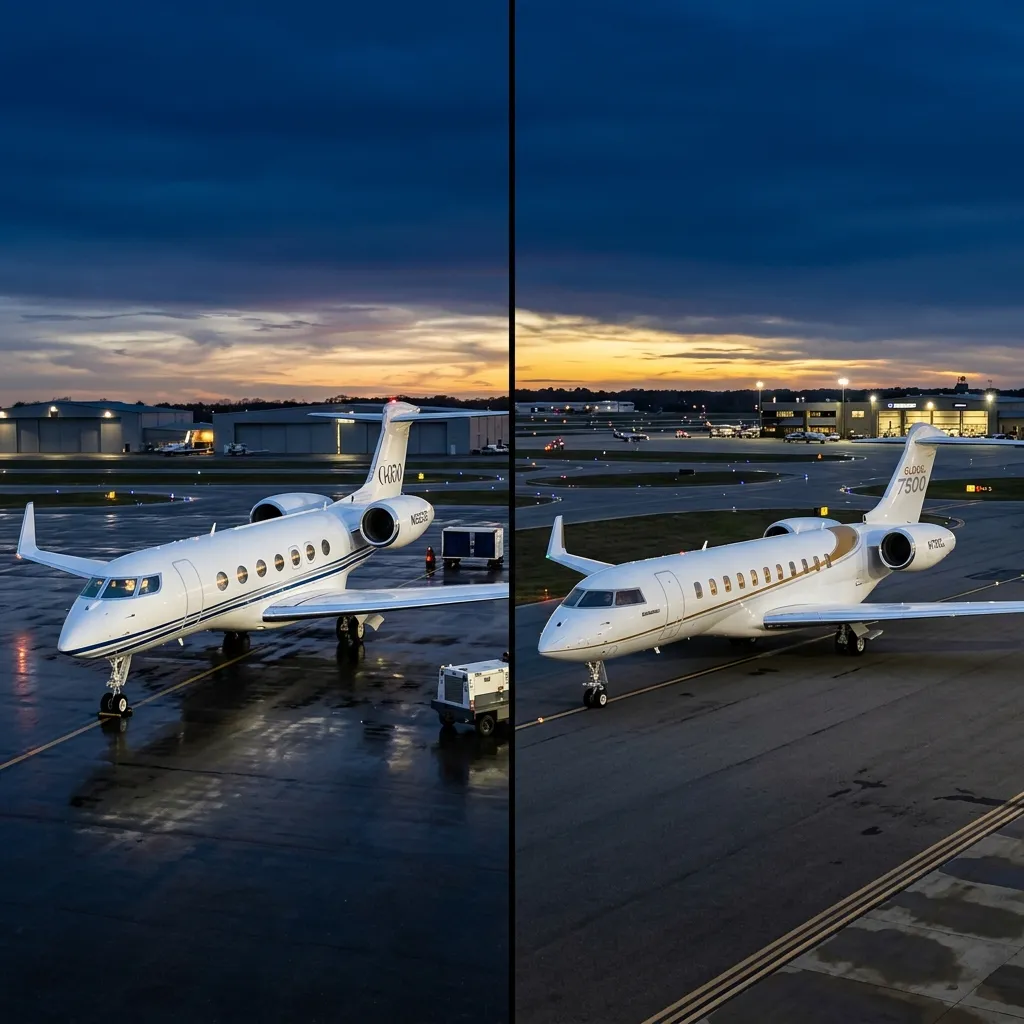
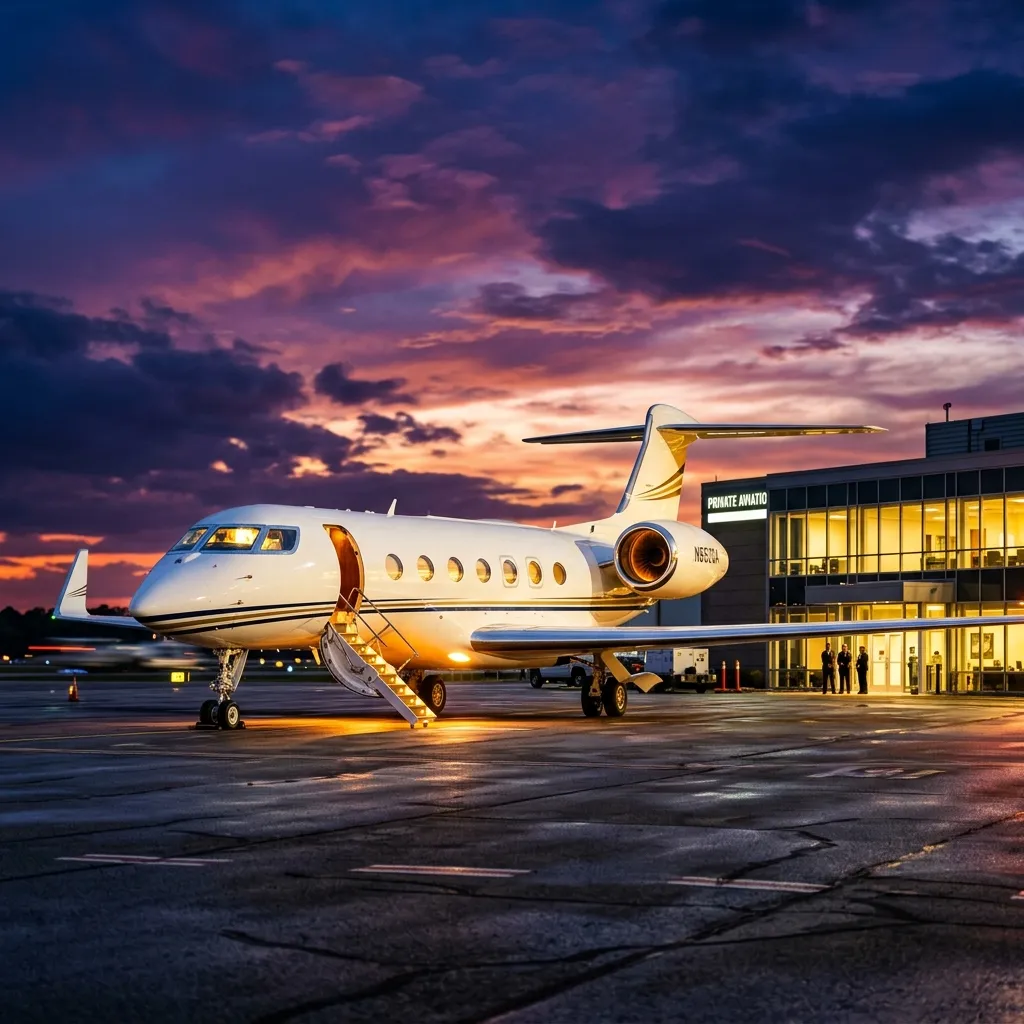
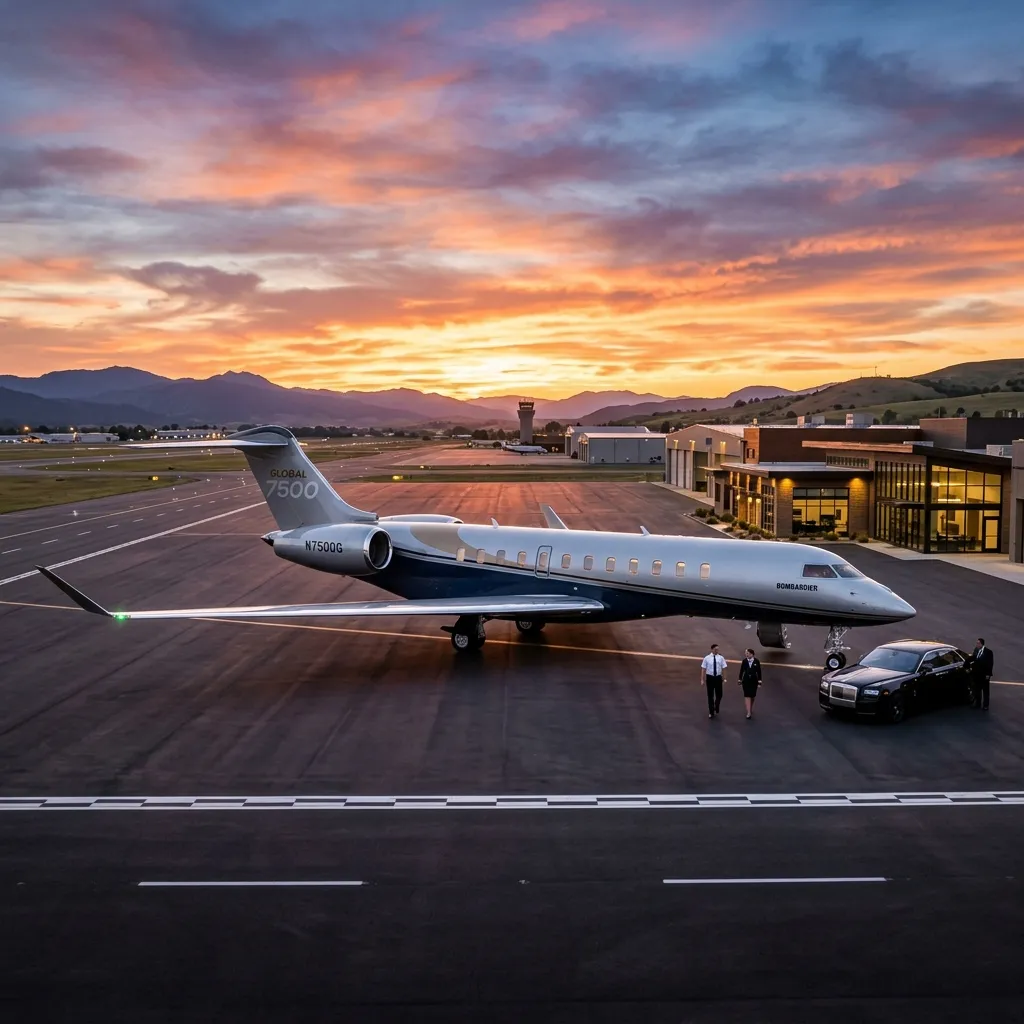
The Gulfstream G650 and Bombardier Global 7500 represent the two dominant approaches to ultra-long-range private aviation. Gulfstream built the G650 around speed: Mach 0.925 maximum operating speed, the fastest civilian aircraft in production when it entered service in 2012. Bombardier built the Global 7500 around cabin volume: 54.4 feet of usable length, four distinct living zones, and a full-size kitchen that does not borrow space from the passenger cabin.
Both aircraft cruise above FL450, maintain cabin altitudes below 5,000 feet at FL510, and clear 7,000 nm with NBAA IFR reserves. The list prices reflect the current market: the G650ER starts at approximately $71.5M, and the Global 7500 at approximately $75M. Pre-owned G650s (2014-2018 models) trade at $32M-$48M. Pre-owned Global 7500s (2019-2022) trade at $50M-$65M. The charter market tells a similar story: the G650 runs $6,500-$10,000/hr; the Global 7500 runs $8,000-$12,000/hr.
7,700 nm
Global 7500 Range
Range: 700 Nautical Miles Is Not a Spec Sheet Detail
The Global 7500's published range of 7,700 nm exceeds the G650ER's 7,500 nm by 200 nm, and the standard G650's 7,000 nm by 700 nm. Those 700 nm determine whether certain city pairs work nonstop or require a fuel stop. New York to Hong Kong (7,010 nm) is within the Global 7500's envelope with 8 passengers. The standard G650 requires favorable winds or a payload reduction. The G650ER covers the route but with less reserve than the Global 7500.
In practice, the routes that separate these aircraft are specific: New York to Dubai (5,810 nm) is comfortable for both. New York to Singapore (8,285 nm) exceeds both. Los Angeles to Tokyo (4,730 nm) is easy for both. The differentiator appears on routes between 7,000 and 7,700 nm: Dubai to São Paulo (7,190 nm), London to Perth (7,600 nm), New York to New Delhi (7,310 nm). For flight departments operating these specific corridors, the Global 7500's range advantage is not marginal. It eliminates technical stops that cost 90 minutes of ground time, $12,000-$18,000 in fuel and handling fees, and crew duty time that can push a mission into a required rest break.
A technical stop on a 14-hour flight does not cost 90 minutes. It costs 90 minutes of ground time, plus the psychological cost of interrupting a cabin that has settled into a work or sleep rhythm. For passengers crossing 10 time zones, that interruption is not a minor inconvenience. It resets the entire experience.
Cabin: Width vs. Length and Why Both Matter
The G650's cabin is 8.5 feet wide and 46.8 feet long. The Global 7500's cabin is 8.0 feet wide and 54.4 feet long. That half-foot of width in the G650 changes the shoulder-to-shoulder experience in a four-place club configuration: two passengers seated across from each other have 6 inches more separation. On a 12-hour flight, that difference registers. The wider fuselage also allows Gulfstream to offer a wider aisle, which matters when passengers move through the cabin during turbulence.
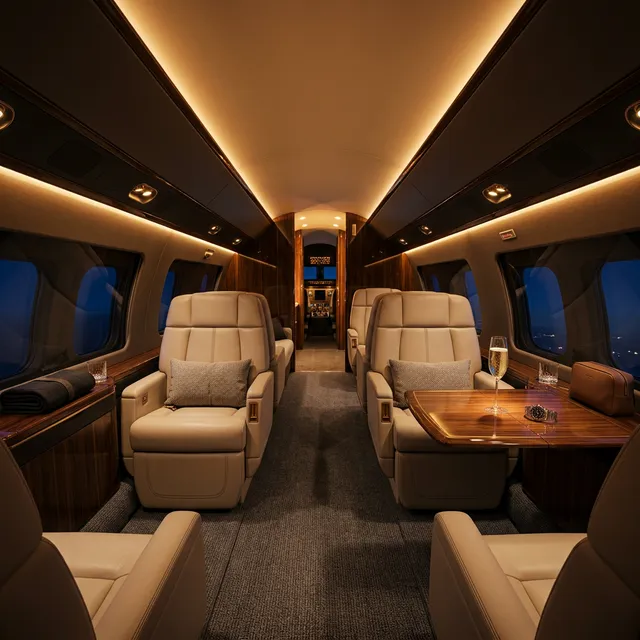
The Global 7500's 7.6 additional feet of length enable a four-zone layout that the G650 cannot replicate: an entryway/kitchen zone, a forward club section, a mid-cabin conference/dining area, and an aft stateroom with a full-width divan that converts to a bed. The G650 typically configures as three zones: forward club, mid-cabin, and aft divan. Bombardier's Nuage seat, standard on the Global 7500, reclines to a full-flat sleeping position without requiring relocation of adjacent furniture, a detail that sounds minor until you fly 14 hours overnight.
The kitchen question
The Global 7500's galley is a full-size kitchen positioned forward of the cabin entrance. It includes a convection oven, espresso system, and enough counter space for a catering team to plate multi-course meals during flight. The G650's galley occupies a more compact footprint. Both aircraft support elaborate catering, but the Global 7500's kitchen does not borrow volume from the passenger cabin. For ultra-long flights where meal service extends across two meal cycles (dinner and breakfast on an overnight), the operational difference is measurable.
Considering Either Aircraft?
Whether you are evaluating a charter, acquisition, or management placement, the routing and mission profile dictate the right answer. Talk to someone who has placed both.
Contact Us →The G650's Mach 0.925 maximum operating speed is the fastest of any purpose-built business jet in production. The Global 7500's MMO is also Mach 0.925, but Gulfstream's aerodynamic design, specifically the wing sweep and the Rolls-Royce BR725 engine installation, allows the G650 to sustain high-speed cruise at Mach 0.90 with lower specific fuel consumption than the Global 7500 achieves at the same speed.
At Mach 0.90, the G650 covers Los Angeles to New York (2,145 nm) in approximately 4 hours and 15 minutes. The Global 7500, at the same Mach number, adds approximately 8-12 minutes due to slightly higher drag at transonic speeds. On a single segment, that difference is negligible. Over 400 flight hours per year, it compounds to roughly 50-80 hours of cumulative time savings for the G650 operator.
| Specification | Gulfstream G650ER | Bombardier Global 7500 |
|---|
| Charter Rate (2026) | $6,500-$10,000/hr | $8,000-$12,000/hr |
| List Price (New) | ~$71.5M | ~$75M |
| Pre-Owned Range | $32M-$48M | $50M-$65M |
| Max Range (NBAA IFR) | 7,500 nm | 7,700 nm |
| Max Cruise Speed | Mach 0.925 | Mach 0.925 |
| Long-Range Cruise | Mach 0.85 (488 kts) | Mach 0.85 (488 kts) |
| Service Ceiling | 51,000 ft | 51,000 ft |
| Cabin Length | 46.8 ft | 54.4 ft |
| Cabin Width | 8.5 ft | 8.0 ft |
| Cabin Height | 6.4 ft | 6.2 ft |
| Living Zones | 3 | 4 |
| Passengers (Typical) | 13-19 | 13-19 |
| Engines | 2x RR BR725 | 2x GE Passport |
| Fuel Burn (LRC) | ~475 gph | ~530 gph |
Both aircraft share a 51,000-foot service ceiling, which provides access to uncongested airspace above commercial traffic. At FL510, both maintain cabin altitudes below 4,850 feet, equivalent to standing at the base of a ski resort. This pressurization performance reduces passenger fatigue on flights exceeding 8 hours, a meaningful advantage over older ultra-long-range aircraft that pressurize to 6,000-6,500 feet at similar altitudes.
Charter and Ownership Economics: The Real Numbers
Direct operating costs for the G650 run approximately $4,800-$5,500 per flight hour. The Global 7500 runs approximately $5,200-$6,200 per flight hour. The difference is driven primarily by engine economics: the GE Passport engines on the Global 7500 are newer to the market, with a smaller overhaul shop network and higher parts pricing than the Rolls-Royce BR725, which has been in service since 2012 and benefits from a mature support infrastructure.
- Fuel: G650 ~$2,800/hr vs. Global 7500 ~$3,100/hr. The G650's BR725 engines burn approximately 475 gph at long-range cruise. The Global 7500's GE Passport engines burn approximately 530 gph. At $5.75/gal, the Global 7500 costs roughly $316 more per hour in fuel.
- Maintenance reserves: G650 ~$1,200/hr vs. Global 7500 ~$1,500/hr. The BR725's time between overhauls and mature MSP program produce lower hourly costs. The GE Passport, while a reliable engine, carries higher per-hour reserve rates reflecting its newer service history and smaller overhaul base.
- Insurance: G650 ~$350-$500/hr vs. Global 7500 ~$450-$650/hr. Hull values drive the difference. A $35M pre-owned G650 insures for less than a $55M pre-owned Global 7500, even with identical loss ratios.
- Crew costs: Comparable at ~$500-$700/hr. Both aircraft require two-pilot crews with specific type ratings ($40,000-$55,000 per rating). The pilot pools overlap significantly, as many ultra-long-range pilots hold both ratings.
On the charter market, the G650 offers 15-25% lower hourly rates than the Global 7500 for missions under 6,000 nm, where the Global 7500's range advantage is unused. For ultra-long missions where the Global 7500 eliminates a fuel stop, the math reverses: the Global 7500's higher hourly rate is offset by eliminating $12,000-$18,000 in fuel stop costs and 90 minutes of ground time.
Which Aircraft for Which Mission
The choice between a G650 and Global 7500 is not about which aircraft is better. It is about which mission profile you fly most often.
Choose the G650 when:
- Most missions are domestic or transatlantic (under 4,500 nm) where speed matters more than range
- Cabin width is prioritized over cabin length (shoulder room vs. separate zones)
- Lower operating costs per hour improve the economics of high-utilization flight departments (400+ hours/year)
- The pre-owned acquisition budget targets $32M-$48M rather than $50M-$65M
Choose the Global 7500 when:
- Routing regularly includes city pairs between 7,000-7,700 nm where nonstop capability eliminates technical stops
- Overnight flights require a true four-zone cabin with a separate sleeping stateroom
- The aircraft will serve as a primary international platform for C-suite executives or UHNW principals
- Catering requirements demand a full-size kitchen separated from the passenger cabin
Most operators who have flown both will tell you the same thing: the G650 is the better airplane for 80% of missions. The Global 7500 is the only airplane for the remaining 20%. If your routing falls entirely within that 20%, nothing else comes close.