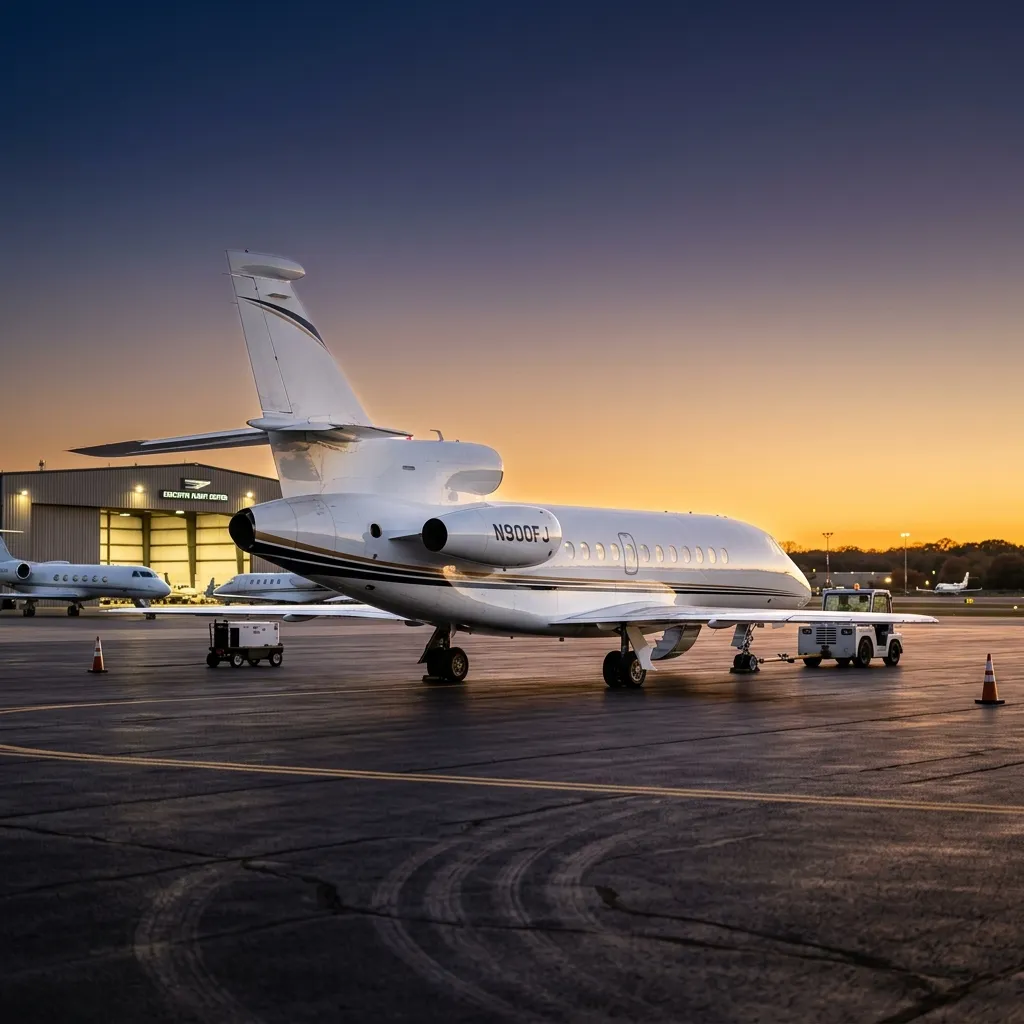
Falcon 900 Charter Rates in 2026
A Dassault Falcon 900 charters for $4,200 to $5,800 per flight hour in 2026. The $1,600 spread across that range reflects aircraft variant (900B vs. 900EX vs. 900LX), engine time remaining, interior condition, and whether the owner subsidizes operating costs through a management agreement. On a 4.5-hour flight from Teterboro to Scottsdale, total cost runs $18,900 to $26,100 before Federal Excise Tax (7.5%) and the $4.50 per-segment fee.
Three Honeywell TFE731-5AR engines burn a combined 265 gallons per hour at normal cruise. At $5.75 per gallon, fuel cost is approximately $1,524 per flight hour. That fuel burn is higher than twin-engine competitors in the heavy-jet segment, where the Challenger 350 burns 210 gph and the Gulfstream G280 burns 195 gph. The third engine adds roughly $375 per hour in fuel cost. What it buys in return is a 51,000-foot ceiling, steep-approach certification, and an engine-out climb gradient that satisfies the most demanding departure procedures in the world.
The Third Engine: Cost Center or Safety Premium?
Every conversation about the Falcon 900 starts with the third engine. Dassault chose a tri-jet configuration for the original 900 in 1984 because ETOPS (Extended-range Twin-engine Operational Performance Standards) rules did not yet allow twin-engine aircraft on certain overwater routes. By the time ETOPS relaxed, the Falcon 900 had proven something that route approvals alone could not: three engines eliminate the single-point-of-failure anxiety that twin-engine jets carry on every oceanic crossing.
The maintenance cost of the third engine is real. Each TFE731-5AR costs approximately $380,000 per overhaul, performed every 4,000-4,200 hours. Three engines at that interval add roughly $90 per flight hour in engine reserves compared to a twin-engine aircraft with the same powerplant. Annual inspection costs scale similarly. But the Falcon 900's hot section intervals are among the longest in the light-thrust turbofan category, and the TFE731 has accumulated over 100 million flight hours across all variants since 1972.
A twin-engine jet with one engine inoperative has lost 50% of its thrust. A Falcon 900 with one engine inoperative has lost 33%. On a departure from Innsbruck or Aspen, that arithmetic is not academic. It is the difference between clearing the terrain or not clearing the terrain.
900B, 900EX, 900LX: Which Falcon Are You Actually Booking?
The Falcon 900 family spans four decades and three major variants, each with meaningfully different capabilities. When an operator quotes a "Falcon 900," the variant determines whether you get 3,000 nm of range or 4,750 nm.
Falcon 900B (1991-2000)
The baseline production model. Range: 3,400 nm with NBAA IFR reserves and 8 passengers. Avionics: Collins Pro Line 4 (analog with some digital glass upgrades on late models). Most 900Bs in the charter fleet have been retrofitted with ADS-B Out compliance and updated interiors. Expect charter rates at the lower end of the spectrum, $4,200-$4,800/hr, reflecting their age (25-35 years) and lower residual values.
Falcon 900EX (1996-2008)
The EX introduced the EASy cockpit (Honeywell Primus Epic) and stretched range to 4,000 nm through improved aerodynamics and increased fuel capacity. The EASy avionics suite dropped crew workload significantly and enabled RVSM certification. Charter rates for the 900EX run $4,500-$5,400/hr. Most EX aircraft in the fleet are 18-28 years old with 6,000-10,000 hours total time.
Falcon 900LX (2008-2016)
The final production variant. Winglets added 200 nm of range (4,000 nm standard, 4,750 nm with optional fuel), and the EASy II avionics brought synthetic vision, WAAS/LPV approaches, and reduced required inspection intervals. The 900LX commands $5,000-$5,800/hr on charter, justified by its newer interior, lower maintenance liability, and full NextGen ATC compatibility. Roughly 120 were delivered before Dassault shifted production to the Falcon 2000LXS and 8X.
Get a Falcon 900 Quote
Tell us your routing and passenger count. We source from the entire Part 135 fleet, not just one operator.
Request a Quote →Where the Falcon 900 Earns Its Keep
The Falcon 900's optimal charter profile is 6-10 passengers on 2,000 to 3,500 nm missions where short-field access or steep approaches are part of the routing. The tri-engine configuration clears performance requirements at airports that force twin-engine heavies into weight restrictions or alternate runway selections.
- London City Airport (LCY): The Falcon 900 is certified for the 5.5° glideslope at London City. Most heavy jets cannot operate there at all. For transatlantic travelers who need to land in central London rather than Luton or Farnborough, the Falcon 900 eliminates a 90-minute ground transfer.
- Lugano, Switzerland (LUG): A 4,429-ft runway surrounded by terrain on three sides. The Falcon 900's steep-approach certification and engine-out climb performance make it one of the few heavy-cabin jets approved for commercial operations at Lugano.
- Aspen, Colorado (ASE): The 900 handles Aspen's 7,820-ft runway and mountainous departure procedures with fewer payload restrictions than twin-engine heavies of similar size. On hot summer days when density altitude penalizes twin-engine climb gradients, the third engine provides the margin.
- Transatlantic crossings: A 900EX or 900LX covers Teterboro to London Luton (3,010 nm) nonstop with NBAA IFR reserves and 8 passengers. The third engine provides operational redundancy over the North Atlantic without ETOPS-specific dispatch requirements.
For straightforward point-to-point domestic missions on 6,000-foot runways, the Falcon 900 does not offer advantages over a Challenger 350 or Gulfstream G550. The third engine's value is situational. When you need it, nothing else substitutes. When you do not, a twin-engine aircraft saves $400-$800 per flight hour.
Falcon 900 Operating Costs: Where the Money Goes
Direct operating cost for a Falcon 900EX runs approximately $2,800 to $3,400 per flight hour. The cost structure breaks down differently from twin-engine jets because of the third powerplant:
- Fuel: ~$1,524/hr. At 265 gph combined and $5.75/gal. The tri-engine burn penalty compared to twin-engine competitors adds roughly $375/hr to the fuel bill. Regional pricing variation (Northeast at $6.50/gal vs. Southeast at $5.00/gal) swings this by ±$330/hr.
- Maintenance reserves: ~$750-$1,000/hr. Three engines, three overhaul cycles, three hot section intervals. The TFE731-5AR is a mature, well-supported powerplant with overhaul costs of approximately $380,000 per engine. Honeywell MSP (Maintenance Service Plan) programs cap exposure at predictable hourly rates for enrolled aircraft.
- Crew: ~$275-$400/hr. Falcon-rated crews are specialized. Type ratings cost $30,000-$40,000 per pilot, and the Falcon-specific systems knowledge (EASy avionics, tri-engine procedures) limits the pool of available contract pilots compared to Gulfstream or Bombardier types.
- Insurance: ~$80-$120/hr. Hull values for Falcon 900EX/LX aircraft range from $4M to $12M depending on variant and year. Lower residual values than comparable Gulfstream models keep insurance costs moderate relative to the cabin class.
The Falcon 900's acquisition cost advantage is significant on the pre-owned market. A 2005 Falcon 900EX trades at $3.5M-$5.5M, roughly half the price of a comparable-year Challenger 604 or Gulfstream GIV-SP. For operators building a charter fleet, the lower capital entry point offsets the higher per-hour fuel cost within 300-400 annual flight hours.
When the Falcon 900 Is Not the Right Aircraft
The Falcon 900 underperforms its segment on two specific mission profiles. First, short domestic flights under 1,000 nm with 4 or fewer passengers waste the aircraft's range and cabin capacity. A Phenom 300 at $2,800/hr covers a Miami-to-Atlanta mission (595 nm) in identical block time with lower total cost. The Falcon's 33.2-foot cabin and 14-seat configuration are unnecessary for small groups on short routes.
Second, ultra-long-range missions beyond 4,200 nm expose the 900EX's range ceiling. A Teterboro-to-Geneva flight (3,630 nm) works with 6 passengers and favorable winds but becomes marginal with 10 passengers and winter headwinds. For guaranteed nonstop transatlantic service at full passenger loads, the Global 7500 or Gulfstream G650 provides the margin. The Falcon 900 is a mid-Atlantic aircraft, not an ultra-long-range platform, and pricing it as one produces avoidable fuel stops.
If your routing never touches a short runway, a steep approach, or an overwater crossing, you are paying the tri-engine premium for capability you will never use. The third engine is insurance. Only buy insurance you will actually need.