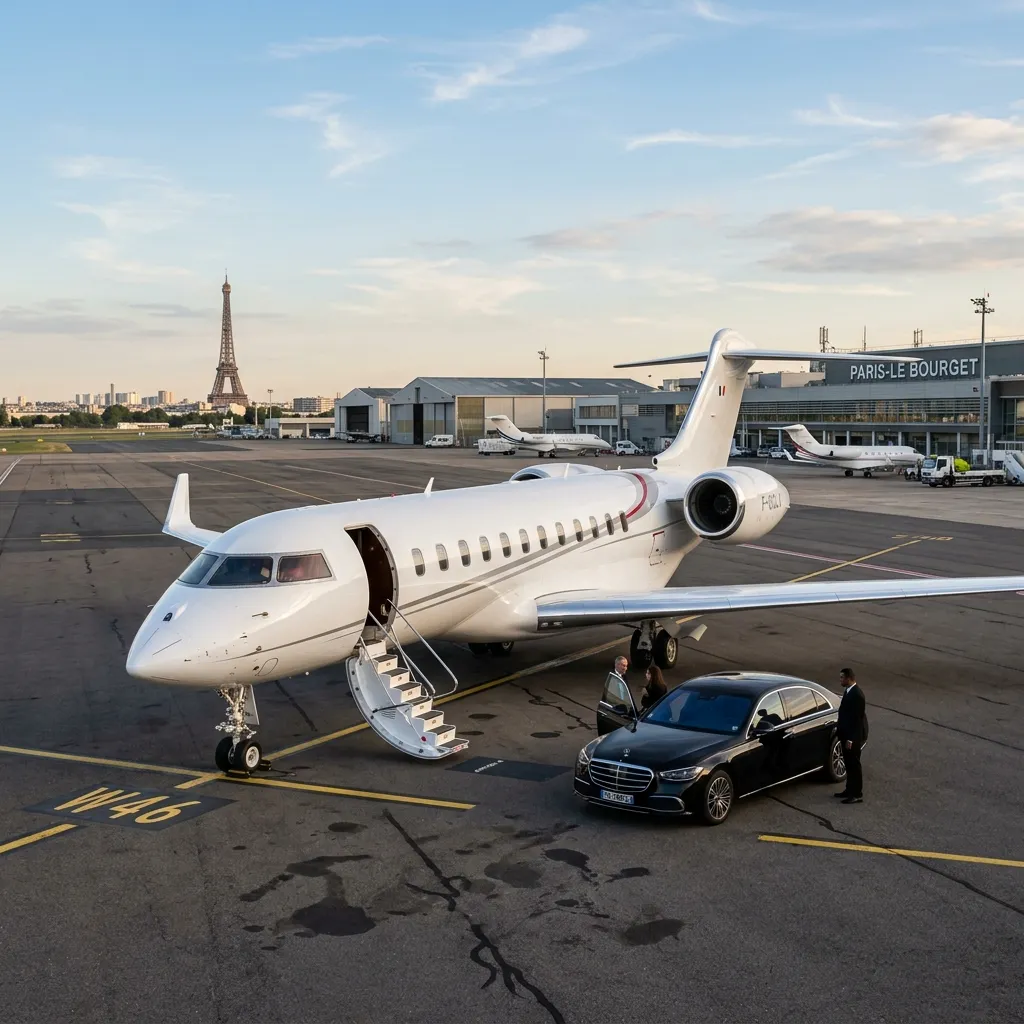
Private jet on the ramp at Le Bourget Airport with Paris skyline in the distance

Flying Private to Paris: Le Bourget, Alternatives, and What to Plan For

Paris has three airports that accept private jets. Most charter clients default to Charles de Gaulle. Experienced operators route through Le Bourget. Here is why, and what to know before you fly.

In This Article

Three Airports, One Clear Winner Le Bourget (LFPB): The Default Private Aviation Hub Customs and Immigration: What to Expect Arriving from Outside Schengen When Paris Gets Expensive: Seasonal Pricing and Slot Restrictions Alternatives to Le Bourget: When and Why Ground Transportation: Leaving the Airport Frequently Asked Questions

Three Airports, One Clear Winner

Paris offers three airports for private jet operations. Charles de Gaulle (LFPG), the commercial gateway. Paris-Orly (LFPO), the secondary airline hub. And Le Bourget (LFPB), the dedicated general aviation field 11 kilometers northeast of the city center. Le Bourget handles 55,000 business jet movements annually, more than any other airport in Europe. It exists solely for private and business aviation. No airline traffic. No shared runways. No terminal congestion.

Charles de Gaulle accepts private jets but treats them as afterthoughts. Your aircraft parks on a remote ramp. Ground handling takes longer because airline operations take priority. Customs processing routes through the same infrastructure that handles 70 million commercial passengers per year. Le Bourget exists because private aviation clients demanded something better, and the French government listened.

Le Bourget (LFPB): The Default Private Aviation Hub

Le Bourget sits 11 kilometers from the 8th arrondissement. A helicopter transfer reaches the city in 8 minutes. A chauffeured car in 25 to 40 minutes depending on traffic and time of day. The airport has two runways: Runway 07/25 at 2,985 meters (9,800 feet) and Runway 03/21 at 3,000 meters (9,843 feet). Both accommodate every business jet in production, including ultra-long-range aircraft like the Global 7500 and Gulfstream G700.

FBO Options at Le Bourget

  • Dassault Falcon Service: Dassault's own FBO. Maintenance hangar on-site. Strongest choice for Falcon operators needing AOG support. Private lounges, customs in-facility.
  • Universal Aviation: Part of the Universal Weather network. Consistent service standards for operators accustomed to Universal's U.S. FBOs. 24-hour operations.
  • Jetex: Dubai-based FBO chain with a growing European presence. Modern terminal. Aggressive pricing on fuel and handling. Popular with Middle Eastern operators routing through Paris.
  • Advanced Air Support (AAS): Independent handler with competitive ramp fees. Smaller operation, often faster turnaround during peak periods like Fashion Week.
  • ExecuJet: Swiss-based MRO and FBO. Full maintenance capability. Preferred by operators needing overnight hangar storage in winter.

Landing fees at Le Bourget range from €600 for a light jet to €1,200 for an ultra-long-range aircraft. Parking runs €80 to €200 per night depending on aircraft weight. These rates are lower than CDG private aviation handling and comparable to London Farnborough.

Customs and Immigration: What to Expect Arriving from Outside Schengen

Flights arriving from within the Schengen Area (most of continental Europe) require no passport control at Le Bourget. The aircraft parks, passengers deplane to a private terminal, and ground transportation is waiting. Total time from touchdown to car: 10 to 15 minutes.

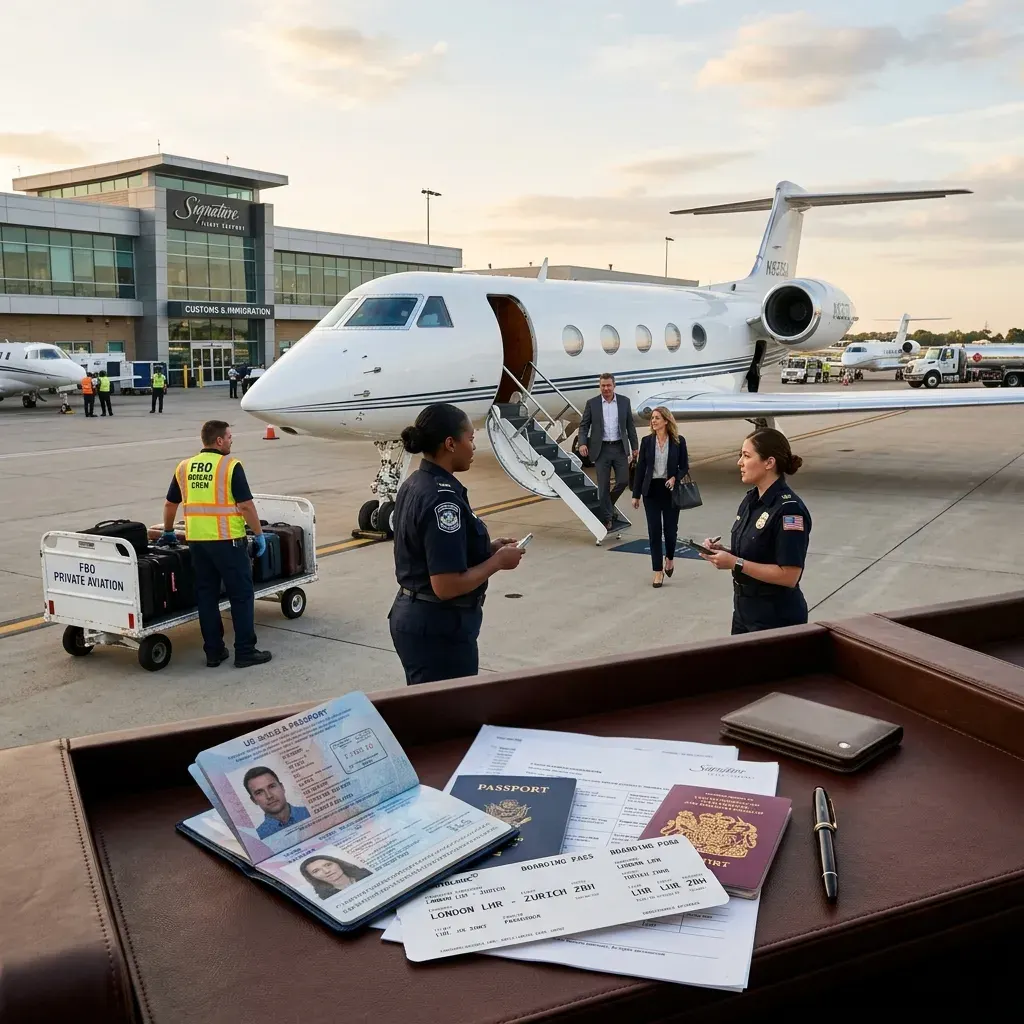
Flights arriving from outside Schengen, including the United States and United Kingdom, require customs and immigration processing. Le Bourget handles this at the FBO facility. French border police (PAF) process passengers in a dedicated lounge. Processing time averages 15 to 25 minutes for a group of four to six passengers. Pre-clearance is not available, but FBOs submit passenger manifests and passport data 24 hours in advance to reduce processing time.

Required Documentation

  • Valid passport with at least 6 months remaining validity
  • No visa required for U.S. citizens staying under 90 days (Schengen rules)
  • ETIAS authorization required starting 2026 for U.S. travelers (€7, valid 3 years)
  • General Declaration (GenDec) filed by the operator before arrival
  • Passenger manifest with full passport details submitted to FBO 24 hours prior

Operators who file complete paperwork 24 hours ahead consistently clear customs in under 15 minutes. Those who arrive without pre-filed manifests wait 30 to 45 minutes while border police process documentation manually. The difference is preparation, not bureaucracy.

Need a Charter Quote?

Contact our team for a personalized quote.

Get a Quote

When Paris Gets Expensive: Seasonal Pricing and Slot Restrictions

Le Bourget operates under slot coordination during peak periods. Unlike U.S. airports where private jets operate on-demand, Le Bourget requires PPR (Prior Permission Required) for all operations. Slots must be requested through the FBO at least 24 hours in advance. During normal periods, slot confirmation takes 2 to 4 hours.

Peak Periods When Slots Tighten

  • Paris Fashion Week (January and June/July): Le Bourget reaches capacity. Slots book 7 to 10 days ahead. FBO ramp parking fills completely. Operators divert to CDG or Pontoise.
  • Roland-Garros (late May to early June): Moderate surge. Slots available 48 to 72 hours out.
  • Paris Air Show (odd years, June): Le Bourget closes to business aviation entirely. All traffic diverts to CDG, Orly, or Pontoise-Cormeilles.
  • Art Basel Paris / FIAC (October): Moderate demand. No slot restrictions but FBO lounges fill quickly.
  • New Year's Eve and Christmas: Light demand. Paris is quieter than London and Geneva during holidays.

Charter pricing into Paris follows predictable patterns. A round-trip New York to Paris charter on a large-cabin jet (Gulfstream G550 or equivalent) runs $180,000 to $220,000 during normal periods. During Fashion Week, the same routing commands $240,000 to $280,000 due to aircraft positioning costs and limited availability. One-way pricing is rarely economical because few operators want to reposition an aircraft across the Atlantic empty.

Alternatives to Le Bourget: When and Why

Pontoise-Cormeilles (LFPT)

Located 35 kilometers northwest of Paris. Runway is 1,700 meters (5,577 feet), limiting operations to midsize jets and smaller. Lower fees than Le Bourget. Used primarily during Paris Air Show diversions and by operators with light jets seeking to avoid Le Bourget's congestion. Transfer time to central Paris: 45 to 60 minutes by car.

Charles de Gaulle (LFPG)

Accepts private jets on the GA terminal (Terminal G3). Runway length is not an issue at 4,215 meters. However, taxi times are long (15 to 25 minutes), landing fees are higher than Le Bourget, and the private aviation experience is diluted by airline infrastructure. CDG makes sense when Le Bourget slots are unavailable or when connecting to a commercial flight.

Paris-Orly (LFPO)

Orly's private jet terminal offers a faster experience than CDG but cannot match Le Bourget's dedicated infrastructure. Orly has an 11 PM to 6 AM curfew that eliminates overnight arrivals from the U.S. West Coast. Useful for intra-European flights when Le Bourget is full.

Le Bourget is the correct answer 90 percent of the time. The other airports exist as contingencies, not preferences. If your operator suggests CDG for a dedicated private charter, ask them why they do not have a Le Bourget slot.

Ground Transportation: Leaving the Airport

FBOs at Le Bourget arrange ground transportation as a standard service. The most common options and their approximate costs from Le Bourget to central Paris:

Helicopter transfers are booked through the FBO with 24-hour notice. The landing zone at Issy-les-Moulineaux heliport is 8 minutes from Le Bourget and 10 minutes by car from the 7th arrondissement. During Fashion Week, helicopter availability tightens. Book 72 hours ahead.

Brian Galvan

Written By

Brian Galvan

Founder, The Jet Finder · Private Aviation Operations & Technology

Former Director of Technology at FlyUSA (Inc. 5000 fastest-growing private jet company). Decade of hands-on experience across Part 135 operations, charter sales, fleet management, and aviation data systems.

LinkedInRead Full Profile →
Common Questions

Frequently Asked Questions


7 questions about flying private to Paris

A chauffeured sedan from Le Bourget to the 8th arrondissement takes 25 to 40 minutes depending on traffic. Morning arrivals (before 8 AM) and late evening arrivals (after 8 PM) typically see the faster end of that range. Rush hour (8 to 10 AM and 5 to 7 PM) pushes transfer times to 40 to 50 minutes. Helicopter transfers take 8 minutes regardless of ground traffic.

Yes. During the Paris Air Show, held in odd-numbered years in June, Le Bourget closes to all business aviation traffic for approximately 10 days. Private jet operations divert to Charles de Gaulle, Pontoise-Cormeilles, or airports in the greater Paris region. FBOs at Le Bourget notify regular clients 3 to 4 months in advance and assist with alternative arrangements.

ETIAS (European Travel Information and Authorization System) launched in 2026 for visa-exempt travelers including U.S. citizens. The authorization costs €7, is valid for 3 years, and is applied for online before departure. Private jet passengers are subject to the same ETIAS requirements as commercial travelers. FBOs at Le Bourget verify ETIAS status as part of pre-arrival manifest processing.

Le Bourget is a dedicated business aviation airport with no airline traffic. Taxi times are 3 to 5 minutes versus 15 to 25 minutes at CDG. Customs processing happens in a private FBO lounge rather than a shared terminal. Ground handling is prioritized for business jets rather than queued behind airline operations. Landing fees are lower. The total time from touchdown to ground transportation is typically 15 to 20 minutes at Le Bourget versus 40 to 60 minutes at CDG.

Le Bourget has two runways: 07/25 at 2,985 meters (9,800 feet) and 03/21 at 3,000 meters (9,843 feet). Both runways accommodate every business jet currently in production, including the Bombardier Global 7500 (requires 5,858 feet), Gulfstream G700 (requires 6,250 feet), and Dassault Falcon 8X (requires 6,000 feet). Weight restrictions may apply during hot summer days but are rare for standard passenger loads.

During Paris Fashion Week in January and June/July, Le Bourget slots should be requested 7 to 10 days in advance. FBO ramp parking reaches capacity during peak show days. Operators who wait until 48 hours before departure risk being diverted to Charles de Gaulle or Pontoise. Outside Fashion Week and the Paris Air Show, 24 to 48 hours advance notice is typically sufficient for slot confirmation.

No. Pontoise-Cormeilles has a 1,700-meter (5,577-foot) runway that limits operations to midsize jets and smaller aircraft. Large-cabin jets like the Challenger 650, Gulfstream G550, and all ultra-long-range aircraft cannot operate from Pontoise. The airport serves as an overflow facility during Le Bourget closures and is primarily used by light jet and turboprop operators.

Continue Reading

Related Articles


Your Next Mission

Ready to Fly?


Whether you need a charter quote or want to explore aircraft options, our team is here.

Contact Us