Carbon offset programs offer an alternative pathway 2026, ReFuelEU Aviation private jets, EU ETS private aviation, carbon offset private jet, SAF mandate Europe, green aviation fuel">
Private jet at European airport

Private Aviation in Europe: A Guide for American Travelers

European private aviation operates under different rules, different airports, and different expectations. If you are an American flying private into or across Europe, here is what you need to know before wheels up.

In This Article

The Airports You Need to Know Cabotage: Why Your U.S. Charter Cannot Fly Customs and Immigration Costs and Pricing Differences SAF and EU ETS: The Environmental Cost Permits and Regulatory Requirements Practical Tips for American Travelers Frequently Asked Questions

The Airports You Need to Know

European business aviation concentrates at dedicated private aviation airports and FBOs that have no equivalent in the U.S. market. These facilities exist specifically for private jet operations, with customs, immigration, lounges, and ground transportation integrated into the FBO experience.

Paris: Le Bourget (LBG)

Europe's busiest business aviation airport. Handles over 50,000 private jet movements per year. Located 12 km northeast of central Paris with 15-minute helicopter transfers available. Multiple FBOs including Dassault Falcon Service and Universal Aviation. This is where you land for Paris. Not CDG. Not Orly.

London: Farnborough (FAB) and Luton (LTN)

Farnborough is the premium choice: dedicated business aviation only, no commercial traffic, 45 minutes to Mayfair. Luton offers more capacity and slightly lower fees, 30 minutes to the City by rail. Biggin Hill (BQH) serves South London. Avoid Heathrow and Gatwick for private aviation; slot restrictions and commercial congestion make them impractical.

French Riviera: Nice (NCE) and Cannes (CEQ)

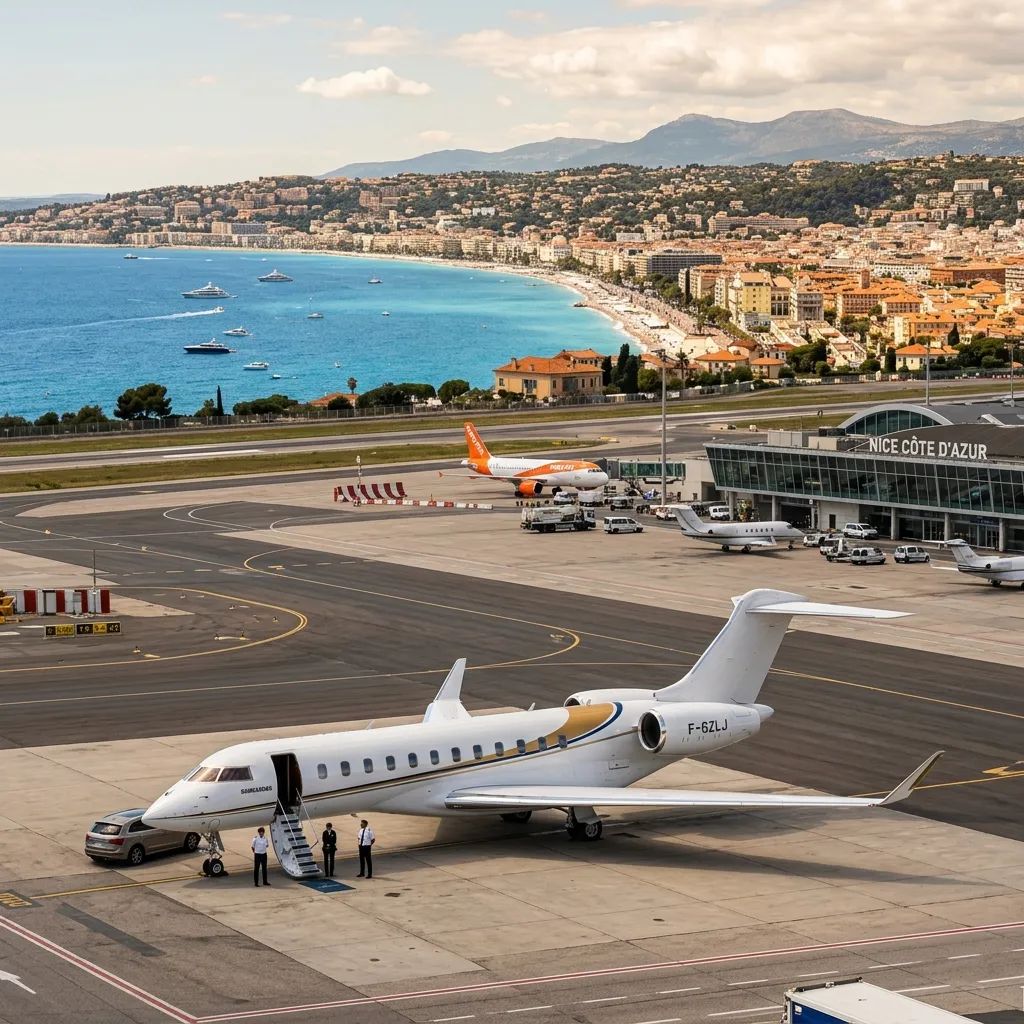
Nice handles business aviation through a dedicated terminal. Cannes-Mandelieu is a smaller, private-aviation-only airport 15 minutes from the Croisette. During the Cannes Film Festival and Monaco Grand Prix, these airports operate near capacity. Book slots 4-6 weeks ahead during May-June. Paris to Cannes route details.

Switzerland: Geneva (GVA) and Zurich (ZRH)

Geneva serves western Switzerland, the UN, and the wealth management corridor. Zurich serves German-speaking Switzerland and is the gateway to St. Moritz and Davos. Both have excellent FBO facilities. Zurich to Milan route details.

Other Key Airports

Cabotage: Why Your U.S. Charter Stops at the Border

This is the rule most Americans do not know until they try to book. Cabotage restrictions prohibit foreign-registered aircraft from operating commercial flights between two points within a sovereign territory. A U.S.-registered Part 135 charter aircraft can fly you from Teterboro to London. It cannot then fly you from London to Nice commercially.

For intra-European flights, you must use a European AOC operator with aircraft registered in an EU or EASA member state. Your U.S. broker or charter company arranges this through their European partner network. The transition is seamless from the passenger's perspective, but you will be on a different aircraft with a different operator.

Exception: if you own a U.S.-registered aircraft and operate under Part 91 (non-commercial), cabotage restrictions do not apply. You can fly your own aircraft anywhere in Europe with proper permits. The restriction only applies to commercial charter operations.

Customs and Immigration: The Private Jet Advantage

Clearing customs on a private jet in Europe is nothing like the commercial experience. At most European business aviation airports, customs and immigration officers come to the FBO or directly to the aircraft. You clear in a private lounge, not a queue.

Requirements for U.S. citizens entering the Schengen Area:

  • Passport: Valid for at least 6 months beyond intended stay
  • ETIAS: European Travel Information and Authorization System approval (mandatory since 2025, valid 3 years, EUR 7)
  • API submission: Your operator submits Advance Passenger Information 24-48 hours before arrival
  • Customs declaration: Goods exceeding EUR 10,000 in value must be declared

The UK has separate entry requirements post-Brexit. No ETIAS needed, but you must clear UK Border Force. Processing at Farnborough and Luton is typically 10-15 minutes.


Planning European Flights?

Our team coordinates European charter operations daily, including transatlantic crossings, intra-European hops, and Mediterranean island circuits.

Speak With an Advisor

Costs: What to Expect

European charter is more expensive than domestic U.S. flying. The reasons are structural: higher fuel costs (20-30% above U.S. prices), Eurocontrol ATC charges, landing fees at major airports (EUR 200-2,000 depending on aircraft and airport), and VAT implications.

RouteAircraftEst. Charter Cost
London → NiceLight JetEUR 8,000-12,000
Paris → GenevaLight JetEUR 6,000-9,000
London → IbizaMidsize JetEUR 14,000-20,000
Zurich → MilanLight JetEUR 5,000-8,000
Nice → MykonosMidsize JetEUR 12,000-18,000

VAT is complex. Flights between two EU countries may be subject to VAT (typically 0-21% depending on the country and operator structure). Most reputable charter operators structure their operations to minimize VAT exposure for clients, but this should be confirmed at the quoting stage.

SAF and EU ETS: The Environmental Cost Layer

European private aviation now carries environmental compliance costs that do not exist in the U.S. market. The ReFuelEU SAF mandate requires 2% sustainable aviation fuel blending at EU airports (rising to 6% by 2030), and the EU ETS requires operators to purchase carbon emission allowances for intra-EEA flights.

These costs are typically embedded in the charter quote. On a London-to-Nice flight, the combined SAF and ETS premium is approximately EUR 50-150. Not material on a EUR 10,000 charter, but the trajectory matters for operators and frequent flyers planning long-term European operations.

Permits and Regulatory Requirements

If you are bringing a U.S.-registered aircraft to Europe (Part 91 owner-flown), you need:

  • Overflight permits: Required for each country's airspace. Most European countries issue blanket permits for general aviation. Your handler or permit service arranges these.
  • Landing permits: Some airports require advance slot reservations (Nice, Geneva, Ibiza during peak season)
  • Eurocontrol registration: Required for ATC services billing. Your management company handles this.
  • Insurance: Your U.S. hull and liability policy must cover European operations. Verify with your broker.
  • Noise certificate: Required for some airports with noise restrictions

Practical Tips for American Travelers

  • Book early for peak season: French Riviera (June-August), Ibiza (July-August), Swiss Alps (December-March), and Cannes Film Festival (May) require 4-6 weeks advance booking.
  • Use a U.S. broker with European partners: They handle the cabotage transition seamlessly.
  • Carry euros and pounds: FBO services, crew gratuities, and ground transportation at European airports are easier in local currency.
  • Confirm ETIAS before departure: Processing is usually instant but can take up to 96 hours.
  • Consider positioning costs: If chartering intra-European legs, the aircraft must reposition to your departure point. Ask about one-way vs. round-trip pricing.

Whether you are planning a transatlantic crossing or island-hopping across the Mediterranean, our team coordinates European operations daily. Contact us for routing advice, operator recommendations, and pricing on any European corridor.

JF

Written By

The Jet Finder Advisory Team

With over 35 years in private aviation, The Jet Finder advisory team brings deep market knowledge to every transaction.

Common Questions

Frequently Asked Questions


8 questions about flying private in Europe

Yes. Americans can charter private jets in Europe through European AOC holders (Air Operator Certificate). You cannot use a U.S.-registered Part 135 operator for flights within Europe due to cabotage restrictions. Your U.S. broker can arrange European-registered aircraft through their network.

The top business aviation airports in Europe are: Paris-Le Bourget (LBG), London Farnborough (FAB), London Luton (LTN), Nice Cote d Azur (NCE), Geneva (GVA), and Zurich (ZRH). Le Bourget handles more business aviation movements than any other airport in Europe.

Cabotage rules prohibit a foreign-registered aircraft from carrying passengers between two points within a country or region where it is not registered. A U.S.-registered charter aircraft cannot fly Paris to Nice commercially. You must use a European-registered operator for intra-European charter flights.

Yes. All passengers on private jets traveling from the U.S. to Europe require a valid passport. As of 2025, American travelers also need ETIAS authorization for Schengen Area countries. Private jet passengers clear customs and immigration at the FBO, which is significantly faster than commercial terminals.

Private jet passengers clear customs at the FBO or General Aviation Terminal. In most European countries, customs and immigration officers come to the aircraft or the FBO lounge. Processing takes 15-30 minutes. You must declare goods over the duty-free allowance. Advance passenger information (API) is submitted by the operator before arrival.

The ReFuelEU Aviation regulation requires fuel suppliers at covered EU airports to blend a minimum 2% SAF into fuel supply (2025), rising to 6% by 2030. This cost is embedded in the fuel price. Anti-tankering provisions prevent operators from avoiding SAF costs by fueling outside the EU.

European charter rates are generally 10-20% higher than comparable U.S. routes due to higher fuel costs, regulatory overhead, and airport fees. A light jet within Europe costs EUR 3,000-5,000 per flight hour. A heavy jet costs EUR 8,000-14,000 per flight hour. VAT may apply depending on the routing and operator structure.

Yes. U.S.-registered Part 91 aircraft can operate in European airspace with proper permits. You need overflight and landing permits (arranged through a handler or permit service), Eurocontrol registration for ATC charges, and compliance with EU noise and emissions requirements. Your aircraft management company handles these arrangements.

Continue Reading

Related Articles


Your Next Mission

Let Us Know How We Can Help


Whether you are chartering, acquiring, or selling an aircraft, our team delivers expert guidance from first call to closing.

Contact Us