Two Airports, Two Trade-Offs
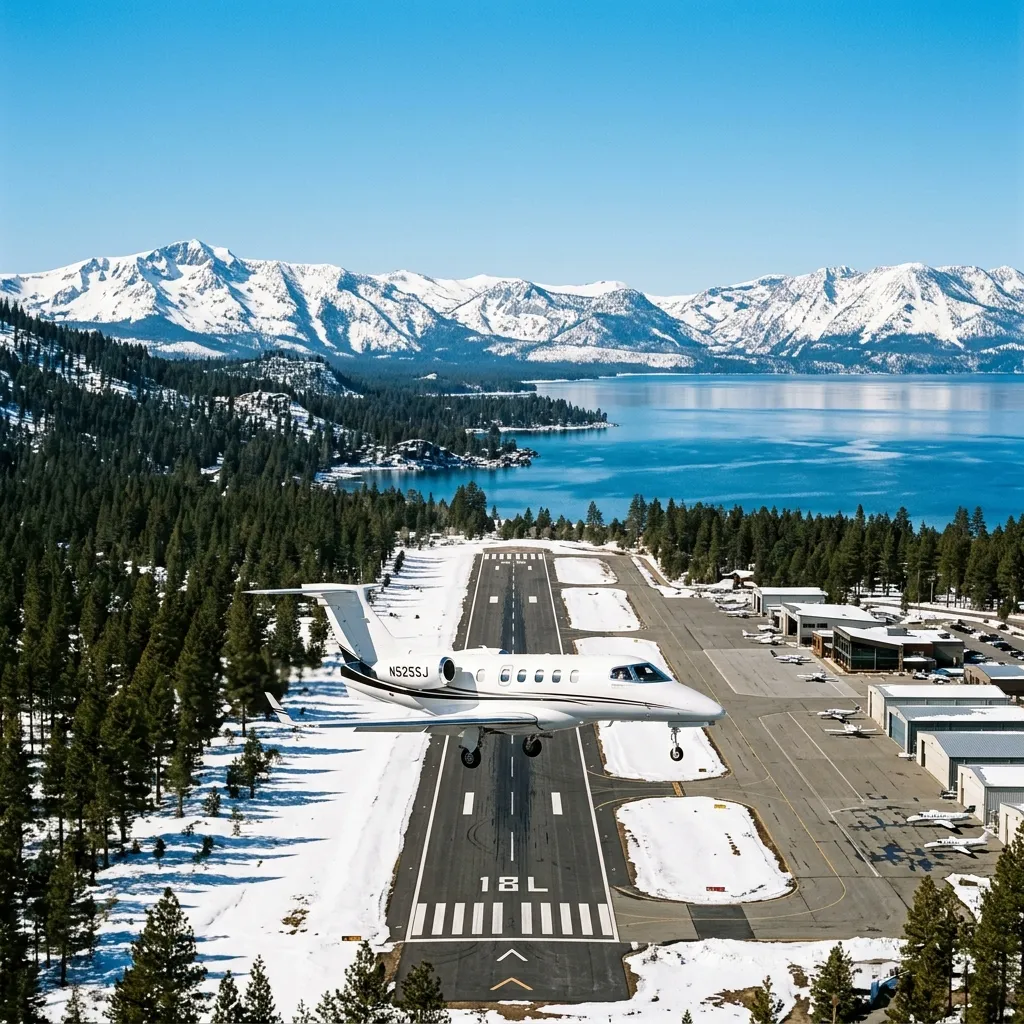
Truckee-Tahoe Airport (TRK) logged approximately 35,000 aircraft operations in 2025, with private jet traffic peaking between December and March. The airport sits at 5,900 feet MSL, 14 miles northwest of Lake Tahoe, with a single 7,000-foot runway. The alternative, Reno-Tahoe International (RNO), offers 11,000 feet of runway at 4,415 feet elevation, 35 miles northeast. The choice between them depends on your jet type, time of year, and tolerance for mountain approaches.
Most charter operators default to RNO for safety margin. TRK requires mountain-qualified crews, VFR or GPS approaches only, and imposes density altitude penalties that can eliminate heavy jets entirely during summer months. Experienced Tahoe-bound passengers who fly light or midsize jets use TRK. Everyone else flies RNO and drives.
Truckee-Tahoe Airport: The Closer Option with Constraints
TRK's single runway (Runway 11/29) is 7,000 feet long and 100 feet wide. At 5,900 feet elevation, density altitude on a 90-degree summer afternoon reaches 8,500-9,000 feet, which effectively shortens the runway for takeoff performance calculations by 25-30%. A Citation XLS that needs 3,560 feet at sea level requires approximately 4,800 feet at TRK on a hot day. A Challenger 350 requiring 4,835 feet at sea level may need 6,500+ feet, leaving minimal margin on a 7,000-foot runway.
Which Jets Can Operate at TRK
- Light jets (CJ3, Phenom 300, Learjet 45): Year-round operations with normal payload. Best choice for TRK.
- Midsize jets (Citation XLS, Hawker 800XP): Year-round with payload awareness. May reduce fuel load in summer for takeoff performance.
- Super-midsize jets (Challenger 350, Citation Latitude): Winter operations comfortable. Summer operations require performance analysis per flight.
- Heavy jets (G550, G650, Global): Generally do not operate at TRK. Runway length and density altitude exceed published performance limits in most conditions.
TRK does not have an ILS approach. Approaches are GPS-based (RNAV) with higher minimums than precision approaches at RNO. In low-visibility winter weather (snow, fog, low ceilings), TRK approaches may require 1,200-foot ceilings and 2-mile visibility where RNO's ILS allows 200-foot ceilings and half-mile visibility. Crews unable to land at TRK divert to RNO, adding 40 minutes of ground time.
Reno-Tahoe International: The All-Weather Alternative
RNO's 11,000-foot Runway 16R/34L accepts every business jet in production without restriction. The airport has two FBOs: Atlantic Aviation on the east side and Signature Flight Support on the west side. Both offer full-service passenger terminals, deicing, and overnight hangar space during ski season (critical because overnight temperatures drop to -10 degrees F or lower, and a jet left on the ramp may have frozen systems at departure).
Ground Transportation from RNO to Lake Tahoe
The drive from RNO to the north shore of Lake Tahoe (Incline Village, Crystal Bay) takes 35-45 minutes via Mt. Rose Highway (SR 431) in clear conditions. The south shore (Heavenly, Stateline) takes 50-60 minutes via US-395 and US-50. During winter storms, Mt. Rose Highway closes for avalanche control, and the alternate route via I-80 to Truckee adds 30-45 minutes. Plan for ground transportation delays during active snowfall.
Pre-arranged ground transportation from the FBO is standard. Black car services run $250-$400 one way to the lake. SUV services with ski equipment capacity cost $350-$500. Helicopter transfers are available from RNO to select Tahoe resorts for approximately $1,500-$2,500 per flight, cutting the door-to-slope time to 12 minutes.