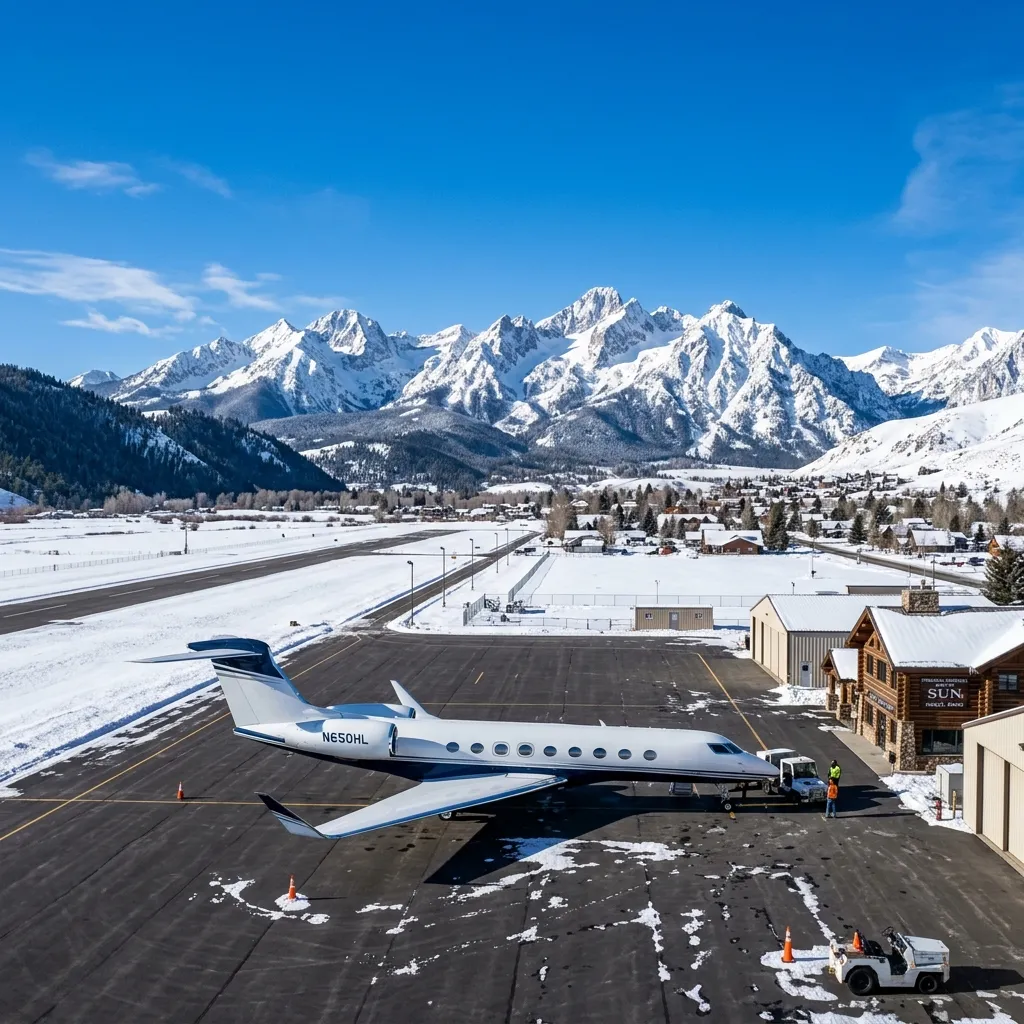
Mountain valley airport with private jets parked against snowy peaks

Flying Private to Sun Valley: Friedman Memorial Guide

Friedman Memorial Airport (SUN) has a 7,550-ft runway at 5,318 ft elevation with steep mountain approaches. Full guide to aircraft restrictions, FBOs, and seasonal operations.

In This Article

Friedman Memorial Airport: The Gateway to Sun Valley Aircraft Restrictions and Operational Limits Approach Procedures and Weather Considerations Atlantic Aviation: The Sole FBO Peak Season: When to Expect Congestion Ground Transportation and Local Access Frequently Asked Questions

Friedman Memorial Airport: The Gateway to Sun Valley

Friedman Memorial Airport (SUN/KSUN) sits at 5,318 feet MSL in Hailey, Idaho, 12 miles south of Ketchum and the Sun Valley Resort. Its single runway (Runway 13/31) measures 7,550 feet, which sounds adequate until you factor in the elevation, the surrounding terrain, and the temperature-driven density altitude that can exceed 8,500 feet on summer afternoons. SUN handled approximately 14,200 aircraft operations in 2025, with private aviation accounting for roughly 60% of total traffic.

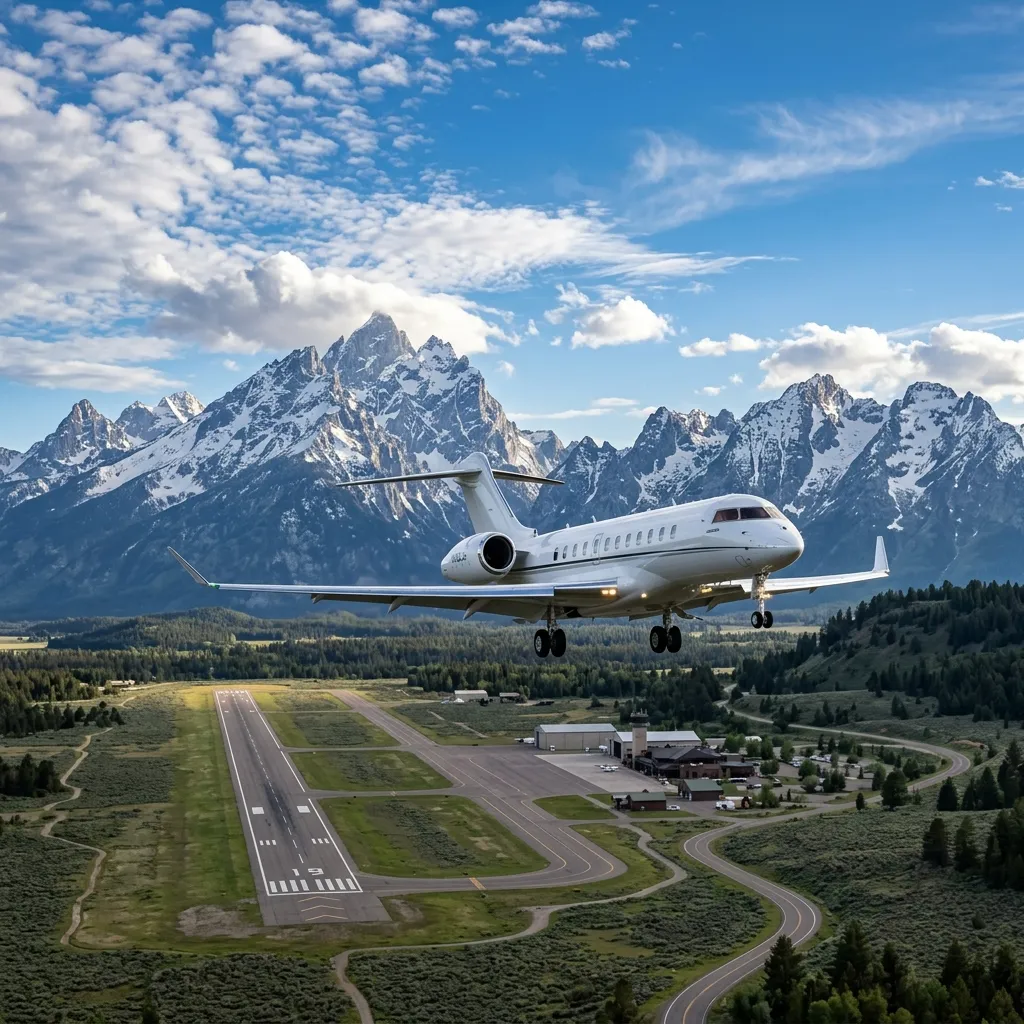
The airport sits in a narrow valley flanked by the Smoky Mountains to the west and the Pioneer Mountains to the east. Terrain rises to over 10,000 feet within 5 miles of the runway. This geography creates one of the most operationally demanding approaches in U.S. private aviation: circling approaches, terrain-driven missed approach procedures, and strict visual requirements that can divert aircraft to Twin Falls (TWF, 65 miles south) without warning.

Aircraft Restrictions and Operational Limits

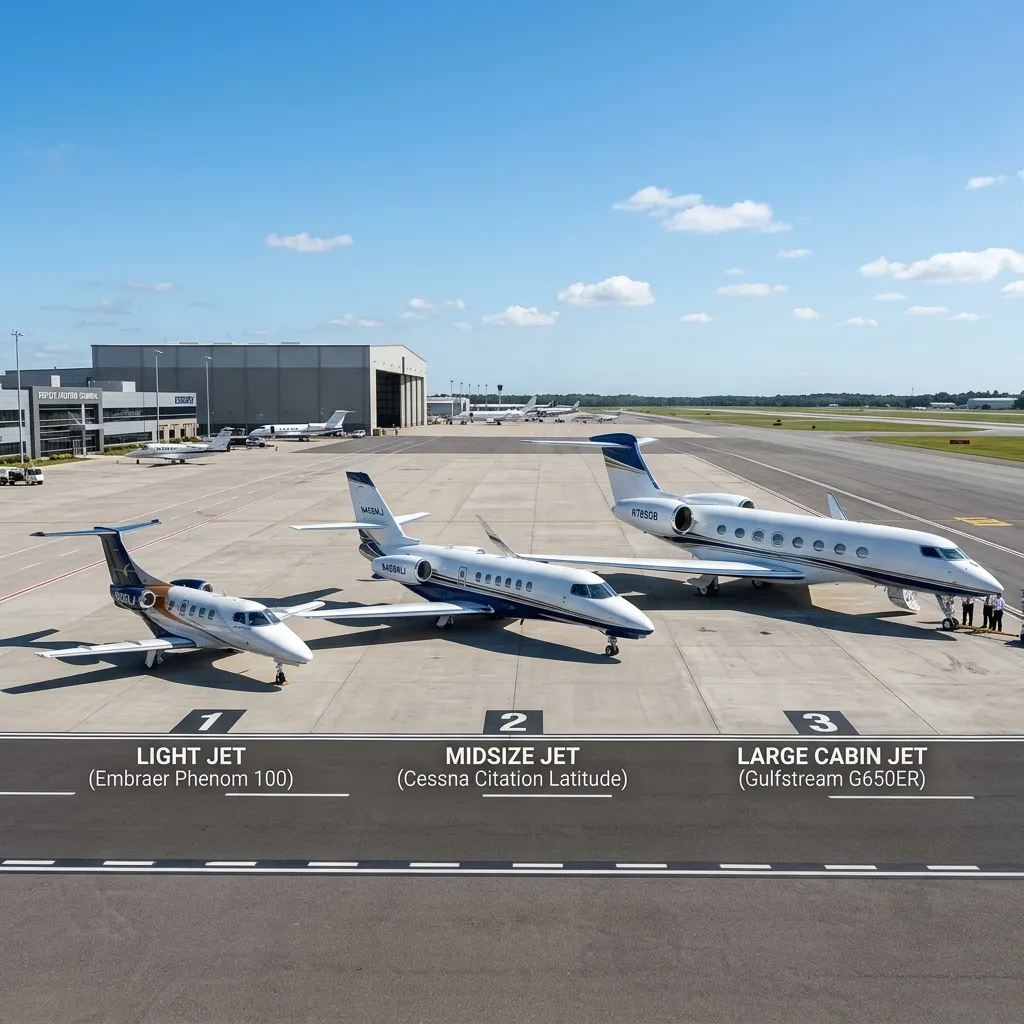
SUN imposes weight restrictions that effectively limit which aircraft types can operate. Maximum landing weight for the runway is approximately 80,000 pounds, which accommodates most midsize and super-midsize jets. Heavy jets like the Gulfstream G550 (MTOW 91,000 lbs) can technically operate but require significant payload restrictions. Ultra-long-range jets like the Global 7500 and G650ER are generally prohibited due to weight and approach category limitations.

  • Light jets (CJ3, CJ4, Phenom 300): Full operations, no restrictions
  • Midsize jets (Citation XLS, Hawker 800XP, Learjet 60): Full operations year-round
  • Super-midsize (Challenger 350, Citation Latitude): Operate with weight monitoring in summer
  • Heavy jets (G550, Challenger 604): Restricted operations, payload-limited in summer heat
  • Ultra-long-range (G650, Global 7500): Generally prohibited or severely restricted

Sun Valley is a light-jet and midsize-jet airport. Passengers arriving on heavy jets typically fly to Twin Falls or Boise and transfer by helicopter or ground vehicle. The 90-minute drive from Boise to Ketchum is scenic but defeats the purpose of flying private for most travelers.

Approach Procedures and Weather Considerations

SUN's instrument approaches are among the most restrictive in the national airspace system. The LOC/DME approach to Runway 13 has minimum descent altitude (MDA) of 7,300 feet MSL, approximately 2,000 feet above the runway. Pilots who cannot acquire visual contact with the runway at that altitude must execute the missed approach, which involves a climbing left turn into the valley with rising terrain on both sides.

Seasonal Weather Patterns

Winter operations (December through March) bring frequent IFR conditions. Ceilings below MDA occur approximately 15-20% of winter mornings, typically clearing by mid-morning as the sun heats the valley. Snow removal operations can close the runway for 30-60 minutes after heavy snowfall. The airport does not have de-icing equipment on-field; aircraft requiring de-icing must depart with holdover time from their origin airport.

Summer operations (June through August) bring a different challenge: density altitude. On a 90°F afternoon, density altitude at SUN exceeds 8,500 feet. This reduces engine performance, increases takeoff roll by 20-30%, and limits payload. Most operators schedule departures for early morning (before 10 AM) during summer to avoid the worst density altitude conditions. Afternoon thunderstorms are common July through August and can close the airport with little notice.

Need a Charter Quote?

Contact our team for a personalized quote.

Get a Quote

Atlantic Aviation: The Sole FBO

Atlantic Aviation operates the only FBO at Friedman Memorial. The facility includes a 4,500-square-foot terminal, passenger lounge, crew lounge, planning room, and covered vehicle pickup area. Atlantic handles all ground services: fueling, ramp parking, GPU, lavatory service, and de-icing coordination. Hangar space is limited to 4 bays and must be reserved in advance during peak season.

SUN
Airport Code
7,550 ft
Runway Length
5,318 ft
Field Elevation
1
FBO On-Field

Fuel pricing at SUN runs $8.50-$9.80 per gallon depending on volume and contract status. This is 25-35% above national average Jet-A pricing, reflecting the cost of trucking fuel to a remote Idaho location. Operators frequently tankering extra fuel from origin airports with lower pricing to minimize SUN uplift. Ramp fees run $350-$500 per overnight, waived with fuel purchase above 100 gallons.

Peak Season: When to Expect Congestion

Sun Valley has two peak seasons. The winter peak runs from December 20 through January 5 and again during Presidents' Day weekend (mid-February). The summer peak spans the Allen & Company Sun Valley Conference (typically early July) and extends through Labor Day. During the Allen & Company conference week, SUN becomes one of the most congested general aviation airports in the country as media executives, tech founders, and investors arrive on private jets.

Allen & Company Conference Week

During conference week, SUN ramp space fills completely. Aircraft are parked wing-to-wing and overflow parking extends to secondary tie-down areas. Departure slots are informally managed by Atlantic Aviation to prevent ramp gridlock. Pilots report 30-60 minute delays for fuel and departure sequencing during peak morning and evening rushes. Charter operators serving conference attendees often stage aircraft at Twin Falls or Boise to free SUN ramp space.

Outside these peak windows, SUN operates with minimal congestion. Weekday operations during shoulder seasons (April-May, September-November) rarely exceed 20 aircraft movements per day. Ramp space is readily available and fuel trucks respond within 10-15 minutes of landing.

Ground Transportation and Local Access

The drive from Friedman Memorial to Ketchum and Sun Valley Lodge takes 15-20 minutes via Highway 75. Atlantic Aviation coordinates ground transportation, including sedan service, SUV transfers, and rental car delivery to the FBO. During peak season, pre-arranged ground transportation is essential. Walk-up rental car availability is unreliable December through March and during conference week.

Helicopter transfers to backcountry lodges and private residences are available through Sun Valley Heli-Ski and other local operators. Flight time from SUN to most destination properties in the Wood River Valley is 5-10 minutes. Helicopter availability should be booked 48-72 hours in advance during peak season.

Brian Galvan

Written By

Brian Galvan

Founder, The Jet Finder · Private Aviation Operations & Technology

Former Director of Technology at FlyUSA (Inc. 5000 fastest-growing private jet company). Decade of hands-on experience across Part 135 operations, charter sales, fleet management, and aviation data systems.

LinkedInRead Full Profile →
Common Questions

Frequently Asked Questions


7 questions about chartering this aircraft

Twin Falls (TWF) is the primary diversion, 65 miles south. It has a 8,700-foot runway at 4,154 feet elevation with ILS approaches and no aircraft weight restrictions. Boise (BOI), 153 miles west, is the secondary option with full commercial and GA infrastructure. Pilots flying to SUN are required to carry sufficient fuel for the diversion, which adds $800-$1,500 to the trip cost in extra fuel uplift.

The Gulfstream G650, G650ER, Global 7500, and Global 6000 are generally restricted or prohibited due to operating weight and approach category limitations at SUN's 7,550-foot runway and 5,318-foot elevation. In summer density altitude conditions, effective runway length drops to 5,500-6,000 feet, well below these aircraft's required landing distances. Passengers needing heavy-jet transport typically fly to Boise or Twin Falls and connect by helicopter or ground vehicle to Ketchum.

SUN has a voluntary noise abatement program requesting that operators avoid arrivals and departures between 10:00 PM and 7:00 AM. The program is not mandatory, and operations outside these hours are permitted under FAA regulations. However, the community is sensitive to noise, and operators who regularly violate the voluntary curfew may face local political pressure and FBO service complications.

A round-trip on a Citation XLS or Hawker 800XP from Van Nuys (VNY) to SUN runs approximately $18,000-$24,000. The one-way distance is 520 NM with a flight time of approximately 1 hour 40 minutes. Round-trip pricing assumes the aircraft waits on the ground at SUN. If the operator repositions the aircraft elsewhere during your stay, each leg is priced independently at $9,000-$13,000 plus repositioning.

No. Friedman Memorial is not an Airport of Entry and has no U.S. Customs and Border Protection facility. International flights must clear customs at Boise (BOI), Salt Lake City (SLC), or another port of entry before proceeding to SUN. This adds a fuel stop and approximately 45-60 minutes to international itineraries, plus CBP processing time.

Jackson Hole Airport (JAC) has a longer runway (6,300 ft but at 6,451 ft elevation) and is located inside Grand Teton National Park, imposing additional approach restrictions. SUN's 7,550-foot runway at lower elevation (5,318 ft) provides better performance margins. Both airports restrict heavy jets in summer. JAC has two FBOs (Jackson Hole Aviation and Signature); SUN has one (Atlantic). Charter pricing to both destinations is comparable from West Coast origins.

April through mid-June and October through mid-December offer the lowest charter demand and pricing. During these shoulder seasons, operators are more likely to offer positioning discounts and empty-leg availability. The Sun Valley Resort is open year-round, and spring skiing (March-April) and fall mountain biking are growing segments that have not yet driven charter demand to peak-season levels.

Continue Reading

Related Articles


Your Next Mission

Ready to Fly?


Whether you need a charter quote or want to explore aircraft options, our team is here.

Contact Us