Why Dassault Built a Tri-Jet
Marcel Dassault signed off on the Falcon 900 program in 1983. The aircraft first flew in September 1984 and received DGAC certification in March 1986. Dassault chose a three-engine configuration for reasons that had nothing to do with fashion. In the early 1980s, ETOPS rules restricted twin-engine aircraft from routes more than 60 minutes from a diversion airport. Three engines meant unrestricted overwater routing from day one.
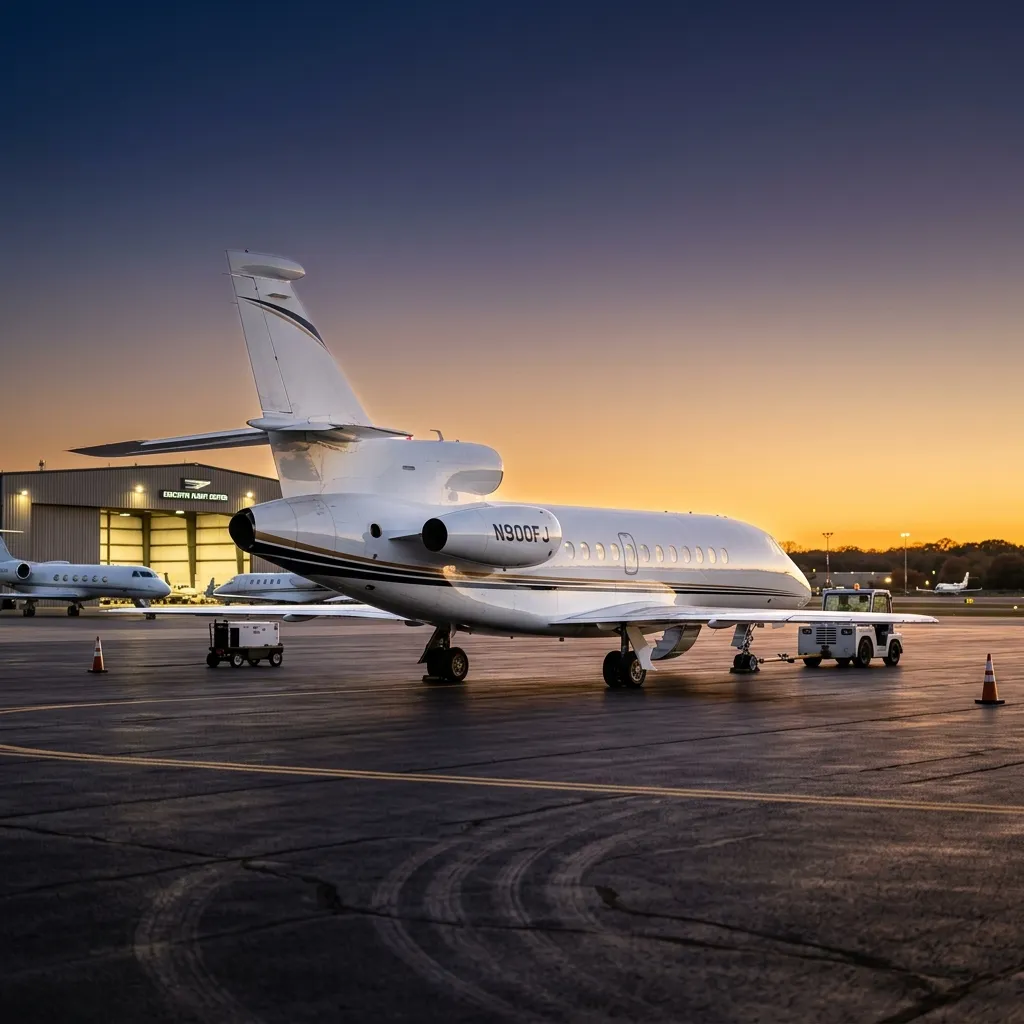
The original Falcon 900 carried three Honeywell TFE731-5AR engines producing 4,500 pounds of thrust each. Total thrust: 13,500 pounds distributed across three lightweight turbofans. The center engine feeds through an S-duct intake above the fuselage. That intake design is a Dassault signature shared with the Falcon 7X and 8X. It allows the fuselage to maintain a clean cross-section without the drag penalty of a straight-through center engine nacelle.
ETOPS restrictions have since loosened. Twins fly everywhere today. But the Falcon 900's three-engine architecture delivered a second advantage that remains relevant 40 years later: short-field performance that no twin-engine heavy jet can replicate.
The Variants: From 900 to 900LX
Dassault produced four major variants of the Falcon 900 over its production run. Each iteration improved range, avionics, and mission capability while maintaining the airframe's fundamental geometry.
Falcon 900 (1986-1991)
The original. Three TFE731-5AR engines, 3,700 NM range, analog Collins avionics. Approximately 100 delivered. These airframes trade between $1.5 million and $3 million today depending on engine time and interior condition. Many have been retired or converted to cargo operations.
Falcon 900B (1991-2000)
Upgraded TFE731-5BR engines with 4,750 lbs thrust each. Range extended to 4,000 NM. Improved fuel efficiency and reduced maintenance intervals. Approximately 90 delivered. These hold $2 million to $5 million in the secondary market.
Falcon 900EX (1996-2008)
The first major redesign. New TFE731-60 engines with 5,000 lbs thrust. Range jumped to 4,500 NM. Digital EASy flight deck replaced analog gauges. This is where the Falcon 900 became a genuine transatlantic aircraft. Approximately 220 delivered. Trades at $4 million to $10 million.
Falcon 900LX (2008-2018)
The final production variant. Same TFE731-60 engines as the EX but with redesigned winglets and aerodynamic improvements that pushed range to 4,750 NM. The LX added blended winglets that reduced drag by 3-4% and improved field performance. Approximately 130 delivered. Trades at $7 million to $15 million.
Short-Field Performance: The Defining Advantage
The Falcon 900LX takes off in 4,675 feet and lands in 2,380 feet at sea level, ISA conditions. For a jet with 4,750 NM of range and a cabin that seats 12, those numbers are exceptional. The Gulfstream G450 needs 5,300 feet for takeoff. The Challenger 604 needs 5,460 feet. Neither can approach the Falcon's landing distance.
Dassault also certified the 900 series for steep approaches. London City Airport requires a 5.5-degree glideslope. Standard ILS approaches use 3 degrees. The Falcon 900 is one of the few heavy-cabin jets certified for London City operations. That certification opens airports across Europe, including Lugano, St. Tropez, and several Swiss mountain fields that reject other heavy jets entirely.