Two Philosophies, One Mission Profile
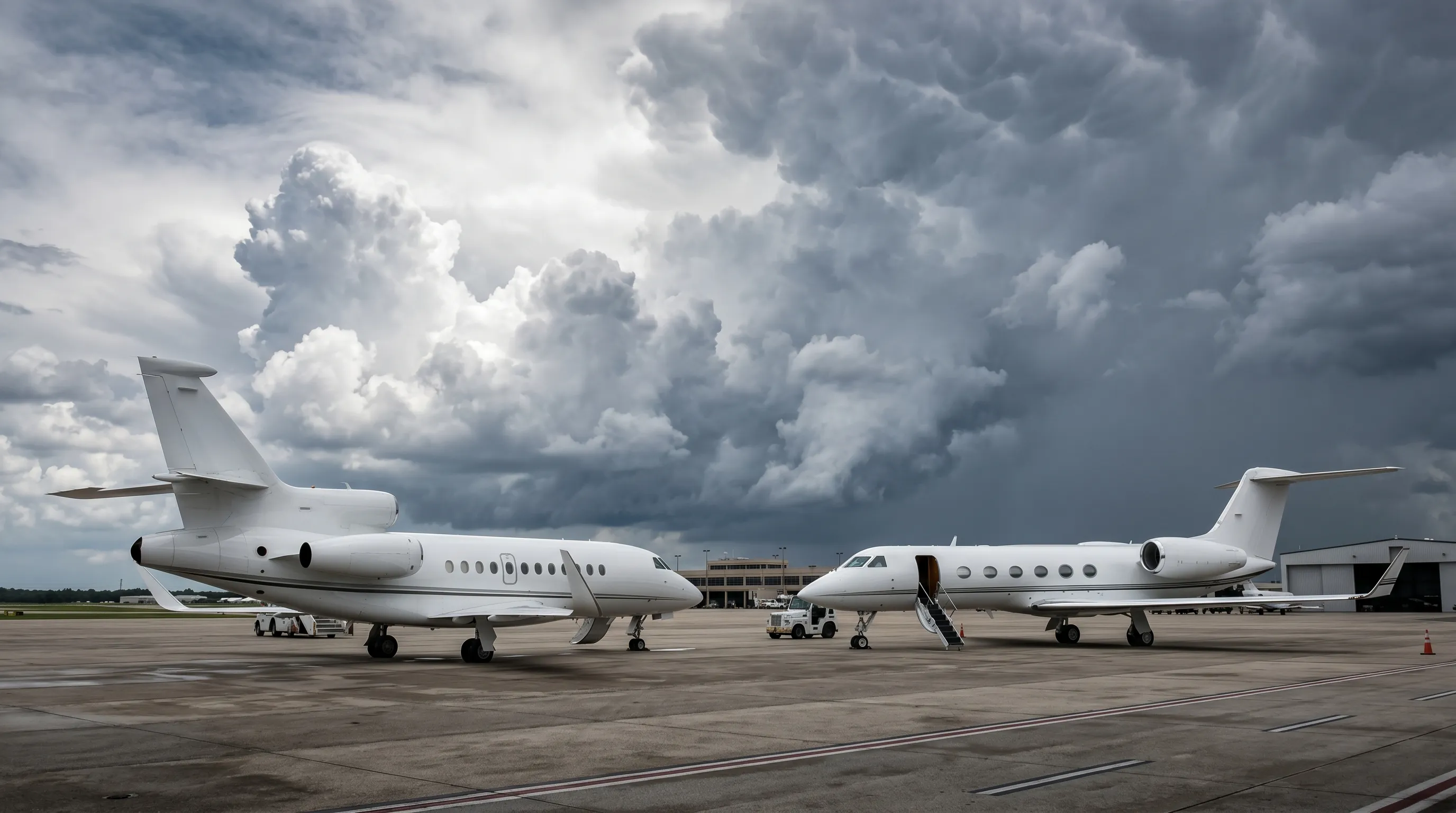
The Dassault Falcon 900LX and Gulfstream G450 both serve the heavy-jet charter segment at $5,000 to $7,000 per flight hour. They compete for the same missions: transcon, Caribbean, and short transatlantic routing. But they solve the problem differently. Dassault chose three engines. Gulfstream chose two. That single design decision cascades into everything from fuel burn to short-field access to maintenance scheduling.
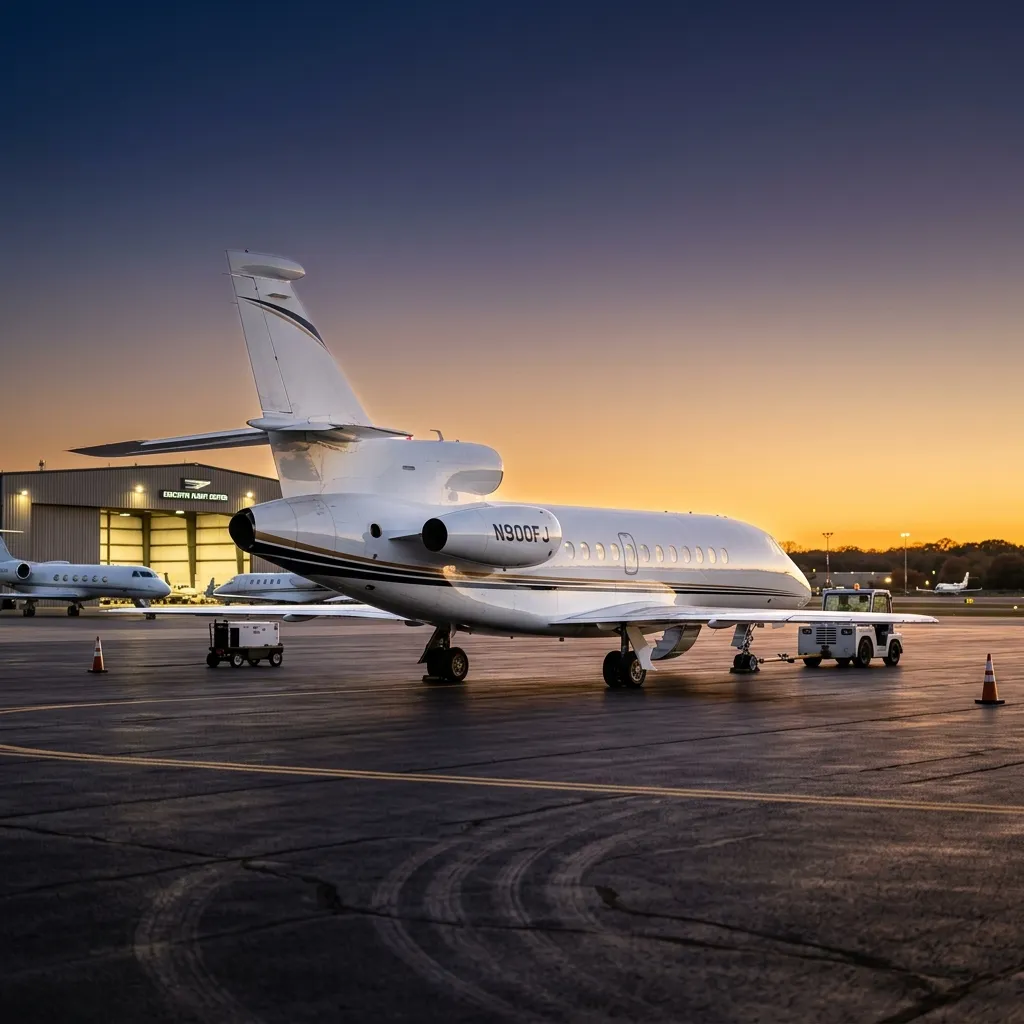
The Falcon 900LX carries three Honeywell TFE731-60 engines producing 5,000 pounds of thrust each. The G450 runs two Rolls-Royce Tay 611-8C turbofans at 13,850 pounds apiece. Total thrust is comparable: 15,000 lbs for the Falcon versus 27,700 lbs for the Gulfstream. But the Falcon distributes that thrust across three smaller, lighter powerplants. That architecture gives the 900LX its defining advantage: short-field performance that no twin-engine heavy jet matches.
Runway Access: Where the Falcon Wins
The Falcon 900LX lands in 2,380 feet and takes off in 4,675 feet at sea level under standard conditions. The G450 requires 5,300 feet for takeoff and over 2,500 feet for landing. At high-altitude airports where density altitude degrades performance, the gap widens further.
Every Falcon 900-series aircraft is certified for steep approaches. That means fields like London City (LCY), Lugano (LUG), and St. Barths (SBH) are accessible. The G450 cannot operate into any of these airports.
For charter clients who fly to European short-field airports, Caribbean islands, or mountain destinations, the 900LX opens 15 to 20 additional airports compared to the G450. That is not a marginal difference. It eliminates ground transfers that can add hours to a trip.
Range and Speed Comparison
The Falcon 900LX holds a 400 NM range advantage at 4,750 NM versus the G450's 4,350 NM (NBAA IFR reserves, 8 passengers). That margin is meaningful on transatlantic routing. New York to London is approximately 3,460 NM. Both jets make it nonstop in favorable winds. New York to Geneva is 3,860 NM. The 900LX handles it with comfortable reserves. The G450 needs the winds to cooperate.
Top speeds are virtually identical: 481 knots for the 900LX, 476 for the G450. Long-range cruise is similarly close. Neither jet holds a meaningful speed advantage. The decision between them comes down to cabin preference, runway requirements, and operating cost tolerance.
Cabin Dimensions and Passenger Experience
The G450 wins the cabin comparison on raw volume. Its interior measures 45.1 feet long, 7.3 feet wide, and 6.1 feet tall. The 900LX cabin is 33.2 feet long, 7.7 feet wide, and 6.2 feet tall. The Gulfstream cabin is 12 feet longer, which translates to an additional seating zone. Most G450 charter configurations seat 12 to 14 in three distinct zones. The 900LX typically seats 12 in two zones.
Baggage and Galley
The G450 carries 169 cubic feet of baggage. The 900LX holds 127 cubic feet. For groups traveling with ski equipment, golf bags, or multi-week luggage, the Gulfstream provides more flexibility. Both aircraft feature full galleys capable of hot meal service. The G450's galley is slightly larger due to the longer fuselage.
Cabin Altitude and Noise
The G450 maintains a cabin altitude of 6,800 feet at FL450. The 900LX holds 6,000 feet at FL390. The Falcon's lower cabin altitude reduces passenger fatigue on flights over four hours. Cabin noise levels are comparable; three smaller engines do not produce noticeably more noise than two larger ones when measured inside the cabin.