The Problem the Latitude Was Built to Solve
Cessna had a super-midsize problem. The Citation Sovereign, introduced in 2004, could fly 2,847 nautical miles, but its 5.5-foot cabin height meant anyone over 5'8" ducked through the aisle. Bombardier's Challenger 300 had a flat floor you could walk through at 6'1". Buyers noticed. The Challenger outsold the Sovereign consistently. Cessna needed a jet where the first thing a buyer felt when stepping aboard was not the ceiling against their forehead.
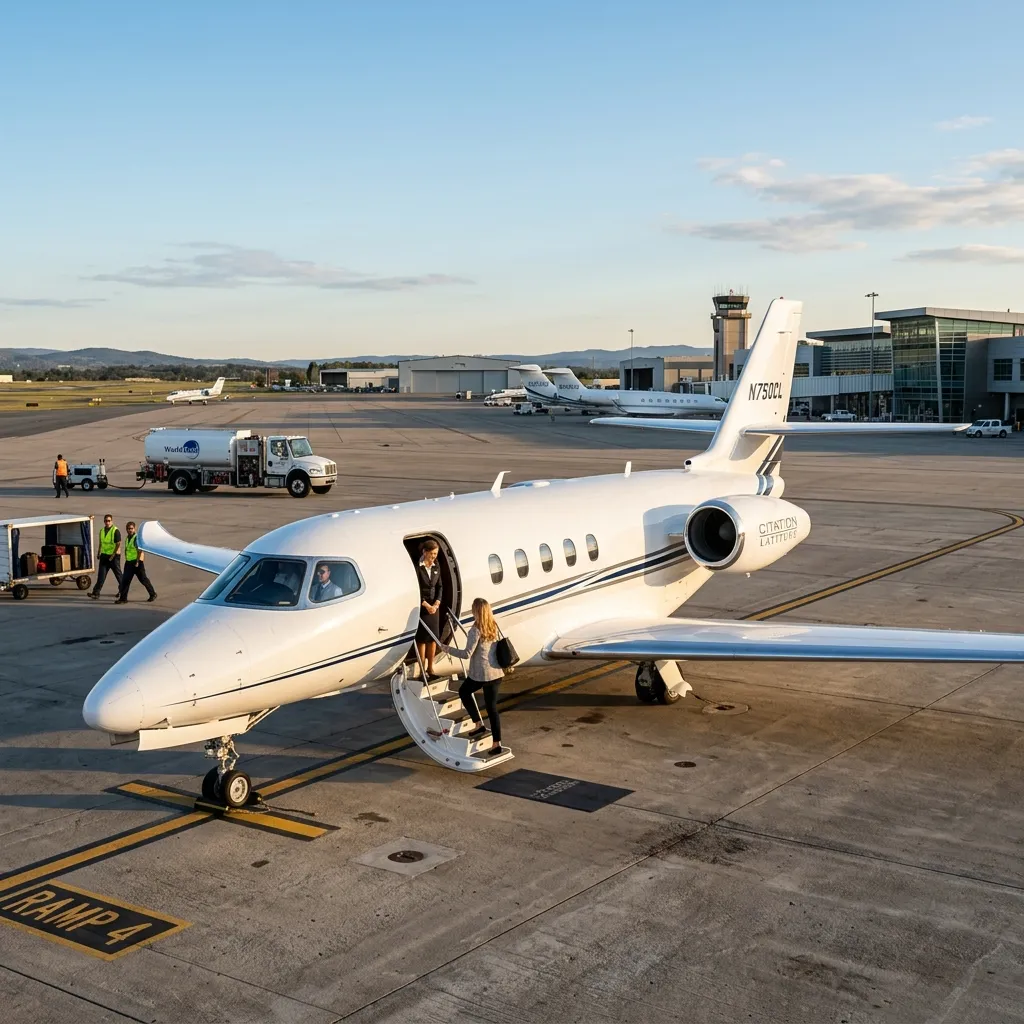
The Latitude, certified in 2015, is that jet. The cabin stands 6 feet tall with a flat floor from the entry to the lavatory. Width is 6.4 feet. Length is 22 feet. Nine passengers fit in a standard configuration. None of them duck. For Cessna, this was not an incremental upgrade. It was an admission that cabin geometry drives the purchase decision in the super-midsize segment, not range, not speed, not operating cost.
Where the Latitude Sits in the Market
The Latitude is the entry point. It costs $800-$1,300 less per hour than the Challenger 350 and $300-$800 less than the Praetor 500. The tradeoff is range: 2,700 NM versus 3,200-3,340 NM. For domestic U.S. operations, that range gap is irrelevant. TEB to VNY is 2,150 NM. ATL to SEA is 1,900 NM. The Latitude covers every coast-to-coast route without a fuel stop. Where it falls short is transatlantic. London is 3,400 NM from Teterboro. The Latitude does not make it nonstop.
The Latitude's real competition is not the Challenger 350. It is the Citation XLS+, which costs less per hour but gives up 4 inches of cabin height and 10 inches of width. Buyers stepping from an XLS into a Latitude for the first time understand the price premium in about three seconds.
Garmin G5000: The Avionics Advantage
The Latitude was the first Cessna jet to ship with the Garmin G5000 integrated flight deck. Three 14-inch touchscreen displays replace the ProLine 21 found in earlier Citations. Pilots who have flown both describe the transition as going from a flip phone to a smartphone. The G5000 handles synthetic vision, WAAS LPV approaches, ADS-B In/Out, CPDLC for oceanic datalink, and SurfaceWatch runway monitoring, all standard.
For charter passengers, the avionics are invisible. What they notice is the result: pilots who spend less time heads-down programming the FMS and more time managing the flight. The G5000's autothrottle integration reduces workload during critical phases. Single-pilot type ratings are available for the Latitude under Part 91, though most Part 135 charter operators fly two-crew.
Software Updates Keep It Current
Garmin pushes regular software updates to the G5000 platform, which means a 2016 Latitude can run the same avionics software as a 2025 delivery. This is a significant departure from legacy avionics platforms (Collins ProLine, Honeywell Primus) where hardware upgrades costing $200,000-$500,000 are required to add features. The G5000's software-driven architecture protects the Latitude's resale value and keeps older airframes operationally current.
Need a Charter Quote?
Contact our team for a personalized quote.
Get a Quote →The Cabin: What 6 Feet of Headroom Changes
The Latitude's cabin measures 22 feet long, 6.4 feet wide, and 6 feet tall. The flat floor runs the full length. No step-up, no step-down, no narrowing aft of the wing spar. This sounds minor until you have spent three hours in a Citation XLS crouching to use the lavatory. The Latitude eliminated that experience entirely.
$3,200-$4,200
Hourly Charter Rate
The standard charter layout seats 9: four in a forward club, two in an aft club, two in a side-facing divan, and one belted lavatory seat. Most operators configure for 7-8 with the divan used for luggage overflow. Baggage compartment is 100 cubic feet, enough for 8 roller bags and soft goods. The lavatory is fully enclosed with a solid door, not a curtain. For a super-midsize cabin, this is standard. For a Citation, it was revolutionary.
Cabin noise at cruise averages 66-68 dB, competitive with the Challenger 350 (65-67 dB) and quieter than the older Sovereign (70-72 dB). The environmental control system provides consistent temperature management across the cabin, though the forward seats tend to run 2-3 degrees cooler than the aft divan area on longer flights.
Two Pratt & Whitney PW306D1 engines produce 5,907 pounds of thrust each. Max cruise is 446 knots. Long-range cruise is 422 knots. Fuel burn averages 210 gallons per hour at high cruise. The Latitude reaches FL450 in approximately 25 minutes and has a maximum ceiling of 45,000 feet, putting it above most commercial traffic and weather.
Takeoff distance is 3,580 feet at sea level. That grants access to every major business aviation airport in the United States and most mountain airports with runways over 4,500 feet at elevation. Aspen (7,820 ft MSL, 8,006 ft runway) is within limits. Telluride (9,070 ft MSL, 7,111 ft runway) requires weight calculations that sometimes restrict passenger count.
- TEB to VNY: 2,150 NM, 4h 50m, nonstop with full passengers
- MDW to OPF: 1,100 NM, 2h 40m, nonstop
- SEA to ASE: 1,050 NM, 2h 35m, nonstop
- ATL to SJD: 1,500 NM, 3h 30m, nonstop
- TEB to LTN: 3,400 NM, requires fuel stop (Keflavik or Goose Bay)
What the Latitude Does Not Do Well
Honesty about limitations builds more trust than pretending they do not exist. The Latitude has three:
- Range ceiling at 2,700 NM. Any mission requiring transatlantic capability or Hawaii from the mainland eliminates the Latitude. Book a Challenger 350 or G280.
- Baggage door dimensions. The external baggage compartment opening is smaller than the Challenger 350's. Golf clubs fit, but hard-shell ski cases longer than 6 feet require creative loading or advance coordination with the operator.
- Speed. At 446 knots max cruise, the Latitude is 20-30 knots slower than the Challenger 350 (470 kts) and Praetor 500 (466 kts). On a 2,000 NM trip, that costs 8-12 minutes. Not decisive, but measurable.
None of these limitations matter for the Latitude's core mission: coast-to-coast domestic charter for 6-8 passengers who want a walk-through cabin at the lowest hourly rate in the super-midsize class. That is the assignment. The Latitude executes it cleanly.