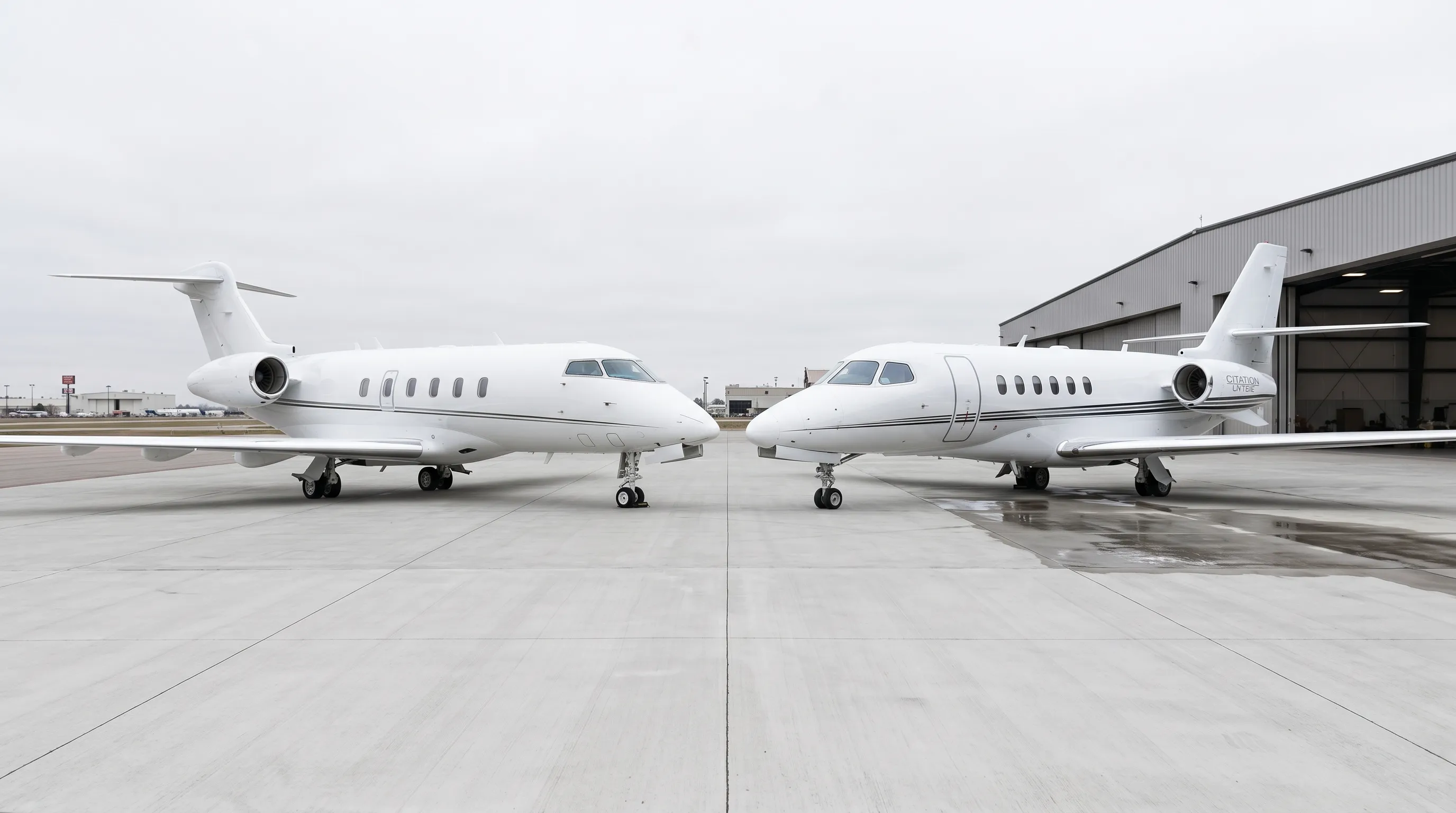
Two super-midsize private jets parked side by side on a corporate aviation ramp

Challenger 350 vs Citation Latitude: Which Super-Midsize Jet Wins?

The Challenger 350 and Citation Latitude dominate the super-midsize category. One offers transcontinental range and a massive cabin; the other delivers flat-floor comfort with unmatched operating economics. Here is how they compare.

In This Article

The Super-Midsize Battleground Cabin Dimensions and Comfort Range and Performance Capabilities Charter Market Economics Ownership and Operating Costs Avionics and the Pilot Experience Baggage Capacity and Storage Logistics The Verdict: Which Super-Mid Wins? Frequently Asked Questions

The Super-Midsize Battleground

The super-midsize category is the most hotly contested segment in business aviation. It represents the sweet spot for corporate flight departments and high-net-worth individuals who need coast-to-coast range without the acquisition and operating costs of a heavy jet. For the better part of a decade, two aircraft have dominated this space: the Bombardier Challenger 350 and the Cessna Citation Latitude.

The Challenger 350 is an evolution of the wildly successful Challenger 300, bringing upgraded Honeywell HTF7350 engines, canted winglets, and avionics enhancements to a proven airframe. It is a true transcontinental workhorse, capable of flying eight passengers from New York to London under the right conditions.

The Citation Latitude, meanwhile, represents a clean-sheet approach to the passenger experience. Cessna recognized that while buyers wanted super-midsize range, they were fundamentally buying cabin comfort. The Latitude introduced a flat floor and a six-foot stand-up cabin, mated to the reliable systems of the Sovereign+. It prioritized passenger space and direct operating costs over raw speed and extreme range.

3,200 nm vs 2,700 nm
Range Comparison
Mach 0.83 vs Mach 0.80
Top Speed
10 vs 9
Max Passengers

Cabin Dimensions and Comfort

If you are chartering or buying either of these aircraft, cabin comfort is likely your primary decision driver. The Challenger 350 boasts one of the widest cabins in the category at 7 feet 2 inches, compared to the Latitude’s 6 feet 5 inches. This extra width is immediately noticeable when passengers pass each other in the aisle or when the club seats are fully reclined.

The Challenger 350’s cabin is also significantly longer—25 feet 2 inches from the cockpit divider to the aft pressure bulkhead, versus the Latitude’s 21 feet 9 inches. This allows the Challenger to comfortably accommodate a divan in the aft cabin, whereas the Latitude typically features a traditional double-club or a forward side-facing two-place divan.

However, the Latitude wins decisively on the floor plan. It features a completely flat floor, whereas the Challenger 350 has a dropped aisle. The flat floor, combined with a 6-foot cabin height, makes the Latitude feel incredibly spacious and eliminates the awkward step-down required when moving through older Citation models. For passengers who value moving around the cabin inflight, the Latitude’s flat floor is a major selling point.

Baggage capacity heavily favors the Challenger 350, which offers 106 cubic feet of accessible inflight storage. The Latitude provides a respectable 100 cubic feet externally, but lacks internal access to the main baggage compartment, meaning you cannot retrieve items from your suitcase once airborne.

Range and Performance Capabilities

This is where the two aircraft diverge significantly. The Challenger 350 is a true coast-to-coast aircraft with a range of 3,200 nautical miles. It can comfortably fly from Los Angeles to New York, or Miami to Seattle, even with strong winter headwinds. It also climbs directly to 43,000 feet, allowing it to top most weather and commercial traffic.

The Citation Latitude has a published range of 2,700 nautical miles. While this is sufficient for New York to Los Angeles on a perfect day, strong winter jet streams often force a fuel stop on westbound transcontinental flights. For an owner based in Chicago or Dallas, the Latitude covers the entire continental United States effortlessly. But for bicoastal flyers, the Challenger 350 provides much-needed margin.

In terms of speed, the Challenger 350 is the faster aircraft, with a high-speed cruise of Mach 0.82 (470 knots) compared to the Latitude’s Mach 0.80 (446 knots). On a four-hour flight, this speed difference translates to arriving about 15-20 minutes earlier.

However, the Latitude excels in short-field performance. It can take off from a 3,580-foot runway at maximum takeoff weight, compared to the Challenger 350’s 4,835-foot requirement. If you regularly operate out of smaller airports like Carlsbad (KCRQ) or Hilton Head, the Latitude offers significantly better access.

Charter Market Economics

Both aircraft are incredibly popular on the charter market, largely due to fractional operators like NetJets, which operate massive fleets of both models. The Challenger 350 generally commands a higher hourly charter rate, averaging $5,500 to $6,500 per flight hour. It is positioned as the premium choice for domestic coast-to-coast charter.

The Citation Latitude charters for approximately $4,800 to $5,800 per hour. For trips under four hours, the Latitude offers nearly identical passenger comfort (thanks to the flat floor) at a 10-15% discount compared to the Challenger 350. Smart charter buyers often request the Latitude for flights like New York to Miami or Chicago to Aspen, where the Challenger’s extra range and speed are irrelevant.

Because NetJets accounts for such a large percentage of Latitude deliveries, finding a Latitude on the open Part 135 charter market can sometimes be challenging, whereas Challenger 350s (and older 300s) are abundant.

Charter a Super-Midsize Jet

Whether you need the range of a Challenger 350 or the value of a Latitude, our team can source the perfect aircraft for your next mission.

Request a Flight

Ownership and Operating Costs

Acquisition costs heavily favor the Citation Latitude. A new Latitude lists for roughly $20 million, while a new Challenger 3500 (the 350's successor) pushes $27 million. On the pre-owned market, a 2018 Latitude trades for $13-$15 million, whereas a 2018 Challenger 350 commands $15-$18 million.

Direct operating costs also favor Cessna. The Latitude’s Pratt & Whitney PW306D1 engines burn roughly 210 gallons of fuel per hour, compared to the Challenger 350’s 260 gallons per hour. When factoring in maintenance reserves, engine programs, and fuel, the Latitude costs approximately $3,000 per flight hour to operate, while the Challenger 350 sits closer to $3,500.

For a corporate flight department flying 400 hours a year, the Latitude represents a savings of roughly $200,000 annually in direct operating costs, plus lower insurance and crew training expenses.

Avionics and the Pilot Experience

For flight departments, the technology on the flight deck is just as critical as the cabin in the back. The Challenger 350 is equipped with the Rockwell Collins Pro Line 21 Advanced avionics suite. While Pro Line 21 is a proven and highly reliable system that tens of thousands of pilots are trained on, it represents older architecture compared to newer touchscreen systems. Bombardier has since moved to the Collins Pro Line 21 Advanced system with Synthetic Vision, but it remains a button-and-knob interface at its core.

The Citation Latitude, conversely, is built around the modern Garmin G5000 touchscreen avionics suite. The G5000 is widely considered one of the most intuitive and capable systems on the market, featuring three 14-inch high-resolution displays and four touchscreen control panels. Pilots transitioning from modern light jets or high-end turboprops will find the Garmin architecture instantly familiar.

This difference in avionics philosophy also impacts pilot training and retention. Many younger pilots prefer the modern, iPad-like interface of the Garmin G5000. However, the Challenger 350's Pro Line 21 is a staple of heavy iron, and pilots transitioning from older Gulfstreams or Falcons will feel right at home with the Collins architecture.

Baggage Capacity and Storage Logistics

For long corporate trips or extended family vacations, baggage volume becomes a hard constraint. The Challenger 350 dominates this category with 106 cubic feet of accessible internal baggage space. This means passengers can retrieve briefcases, coats, or personal items from their luggage while cruising at 41,000 feet. The compartment is fully heated and pressurized, making it safe for delicate items.

The Citation Latitude offers 100 cubic feet of exterior baggage space. While this is a generous volume capable of holding golf clubs and multiple large suitcases, it is entirely inaccessible from the cabin during flight. Passengers must ensure they have all necessary items with them in the main cabin before the main door closes.

Additionally, the Challenger 350's payload capability with full fuel is generally higher than the Latitude's. This allows the Challenger to take off with maximum fuel and a full passenger load without exceeding weight limits, a scenario that occasionally requires baggage tradeoffs on the Latitude during long-range westbound missions.

The Verdict: Which Super-Mid Wins?

The Challenger 350 is the superior aircraft if your mission profile frequently involves flying coast-to-coast or launching fully loaded out of high-altitude airports like Aspen. It is a heavy jet masquerading as a super-midsize, offering unmatched range, speed, and a massive cabin.

The Citation Latitude, however, is arguably the smarter financial decision for 80% of buyers. If your typical flight is under four hours and carries 4-6 passengers, the Latitude’s flat floor, superior short-field performance, and drastically lower operating costs make it the ultimate domestic business tool.

Buy the Challenger 350 if you need to fly from New York to Los Angeles in the winter without stopping. Buy the Latitude if you value a flat floor and want to save $200,000 a year in operating costs.

Brian Galvan

Written By

Brian Galvan

Founder, The Jet Finder · Private Aviation Operations & Technology

Former Director of Technology at FlyUSA (Inc. 5000 fastest-growing private jet company). Decade of hands-on experience across Part 135 operations, charter sales, fleet management, and aviation data systems.

LinkedInRead Full Profile →
Common Questions

Frequently Asked Questions


7 questions about Challenger 350 vs Citation Latitude comparison

The Challenger 350 has a significantly longer range at 3,200 nautical miles, compared to the Citation Latitude's 2,700 nautical miles. The Challenger can comfortably fly coast-to-coast against winter headwinds, while the Latitude may require a fuel stop on westbound transcontinental flights.

The Challenger 350 is faster, with a typical high-speed cruise of Mach 0.82 (470 knots), while the Citation Latitude cruises at Mach 0.80 (446 knots). This saves about 15-20 minutes on a coast-to-coast flight.

The Challenger 350 has a wider (7' 2" vs 6' 5") and longer (25' 2" vs 21' 9") cabin. However, the Citation Latitude features a completely flat floor, whereas the Challenger 350 has a dropped aisle. Both offer a 6-foot stand-up height.

The Challenger 350 typically charters for $5,500 to $6,500 per hour, while the Citation Latitude charters for $4,800 to $5,800 per hour. The Latitude offers excellent value for trips under four hours.

The Citation Latitude excels in short-field performance, requiring only 3,580 feet for takeoff at maximum weight, compared to the Challenger 350's requirement of 4,835 feet. This gives the Latitude access to much smaller regional airports.

No, the Citation Latitude does not offer inflight access to the main baggage compartment. The Challenger 350, however, does provide full access to its 106 cubic-foot baggage area while airborne.

The Citation Latitude is significantly cheaper to operate. Its Pratt & Whitney engines burn about 210 gallons of fuel per hour compared to the Challenger's 260. Total direct operating costs for the Latitude are roughly $500 less per hour than the Challenger 350.

Continue Reading

Related Articles


Your Next Mission

Ready to Fly?


Whether you need a charter quote or want to explore aircraft options, our team is here.

Contact Us