Citation Latitude Charter Rates in 2026
A Citation Latitude charters for $3,200 to $4,200 per flight hour in 2026. Among super-midsize jets, that rate buys the widest cabin in the category (6.4 ft) with a flat floor that no previous Citation offered. On a 3.5-hour coast-to-coast flight from Teterboro to Van Nuys, expect a total bill of $11,200 to $14,700 before Federal Excise Tax (7.5%), fuel surcharges, and destination handling. Compared to the Challenger 350 on the same route, the Latitude saves $2,100 to $3,500.
The two Pratt & Whitney Canada PW306D1 engines burn approximately 190 gallons per hour combined at long-range cruise. At $5.75 per gallon, fuel cost comes to roughly $1,093 per flight hour, representing 26-34% of the total charter rate. The PW306D1 is a newer engine program than the Honeywell HTF7000 powering the Challenger 350, with lower maintenance reserves due to the Latitude's shorter time in service and Pratt & Whitney's competitive engine support programs.
The Flat-Floor Cabin: Why 6 Feet Changes Everything
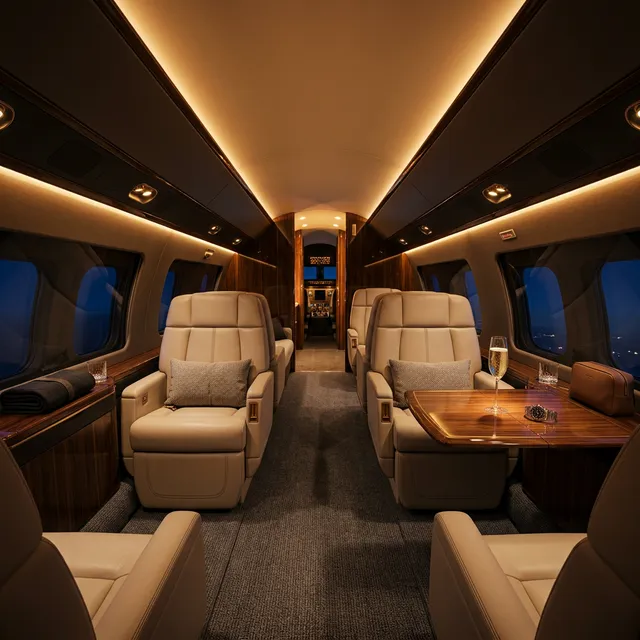
The Citation Latitude's cabin is 22.0 feet long, 6.4 feet wide, and 6.0 feet tall with a completely flat floor. That flat floor is the specification that separates the Latitude from every previous Citation. In the Citation XLS, the center aisle sits lower than the seat tracks, creating a tub-shaped floor that passengers step down into. In the Latitude, floor-to-ceiling height is a consistent 6 feet across the entire width of the cabin.
For a 5'11" passenger, walking the length of the Latitude cabin without ducking is unremarkable. In a Learjet 45 (4.9 ft ceiling) or Citation XLS (5.7 ft), the same passenger stoops. That difference between walking upright and stooping defines the break point between midsize and super-midsize charter experiences. The Latitude was designed specifically to cross that threshold.
Market Context: The flat-floor cabin is not an engineering curiosity. It is the reason the Latitude exists. Cessna's market research showed that cabin height was the number one reason Citation buyers traded up to Challenger or Gulfstream products. The Latitude was built to close that gap.
Garmin G5000: The Cockpit That Pilots Prefer
The Citation Latitude runs the Garmin G5000 avionics suite, a touchscreen-based flight deck that represents a generational leap over the Collins Pro Line 21 systems in older Citations and the Honeywell Primus Epic in the Challenger 350. For charter clients, the avionics suite matters indirectly: it affects pilot workload, which affects operational safety and flight planning efficiency.
The G5000 integrates SurfaceWatch (runway awareness), synthetic vision, ADS-B In weather and traffic, and CPDLC datalink for oceanic and high-altitude clearances. Pilots transitioning from older Citation models to the Latitude consistently cite the avionics as the most significant operational improvement. Lower pilot workload translates to fewer errors, faster decision-making in complex airspace, and a calmer cockpit environment on demanding approaches.
Autothrottle integration
The Latitude was one of the first Citations to include autothrottle as standard equipment. Autothrottle manages engine power throughout climb, cruise, descent, and approach phases, reducing pilot workload on long flights and improving fuel efficiency by maintaining optimal power settings. For charter operators, the fuel savings from autothrottle management compound into measurable per-hour cost reductions that flow through to competitive charter rates.
Get a Citation Latitude Quote
Looking for a super-midsize with a flat-floor cabin and coast-to-coast range? Tell us the route.
Request a Quote →Citation Latitude vs. Challenger 350: The Super-Mid Decision
The Latitude and Challenger 350 compete directly for the same charter missions. They represent different design philosophies from different manufacturers, and the comparison reveals meaningful differences beyond the spec sheet:
| Specification | Citation Latitude | Challenger 350 |
|---|
| Charter Rate (2026) | $3,200-$4,200/hr | $3,800-$5,200/hr |
| Max Passengers | 9 | 10 |
| Range (NBAA IFR) | 2,700 nm | 3,200 nm |
| Max Cruise Speed | 446 kts | 458 kts |
| Cabin Length | 22.0 ft | 28.5 ft |
| Cabin Width | 6.4 ft | 6.1 ft |
| Cabin Height | 6.0 ft | 6.1 ft |
| Takeoff Distance | 3,580 ft | 4,835 ft |
| Avionics | Garmin G5000 | Honeywell Primus Epic |
| Pre-Owned Price | $8M-$14M | $14M-$20M |
The Challenger 350 wins on range (3,200 nm vs. 2,700 nm), speed (458 kts vs. 446 kts), and cabin length (28.5 ft vs. 22.0 ft). The Latitude wins on price ($3,200-$4,200 vs. $3,800-$5,200), cabin width (6.4 ft vs. 6.1 ft), takeoff distance (3,580 ft vs. 4,835 ft), and avionics modernity (Garmin G5000 vs. Honeywell). For domestic missions under 2,500 nm with 6-7 passengers, the Latitude delivers comparable comfort at $600-$1,000 less per flight hour.
The Challenger 350 becomes the necessary choice on transcontinental missions where headwinds push beyond the Latitude's 2,700 nm range, or when the third cabin zone (the Challenger's aft section) is required for privacy or sleeping. For Teterboro to Miami, Dallas to Aspen, Chicago to Scottsdale, or Atlanta to Los Angeles, both aircraft serve the mission nonstop, and the Latitude's price advantage is the deciding factor.
Fleet Expansion: A Growing Charter Supply
Textron Aviation has delivered over 300 Citation Latitudes since certification in 2015. As early-production aircraft reach 8-10 years of age, the fleet is transitioning from corporate flight departments to managed Part 135 charter operations. This lifecycle migration is increasing charter availability and will continue through the late 2020s as depreciation accelerates on 2015-2018 vintage aircraft.
- Acquisition cost: $8M-$14M pre-owned. A 2016 Latitude with 3,000 hours trades at $8M-$10M. A 2022 model with 1,000 hours commands $13M-$14M. These acquisition costs are 30-40% below comparable Challenger 350 values, which translates to lower financing costs for operators and therefore lower charter rates.
- Annual fixed costs: $800K-$1.2M. Crew ($350K-$450K for two pilots), insurance ($120K-$180K), hangar ($80K-$150K), training ($50K-$70K), and management fees ($200K-$350K). The Latitude's single-pilot certification (SPC) for Part 91 does not apply to Part 135 charter, which requires two pilots.
- Direct operating cost: $2,100-$2,800/hr. Fuel ($1,093/hr at $5.75/gal), maintenance reserves ($600-$900/hr), crew variable ($200-$300/hr), and navigation/handling ($150-$250/hr). The PW306D1 engines are on-condition rather than time-limited, which can reduce maintenance reserve costs for low-utilization aircraft.
- Break-even utilization: 300-400 hours/year. At $3,700/hr average charter rate and 350 hours of utilization, gross revenue is $1.295M against total costs of $1.5M-$2.0M. Like most owner-managed charter operations, the gap is filled by the owner's personal use value.
The Latitude fleet's growth trajectory mirrors the early years of the Citation XLS program, which now has one of the densest charter fleets in the midsize category. Expect Latitude charter availability to improve steadily through 2028-2030 as fleet migration accelerates.
When the Latitude Is the Right Charter
The Citation Latitude fills a specific gap: clients who need a stand-up cabin and super-midsize range but do not need the Challenger 350's extra cabin length or 3,200 nm range. For 4-7 passengers on domestic routes between 1,000 and 2,500 nm, the Latitude delivers the flat-floor experience at $600-$1,000 less per hour than the Challenger 350. That savings compounds significantly on multi-leg trips.
Short-field advantage
The Latitude's 3,580-foot takeoff distance gives it access to airports that the Challenger 350 (4,835 ft) cannot reach. Aspen (8,000 ft MSL, 8,006 ft runway) is a notable example: both aircraft operate from Aspen, but the Latitude carries more payload due to its shorter ground roll. At sea-level airports with short runways, the Latitude accesses fields like Boca Raton (BCT, 6,276 ft), Morristown (MMU, 5,997 ft), and dozens of regional airports where every foot of runway matters.
When to step up
For groups of 8+, the Latitude's 9-passenger capacity works but the cabin becomes dense on flights over 3 hours. Step up to a G550 for large groups needing separation. For transcontinental routes with significant headwinds (eastbound winter flights), the Latitude's 2,700 nm range may require a fuel stop that the Challenger 350 avoids. Evaluate the specific route and wind forecast before defaulting to the larger aircraft.