Learjet 45 Charter Rates in 2026
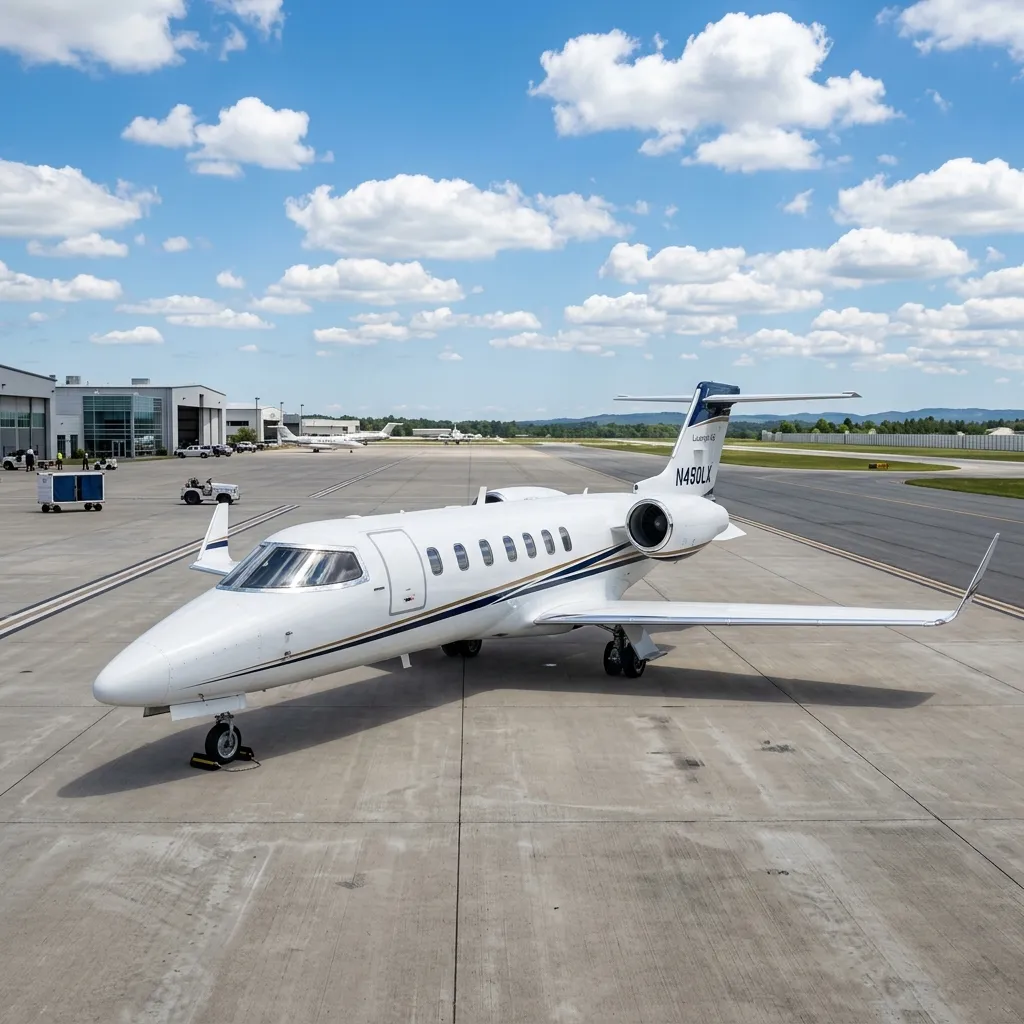
A Learjet 45 charters for $2,800 to $3,800 per flight hour in 2026. That rate overlaps directly with the Citation XLS despite the Learjet 45 being categorized as a light jet. The overlap exists because the Learjet 45 delivers midsize-jet speed in a light-jet cabin. On a 2.5-hour flight from Chicago Executive to Teterboro, total charter cost runs $7,000 to $9,500 before Federal Excise Tax (7.5%) and the $4.50 per-segment fee.
The two Honeywell TFE731-20 engines burn approximately 160 gallons per hour combined at cruise. At $5.75 per gallon, fuel cost is roughly $920 per flight hour. That puts fuel at 24-33% of the total charter rate. The balance covers crew compensation, maintenance reserves on a 12-26 year old airframe, insurance, fixed overhead, and the operator's margin. Maintenance reserves are the variable to watch: the TFE731 engine series has been in service since the 1970s, which makes parts available but age-related maintenance events more frequent on high-time examples.
465 Knots: Why a Light Jet Outruns Most Midsize Jets
The Learjet 45's max cruise speed of 465 knots is faster than every midsize jet on the charter market except the Citation X. The Citation XLS cruises at 441 kts. The Phenom 300 hits 453 kts. The Hawker 800XP tops out at 448 kts. The Learjet 45 beats them all, carrying 9 passengers at a speed that only super-midsize and heavy jets can match.
On a New York to Miami flight (1,030 nm), the Learjet 45 completes the mission in approximately 2 hours 15 minutes gate-to-gate. The Citation XLS takes 2 hours 25 minutes. The CJ3 takes 2 hours 35 minutes. That 10-20 minute difference is marginal on a single flight. Over 50 charter legs per year, it compounds into 8-16 hours of recovered time. For time-sensitive corporate travel, the Learjet's speed advantage is not a spec sheet curiosity; it is operational throughput.
Bill Lear designed the original Learjet to go fast. Every model that followed inherited that priority. The 45 is the last expression of that philosophy before Bombardier discontinued the line.
The Cabin Tradeoff: Speed Costs Space
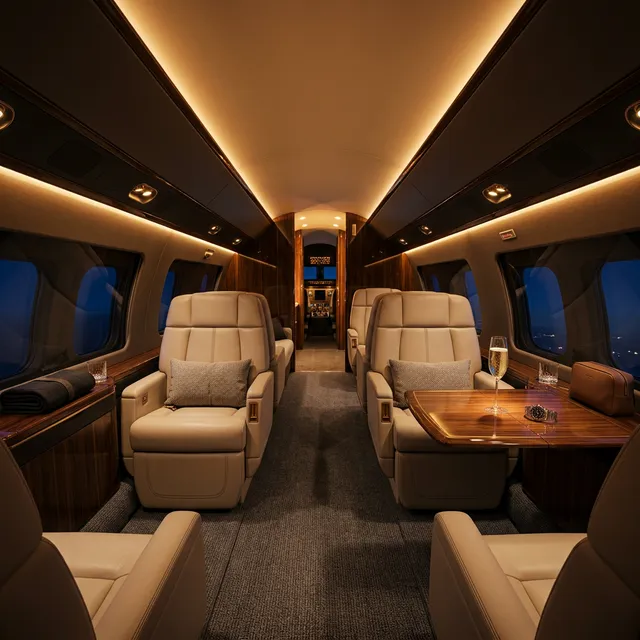
The Learjet 45 cabin is 19.8 feet long, 5.1 feet wide, and 4.9 feet tall. That 4.9-foot ceiling is the tradeoff. A passenger at 5'10" cannot walk the aisle without ducking. The Citation XLS at 5.7 feet and the Challenger 350 at 6.1 feet offer meaningfully more headroom. For business travelers who work the aisle during flight or need to move between zones, the Learjet's ceiling requires awareness.
Width is 5.1 feet, matching the Phenom 300 and typical for the light jet class. The double-club seating arrangement accommodates 8 passengers in facing seats with a narrow center aisle. The ninth seat is a belted position. For groups of 4-6, the cabin works well: everyone faces forward or rearward, shoulder room is adequate, and the enclosed lavatory provides privacy. For 8-9 passengers on flights over 3 hours, the cabin density becomes noticeable.
Baggage reality
The Learjet 45 has 65 cubic feet of baggage capacity. That is less than the Citation XLS (80 cu ft) and substantially less than the Challenger 350 (106 cu ft). For 4 passengers with standard rolling bags and carry-ons, it handles the load without discussion. For 6-8 passengers, expect the crew to enforce soft-bag requirements and potentially limit oversized items. Golf clubs fit but displace 2-3 standard bags. Plan accordingly.
Get a Learjet 45 Quote
Tell us your route. We source from the full Part 135 fleet, including Learjet 45 and 45XR operators nationwide.
Request a Quote →Learjet 45 vs. 45XR: The Upgrade That Matters
Bombardier produced two variants. The original Learjet 45 (1998-2007) and the 45XR (2004-2012). They share the same type certificate and identical cabin dimensions. The differences are under the cowlings:
| Specification | Learjet 45 (Original) | Learjet 45XR |
|---|
| Production Years | 1998-2007 | 2004-2012 |
| Charter Rate (2026) | $2,800-$3,400/hr | $3,000-$3,800/hr |
| Engine | TFE731-20 (3,500 lbs) | TFE731-20BR (3,800 lbs) |
| Max Cruise Speed | 465 kts | 465 kts |
| Range (4 pax, NBAA IFR) | 2,120 nm | 2,120 nm |
| Takeoff Distance (SL) | 4,350 ft | 4,080 ft |
| Service Ceiling | 51,000 ft | 51,000 ft |
| Cabin Dimensions | 19.8 ft × 5.1 ft × 4.9 ft | 19.8 ft × 5.1 ft × 4.9 ft |
| Pre-Owned Price | $1.8M-$3.0M | $2.5M-$4.5M |
The 45XR's upgraded TFE731-20BR engines produce 300 lbs more thrust each and improve hot-and-high performance. At sea level, the difference is negligible. At Aspen (7,820 ft MSL) on a 90°F day, the 45XR's additional thrust translates to 400-600 lbs more payload capability, which can mean the difference between carrying 6 passengers with bags and carrying 8.
Charter rates for the 45XR run $200-$400 per hour higher than the original 45. For clients, the practical cabin experience is identical. The 45XR is the better option for mountain destinations and hot-weather operations. For standard sea-level to sea-level missions (Teterboro to Palm Beach, Chicago to Dallas), the original 45 delivers the same result at the lower rate.
Flying a Discontinued Aircraft: What Clients Should Know
Bombardier discontinued the Learjet line in 2021, ending a brand that began in 1963. For charter clients, the relevant question is not nostalgia; it is parts availability, maintenance support, and fleet longevity. The answers are more reassuring than the headline suggests.
- Parts support: Bombardier commitment through 2041. Bombardier committed to supporting the Learjet fleet for at least 20 years post-production. That means factory parts, technical support, and authorized service centers remain available until at least 2041.
- MRO network: deep and established. The TFE731 engine powers over 15,000 aircraft worldwide. Maintenance, repair, and overhaul (MRO) facilities that service TFE731 engines are abundant. Engine shops like StandardAero, Dallas Airmotive, and Honeywell authorized centers have decades of experience with this powerplant.
- Fleet size: still substantial. Over 500 Learjet 45/45XR aircraft were delivered. The active fleet in the U.S. still numbers approximately 250-300 aircraft, a sufficient base to sustain the parts and maintenance ecosystem for decades.
- Insurance: no penalty. Underwriters have not added surcharges for discontinued Learjet models. Hull values are declining naturally with age, which actually reduces insurance premiums. Liability coverage remains standard at $100M-$200M combined single limit.
The real risk of a discontinued aircraft is not parts or maintenance. It is resale value for owners, which does not affect charter clients. Charter clients pay for the mission; they do not carry the depreciation. A Learjet 45 that completes a 2-hour flight safely and on time delivers identical value to a charter client regardless of whether Bombardier is still making them.
When the Learjet 45 Is the Right Call
The Learjet 45 occupies a specific niche: speed-sensitive missions with 4-6 passengers on routes under 2,000 nm. That covers most of the domestic charter market's high-traffic corridors. New York to Miami (1,030 nm), Chicago to Aspen (880 nm), Dallas to Atlanta (720 nm), and Los Angeles to San Francisco (340 nm) are all routes where the Learjet's speed advantage compounds into real time savings.
When to look elsewhere
For groups of 7+ passengers, the cabin density and baggage limitations push toward a midsize jet. A Citation XLS at the same hourly rate offers a wider, taller cabin and 15 more cubic feet of baggage space. For coast-to-coast nonstop missions (2,145 nm), the Learjet 45's 2,120 nm range falls marginally short; plan a 30-minute fuel stop or step up to a Challenger 350 that clears the distance without calculation.
Empty leg availability
Learjet 45 empty legs are moderately available. The fleet is smaller than the Citation or Phenom fleets, so repositioning opportunities appear less frequently. The highest-probability corridors are Northeast to Florida (Sunday/Monday), Texas to Midwest (mid-week), and California coastal routes (Friday/Sunday). Discounts run 40-60% off standard charter rates. Because Learjet 45s tend to be operated by smaller management companies rather than large fleet operators, empty legs may require direct operator contact rather than appearing on broker aggregator platforms.
Note: The Learjet 45 does not try to be everything. It goes fast, it carries 6 passengers comfortably, and it costs less per hour than jets that go slower. For clients who value time over cabin width, nothing in the light jet category matches it.