Single-Pilot Certified Jets: The Complete List
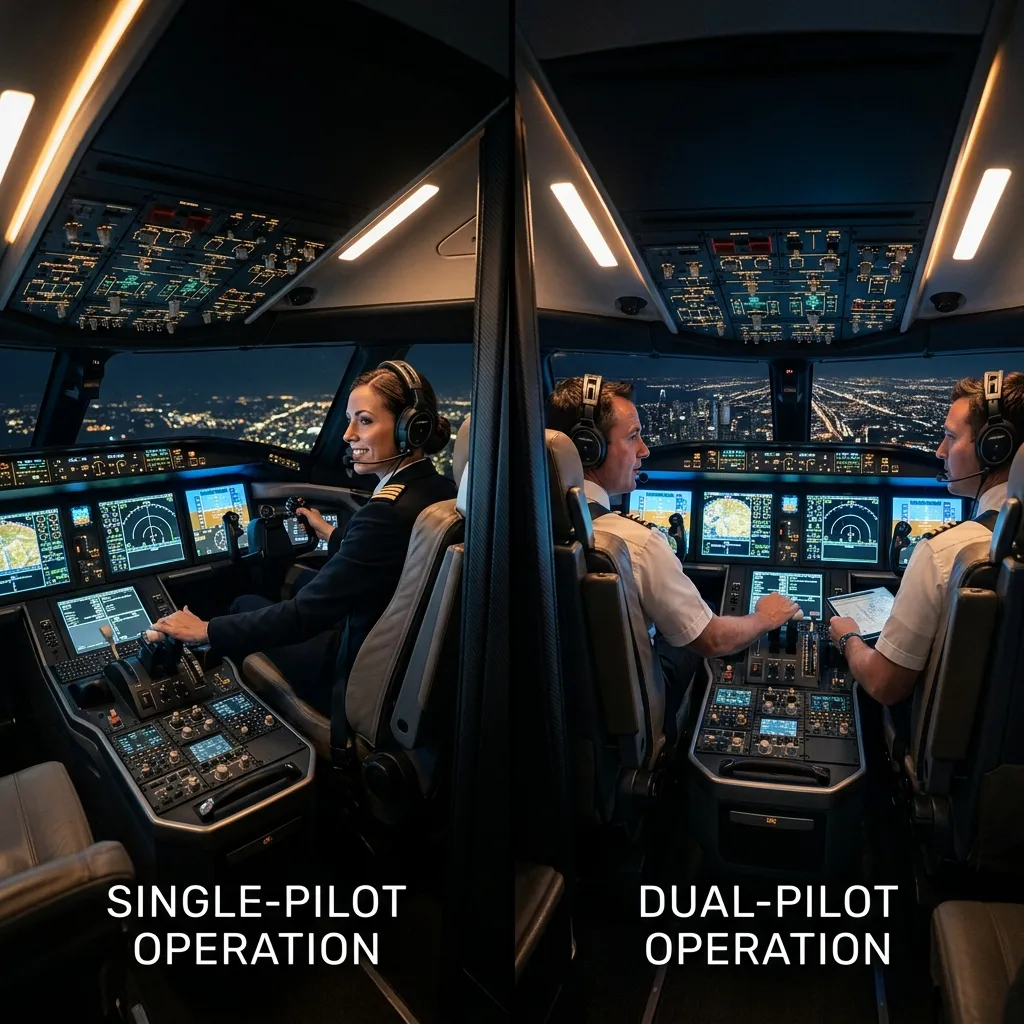
Single-pilot certification means the aircraft was designed and type-certificated for operation by one pilot. The pilot must hold a type rating for the specific aircraft (except Eclipse 500/550, which require only a jet type rating endorsement). Insurance companies may require additional minimums: typically 500-1,000 hours total time and 25-100 hours in type before approving single-pilot coverage.
The Embraer Praetor 500 and 600 are the longest-range single-pilot certified jets in the world. The Praetor 600 at 4,018 nm can fly New York to London single-pilot, though insurance requirements and pilot fatigue make single-pilot transatlantic operations unusual in practice. Most owner-pilots use the single-pilot certification for domestic flying and add a contract SIC (second-in-command) for international trips.
The Economics of Flying Single-Pilot
A full-time second-in-command (SIC) costs $85,000-$130,000 in annual salary plus $35,000-$50,000 in benefits, training, and travel expenses. Total annual cost: $120,000-$180,000. For an owner-pilot flying 200-400 hours per year, eliminating the SIC saves $300-$900 per flight hour in crew cost alone.
The savings come with conditions. Insurance premiums for single-pilot operations run 15-30% higher than two-pilot premiums on the same aircraft: $8,000-$15,000 more per year depending on the owner-pilot's experience level and annual hours. Some underwriters require 250-500 hours of dual-pilot operation before approving single-pilot coverage. A few underwriters will not write single-pilot policies at all.
Contract SIC services offer a middle path. Companies like PilotPool, Contract Crew Solutions, and various regional services provide qualified SICs at $400-$800 per day plus travel expenses. An owner-pilot flying 200 hours might hire a contract SIC for 50 of those hours (long trips, IFR in weather, unfamiliar airports) and fly single-pilot for the remaining 150 hours. Annual SIC cost: $10,000-$20,000 instead of $120,000-$180,000.
The Most Popular Owner-Pilot Jets
The Phenom 300E dominates the owner-pilot segment by unit sales and flight hours. Its combination of 2,010 nm range, 8-10 passenger cabin, single-pilot Garmin Prodigy Touch avionics, and $9.65 million price creates a compelling package. The Phenom 300 series has led light jet deliveries for 11 consecutive years. Approximately 35-40% of Phenom 300/300E aircraft are owner-flown.
The Citation CJ3+ and CJ4 Gen2 hold the second tier. Cessna's CJ line was designed from inception for owner-pilot operation: simple systems, single-pilot Garmin G3000 avionics, and docile handling characteristics that reward procedural flying. The CJ3+ offers 2,040 nm range at $8.9 million. The CJ4 Gen2 stretches to 2,165 nm and 9 passengers at $10.2 million. Together, the CJ3 and CJ4 families represent the largest single-pilot fleet in business aviation.
The Cirrus Vision Jet SF50 occupies a unique niche: the personal jet. Its single Williams FJ33 engine, built-in CAPS (Cirrus Airframe Parachute System), and Garmin Perspective Touch+ avionics target high-time Cirrus piston pilots stepping up to jet aviation. At $2.6-$3.2 million pre-owned, the SF50 is the lowest-cost jet currently in production (new list: $3.25 million). Its 1,275 nm range and single-engine configuration limit its mission scope but match the typical owner-pilot profile: 300-700 nm domestic trips.