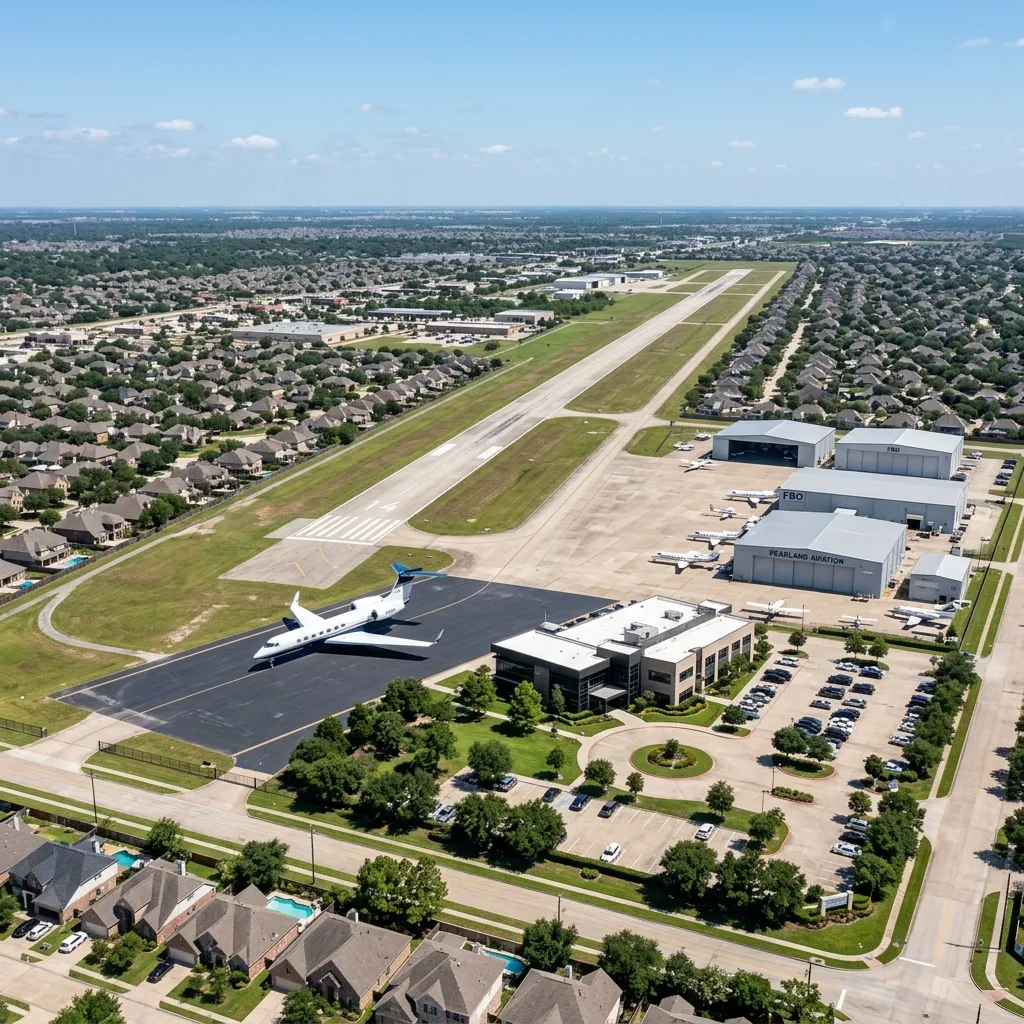
Aerial view of Sugar Land Regional Airport runway and surrounding Houston suburban development

Sugar Land Regional Airport: Houston's Quieter Private Aviation Gateway

undefined

In This Article

Houston Has Five Airports. Sugar Land Is the One You Want. FBO Options: Galaxy FBO and Henriksen Jet Center Ground Transportation and Drive Times Why Charter Operators Prefer SGR Over Hobby Limitations: When Sugar Land Does Not Work Frequently Asked Questions

Houston Has Five Airports. Sugar Land Is the One You Want.

The Houston metropolitan area offers five airports with private jet access: George Bush Intercontinental (IAH), William P. Hobby (HOU), Ellington Field (EFD), West Houston (IWS), and Sugar Land Regional (SGR). Of these, IAH and Hobby handle 95% of commercial traffic and the congestion that comes with it. ATC delays at IAH average 12-18 minutes during peak hours. Hobby's general aviation ramp shares taxiways with Southwest Airlines' 180+ daily departures. Sugar Land Regional handles approximately 4,200 private jet operations annually with none of that friction.

KSGR sits 22 miles southwest of downtown Houston in Fort Bend County, the wealthiest county in the Houston metropolitan area. The airport's single runway, 17/35, measures 8,000 feet of grooved asphalt with ILS and GPS approaches on both ends. That accommodates every business jet in production, including heavy jets like the G650 and Global 7500. The tower operates 6 AM to 10 PM local time; after hours, KSGR reverts to uncontrolled operations on the CTAF.

FBO Options: Galaxy FBO and Henriksen Jet Center

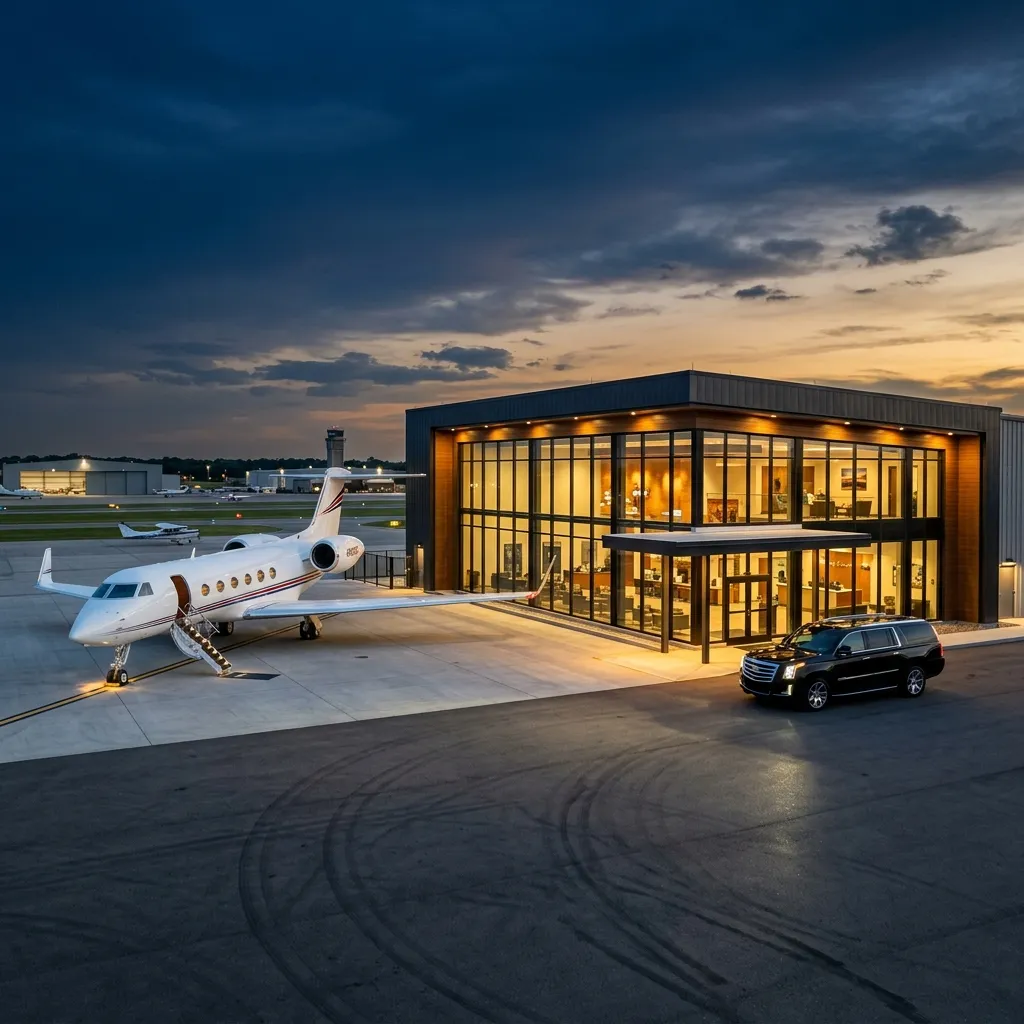
Sugar Land has two fixed-base operators. Galaxy FBO operates the primary facility on the south side of the field with a 15,000-square-foot terminal, three hangars (accommodating up to G650-size aircraft), a conference room, crew lounge with sleeping quarters, and a covered ramp with space for 20+ aircraft. Galaxy handles the majority of transient private jet traffic.

Henriksen Jet Center operates from the north side of the field. Its terminal is smaller but the service model focuses on personalized handling for repeat clients. Henriksen's fuel pricing is often competitive with Galaxy, and both offer Jet-A from contract fuel providers. Fuel at SGR runs $5.80 to $7.00 per gallon, consistently $0.50-$1.00 below Hobby Airport's FBO pricing.

8,000 ft
Runway Length
2 FBOs
Private Terminals
20 min
Drive to Galleria
4,200
Annual Jet Movements

Hangar Availability

Based aircraft at SGR include approximately 45 turbine aircraft (jets and turboprops). Hangar space is available for transient aircraft at both FBOs, though summer months require advance reservation to avoid ramp parking in Houston's 100°F heat. Hangar rates for overnight storage run $300-$600 for light and midsize jets and $600-$1,200 for heavy jets. Monthly hangar leases for based aircraft start at $2,500 for T-hangars and $5,000-$12,000 for heated/cooled community hangars.

Ground Transportation and Drive Times

Sugar Land's location in southwest Houston places it closer to the Galleria, Memorial, Katy, and the Energy Corridor than either IAH or Hobby. The drive time math favors SGR for business travelers headed to the western half of the metro area. For travelers headed to downtown Houston or the Medical Center, Hobby (20-25 minutes) is marginally closer.

Both FBOs arrange car service, rental vehicles, and helicopter transfers. Uber and Lyft reliably service the airport with 3-5 minute pickup times. For clients visiting the Sweetwater, Telfair, or Sienna communities (Fortune 500 executive neighborhoods), Sugar Land is a 10-minute door-to-door commute from the aircraft.

Need a Charter Quote?

Contact our team for a personalized quote.

Get a Quote

Why Charter Operators Prefer SGR Over Hobby

From an operator's perspective, Sugar Land offers three advantages over Hobby. First, lower landing fees. KSGR charges $50-$150 per landing based on aircraft weight versus Hobby's $150-$400 range. Second, faster taxi times. SGR's single runway and compact layout mean taxi from ramp to takeoff roll averages 3-5 minutes. Hobby's taxi averages 10-15 minutes during commercial bank hours. Third, no slot restrictions. Hobby implements flow control during peak hours; SGR does not.

The cumulative time savings at SGR versus Hobby adds up. Shorter taxi, no ATC hold, no flow control delay, faster FBO processing (no terminal security screening), and a 5-minute shorter ground transport to western Houston destinations. For a business executive who values the 30-45 minutes that private aviation is supposed to save, SGR delivers that promise more consistently than Hobby.

  • Landing fees: $50-$150 at SGR vs $150-$400 at Hobby
  • Average taxi time: 3-5 min at SGR vs 10-15 min at Hobby
  • Ramp-to-car time: 5 min at SGR vs 10-15 min at Hobby (terminal processing)
  • Fuel cost savings: $0.50-$1.00 per gallon lower than Hobby FBOs
  • No slot restrictions or flow control at SGR

Limitations: When Sugar Land Does Not Work

Sugar Land is not the right airport for every Houston trip. The tower closes at 10 PM, and while after-hours operations are permitted (uncontrolled), some corporate flight departments and insurance policies restrict operations at untowered fields after dark. Aircraft exceeding 100,000 lbs MTOW (Boeing Business Jets, Airbus ACJ) face ramp weight limitations at both FBOs; call ahead for clearance.

International flights require customs clearance. SGR has a U.S. Customs port of entry, but CBP staffing is limited and requires 24-48 hour advance notice. Hobby and IAH offer 24/7 CBP services. For flights arriving from Mexico, the Caribbean, or Central America, Hobby's customs capability is materially better.

Noise abatement procedures apply. Residential development has encroached on the airport's traffic pattern over the past decade. Sugar Land enforces a voluntary curfew from 10 PM to 7 AM and recommends noise abatement departure headings that add 2-3 minutes to southbound departures. These are advisory, not mandatory, but operators who routinely violate them risk community complaints and political pressure on airport management.

Brian Galvan

Written By

Brian Galvan

Founder, The Jet Finder · Private Aviation Operations & Technology

Former Director of Technology at FlyUSA (Inc. 5000 fastest-growing private jet company). Decade of hands-on experience across Part 135 operations, charter sales, fleet management, and aviation data systems.

LinkedInRead Full Profile →
Common Questions

Frequently Asked Questions


8 questions about chartering this aircraft

KSGR's Runway 17/35 is 8,000 feet long and 100 feet wide with grooved asphalt surface. It offers ILS approaches on both ends (ILS Runway 17 and ILS Runway 35), GPS RNAV approaches with LPV minimums, and VOR approaches. The ILS to Runway 35 has 200-foot decision height minimums. The runway also has PAPI lights on both ends and REIL on Runway 17. Medium-intensity runway edge lights support night operations.

Jet-A fuel at Sugar Land's two FBOs ranges from $5.80 to $7.00 per gallon for transient aircraft. Hobby Airport FBOs (Atlantic Aviation, Signature Flight Support) typically price $0.50-$1.00 higher at $6.30-$8.00 per gallon. IAH's FBO fuel runs $6.50-$8.50. Contract fuel programs through CAA, Colt, or UVair offer additional discounts of $0.30-$0.70 per gallon at SGR. For a midsize jet burning 200 gallons, the savings from fueling at SGR versus Hobby range from $100-$200 per stop.

Yes, KSGR has a CBP port of entry designation. However, customs staffing is limited and requires 24-48 hours advance notice through your FBO or operator to schedule an officer. Same-day customs clearance is not guaranteed. For international arrivals requiring guaranteed CBP availability, Hobby Airport (KHOU) offers more consistent staffing with 24/7 processing. Ellington Field (KEFD) is another nearby option with customs capability and lower traffic volume than Hobby.

SGR's 8,000-foot runway accommodates the full range of business jets. Regular operators include light jets (Citation CJ3, Phenom 300), midsize jets (Citation XLS, Hawker 800XP), super-midsize jets (Challenger 350, Citation Latitude), and heavy jets (Gulfstream G550, G650, Global 6000). Approximately 45 turbine aircraft are based at the field. The most common transient visitors are midsize jets serving Houston's energy sector executives.

SGR operates under a voluntary noise abatement program. The airport recommends a voluntary curfew from 10 PM to 7 AM local time for jet operations. Departure procedures recommend a heading of 170° (southbound) after takeoff from Runway 17 to avoid overflying the Telfair and Riverstone communities before turning on course. Runway 35 departures should maintain runway heading until reaching 3,000 feet MSL. These procedures are advisory and not FAA-mandated, but operators who routinely disregard them generate community complaints.

The Texas Medical Center (the world's largest medical complex) is approximately 22 miles northeast of KSGR, a 25-minute drive via US-59. MD Anderson Cancer Center, Houston Methodist, and Texas Children's Hospital are all within the Medical Center campus. Memorial Hermann Sugar Land hospital is only 5 minutes from the airport. For medevac and medical transport operations, SGR offers faster ramp access and shorter ground transfer times to Memorial Hermann Sugar Land than Hobby provides to the main Medical Center campus.

Several helicopter operators stage from SGR or can position to the airport within 30 minutes. Helicopter transfers to downtown Houston heliports take 12-15 minutes by air versus 30 minutes by car. Bristow Group and PHI Aviation maintain Gulf Coast operations that can be chartered through their Part 135 certificates. Helicopter-to-jet transfers at SGR are less common than at Hobby but available by arrangement through either FBO. Expect $2,500-$4,500 for a one-way helicopter transfer to downtown Houston.

KSGR's tower operates from 6 AM to 10 PM local time. After tower closure, the airport becomes uncontrolled Class G airspace. Pilots self-announce on the CTAF frequency (118.35 MHz) and execute published instrument approaches or visual patterns without ATC guidance. This is standard procedure at hundreds of U.S. airports. Most charter operators and corporate flight departments have no restriction on operating at untowered fields. Some insurance policies require IFR-rated pilots for after-hours operations at uncontrolled fields; verify with your operator.

Continue Reading

Related Articles


Your Next Mission

Ready to Fly?


Whether you need a charter quote or want to explore aircraft options, our team is here.

Contact Us