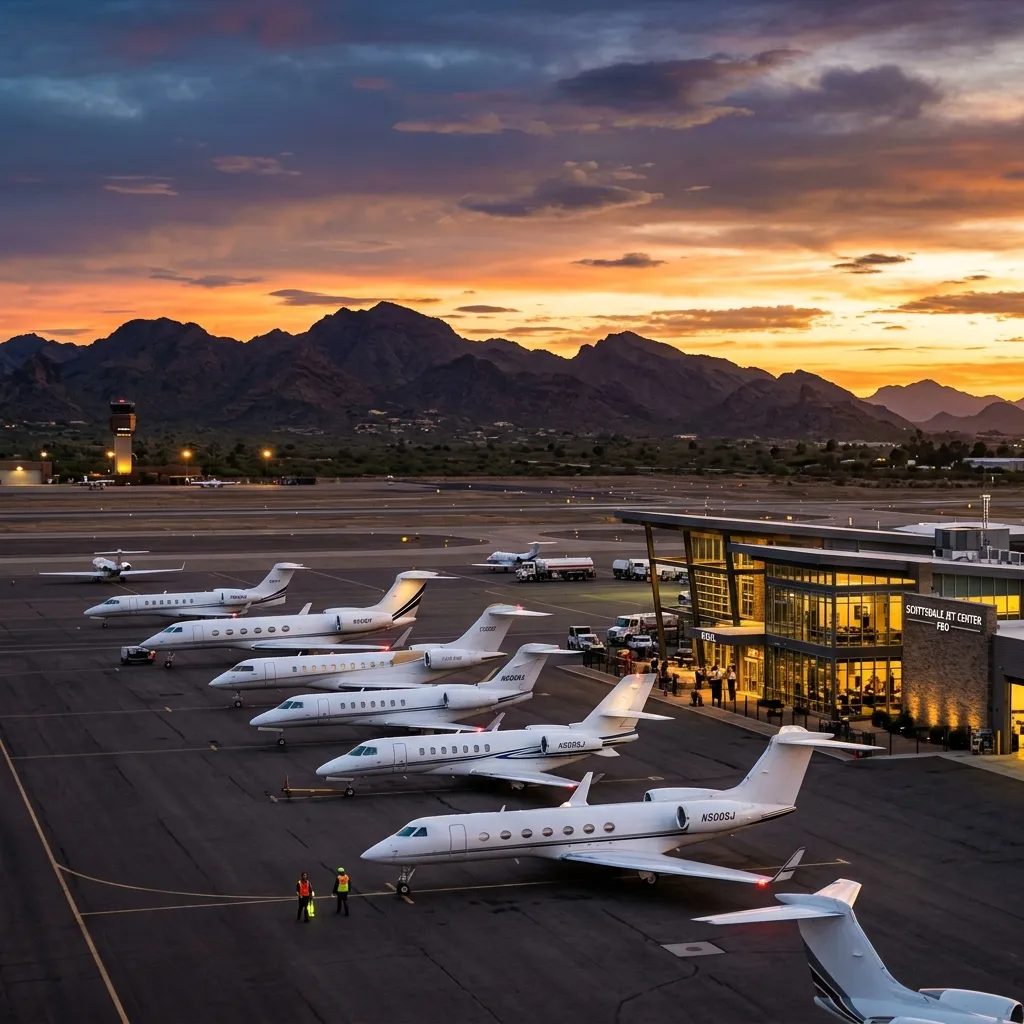
Scottsdale Airport ramp with private jets and the McDowell Mountains in the background at sunset

Scottsdale Airport: Where Noise Curfews Meet Desert Demand

Scottsdale Airport sits in the middle of a residential neighborhood that voted it into existence and then spent 40 years trying to make it quieter. Here is how that tension shapes every charter operation at SDL.

In This Article

The Airport: 8,249 Feet in the Middle of North Scottsdale Noise Restrictions: The Rules That Shape Your Schedule FBO Competition: Three Options, Distinct Positioning Seasonal Demand: The January-to-March Crush Density Altitude: The Heat Tax on Performance SDL vs Phoenix Deer Valley (DVT): Which Airport to Choose Frequently Asked Questions

The Airport: 8,249 Feet in the Middle of North Scottsdale

Scottsdale Airport (SDL/KSDL) sits at 1,510 feet elevation in the heart of North Scottsdale, Arizona. The single runway (3/21) is 8,249 feet long and 150 feet wide, which comfortably accepts everything from turboprops to heavy jets like the Gulfstream G650 and Global 7500. The field handles approximately 180,000 annual operations, making it one of the busiest single-runway airports in the country for general aviation.

The airport is surrounded on three sides by residential neighborhoods (Gainey Ranch to the south, McCormick Ranch to the west, Kierland to the northwest) and by the Scottsdale Airpark commercial district to the north. This geographic reality is the source of every operational restriction the airport imposes. The people who live around SDL pay property taxes that fund the city services that maintain the airport. They also call the noise complaint hotline.

SDL is owned and operated by the City of Scottsdale. It is not an FAA-contracted tower. The control tower operates from 6 AM to 9 PM local time. After tower closure, the airport transitions to CTAF (Common Traffic Advisory Frequency) procedures.

Noise Restrictions: The Rules That Shape Your Schedule

Scottsdale Airport enforces a tiered noise restriction program that affects departure and arrival scheduling for charter passengers:

  • Before 10 PM: No noise restrictions. All aircraft types operate normally.
  • 10 PM to 7 AM: Voluntary noise abatement procedures. Pilots are requested to use Runway 21 (southbound departure) to direct noise away from residential areas. Departure noise should not exceed 85 dBA at the monitoring stations.
  • Midnight to 6 AM: Strongly discouraged operations. The airport is technically open 24 hours, but the city's noise abatement program tracks all operations during this window and contacts operators who fly during these hours.
  • Stage 2 aircraft: Prohibited at all times. Only Stage 3 and Stage 4 compliant aircraft may operate at SDL.

The noise restrictions are voluntary, not regulatory. The FAA prevents municipally-owned airports from banning operations outright. But the City of Scottsdale maintains a noise monitoring system with permanent stations around the airport perimeter, and operators who consistently violate the voluntary curfew receive letters, then meetings with the airport director, then public shaming at city council meetings. In practice, the voluntary restrictions function as mandatory for operators who want to maintain their FBO leases.

If your charter is scheduled to arrive after 10 PM, confirm with the operator that they are comfortable with a late arrival at SDL. Some operators will divert to Phoenix Deer Valley (DVT) or Mesa Gateway (IWA) rather than land at SDL after curfew. This is a business decision, not a regulatory one. The operator is protecting their relationship with the airport.

FBO Competition: Three Options, Distinct Positioning

Scottsdale Airport has three full-service FBOs competing for charter and transient traffic. The competitive dynamic keeps service standards high and pricing competitive.

Signature Flight Support

Signature operates the largest facility at SDL with a recently renovated terminal, conference rooms, crew lounge, and a full concierge desk. Fuel pricing is competitive with published rates. Signature handles the highest volume of transient traffic at SDL, particularly during peak events (Super Bowl, Waste Management Phoenix Open, Barrett-Jackson auction). Ramp space can be tight during January-March peak season.

Ross Aviation

Ross Aviation (formerly Scottsdale Air Center) is an independent FBO with a strong local reputation. The facility is smaller than Signature but consistently rated among the top independent FBOs in the Southwest for customer service. Ross operates a full-service maintenance facility on-site, which is useful for operators who need minor squawk repairs during a stay. Fuel pricing is typically $0.10-$0.30 per gallon below Signature.

AeroGuard Flight Training Center

AeroGuard primarily serves flight training but handles transient general aviation traffic. Not a full-service FBO for charter passengers but an option for owner-pilots in light aircraft who want lower ramp fees.

Need a Charter Quote?

Contact our team for a personalized quote.

Get a Quote

Seasonal Demand: The January-to-March Crush

Scottsdale's private aviation traffic follows the desert calendar. Peak season runs from early January through late March, driven by snowbird migration, spring training, and a dense event calendar.

During Super Bowl weeks, SDL operates at maximum capacity and overflow traffic diverts to Phoenix Deer Valley (DVT, 15 minutes north) and Phoenix-Mesa Gateway (IWA, 45 minutes southeast). FBO slots at SDL during Super Bowl weekend sell out weeks in advance. If you are flying in for the game, book your FBO parking slot before you book the charter.

Summer traffic drops 40-50% as temperatures exceed 110°F and the snowbird population departs. Charter rates to Scottsdale in July are 15-25% lower than January rates. For travelers who can handle the heat, summer is the value season.

Density Altitude: The Heat Tax on Performance

SDL sits at 1,510 feet elevation in a desert environment where summer temperatures regularly exceed 110°F. At 115°F and 1,510 feet field elevation, the density altitude at SDL can reach 4,500-5,000 feet. This affects takeoff performance for every aircraft type.

A Gulfstream G550 that requires 5,910 feet of runway at sea level and standard temperature may require 6,800+ feet at SDL on a 115°F afternoon. The 8,249-foot runway provides sufficient margin, but lighter jets with higher wing loading (Learjet 60, Citation XLS) may face payload restrictions during the hottest hours. Operators routinely schedule departures before 10 AM or after 6 PM during summer to mitigate density altitude penalties.

Turboprops and very light jets are the most affected. A King Air 350 departing SDL at maximum gross weight on a 115°F day will use nearly the full runway. A Pilatus PC-12 may require reducing passengers or fuel. Pilots who operate into SDL during summer months factor density altitude into every dispatch decision.

SDL vs Phoenix Deer Valley (DVT): Which Airport to Choose

Phoenix Deer Valley (DVT) sits 15 miles northwest of SDL and serves as the primary alternative for private aviation in the north Phoenix/Scottsdale corridor. DVT has two runways (7,100 ft and 4,500 ft), lower ramp fees, and no noise curfew. The drive from DVT to central Scottsdale (Kierland, Scottsdale Quarter, Old Town) takes 20-30 minutes.

Choose SDL if: Your destination is in Scottsdale, Gainey Ranch, or Paradise Valley. The drive from SDL to most Scottsdale resorts (Sanctuary, Four Seasons, Fairmont Princess) is under 15 minutes. SDL's location advantage over DVT eliminates 20-30 minutes of ground time each way.

Choose DVT if: You are arriving after 10 PM, departing before 6 AM, flying during Super Bowl week with no SDL ramp reservation, or operating a noisier older jet that may trigger SDL noise monitors. DVT has no curfew, lower traffic, and generally lower fuel pricing.

Brian Galvan

Written By

Brian Galvan

Founder, The Jet Finder · Private Aviation Operations & Technology

Former Director of Technology at FlyUSA (Inc. 5000 fastest-growing private jet company). Decade of hands-on experience across Part 135 operations, charter sales, fleet management, and aviation data systems.

LinkedInRead Full Profile →
Common Questions

Frequently Asked Questions


6 questions about Scottsdale Airport for private jet operations

The City of Scottsdale uses a noise monitoring system with permanent measurement stations around the airport perimeter to track every operation between 10 PM and 7 AM. Operators who consistently fly during restricted hours receive formal letters from the airport director. Repeat offenders are discussed at public city council meetings and face political pressure that can affect FBO lease negotiations. The enforcement is social and commercial, not regulatory. Most charter operators treat the voluntary curfew as mandatory because the cost of damaging their relationship with the airport and its FBOs exceeds the revenue from a single late-night departure.

SDL's 8,249-foot runway and 150-foot width accommodate all current production business jets without restriction, including the Gulfstream G700 (99,600 lbs MTOW, 103-foot wingspan) and Global 7500 (104,800 lbs MTOW, 104-foot wingspan). The only aircraft-level restriction is the prohibition on Stage 2 noise-compliant engines, which excludes certain older jets like unremodified Gulfstream IIs and early Falcon 20s. Runway load-bearing capacity (PCN) supports all business jet wheel loads without weight waivers.

Yes. Ross Aviation operates a full-service maintenance facility on the SDL airfield with A&P mechanics available for unscheduled squawk repairs, tire changes, and minor avionics troubleshooting. This is unusual among FBOs; most FBOs contract maintenance out to a separate MRO. For charter operators whose aircraft develops a hydraulic leak or avionics fault during an overnight in Scottsdale, Ross can often return the aircraft to service by the next morning without repositioning to a maintenance base. Signature Flight Support at SDL does not have an in-house maintenance shop.

SDL is centrally located for Scottsdale destinations. The Fairmont Scottsdale Princess is 8 minutes away. Sanctuary on Camelback Mountain is 15 minutes. TPC Scottsdale (home of the WM Phoenix Open) is 10 minutes. Old Town Scottsdale is 12 minutes. Kierland Commons and Scottsdale Quarter are 5 minutes. Paradise Valley resorts (Hermosa Inn, Mountain Shadows) are 15-20 minutes. The location advantage over Phoenix Deer Valley (DVT) is 20-30 minutes less drive time to most Scottsdale destinations.

Ramp fees at SDL's FBOs range from $100 to $400 depending on aircraft size and parking duration. Both Signature and Ross typically waive ramp fees with a minimum fuel purchase (usually 100-200 gallons depending on aircraft category). During peak events like the Waste Management Phoenix Open or Super Bowl, overnight parking surcharges of $200-$500 may apply regardless of fuel purchase. Reserve parking slots 3-4 weeks ahead for major events; walk-up availability during tournament week is effectively zero for large-cabin jets.

At 115°F and SDL's 1,510-foot field elevation, density altitude reaches 4,500-5,000 feet. A Gulfstream G550 requiring 5,910 feet at sea level standard temperature may need 6,800+ feet at SDL on a peak-summer afternoon. The 8,249-foot runway provides margin for heavy jets, but lighter types face payload limits. Operators routinely schedule summer departures before 10 AM or after 6 PM to mitigate density altitude penalties. A Citation XLS departing at 7 AM versus 3 PM in July gains approximately 800 feet of runway performance margin.

Continue Reading

Related Articles


Your Next Mission

Ready to Fly?


Whether you need a charter quote or want to explore aircraft options, our team is here.

Contact Us