Why Scottsdale Airport Instead of Sky Harbor
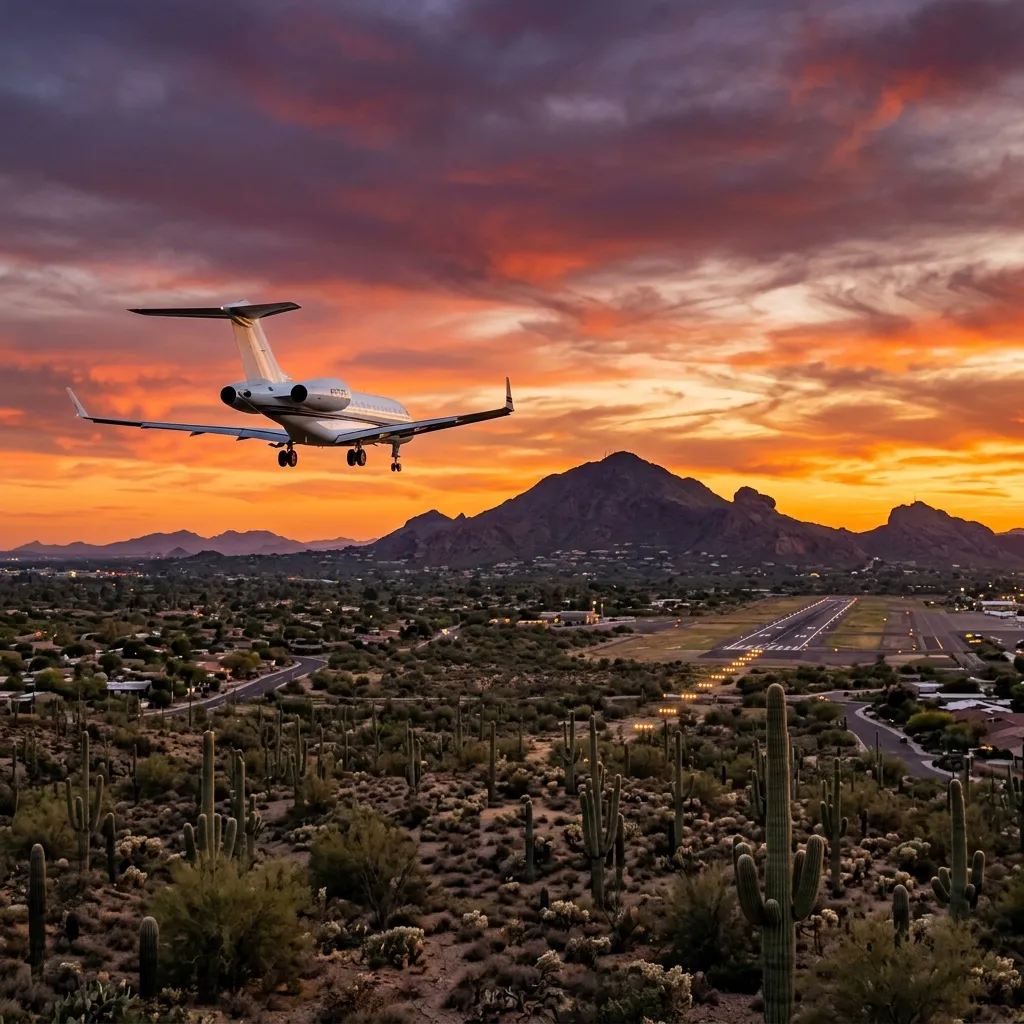
Scottsdale Airport (KSDL) sits at the intersection of Hayden Road and the 101 Loop, four miles northeast of Old Town Scottsdale. Phoenix Sky Harbor (PHX) is 12 miles south. The distance alone does not explain why 160,000 annual flight operations choose SDL over a commercial airport with longer runways and ILS approaches. The answer is speed on the ground.
A charter passenger landing at Scottsdale Airport clears the FBO and reaches The Phoenician, Sanctuary on Camelback, or the Boulders Resort in 15 minutes. The same passenger landing at Sky Harbor faces 35-45 minutes of highway traffic through the Phoenix urban core. For a client arriving Thursday evening for a long weekend, that 30-minute difference is the entire value proposition.
160,000+
Annual Operations
SDL Runway and Arrival Procedures
Scottsdale has a single runway: 3/21, measuring 8,249 feet long and 100 feet wide with asphalt surface. That length accommodates every aircraft from a Phenom 100 to a Gulfstream G550. A Gulfstream G650 can land at SDL but faces takeoff weight restrictions on hot summer days when density altitude pushes effective runway performance.
Density Altitude: The Desert Factor
SDL sits at 1,510 feet MSL. During July and August, surface temperatures regularly reach 115°F, pushing density altitude above 4,000 feet. That reduces engine thrust and increases required takeoff roll. A Citation XLS that needs 3,500 feet in January may need 4,800 feet in July. Operators flying heavy jets into SDL during summer months calculate performance charts carefully and sometimes reduce payload to maintain takeoff margins.
The RNAV GPS approach to Runway 21 and the VOR approach to Runway 3 are the primary instrument procedures. SDL does not have an ILS. In practice, Scottsdale weather rarely requires precision approaches; the airport averages 299 days of sunshine per year. Fog and low ceilings are statistically irrelevant.
FBOs at Scottsdale Airport
Two FBOs operate at SDL: Signature Flight Support and Scottsdale AirCenter (formerly Ross Aviation). Both occupy the west side of the field and offer full-service ground handling, Jet-A fueling, passenger lounges, crew rest areas, and ground transportation coordination.
Signature Flight Support
Signature's Scottsdale location is one of its highest-volume facilities nationally. The terminal was renovated in 2022 with a southwest-modern interior featuring desert stone, leather seating, and floor-to-ceiling windows overlooking the ramp. Conference rooms are available for passenger use. Valet parking, rental car delivery to the ramp, and complimentary snack service are standard. Jet-A pricing runs $7.50 to $8.50 per gallon with volume discounts for purchases above 500 gallons.
Scottsdale AirCenter
AirCenter operates from the north end of the west ramp. The facility is smaller but maintains a loyal operator base that prefers its pricing. Jet-A averages $0.30-$0.50 per gallon below Signature. The trade-off is a more modest terminal with fewer passenger amenities. For operators who pass fuel savings to charter clients, AirCenter is the preferred stop.
During peak season (January through April), both FBOs operate at near-capacity ramp utilization. Overnight hangar space must be reserved 48-72 hours in advance or the aircraft sits on the ramp in 100-degree heat.
Charter a Jet to Scottsdale
We source aircraft for Scottsdale arrivals from operators across the country.
Request a Quote →The SDL Noise Curfew: What You Need to Know
Scottsdale Airport enforces a voluntary noise curfew from 9 PM to 7 AM and a mandatory curfew from 10 PM to 7 AM for Stage 2 aircraft. Stage 3 and Stage 4 aircraft (which includes every modern business jet) face voluntary restrictions between 9 PM and 7 AM, meaning operations are technically permitted but strongly discouraged by the airport authority.
In practice, the curfew shapes charter scheduling more than any other single factor at SDL. A dinner reservation at 8 PM in Scottsdale means your aircraft needs wheels down by 7:30 PM to clear the FBO and reach Old Town. A 9 PM dinner pushes your arrival past the voluntary curfew threshold. Operators regularly adjust departure times from origin cities to ensure SDL arrival before 9 PM.
- 7 AM - 9 PM: Unrestricted operations for all aircraft types.
- 9 PM - 10 PM: Voluntary quiet hours. Operations permitted but noise complaints are tracked and reported to operators.
- 10 PM - 7 AM: Mandatory curfew for Stage 2. Voluntary for Stage 3/4. Late arrivals are logged and repeated violations trigger conversations with the airport authority.
- Weekend/event exceptions: Major events (WM Phoenix Open, Barrett-Jackson, Super Bowl) see relaxed enforcement but not formal curfew suspension.
Peak Season: January Through the Phoenix Open
Scottsdale's charter season peaks between the first week of January and the last week of March. The Waste Management Phoenix Open in late January/early February is the single busiest week at SDL. During the 2026 tournament, SDL logged over 1,200 operations in five days. Both FBOs operated extended ramp hours and brought in temporary staff to manage the volume.
Spring training (February through March) adds sustained demand as groups fly in for Cactus League games at the 10 stadiums spread across the Scottsdale-Mesa-Tempe corridor. Barrett-Jackson's annual collector car auction in January creates a second demand spike that overlaps with resort season bookings.
Summer is the inverse. From June through September, SDL traffic drops 40-50% as temperatures make the Valley uninhabitable for casual travel. Charter rates on routes to Scottsdale drop accordingly. A Phenom 300 from Los Angeles that costs $5,500 one-way in February may price at $3,800 in July.
Alternative Airports: Deer Valley and Falcon Field
Phoenix Deer Valley (KDVT) sits 15 miles northwest of SDL. Its runway is shorter at 4,500 feet, limiting operations to light jets and turboprops. The advantage is lower ramp fees and better availability during peak SDL weekends. For passengers staying in North Scottsdale or Carefree, DVT is closer than SDL.
Falcon Field (KFFZ) in Mesa offers a 5,100-foot runway and serves the East Valley. It handles fewer business jets than SDL or DVT but provides uncongested access for light jet traffic headed to destinations south of the Loop 202. Spring training visitors attending games at Hohokam Stadium or Sloan Park find FFZ marginally more convenient than SDL.
Phoenix Sky Harbor (KPHX) remains the default for heavy jets that require longer runways or ILS approaches for scheduled arrivals in marginal weather. Atlantic Aviation operates the primary FBO at PHX with full heavy jet handling capability.