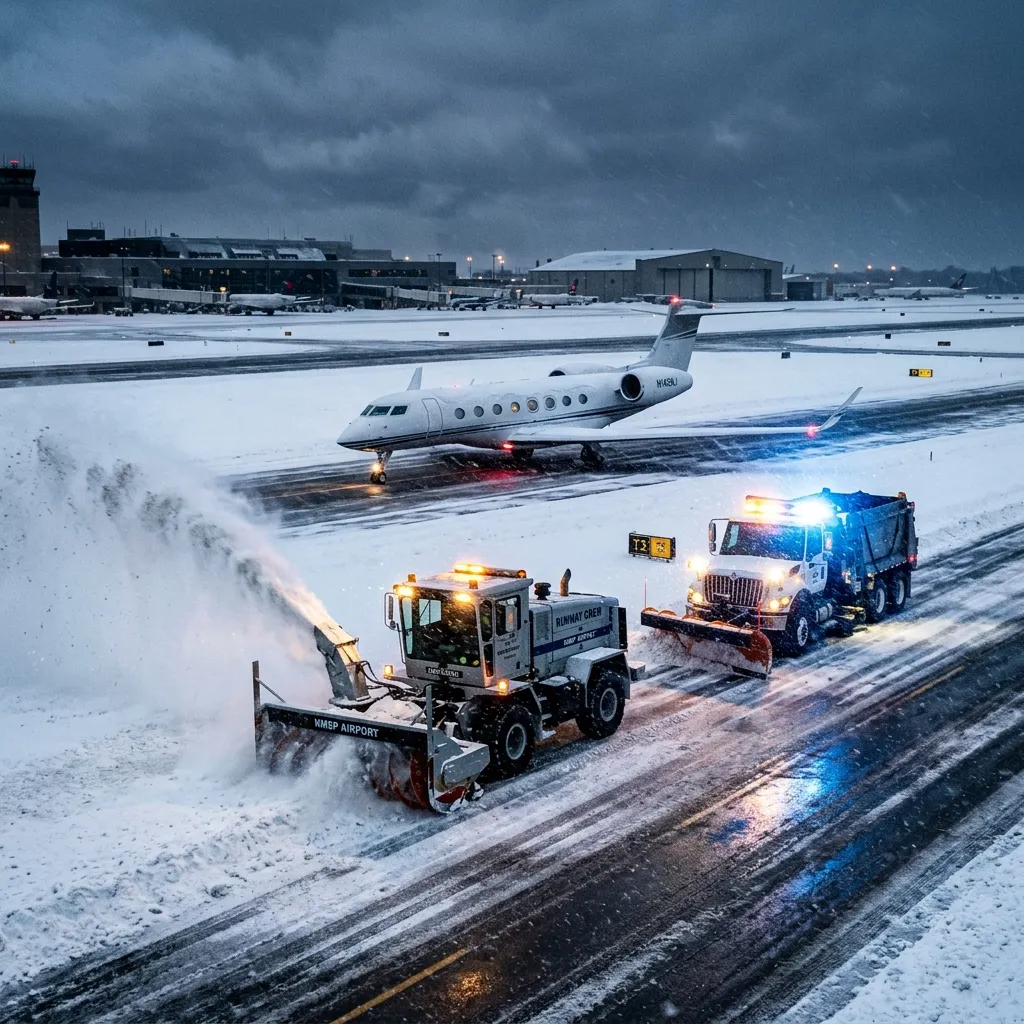
Airport runway with snow removal equipment clearing ice during winter operations

How Runway Condition Reporting Works: GRF, RCAM, and What Pilots Read Before Landing

Before October 2021, a pilot calling for runway conditions might hear 'fair braking action reported by a 737 ten minutes ago.' That is a subjective opinion from a different aircraft at a different weight on a runway that may have changed. The GRF fixed that.

In This Article

The Old System and Why It Failed How the GRF and RCAM Work How Airport Operators Assess Runway Conditions What GRF Means for Charter Passengers GRF Limitations: What the System Does Not Cover Frequently Asked Questions

The Old System and Why It Failed

Before the Global Reporting Format (GRF) took effect in the United States on October 1, 2021, runway braking conditions were reported using subjective pilot reports (PIREPs): 'good,' 'fair,' 'poor,' or 'nil.' A pilot who landed and reported 'fair braking' on Runway 28L was sharing a subjective assessment that depended on the aircraft type, landing weight, speed, and tire condition. A Boeing 737 reporting 'fair' braking at 140 knots and 150,000 pounds does not tell a Gulfstream G550 pilot at 130 knots and 75,000 pounds anything actionable.

The NTSB identified subjective braking reports as a contributing factor in multiple runway excursion accidents. The most notable: the 2005 Southwest Airlines overrun at Chicago Midway (KMDW), where the Boeing 737 slid off the runway onto a road in a snowstorm. The crew had received a 'fair' braking action report from a preceding aircraft. The runway was icy.

The International Civil Aviation Organization (ICAO) developed the Global Reporting Format to replace subjective reports with standardized, objective assessments. The FAA adopted GRF via Advisory Circular 91-79A and SAFO 20009, making it mandatory for airports with Part 139 certificates.

How the GRF and RCAM Work

The GRF system has two components: the Runway Condition Assessment Matrix (RCAM), which translates observed contaminant types and depths into standardized condition codes, and the Runway Condition Report (RCR), which airport operators publish to pilots via ATIS, NOTAMs, and dispatch systems.

The Runway Condition Code: 0 Through 6

Each runway is divided into three equal-length zones (touchdown, midpoint, rollout). The airport operator assesses and reports a condition code for each zone independently. A runway might report 5/3/3, meaning the touchdown zone is wet (Code 5) but the mid-runway and rollout zones have dry snow exceeding 3mm (Code 3). Pilots use the lowest code in the three zones as the controlling condition for landing distance calculations.

How Airport Operators Assess Runway Conditions

Airport operations teams conduct runway condition assessments using a combination of visual inspection, contaminant depth measurement, and surface friction testing equipment. At major airports with full Part 139 certificates, assessments occur every 30-60 minutes during active precipitation and every 2-4 hours during stable winter conditions.

Contaminant Identification

The RCAM defines seven contaminant types: dry snow, wet snow, compacted snow, ice, wet ice, slush, and standing water. Each contaminant type maps to a specific condition code range in the RCAM table. Depth thresholds determine the code within the range: dry snow less than 3mm is Code 4; dry snow greater than 3mm is Code 3.

Airport inspectors measure contaminant depth using calibrated depth gauges at standardized points along the runway. The assessment is objective and repeatable, unlike the old system where a maintenance truck driver might radio 'looks like about half an inch of slush' to the tower.

Publication and Distribution

Runway condition reports are published via ATIS (Automatic Terminal Information Service), D-ATIS (digital ATIS), and NOTAMs. The report format includes: runway designator, condition codes for all three zones (e.g., 5/5/3), contaminant type and depth for each zone, and the time of assessment. Pilots receive this data through their dispatch system, ACARS datalink, or by listening to the ATIS broadcast during approach.

Need a Charter Quote?

Contact our team for a personalized quote.

Get a Quote

What GRF Means for Charter Passengers

Charter passengers do not interact with runway condition codes directly. But GRF affects trip outcomes during winter weather in three ways:

1. Landing Distance Requirements

Each runway condition code maps to a landing distance correction factor. A runway with Code 3 conditions may require 1.5x the dry-runway landing distance. For a Gulfstream G550 that needs 2,770 feet to land on a dry runway, Code 3 conditions extend the required distance to approximately 4,155 feet. If the available runway is 5,000 feet, the G550 can still land. If the available runway is 4,000 feet, the pilot diverts.

2. Airport Closures and Diversions

When runway condition codes drop to 1 (poor) or 0 (nil), most charter operators will not dispatch to that airport regardless of runway length. The risk of a runway excursion at Code 0 is unacceptable. The aircraft diverts to an alternate airport with better conditions. For passengers flying to Aspen (ASE), Sun Valley (SUN), or Jackson Hole (JAC) in winter, diversions due to runway conditions are more common than diversions due to visibility.

3. Delay for Runway Treatment

Airports treat contaminated runways with chemical deicing agents, plowing, and sweeping. Treatment converts a Code 2 runway to a Code 4 or 5, which is adequate for normal operations. However, treatment takes time. A runway closure for plowing and chemical treatment may last 20-45 minutes. During active snowfall, the runway may degrade from Code 5 back to Code 3 within 30 minutes of treatment. Pilots and dispatchers monitor conditions in real time and may hold or delay approach clearance until post-treatment conditions are confirmed.

GRF Limitations: What the System Does Not Cover

The GRF system is a significant improvement over subjective pilot reports, but it has limitations that pilots and operators must understand:

  • GRF applies only to the runway surface. Taxiways and ramp areas are not covered by the GRF reporting format. A runway with Code 5 conditions may connect to a taxiway with Code 1 ice conditions that are not formally reported.
  • GRF assessments are time-stamped snapshots. Conditions change between assessments. A Code 4 assessment taken 45 minutes ago may not reflect the Code 2 conditions that developed during continued snowfall.
  • Not all airports assess conditions with the same rigor. Part 139 airports with full operations staff produce consistent, high-quality assessments. Smaller uncontrolled airports may not produce GRF-compliant reports at all, reverting to pilot reports and tower observations.
  • The RCAM does not account for tire type, anti-skid system capability, or aircraft-specific braking performance. Pilots must apply aircraft-specific corrections to the GRF data using their aircraft's performance manual.

The GRF gives pilots a common language for runway conditions. It does not remove the need for judgment. A Code 3 runway at sea level on a 10,000-foot runway is a different operational decision than a Code 3 runway at 7,000 feet elevation on a 7,000-foot runway. The code is the starting point. The pilot's experience with the aircraft, airport, and conditions is the rest.

Brian Galvan

Written By

Brian Galvan

Founder, The Jet Finder ยท Private Aviation Operations & Technology

Former Director of Technology at FlyUSA (Inc. 5000 fastest-growing private jet company). Decade of hands-on experience across Part 135 operations, charter sales, fleet management, and aviation data systems.

LinkedInRead Full Profile →
Common Questions

Frequently Asked Questions


6 questions about runway condition reporting and the GRF/RCAM system

The FAA's Global Reporting Format (GRF), implemented October 1, 2021, replaced subjective braking action descriptions with standardized Runway Condition Codes (0-6). Under GRF, airport operators assess contaminant type and depth on three runway zones and report numeric codes using the Runway Condition Assessment Matrix (RCAM). Subjective pilot braking reports can still supplement GRF data, but the standardized codes are the primary reporting method.

The three numbers represent conditions in the runway's touchdown zone, midpoint zone, and rollout zone respectively. Code 3 indicates contaminants like wet snow or dry snow exceeding 3mm depth with medium braking action. Code 2 indicates worse conditions like wet compacted snow or standing water exceeding 3mm with medium-to-poor braking. The pilot uses the lowest code (2) as the controlling condition for landing distance calculations. This runway has deteriorating conditions toward the departure end.

Most Part 135 charter operators will not dispatch to a runway with condition codes below 2 (medium-to-poor braking). At Code 1 (poor braking / ice), the risk of a runway excursion is substantial. At Code 0 (nil braking / wet ice), landing is not attempted; the aircraft diverts. Some operators set their minimum at Code 3 as a matter of company policy, which is more conservative than the regulatory minimum.

At Part 139 certificated airports, runway condition assessments are conducted every 30-60 minutes during active precipitation and every 2-4 hours during stable post-storm conditions. After runway treatment (plowing, chemical deicing), the assessment is updated within 15-30 minutes to reflect improved conditions. The frequency of assessment varies by airport; some major airports maintain continuous assessment during winter operations.

Teterboro (TEB) is not Part 139 certificated because it has no scheduled airline service, so it is not required to publish GRF-compliant reports. The same applies to Van Nuys (VNY), Opa-locka (OPF), and most private aviation-only airports. These facilities may voluntarily issue runway condition information via NOTAMs or pilot reports, but the assessment methodology may not follow GRF standards. Pilots arriving at TEB during a winter storm may have less standardized surface data than at a Part 139 airport like Westchester County (HPN).

Mountain airports like Aspen face compounding factors: higher elevation reduces braking performance (thinner air means less aerodynamic drag), shorter runways leave less margin for error, and temperature inversions can create localized ice conditions that change rapidly. ASE publishes GRF-compliant runway condition reports and treats the runway aggressively during winter storms. However, the combination of a 7,006-foot runway at 7,820 feet elevation with Code 3 conditions creates performance constraints that would not exist at a sea-level airport with the same conditions.

Continue Reading

Related Articles


Your Next Mission

Ready to Fly?


Whether you need a charter quote or want to explore aircraft options, our team is here.

Contact Us