Same Market, Different Engineering
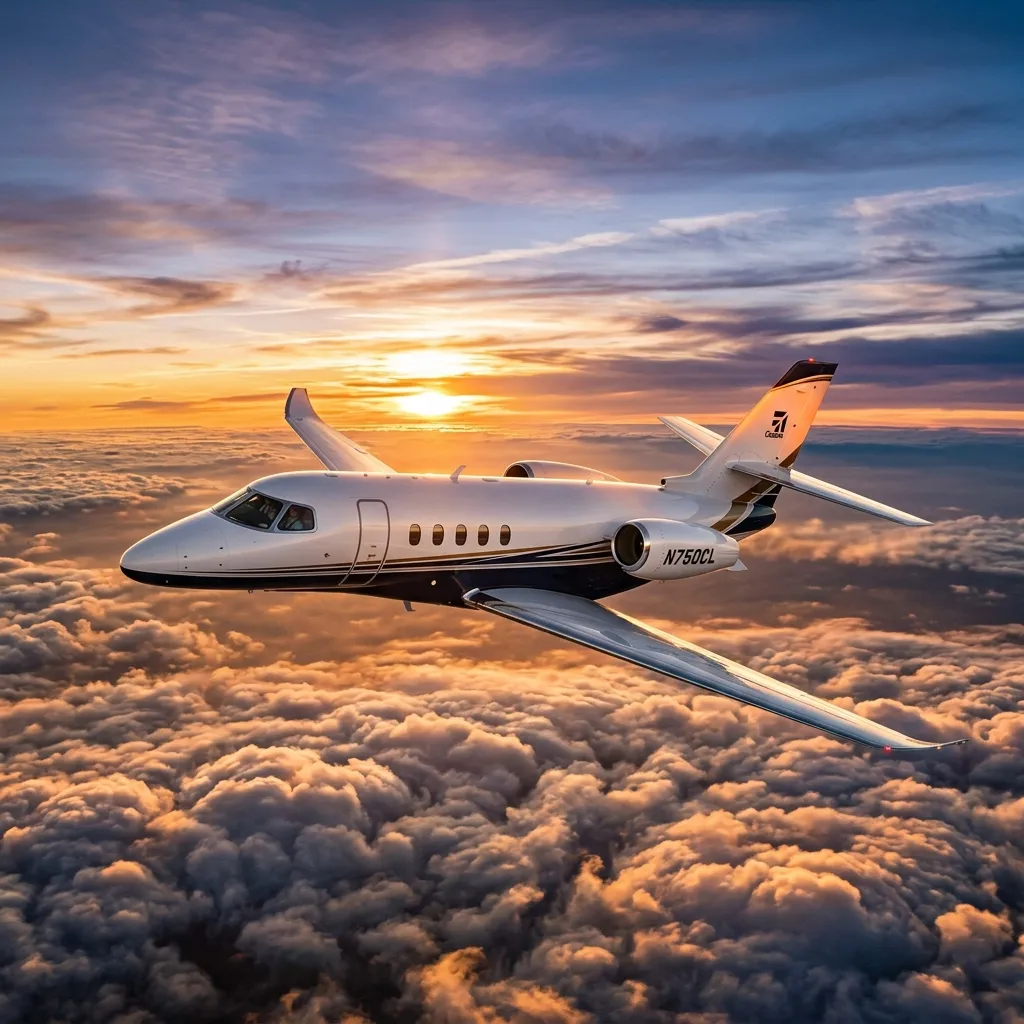
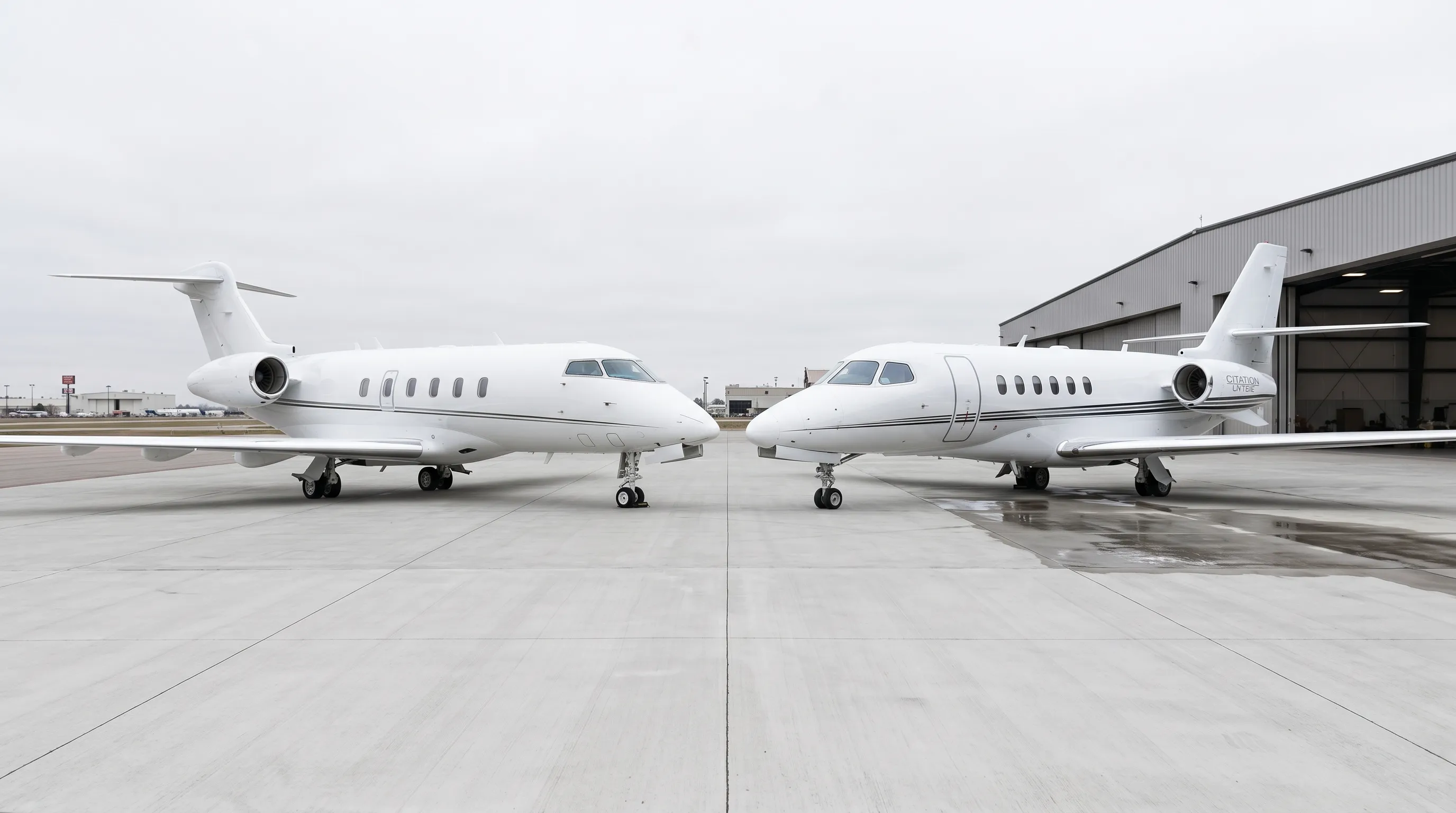
Cessna introduced the Citation Latitude in 2015 to a midsize market dominated by aging Hawker 800XPs and Citation Sovereigns. Embraer followed in 2019 with the Praetor 500, a redesign of the Legacy 450 with extended fuel tanks, new winglets, and upgraded avionics. Both aircraft seat nine passengers in a standard configuration. Both cruise above 40,000 feet. Both cost between $17 million and $20 million new. The similarities end there.
The Latitude has outsold the Praetor 500 by a factor of roughly four to one. As of early 2026, Cessna has delivered over 300 Latitudes compared to approximately 80 Praetor 500s worldwide. Fleet size matters. More aircraft in the charter pool means more availability, more competitive pricing, and more pilots with type ratings. The Praetor 500 counters with specifications that make the Latitude look like a previous-generation aircraft.
Specification Comparison: Where the Gap Opens
The Praetor 500 leads in range by 640 nautical miles, cabin length by 2.1 feet, baggage volume by 50 percent, and cruise speed by 17 knots. The Latitude leads in cabin width by half a foot, takeoff distance by 642 feet, and offers single-pilot certification. Neither advantage is trivial.
The Range Argument: 640 Nautical Miles of Difference
The Praetor 500's 3,340-nautical-mile range reaches city pairs the Latitude cannot cover nonstop. New York to London eastbound with a tailwind. Los Angeles to Honolulu. Miami to Bogotá. The Latitude's 2,700-nautical-mile envelope covers most domestic U.S. routing with comfortable reserves but runs out of fuel before reaching Europe or deep South America.
For operators whose flight schedules stay within the continental United States and Caribbean, the Latitude handles every realistic city pair. The Praetor 500 becomes essential when the mission set includes transatlantic positioning, Hawaii routing, or regular flights exceeding 2,500 nautical miles with full passenger loads and headwinds.
Cabin Width vs Cabin Length: The Engineering Trade-Off
The Latitude measures 6.4 feet wide. The Praetor 500 measures 5.9 feet. Half a foot of cabin width changes the shoulder-level experience in a four-seat club configuration. Two passengers sitting across from each other in the Latitude have noticeably more lateral breathing room. Laptop work in a club-seat arrangement is more comfortable in the wider cabin.
Where the Praetor 500 Recovers
The Praetor 500 compensates with 24 feet of cabin length versus the Latitude's 21.9 feet. Those extra 2.1 feet allow a more distinct separation between the forward club section and the aft seating area. For charter clients who treat the aft section as a work zone and the forward section as a meeting space, the additional length matters more than the width deficit.
Baggage is where the Praetor 500 pulls away decisively. At 150 cubic feet of in-flight accessible storage, it holds 50 percent more luggage than the Latitude's 100-cubic-foot compartment. Six passengers traveling with full roller bags, a golf bag, and ski equipment will fill the Latitude's hold. The Praetor 500 handles the same load with room to spare.
Width determines comfort on a two-hour flight with four passengers. Length and baggage capacity determine viability on a four-hour flight with six passengers and winter gear. The mission profile should drive the decision, not the brochure.
Need a Charter Quote?
Contact our team for a personalized quote.
Get a Quote →Fly-By-Wire: What Passengers Actually Feel
The Praetor 500 is one of only three business jets in its size class with full fly-by-wire flight controls (the others being the Praetor 600 and Dassault Falcon 6X). Conventional cable-and-pulley systems in the Latitude respond to control inputs through mechanical linkages. Fly-by-wire processes pilot inputs through computers that optimize surface deflections for efficiency, structural load protection, and ride quality.
In turbulence, the difference is perceptible. The Praetor 500's flight computers dampen gust response faster than mechanical systems can react. Passengers on the Praetor 500 experience noticeably smoother rides in convective weather. The system also provides envelope protection, preventing the aircraft from exceeding structural limits regardless of pilot input. During approach in gusty crosswind conditions, the fly-by-wire system reduces workload measurably.
The Counter-Argument
Conventional controls in the Latitude are simpler to maintain. No flight control computers to replace at $200,000 per unit. No software updates requiring Embraer service center visits. The Latitude's Pratt & Whitney PW306D1 engines and Garmin G5000 avionics are widely supported across hundreds of Cessna service centers in North America. The Praetor 500 depends on Embraer's smaller authorized service network, concentrated in 14 U.S. locations.
Operating Economics: The Latitude's Strongest Card
The Citation Latitude burns approximately 165 gallons per hour at long-range cruise. The Praetor 500 burns approximately 190 gallons per hour. At $6.50 per gallon average fuel cost, the Latitude saves $162 per flight hour in fuel alone. Over 400 annual flight hours, that gap represents $65,000.
Annual Cost Comparison (Owner-Operated, 400 Hours)
- Fuel: Latitude $429,000 vs Praetor 500 $494,000 ($65,000 advantage Latitude)
- Maintenance reserves: Latitude $400,000 vs Praetor 500 $460,000 (PW306D1 has extensive field support and competitive reserve rates)
- Crew: Similar at $350,000 to $400,000 for two pilots. Latitude's single-pilot cert saves crew cost for owner-operators with type ratings
- Insurance: Latitude $95,000 vs Praetor 500 $115,000 (lower hull values and larger fleet create actuarial advantages)
- Charter hourly rate: Latitude $4,000 to $4,800 vs Praetor 500 $4,800 to $5,400
Total annual operating cost advantage for the Latitude: approximately $120,000 to $150,000. That gap narrows significantly when the Praetor 500's additional range eliminates fuel stops. A single fuel stop on a coast-to-coast flight adds $3,000 to $5,000 in ramp fees, handling charges, and time. An operator averaging 20 such fuel stops annually erases most of the Latitude's cost advantage.
The Charter Client's Decision
Charter clients booking a midsize jet for a 1,200-nautical-mile domestic flight will notice the Latitude's wider cabin and lower hourly rate. They will not notice the Praetor 500's range advantage or fly-by-wire smoothness on a calm-air, two-hour flight.
Charter clients booking a 2,800-nautical-mile transcontinental flight with six passengers and luggage will notice the Praetor 500's direct routing, additional baggage space, and ride quality in weather. They will pay $600 to $800 more per hour for the privilege. Whether that premium buys measurable value depends entirely on the routing.
When Each Aircraft Wins
- Latitude wins: Flights under 2,200 NM, price-sensitive missions, owner-operators who fly single-pilot, markets where availability matters (300+ aircraft in service vs ~80)
- Praetor 500 wins: Flights over 2,500 NM, full-cabin loads with heavy luggage, turbulence-prone routing, operators who value fly-by-wire smoothness and envelope protection
- Draw: Coast-to-coast with four passengers, light luggage, clear weather. Both aircraft complete the mission without compromise
The Latitude is the Toyota Land Cruiser of midsize jets. Reliable, widely available, cost-effective, excellent at 90 percent of missions. The Praetor 500 is the Range Rover. Better ride quality, more capability, higher operating cost, smaller service network. Both get you where you are going. The question is how much the journey matters.