Twelve Years at Number One: Not an Accident
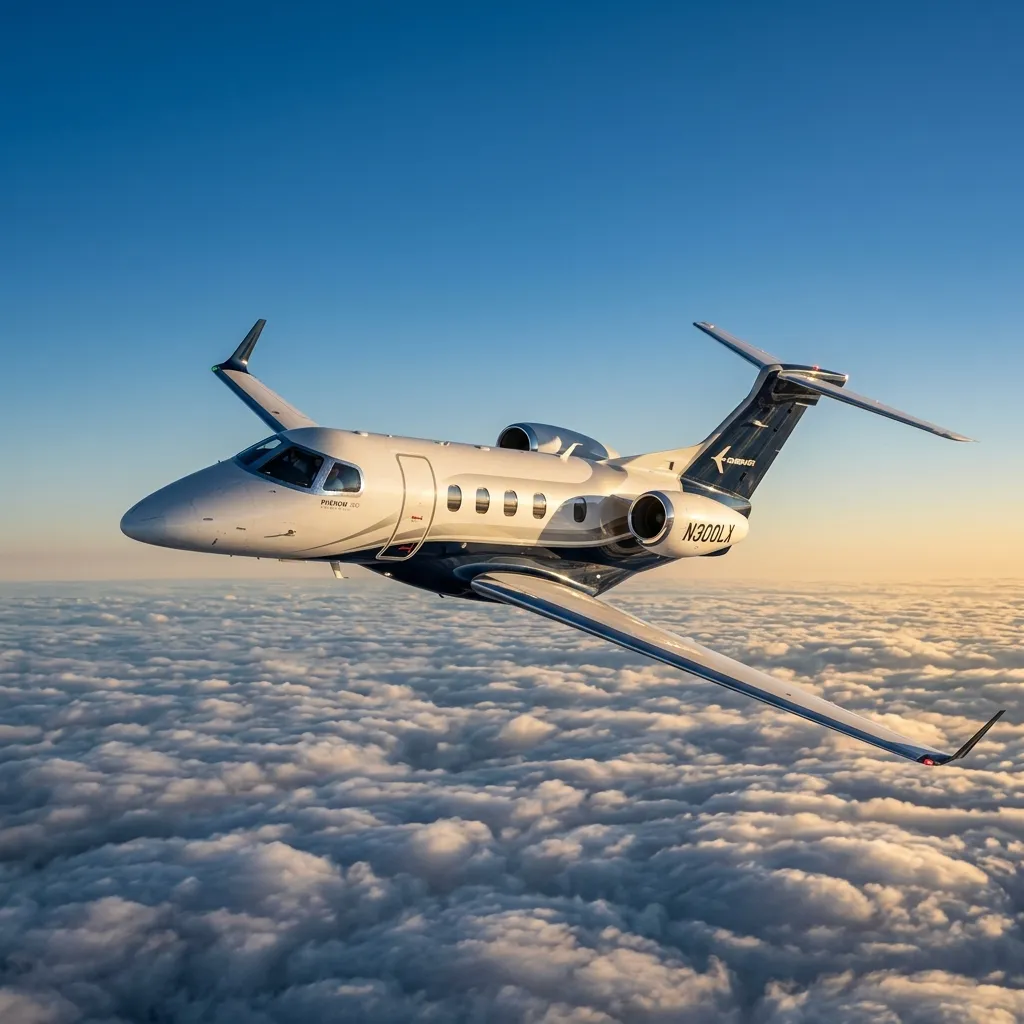
Embraer delivered 54 Phenom 300/300E aircraft in 2024, maintaining its position as the world's best-selling light jet for the twelfth consecutive year. Total deliveries since 2009 exceed 700 airframes across 37 countries. That delivery volume creates a self-reinforcing advantage: more aircraft on the market means more maintenance facilities, more available parts, more trained pilots, and more pre-owned inventory for buyers who want to enter the market below new-delivery pricing.
The dominance did not happen because the Phenom 300 is the fastest light jet (the Citation CJ4 matches its speed) or the longest-range (the Learjet 75 exceeds it). It happened because Embraer found the intersection of cabin size, operating cost, single-pilot capability, and runway performance that no competitor matched simultaneously. The Phenom 300 is not the best at any single metric. It is the least compromised across all of them.
The Engineering Decisions That Define the Aircraft
The Phenom 300's competitive position rests on four engineering choices that Embraer made before the first prototype flew in 2008:
The Pratt & Whitney PW535E1 engines
Each PW535E1 produces 3,360 lbs of thrust, giving the Phenom 300 a combined 6,720 lbs at a maximum takeoff weight of 18,387 lbs. That thrust-to-weight ratio (0.366) is the highest in the light jet segment. The practical result: 3,138 feet of takeoff distance at sea level and strong climb performance that gets the aircraft to FL430 in under 24 minutes. The engines burn a combined 135 gallons per hour at long-range cruise, putting fuel cost at roughly $776/hr at $5.75/gal.
The wing
Embraer applied its regional jet aerodynamic expertise to the Phenom 300's wing design. The swept wing (14.4-degree sweep angle) with advanced profiles delivers efficient cruise at Mach 0.78 while maintaining docile low-speed handling characteristics. The wing is wet (integral fuel tanks) with a total fuel capacity of 5,080 lbs, enough for 2,010 nm with NBAA IFR reserves and 4 passengers.
Single-pilot certification
The Phenom 300 received single-pilot certification from the FAA, allowing owner-operators to fly without a second crewmember. This certification, combined with the Garmin G3000 Prodigy Touch avionics suite, reduced the operating cost floor for private owners who fly themselves. A single-pilot owner eliminates $120,000-$180,000 in annual crew costs. Approximately 35-40% of Phenom 300s in the U.S. fleet are owner-flown at least part of the time.
The flat-floor cabin
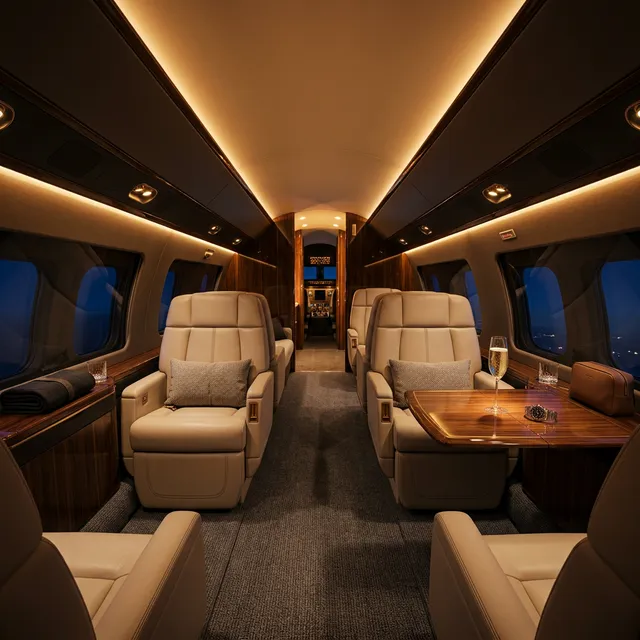
At 17.2 feet long, 5.1 feet wide, and 4.9 feet high, the Phenom 300's cabin is larger than any competing light jet. The flat floor (no step-up from the entry) and 4-place club seating with a side-facing fifth seat (or belted lavatory seat) give it a cabin feel closer to midsize jets than to the CJ3 or Learjet 75. The 84 cubic feet of baggage capacity, accessible in flight through an internal baggage door, exceeds the CJ4's 77 cubic feet and the Learjet 75's 65 cubic feet.
Phenom 300 vs. 300E: The Upgrade That Matters
Embraer introduced the Phenom 300E (Enhanced) in 2018 with modifications that addressed the original aircraft's two primary limitations: cruise speed and cabin noise.
The 300E increased maximum cruise speed from 446 knots to 453 knots through engine software optimization and aerodynamic refinements to the winglets. More importantly, it reduced cabin noise by 3 dB through additional insulation and structural damping, moving the Phenom 300E from 'acceptable for a light jet' to 'competitive with midsize jets' on the cabin noise spectrum.
| Specification | Phenom 300E | Citation CJ4 | Learjet 75 Liberty |
|---|---|---|---|
| Charter Rate (2026) | $2,400-$3,400/hr | $2,600-$3,600/hr | $2,800-$3,800/hr |
| Max Cruise Speed | 453 kts | 453 kts | 465 kts |
| Range (4 pax, NBAA IFR) | 2,010 nm | 2,165 nm | 2,040 nm |
| Cabin Width | 5.1 ft | 4.8 ft | 5.0 ft |
| Cabin Length | 17.2 ft | 17.3 ft | 17.7 ft |
| Baggage Volume | 84 cu ft | 77 cu ft | 65 cu ft |
| Single-Pilot Certified | Yes | Yes | No |
| New Delivery Price | ~$10.5M | ~$9.7M | Discontinued |
| Fuel Burn (LRC) | 135 gph | 142 gph | 155 gph |
| Takeoff Distance (SL) | 3,138 ft | 3,410 ft | 3,950 ft |
The avionics upgrade from Prodigy Touch G3000 to Prodigy Touch with runway overrun awareness and protection (ROAAP), autothrottle, and enhanced stability protection brought the 300E closer to the automation level of midsize jets costing $10M-$15M more. For single-pilot operators, the autothrottle alone justifies the upgrade: it reduces workload during approach and landing, the highest-workload phase of flight for a single pilot.
Pre-owned pricing reflects the difference. A 2015 Phenom 300 (original) trades at $5.5M-$7M. A 2020 Phenom 300E trades at $8M-$10.5M. The $2.5M-$3.5M premium buys the speed increase, noise reduction, autothrottle, and newer maintenance status.