Two Turboprops, One Lineage, Different Missions
The King Air 200 entered production in 1974. The King Air 350 followed in 1990. Both share Beechcraft's T-tail silhouette, Pratt & Whitney Canada PT6A engines, and a reputation for operating into airports that jets cannot reach. But 16 years of engineering evolution separate them, and that gap shows up in range, cabin volume, payload, and hourly operating cost. In 2026, the 200 charters at $1,800 to $2,400 per hour. The 350 runs $2,400 to $3,200. The question is whether the extra $600-$800 per hour buys enough mission capability to justify the premium.
There are approximately 1,900 King Air 200-series airframes on the U.S. registry and roughly 850 King Air 350-series. Combined, they represent the largest turboprop fleet in business aviation. Both types are available for charter in virtually every U.S. market.
Performance Specifications Compared
The 350's performance advantage comes from more powerful engines and a longer wing. The PT6A-60A on the 350 produces 1,050 shaft horsepower per side, versus the 200's PT6A-42 at 850 SHP. That 24% power increase translates to a 23-knot speed advantage at max cruise and 226 NM of additional range.
The 200 wins on two metrics: takeoff distance and fuel economy. Its 2,579-foot ground roll opens grass strips, mountain airstrips, and rural fields that even the 350 cannot use without weight restrictions. That 721-foot advantage matters at airports like Telluride (6,870 ft runway at 9,070 ft elevation) and backcountry strips throughout Montana and Idaho.
Cabin Dimensions: Where the 350 Pulls Away
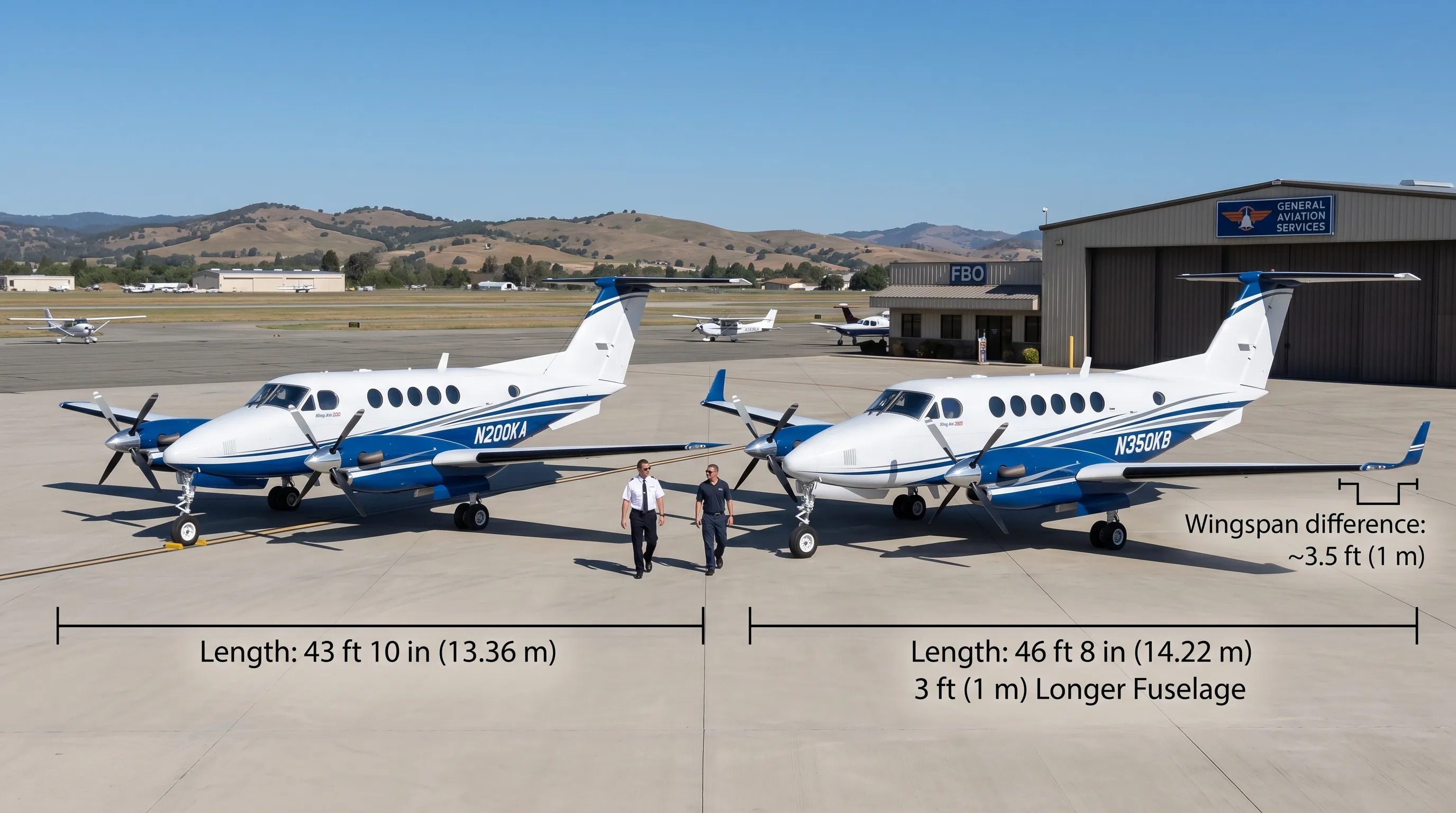
The King Air 350's cabin is meaningfully larger. Beechcraft stretched the fuselage by 34 inches over the 200, adding a third row of seats and genuine stand-up headroom for passengers under 5'9". The 200's cabin requires most adults to crouch while moving to their seat.
Both aircraft share a 4.5-foot cabin width and 4.8-foot height, which is narrower than any light jet. Seats are arranged in a facing club configuration. The 200 typically seats 7 passengers in charter configuration with a small refreshment station. The 350 seats 9 to 11 in a double-club with a forward-facing row. For groups of 5 or fewer, the cabin size difference is academic. For groups of 7-9, only the 350 works without squeezing.
The King Air 350's 55-cubic-foot baggage compartment is externally accessible and pressurized. The 200's baggage area holds 33 cubic feet. For hunting trips, ski gear, or golf clubs, the 350's cargo advantage is the deciding factor.
Charter Economics: When the 200 Wins on Price
The King Air 200's operating cost advantage is substantial. Fuel burn at typical cruise power runs 100 gallons per hour versus the 350's 130 gallons. At $6.50 per gallon, that is $650 per hour versus $845 per hour in fuel alone. Engine maintenance reserves are lower because the PT6A-42 overhaul costs $200,000 to $250,000 per engine versus $300,000 to $380,000 for the PT6A-60A. Insurance, inspection costs, and crew salaries are comparable.
Route-Specific Pricing Comparison
On short legs under 300 NM, the 200 saves $1,200 to $1,800 per trip. That gap narrows on longer flights because the 350's speed advantage reduces block time. On a 600 NM leg, the 350 arrives 15-20 minutes earlier. If you are chartering for time-sensitive business travel, that speed premium has real value. If you are moving 4 passengers to a fishing lodge 200 miles away, the 200 is the smarter spend.