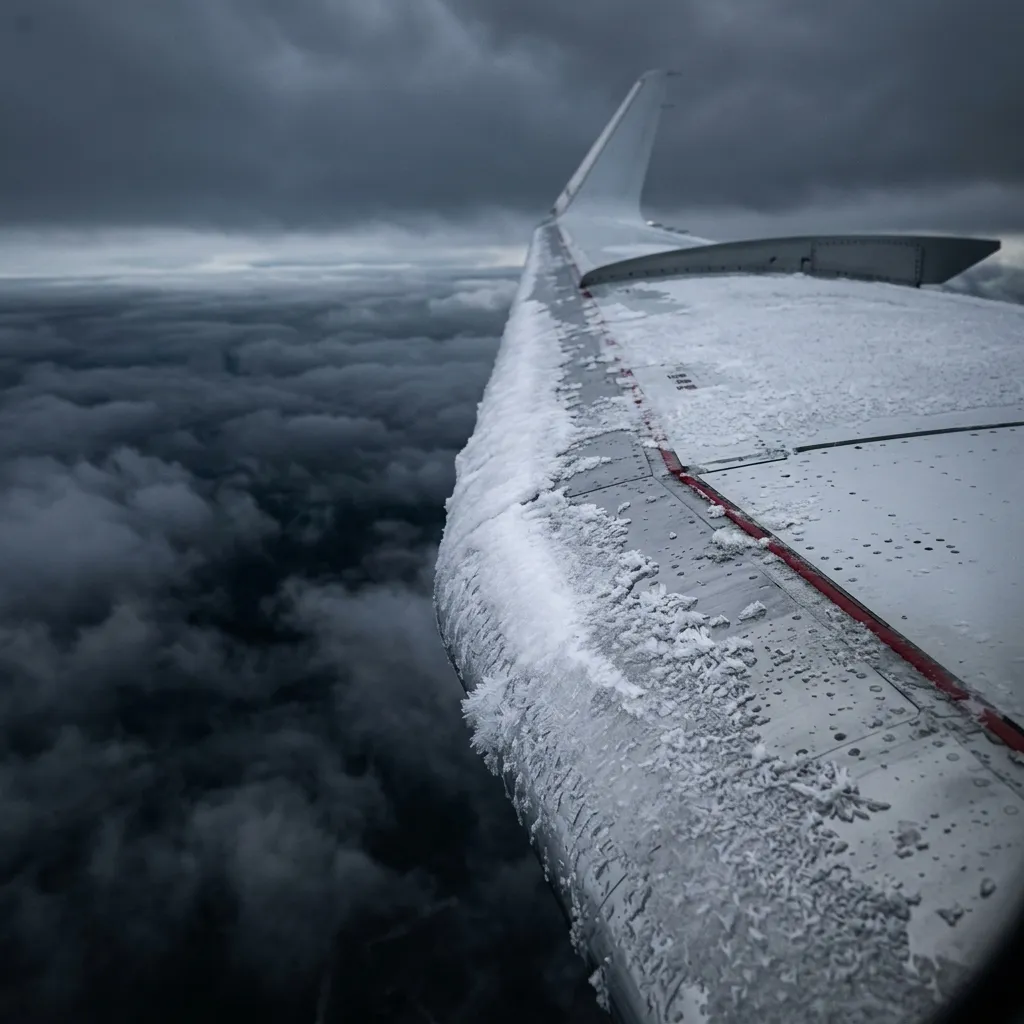
Private jet wing with ice accumulation visible on the leading edge during winter flight

How Icing Affects Business Jet Performance: What Charter Clients Should Understand

Half an inch of ice on a wing leading edge reduces lift by 25 percent and increases stall speed by 15 knots. Every business jet certified for flight into known icing carries systems to prevent this. Here is how they work and when they fail.

In This Article

What 0.5 Inches of Ice Does to a Wing Where and When Icing Occurs Anti-Ice vs De-Ice: Two Different Systems Ground De-Icing: What Happens Before Takeoff What Charter Clients Should Know About Winter Flights Frequently Asked Questions

What 0.5 Inches of Ice Does to a Wing

NASA Langley Research Center studies demonstrate that 0.5 inches of rough ice accumulation on a wing leading edge reduces maximum lift coefficient by 25 percent and increases aerodynamic drag by 40 percent, based on over 2,000 hours of icing wind tunnel testing at NASA Glenn Research Center. The ice disrupts the smooth airflow that generates lift by creating surface roughness where the wing's designed contour should be. Stall speed increases by 10 to 15 knots. Takeoff distance extends by 20 to 30 percent. Fuel consumption rises by 15 to 25 percent because the engines must overcome the additional drag.

These are not theoretical numbers. They are measured values from icing wind tunnel tests conducted at NASA Glenn Research Center's Icing Research Tunnel and validated by in-flight testing on instrumented aircraft. The effects compound: 1 inch of ice is not twice as bad as 0.5 inches. It is exponentially worse because the disrupted airflow over the first 0.5 inches creates turbulent boundary layers that amplify the effect of additional accumulation.

Where and When Icing Occurs

Icing requires three simultaneous conditions: visible moisture (clouds or precipitation), air temperature between 0°C and -20°C (32°F to -4°F), and an aircraft surface at or below 0°C. Below -20°C, water droplets in clouds are typically already frozen as ice crystals that bounce off aircraft surfaces rather than adhering. Between -5°C and -15°C, supercooled liquid water droplets remain liquid despite being below freezing, and they freeze instantly on contact with any surface. This temperature range produces the most severe icing.

Common Icing Altitudes

  • Sea level to 8,000 feet: Freezing rain and freezing drizzle. The most dangerous icing type because droplets are large and freeze on contact across wide surface areas. Often occurs ahead of warm fronts.
  • 8,000 to 18,000 feet: The primary icing band for business aviation. Stratiform clouds at these altitudes frequently contain supercooled water during winter months across the northern United States.
  • 18,000 to 25,000 feet: Moderate icing possible in convective clouds (thunderstorms) and at the tops of thick stratiform layers. Less common than lower altitudes.
  • Above 25,000 feet: Icing is rare because temperatures are typically below -40°C. Most water exists as ice crystals at these altitudes. Business jets cruising at FL400 to FL510 operate above the icing layer.

The most effective icing escape for any business jet is altitude. Climbing to FL250 or higher places the aircraft above 95 percent of icing conditions. This is one reason business jets routinely climb to FL400 to FL510 for cruise: the air is too cold and too dry for liquid water to exist.

Anti-Ice vs De-Ice: Two Different Systems

Business jets use two fundamentally different approaches to manage ice, and most aircraft carry both systems for different airframe components:

Anti-Ice (Prevention)

Anti-ice systems prevent ice from forming by heating surfaces before ice can accumulate. Business jets use engine bleed air (hot compressed air from the engines) routed through ducts along wing leading edges, engine nacelle inlets, and horizontal stabilizer leading edges. The bleed air heats the surface to above 0°C, preventing supercooled water from freezing on contact. Anti-ice is proactive: pilots activate it before entering icing conditions.

  • Wing leading edge hot-air anti-ice: Standard on all Part 25 certified business jets. Uses engine bleed air at 200°C+ routed through piccolo tubes.
  • Engine nacelle inlet anti-ice: Prevents ice ingestion into the engine. Mandatory activation when operating in visible moisture below 10°C.
  • Windshield electric anti-ice: Heated glass or conductive film layers prevent windshield icing. Separate from airframe systems.
  • Pitot tube and AOA vane heating: Prevents ice blockage of critical flight instruments. Automatic on most modern business jets.

De-Ice (Removal)

De-ice systems remove ice after it has accumulated. Turboprops like the King Air 350 and PC-12 use pneumatic de-ice boots: rubber bladders bonded to wing and tail leading edges that inflate cyclically (every 60 to 90 seconds) to crack accumulated ice, which is then carried away by airflow. Business jets rarely use boots. Their bleed-air anti-ice systems prevent accumulation rather than removing it. However, some aircraft surfaces (like stabilizer tips and winglets) may use electric de-ice pads that cycle on and off.

Need a Charter Quote?

Contact our team for a personalized quote.

Get a Quote

Ground De-Icing: What Happens Before Takeoff

When ice, frost, or snow contaminates aircraft surfaces on the ground, the aircraft must be de-iced before takeoff. FAA regulations (14 CFR 91.527 for large aircraft and 14 CFR 135.227 for charter operations) prohibit takeoff with frost, ice, or snow adhering to any critical surface. Ground de-icing is a separate process from in-flight ice protection.

The De-Icing Process

  • Type I fluid: Heated glycol-based fluid sprayed at 140°F to 180°F to remove existing contamination. Orange-colored. No holdover time; used only to remove ice.
  • Type IV fluid: Applied over clean surfaces after Type I treatment. Green-colored. Provides holdover protection of 45 to 80 minutes depending on temperature and precipitation type. Prevents re-contamination during taxi and takeoff preparation.
  • Cost: Ground de-icing for a midsize jet costs $1,500 to $4,000 per application. Large-cabin jets cost $3,000 to $8,000 due to larger surface area and higher fluid volumes.
  • Holdover time: If the aircraft does not take off before holdover time expires, the de-icing process must be repeated. During heavy snowfall, holdover times can be as short as 15 minutes, creating urgency in the departure sequence.

Charter clients rarely see the de-icing process. It occurs on the ramp before passengers board or during the taxi sequence at larger airports with dedicated de-icing pads. The cost is typically passed through as a line item on the charter invoice. During heavy winter storms, de-icing can add 30 to 60 minutes to departure times and $2,000 to $8,000 to the trip cost.

What Charter Clients Should Know About Winter Flights

Private jet passengers benefit from ice protection systems that make winter flying safe and routine. The pilot handles all decisions regarding icing conditions. However, understanding the basics helps manage expectations:

  • Departure delays: Ground de-icing adds 20 to 60 minutes to departure in active precipitation. The crew will not rush this process.
  • Altitude changes: If icing is reported at cruise altitude (rare above FL300 but possible), the crew may climb or descend to exit the icing layer. This may increase fuel consumption and reduce range by 5 to 10 percent.
  • Route deviations: Severe icing forecasts (SLD, Supercooled Large Droplets) may cause the crew to select a routing that avoids the affected airspace entirely, adding 15 to 30 minutes to the flight.
  • Airport closures: Runway icing and braking action reports may close airports temporarily. Alternate airport planning is mandatory for winter IFR flights.
  • Cost implications: De-icing fluid, additional fuel for altitude deviations, and potential overnight stays at alternate airports can add $2,000 to $10,000 to a winter charter trip.

Every business jet certified for flight into known icing conditions (FIKI) carries systems designed to handle icing safely. The pilot's decision to delay, divert, or deviate is not overcaution. It is the reason business aviation's safety record in icing conditions has improved 400 percent since 1990.

Brian Galvan

Written By

Brian Galvan

Founder, The Jet Finder · Private Aviation Operations & Technology

Former Director of Technology at FlyUSA (Inc. 5000 fastest-growing private jet company). Decade of hands-on experience across Part 135 operations, charter sales, fleet management, and aviation data systems.

LinkedInRead Full Profile →
Common Questions

Frequently Asked Questions


7 questions about icing and business jet performance

NASA research shows that 0.5 inches of rough ice on wing leading edges reduces maximum lift coefficient by 25 percent and increases drag by 40 percent. Stall speed increases by 10 to 15 knots. Takeoff distance extends by 20 to 30 percent. Fuel consumption rises by 15 to 25 percent. These effects compound with additional ice accumulation, making timely activation of ice protection systems critical.

The primary icing band for business aviation spans 8,000 to 18,000 feet MSL, where stratiform clouds frequently contain supercooled water during winter months. Below 8,000 feet, freezing rain and freezing drizzle present the most dangerous icing conditions. Above 25,000 feet, icing is rare because temperatures typically fall below -40°C where water exists as ice crystals rather than supercooled liquid droplets. Business jets cruising at FL400+ operate above the icing layer.

Most Part 25 certified business jets (Gulfstream, Bombardier, Dassault, Cessna Citation) use engine bleed air anti-ice systems that heat wing and nacelle leading edges to prevent ice formation. Pneumatic de-ice boots, which inflate to crack accumulated ice, are used primarily on turboprops like the King Air 350 and older commuter aircraft. Some light jets and turboprops use electrothermal or TKS (fluid-weeping) anti-ice systems as alternatives to bleed air.

Ground de-icing costs range from $1,500 to $4,000 for midsize jets and $3,000 to $8,000 for large-cabin aircraft. The cost depends on aircraft size, contamination severity, fluid type (Type I for removal, Type IV for holdover protection), and ambient conditions. If holdover time expires before takeoff, the process must be repeated at full cost. These charges are typically passed through to the charter client as a line item on the invoice.

All Part 25 certified business jets are tested and certified for flight into known icing (FIKI) conditions. Their bleed-air anti-ice systems, heated windshields, and engine inlet protection are designed to handle icing encounters within the certification envelope. Pilots activate anti-ice systems proactively before entering icing conditions. The limitation is Supercooled Large Droplets (SLD), which can overwhelm anti-ice systems. SLD conditions are forecast by the National Weather Service and pilots are required to avoid them.

Ground de-icing typically adds 20 to 60 minutes to departure depending on contamination severity and precipitation intensity. Light frost removal with Type I fluid takes 15 to 20 minutes. Active snowfall requiring Type I removal followed by Type IV holdover protection takes 30 to 45 minutes. In heavy snowfall with short holdover times (15 to 20 minutes), the crew must time the de-icing to minimize ground time before takeoff, occasionally requiring a second application.

At FL400 to FL510, air temperatures typically range from -56°C to -70°C, well below the -40°C threshold where supercooled liquid water can exist. All moisture at these altitudes exists as ice crystals that do not adhere to aircraft surfaces. Cruising above the icing layer eliminates the performance penalties (drag, fuel consumption, lift reduction) associated with icing encounters. This altitude advantage, combined with thinner air producing less drag, is a primary reason business jets are designed for high-altitude cruise.

Continue Reading

Related Articles


Your Next Mission

Ready to Fly?


Whether you need a charter quote or want to explore aircraft options, our team is here.

Contact Us