A Lineage That Started in 1962
The Hawker 800XP traces its roots to the de Havilland DH.125, which first flew in August 1962 as one of the earliest purpose-built business jets. Through six decades of ownership changes, the design passed from de Havilland to Hawker Siddeley, then to British Aerospace (BAe), then to Raytheon Aircraft, and finally to Hawker Beechcraft before the company's 2012 bankruptcy and subsequent acquisition by Textron. Each owner refined the airframe without fundamentally redesigning it, creating a jet that evolved incrementally through more than a dozen variants.
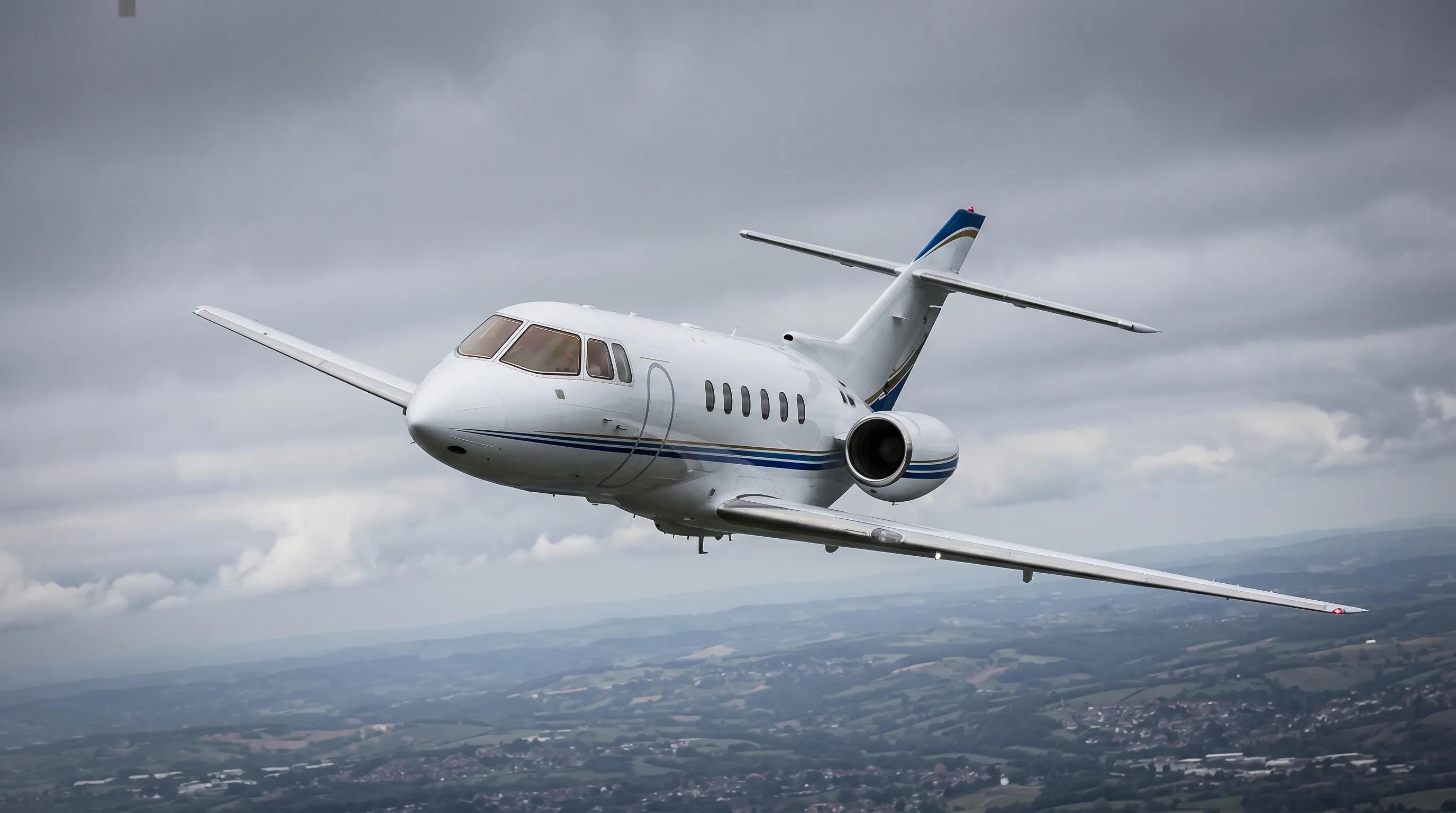
The 800XP (Extended Performance) entered production in 1995 as Raytheon Aircraft's midsize offering. It retained the 125's characteristic low-wing, T-tail configuration and circular fuselage cross-section while adding Honeywell TFE731-5BR engines rated at 4,660 pounds of thrust each. Raytheon delivered 596 Hawker 800XP airframes before transitioning to the 900XP variant in 2006. In the U.S. charter market, the 800XP became synonymous with accessible midsize private aviation.
The Cabin That Won the Charter Market
The Hawker 800XP's cabin measures 21.3 feet long, 6.0 feet wide, and 5.8 feet tall. Those numbers made it the widest and longest cabin in its price class during its production run. The Citation XLS (18.5 ft long, 5.5 ft wide) and Learjet 60 (17.7 ft long, 5.9 ft wide) were its primary competitors, and neither matched the Hawker's combination of length and width.
The Hawker 800XP cabin was designed for the British corporate market of the 1980s, where flights from London to the Middle East demanded 4-5 hours of genuine comfort for 6 passengers. That mission profile produced a cabin that remains competitive 40 years later. Width and length age better than avionics or engines.
Configuration and Comfort
Standard charter configuration seats 8 in a double-club arrangement: two pairs of facing seats forward and two pairs aft, separated by a work table. The cabin width allows passengers in opposite seats to work without touching elbows. The flat floor extends the full cabin length, and headroom permits most passengers (under 5 feet 10 inches) to walk upright. The aft lavatory is enclosed, a feature that the Learjet 60 and early Citations did not offer.
The Hawker 800XP cruises at 448 ktas (Mach 0.80) with a maximum range of 2,540 nautical miles carrying 4 passengers and NBAA IFR fuel reserves. Full-passenger range (8 passengers) drops to approximately 2,100 NM. The aircraft's Honeywell TFE731-5BR engines consume approximately 200-220 gallons per hour at typical cruise power settings, placing it in the middle of the midsize fuel burn envelope.
The 800XP's service ceiling of 41,000 feet is its most notable performance limitation. Most midsize competitors reach FL450 or higher, allowing them to fly above airline traffic and weather. The Hawker typically cruises at FL370-FL410, placing it in the same altitude bands as commercial aircraft and occasionally subjecting it to ATC routing delays that higher-ceiling jets avoid.
Need a Charter Quote?
Contact our team for a personalized quote.
Get a Quote →Maintenance Reality in 2026
Operating a 20-30 year old airframe on a charter certificate requires sustained maintenance investment. The Hawker 800XP's TFE731-5BR engines are well-supported by Honeywell with overhaul intervals of approximately 4,200 flight hours and per-engine overhaul costs of $650,000-$750,000. Engine parts availability is excellent because the TFE731 family powers thousands of aircraft worldwide across military and civilian applications.
Airframe Inspections and Corrosion
The 800XP follows a progressive inspection program rather than calendar-based annual inspections. Major inspections occur at 600, 1,200, and 4,800-hour intervals, with the 4,800-hour inspection costing $80,000-$120,000. Corrosion management is the primary airframe concern for older Hawkers, particularly those operated in coastal or humid environments. Wing spar inspections and landing gear overhauls are the most expensive structural maintenance events, running $40,000-$60,000 each.
Avionics obsolescence drives significant upgrade costs. Many charter-fleet Hawker 800XPs have been upgraded from original Honeywell SPZ-8000 avionics to Collins Pro Line 21 or Garmin G5000 systems at costs of $300,000-$600,000 per aircraft. These upgrades are functionally mandatory for charter operations because outdated avionics limit access to NextGen airspace procedures and reduce dispatch reliability.
Charter Market Position in 2026
The Hawker 800XP charters between $2,800 and $4,000 per flight hour, making it one of the most affordable midsize charter options. Its combination of large cabin, moderate pricing, and coast-to-coast range keeps it competitive despite its age. Approximately 180-200 Hawker 800XPs remain on U.S. Part 135 charter certificates in 2026, down from an estimated peak of 250-280 in 2018.
The type's charter viability hinges on operating cost management. Operators running well-maintained, recently-avionics-upgraded 800XPs can price competitively against newer types because the aircraft's low acquisition cost ($1.5-$3.0 million) eliminates the depreciation burden that weighs on new-jet operators. An operator who bought a Hawker 800XP for $2 million and invested $500,000 in avionics has $2.5 million deployed versus $9-12 million for a new Phenom 300E, a cost advantage that flows directly to charter pricing.
Who Charters the Hawker 800XP
The typical Hawker 800XP charter customer is a cost-conscious business traveler flying 4-6 passengers on domestic routes under 2,000 NM. Corporate flight departments use the type for non-executive travel. Sports teams charter Hawkers for coaching staff and advance personnel. Medical transport operators value the cabin size for patient stretchers. The aircraft's value proposition is straightforward: the most cabin volume per charter dollar in the midsize category.
The Successor Chain: 900XP, 750, and Beyond
Raytheon (later Hawker Beechcraft) followed the 800XP with the 900XP in 2006, adding Honeywell TFE731-50R engines with improved hot-and-high performance and a Rockwell Collins Pro Line 21 glass cockpit. The 850XP offered extended range via additional fuel capacity. The Hawker 750 stripped the type back to a shorter-range, lower-cost variant. The Hawker 4000, a completely new carbon-composite design, was produced from 2008 to 2013 before Hawker Beechcraft's bankruptcy ended the line.
No successor exists. When Textron acquired Hawker Beechcraft in 2014, it discontinued the Hawker brand entirely, focusing on the Beechcraft King Air and Cessna Citation lines. The Hawker 800XP's market niche, a wide-cabin midsize jet at a moderate price, has been partially filled by the Citation Latitude and Embraer Praetor 500, but neither replicates the Hawker's combination of low acquisition cost and spacious cabin that makes it attractive to charter operators running tight margins.