Global 7500 Charter Economics
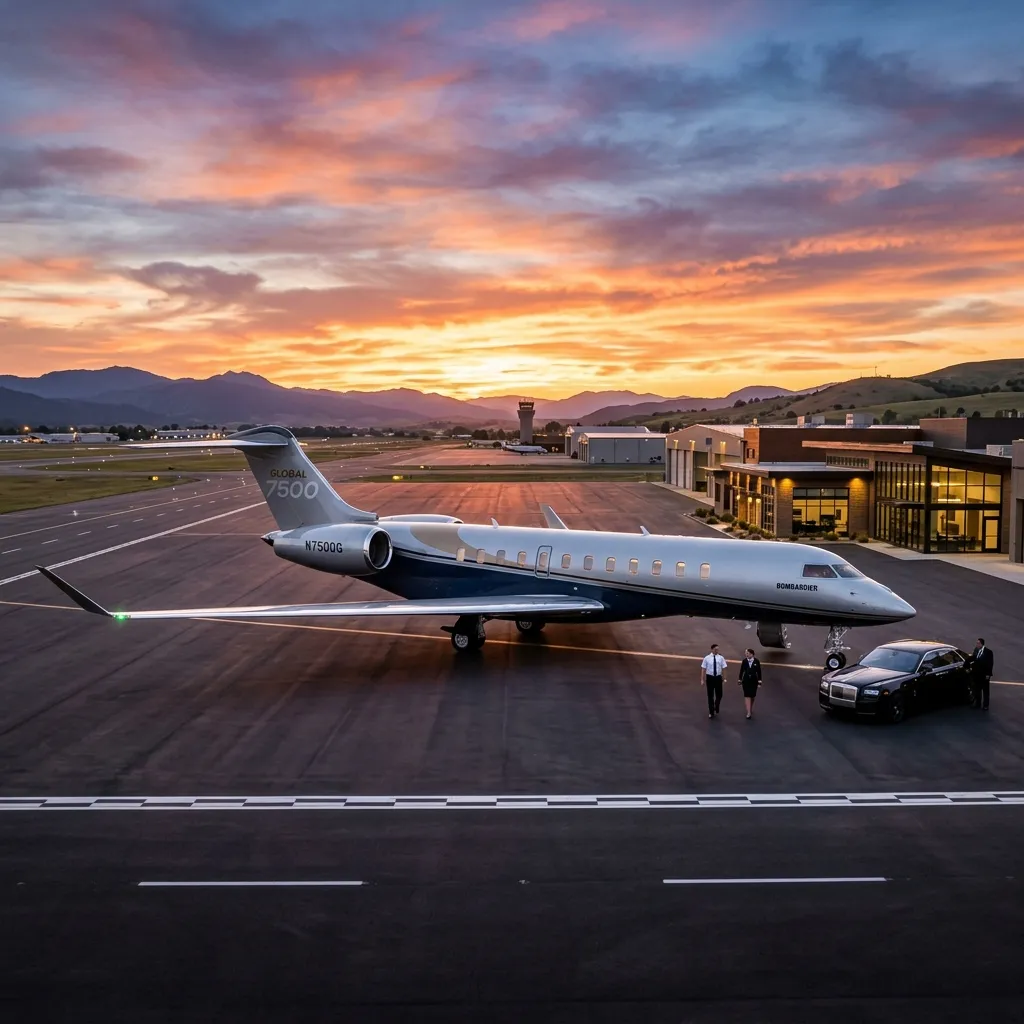
A Bombardier Global 7500 charters for $8,000 to $12,000 per flight hour. On an ultra-long-haul route like Los Angeles to Sydney (6,500 nm, ~14.5 hours), expect the one-way charter cost to range between $130,000 and $180,000 before taxes and international handling fees. A round-trip journey between New York and Hong Kong can easily exceed $300,000 depending on the exact routing and ground time.
These figures reflect the reality of chartering the largest, longest-range purpose-built business jet in the world. When you charter a Global 7500, you are buying the ability to depart when you want, connect any two major global financial centers nonstop, and arrive refreshed after a 15-hour flight. It is the pinnacle of the ultra-long-range category, offering capabilities that fundamentally change how executives structure their international travel.
Four True Living Zones: The 54-Foot Cabin
The Global 7500’s cabin measures 54.4 feet in length, providing enough space for four distinct living zones. This is not marketing hyperbole—it is a physical distinction that sets the aircraft apart from its closest competitors. Most configurations feature a forward club seating area for meetings, a dining or conference zone, an entertainment or cinema room with a large screen, and an aft Principal Suite with a permanent bed and an en-suite lavatory.
The aircraft is equipped with Bombardier’s patented Nuage seats, which feature a deep recline architecture and a tilting headrest designed specifically for long-haul comfort. Unlike traditional aircraft seats, the Nuage seat mimics the deep recline of high-end domestic furniture, drastically reducing lower back fatigue.
Environmental factors are aggressively managed through the Pur Air system, which replaces cabin air with 100% fresh air every 90 seconds while filtering out pathogens and volatile organic compounds. Furthermore, the Soleil lighting system is the first aviation lighting technology tied directly to the aircraft's flight management system. It dynamically adjusts the cabin lighting spectrum to help synchronize your circadian rhythm to the destination's time zone, effectively combatting jet lag before you even land.
The forward galley is the largest in the industry, designed to prepare multi-course hot meals for up to 19 passengers. The aft lavatory features a stand-up shower on many configurations, allowing executives to step off the plane in Tokyo or London ready to head straight into a boardroom.
Where the Global 7500 Goes
The Global 7500’s 7,700-nautical-mile range redefines nonstop capability. It is designed to connect the world’s most distant city pairs without the operational drag of a fuel stop. Here is what that range makes possible:
- New York (TEB) → Hong Kong (HKG): 7,000 nm, ~15h. A direct routing over the polar region, eliminating a stop in Anchorage.
- Los Angeles (VNY) → Sydney (SYD): 6,500 nm, ~14.5h. Nonstop transpacific performance, turning a grueling commercial itinerary into a seamless overnight flight.
- London (FAB) → Perth (PER): 7,800 nm, ~16.5h. Push the aircraft to its limits under ideal conditions, connecting Europe directly to Western Australia.
- Miami (OPF) → Dubai (DWC): 6,800 nm, ~14h. Effortless connection between the Americas and the Middle East.
While the aircraft can easily fly from Teterboro to Miami, doing so is highly inefficient. Using a Global 7500 for a 2.5-hour domestic flight is like taking a superyacht across a lake. It is mathematically viable, but a Gulfstream G650 or a super-midsize jet is far more appropriate for short-haul domestic missions.
Breaking Down the $12,000 Hourly Rate
The GE Passport engines powering the Global 7500 burn approximately 460 gallons per hour at cruise. At an average FBO price of $5.75 per gallon, fuel alone costs over $2,640 per flight hour. On a 14-hour flight to Tokyo, fuel expenses easily surpass $36,000.
Crew logistics on ultra-long-haul flights are a significant cost driver. Flights exceeding 10 hours typically require an augmented crew—three or even four pilots—to comply with duty time regulations. In addition to their salaries, operators must price in commercial return flights, extended hotel stays, and per diem for the crew while they wait in the destination city.
Maintenance reserves and international handling fees—including overflight permits across foreign airspace—add thousands of dollars to the bottom line. When an operator quotes $150,000 for a one-way international charter, those numbers reflect the immense operational footprint required to execute the mission safely. Every detail, from specialized catering to international customs clearances, is factored into the final invoice.