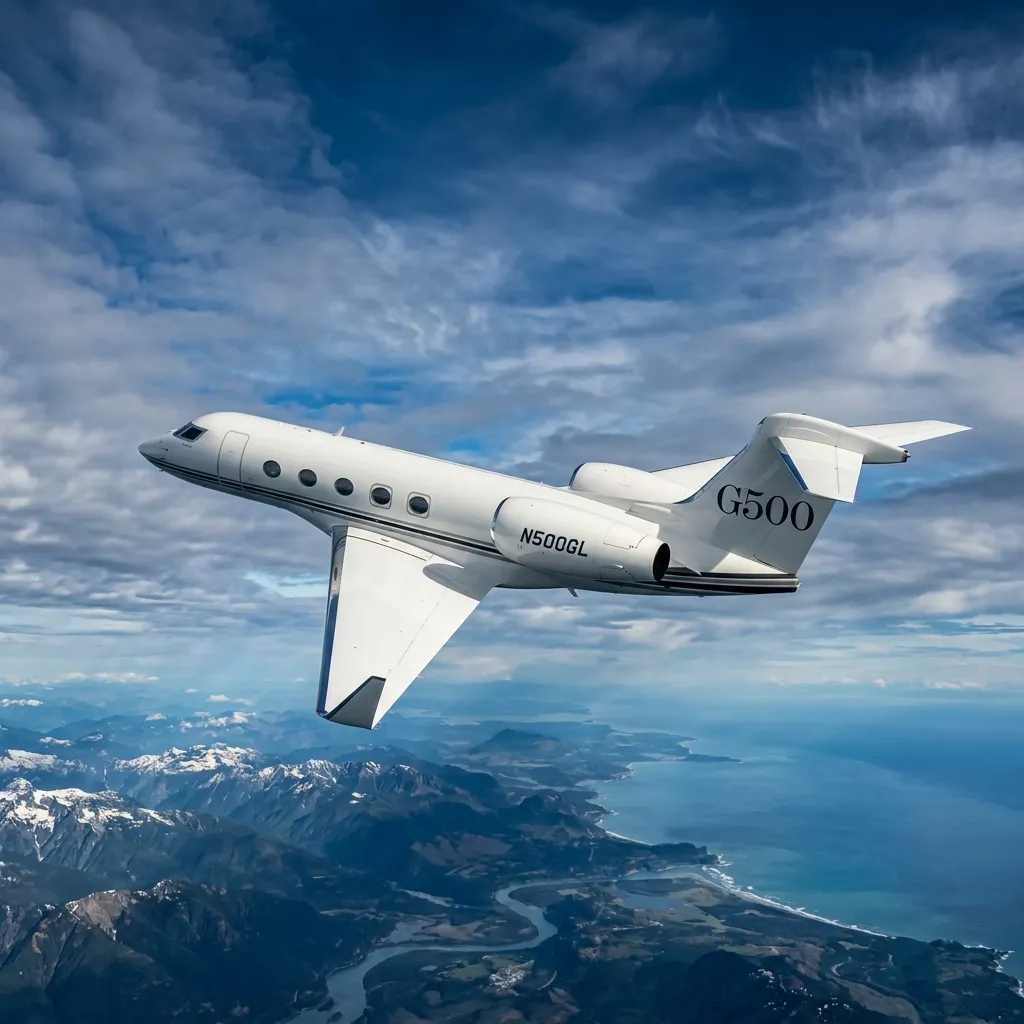
Gulfstream G500 business jet in flight showing its clean wing design and active winglets

The Gulfstream G500: Fly-by-Wire, Symmetry Flight Deck, and the Heavy Jet That Flies Like a Fighter

undefined

In This Article

Gulfstream's Technology Flagship Performance: Speed and Technology The Symmetry Flight Deck Cabin and Operating Economics Market Position and Who Flies the G500 Frequently Asked Questions

Gulfstream's Technology Flagship

The Gulfstream G500 (2018-present) introduced three firsts for Gulfstream: fly-by-wire flight controls, the Symmetry flight deck with 10 touchscreen displays, and active control sidesticks that provide tactile feedback to both pilots simultaneously. These technologies, previously reserved for military fighters and next-generation airliners, make the G500 the most technologically advanced aircraft in Gulfstream's history, including the G650. The G500 is not a smaller G650; it is an entirely new design that happens to share Gulfstream's signature oval windows and brand DNA.

The G500 competes in the heavy jet segment against the Bombardier Global 5500, Dassault Falcon 6X, and Embraer Praetor 600. Its 5,200 NM range bridges the gap between super-midsize jets (3,000-4,000 NM) and ultra-long-range jets (6,000+ NM), providing transatlantic capability without the operating costs of a G650 or Global 7500.

Performance: Speed and Technology

The G500's Mach 0.925 top speed matches the G650, making it the fastest aircraft in its price class. At Mach 0.90 (high-speed cruise), the G500 covers New York to London in 6 hours. The Global 5500 counters with 500 NM more range (5,700 NM vs 5,200 NM), enough to extend nonstop capability to routes like London to Dubai (3,000 NM, easy for both) and New York to Tel Aviv (5,000 NM, marginal in the G500 with headwinds, comfortable in the Global 5500).

The fly-by-wire system fundamentally changes how the G500 flies. The active control sidesticks replace traditional yokes, reducing pilot workload and providing precise control inputs that the flight computers translate into optimal control surface movements. The system includes envelope protection that prevents the aircraft from exceeding structural limits, stall protection that automatically maintains safe airspeed, and auto-trim that eliminates the need for manual trim adjustments. Pilots describe the transition from conventional Gulfstreams to the G500 as transformative.

The Symmetry Flight Deck

The Honeywell Symmetry flight deck replaces Gulfstream's PlaneView avionics with an all-new architecture built around 10 touchscreen displays. The flight deck eliminates most traditional switches and knobs, replacing them with touchscreen interfaces that can be reconfigured for different phases of flight. Cursor control devices (similar to a laptop trackpad) provide precision input when touchscreens are impractical due to turbulence.

The Combined Vision System (CVS) merges synthetic vision (terrain database) with Enhanced Vision System (EVS) infrared camera imagery into a single head-up display (HUD) view. This gives pilots a clear picture of terrain, runway, and obstacles in zero-visibility conditions. The system is certified for EVS approaches to 100-foot minimums, allowing the G500 to land in weather conditions that ground aircraft without EVS capability.


Need a Charter Quote?

Contact our team for a personalized quote.

Get a Quote

Cabin and Operating Economics

The G500 cabin at 7.6 feet wide is a step down from the G650's 8.5 feet but wider than the Falcon 8X (7.7 ft) and most heavy jets. The cabin supports three-zone configurations with Gulfstream's signature large oval windows. For operators whose missions do not require the G650's extra width and length, the G500 delivers 90% of the Gulfstream experience at 60-70% of the operating cost.

The PW814GA engines are Pratt & Whitney Canada's newest pure business aviation powerplant, designed specifically for the G500/G600 program. The engines benefit from P&WC's ESP maintenance program and a growing service network. Operating costs run approximately 15-20% below a G650, driven by lower fuel burn, lower engine maintenance costs, and lower insurance premiums (reflecting the lower hull value).

Market Position and Who Flies the G500

The G500 fleet splits between corporate flight departments (approximately 60%) and charter/management operators (approximately 40%). Corporate buyers value the technology stack, speed, and transatlantic range for executive travel between U.S. and European offices. Charter operators value the G500's ability to command premium hourly rates while operating at lower cost than G650. The aircraft fills a specific niche: clients who need Gulfstream quality and transatlantic range but whose mission profile does not justify a $65 million G650 or G700.

Gulfstream has delivered approximately 200 G500 aircraft since 2018. The production rate is approximately 30-35 per year, constrained by Savannah factory capacity shared with the G600, G650ER, and G700 programs. Pre-owned G500 availability is limited (fewer than 15 aircraft listed at any given time), which supports strong residual values. The combination of limited supply, strong demand, and Gulfstream's brand strength makes the G500 one of the most stable value propositions in the heavy jet category.

The G500 represents the first generation of business jets that will see fly-by-wire become the industry standard. Bombardier followed with fly-by-wire on the Global 7500, and Dassault has incorporated it on the Falcon 6X and upcoming Falcon 10X. Within 10 years, most new large-cabin business jets will feature fly-by-wire controls. The G500 was first to market, giving Gulfstream a head start in pilot training, maintenance experience, and in-service reliability data that later entrants must build from scratch.

Brian Galvan

Written By

Brian Galvan

Founder, The Jet Finder ยท Private Aviation Operations & Technology

Former Director of Technology at FlyUSA (Inc. 5000 fastest-growing private jet company). Decade of hands-on experience across Part 135 operations, charter sales, fleet management, and aviation data systems.

LinkedInRead Full Profile →
Common Questions

Frequently Asked Questions


8 questions about chartering this aircraft

Type-rating training for the G500 takes 12-15 days at FlightSafety International, approximately 3-5 days longer than a typical Gulfstream transition course. The additional time covers sidestick technique, fly-by-wire logic, and Symmetry flight deck procedures. Pilots report that the muscle memory adjustment from yoke to sidestick takes 10-20 hours of flight time to become natural. The envelope protection and auto-trim features actually reduce workload once pilots trust the system, which typically occurs within the first 50 hours of operation.

The G600 stretches the fuselage by 4.6 feet (cabin length 45.2 ft vs 41.5 ft) and extends range to 6,600 NM versus 5,200 NM. The G600 is priced approximately $5-$8 million above the G500 new. The G600 makes sense for operators who regularly fly transatlantic routes with full passenger loads (where the G500's 5,200 NM is marginal with headwinds), or who need the extra cabin length for four-zone configurations with a dedicated crew rest area. For domestic operations and short international routes (under 4,500 NM), the G500 delivers equivalent performance at lower cost.

The PW814GA has accumulated over 500,000 flight hours since the G500's entry into service in 2018. Initial dispatch reliability was approximately 99.7%, improving to 99.9%+ as the engine matured. P&WC addressed early-service issues (primarily related to the engine's FADEC software and bleed air system) through service bulletins that have been incorporated into the production baseline. The engine is covered under P&WC's ESP at $200-$260 per engine flight hour. No major unscheduled removals or fleet-wide airworthiness directives have been issued as of 2026.

The Symmetry flight deck is designed with triple redundancy. If one touchscreen fails, its functions transfer automatically to adjacent screens. The cursor control devices provide an alternative input method that works independently of the touchscreens. Backup analog instruments (standby attitude indicator, airspeed, and altitude) are installed behind a panel that deploys if all primary displays fail simultaneously. The system has been certified to RTCA DO-178C Level A software assurance, the highest safety standard for aviation electronics.

The G500 offers three advantages that justify the premium: fly-by-wire flight controls that reduce pilot workload and improve safety margins, the Symmetry flight deck that represents a generational leap in avionics capability, and new-generation PW814GA engines that are more fuel-efficient than the G550's Rolls-Royce BR710. The G500 also carries higher residual values (newer aircraft depreciate more slowly than 15+ year-old G550s). For operators who plan to own for 10+ years, the G500's lower depreciation rate offsets part of the acquisition premium.

The G500 compensates for its narrower cabin with significantly better performance: Mach 0.925 versus Mach 0.82, FL510 versus FL410, 5,200 NM versus 4,000 NM, and fly-by-wire handling. For domestic missions where 8 passengers need to arrive quickly, the G500 saves 15-20 minutes on a 3-hour flight and provides access to higher altitudes with smoother rides. The cabin width disadvantage is most noticeable in club-four seating configurations; for 6 or fewer passengers, the G500's width is adequate.

The G400 (announced 2021, expected first delivery 2026-2027) targets the midsize segment with 4,200 NM range, a narrower cabin (6.9 ft width), and pricing below the G500. The G400 does not replace the G500; it fills the gap below it. Operators who need transatlantic range (5,000+ NM), wide-body cabin comfort, and Mach 0.90+ cruise speed remain in G500 territory. The G400 is for operators whose missions stay under 4,000 NM and who want Gulfstream's fly-by-wire technology at a lower price point.

Yes. The G500's Combined Vision System with EVS allows certified approaches to 100-foot decision altitude, where the pilot must see the runway environment through the EVS camera image on the HUD. Standard Category I ILS approaches require 200-foot minimums. The 100-foot reduction means the G500 can attempt approaches in fog, low clouds, and reduced visibility conditions that force aircraft without EVS to hold, divert, or go missed. On a practical basis, the EVS advantage eliminates 5-10 diversions per year for operators based in fog-prone areas (San Francisco, London, Pacific Northwest).

Continue Reading

Related Articles


Your Next Mission

Ready to Fly?


Whether you need a charter quote or want to explore aircraft options, our team is here.

Contact Us