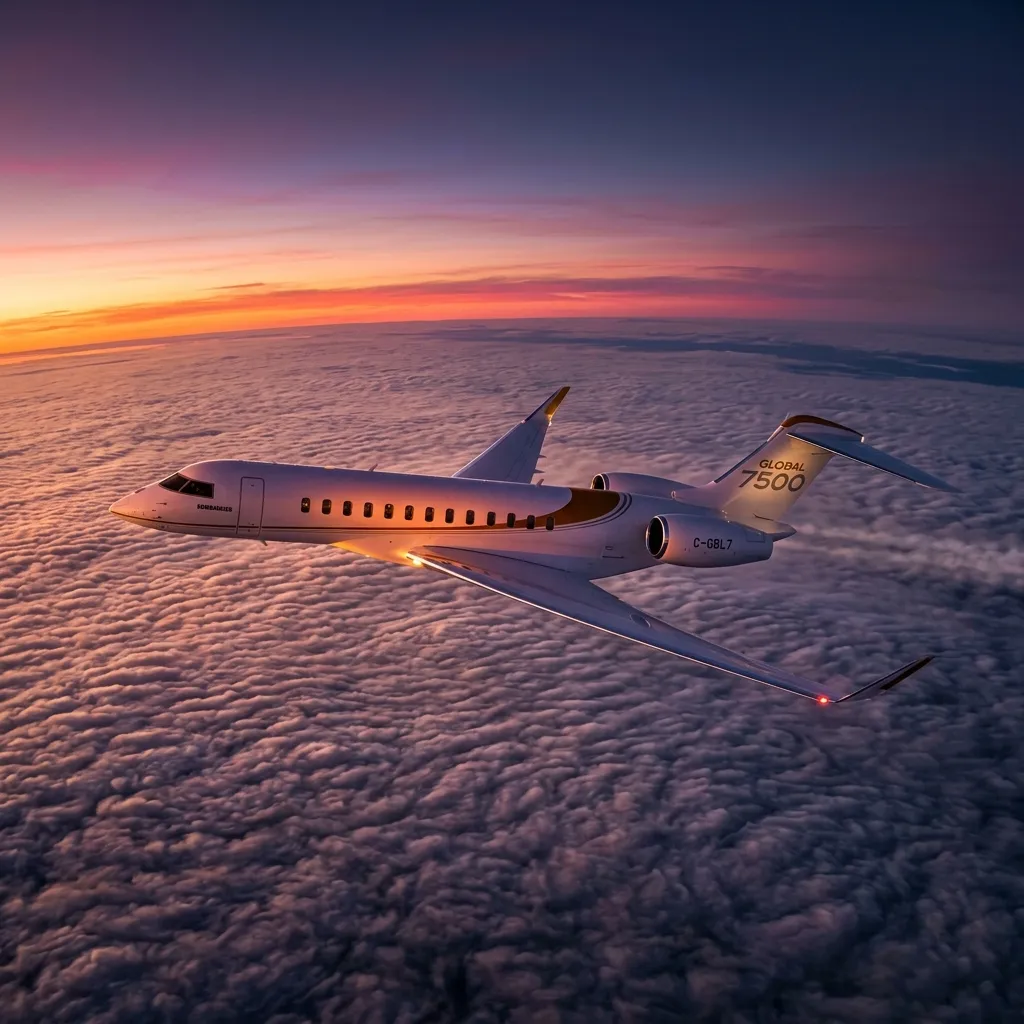
The Aircraft That Changed Business Aviation's Geography
Before 1997, nonstop transatlantic business jet travel was a compromise. Aircraft like the Gulfstream GIV and Falcon 900 could reach London from the East Coast under favorable conditions, but headwinds, payload restrictions, and fuel reserves turned many transatlantic flights into two-leg trips with fuel stops in Gander, Shannon, or Keflavik. The Gulfstream GV (certified 1997) and Bombardier Global Express (certified 1998, first delivery 1999) eliminated that compromise. Both aircraft could fly New York to Tokyo, London to Singapore, or Los Angeles to London nonstop, fully loaded, regardless of wind conditions.
These two jets created the ultra-long-range category from nothing. Gulfstream delivered approximately 190 GV aircraft between 1997 and 2003 before transitioning to the G550. Bombardier delivered roughly 160 Global Express aircraft between 1999 and 2005 before evolving the platform into the Global 5000 and Global 6000. Combined, approximately 200 of these original aircraft remain in active service in 2026, still flying missions that many newer jets cannot match.
Performance: Range Versus Speed
The GV holds a 600 NM range advantage over the Global Express, a gap that matters on the longest routes. New York to Tokyo Narita is approximately 5,850 NM. The Global Express covers it with minimal reserves; the GV covers it comfortably. The GV also burns approximately 20 fewer gallons per hour, a modest but compounding efficiency advantage that saves $56,000 annually at 400 flight hours ($7/gallon fuel). The Global Express counters with 11 knots more speed at max cruise (Mach 0.89), reaching destinations 15-20 minutes sooner on 8-hour flights.
Both aircraft use variants of the Rolls-Royce BR710 engine, one of the most proven powerplants in ultra-long-range aviation. The BR710's reliability record exceeds 99.9% dispatch reliability across 30 million flight hours. Both variants produce identical thrust (14,750 lbs each), but the A2-20 on the Global Express is optimized for Bombardier's higher max cruise speed target while the A1-10 on the GV is tuned for fuel efficiency at long-range cruise settings.
Cabin: Where the Global Express Wins Decisively
The Global Express cabin is meaningfully wider: 8.2 feet versus the GV's 7.3 feet. That 10.8-inch difference transforms the cross-section. The Global Express allows true stand-up headroom for passengers up to 6'3", and its wider floor plan accommodates larger seats, wider aisles, and more comfortable three-zone configurations. On 10-14 hour flights to Asia or Australia, cabin width is arguably the most important comfort variable. Bombardier designed the Global Express cabin specifically to compete with, and exceed, the GV's interior volume.
The Global Express is also 4.6 feet longer in the cabin, providing space for a dedicated crew rest area or an additional seating group that the GV cannot match without sacrificing the aft lavatory or galley. For 8-10 passengers on overnight transoceanic flights, the Global Express provides more separation between sleeping and working zones. The GV's cabin, while smaller, benefits from Gulfstream's signature oval windows (the largest in the industry at the time) that create a sense of openness that cabin dimensions alone do not capture.