Why Twin Turboprops Still Exist in the Jet Age
The Beechcraft King Air 350 burns approximately 100 gallons per hour at cruise. A comparable light jet, the Citation CJ3+, burns approximately 150 gallons per hour. At $7.00 per gallon, that is a $350 per hour fuel savings on the King Air. Over 400 annual flight hours, the fuel difference alone exceeds $140,000. That is not a rounding error; that is a crew member's salary.
But fuel savings only tell half the story. Twin turboprops access 5,000+ airports in the United States that jets cannot use. Grass strips, gravel runways, short fields under 3,000 feet, and remote airstrips in Alaska, the Mountain West, and rural communities across the country. The King Air 350 lands on a 3,300-foot runway with reserves to spare. The Citation CJ3+ needs 3,200 feet on a good day and 4,000 feet at elevation.
The trade-off is speed. The King Air 350 cruises at 312 knots true airspeed. The CJ3+ cruises at 415 knots. On a 500 nm trip, the jet saves 30 minutes. On a 200 nm trip, the difference shrinks to 12 minutes. For mission profiles under 400 nm, the twin turboprop's lower operating costs and superior airport access offset the speed disadvantage entirely.
The King Air Family: 350, 250, and 90
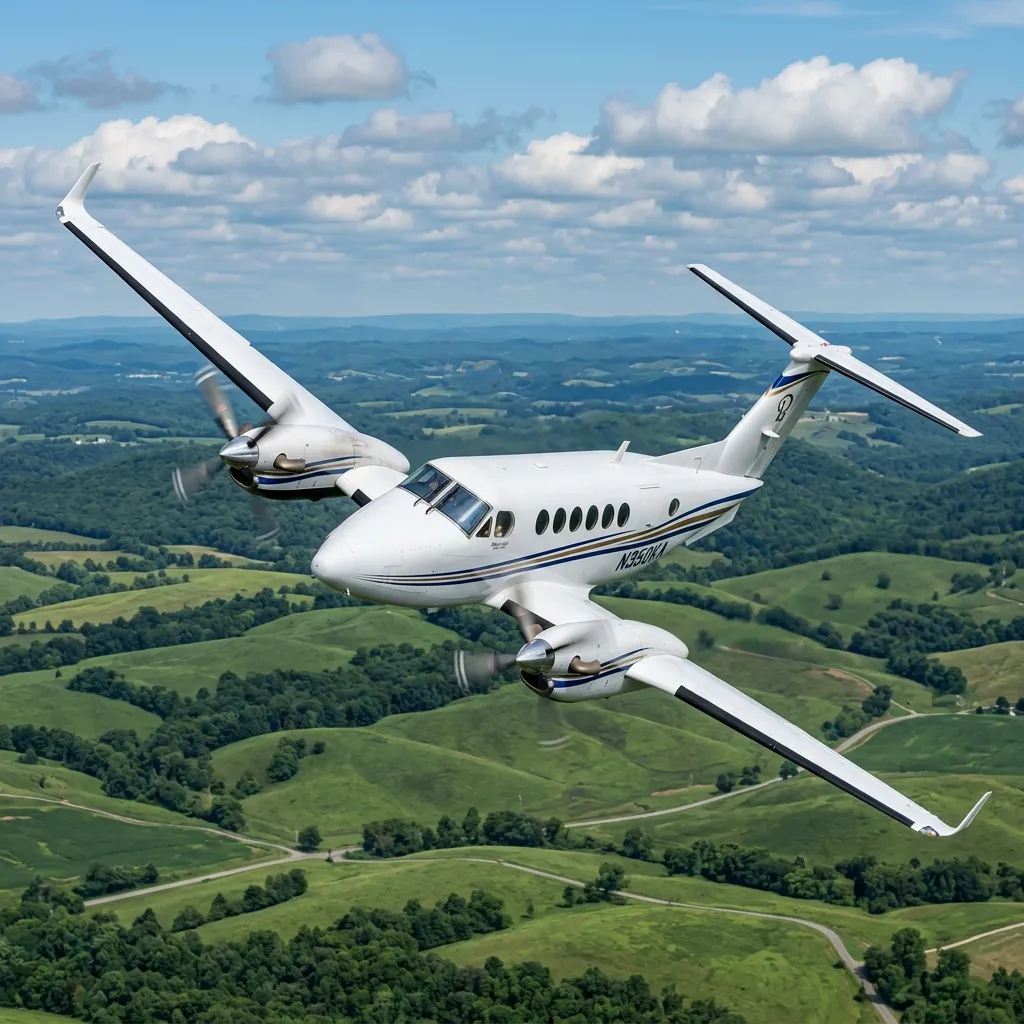
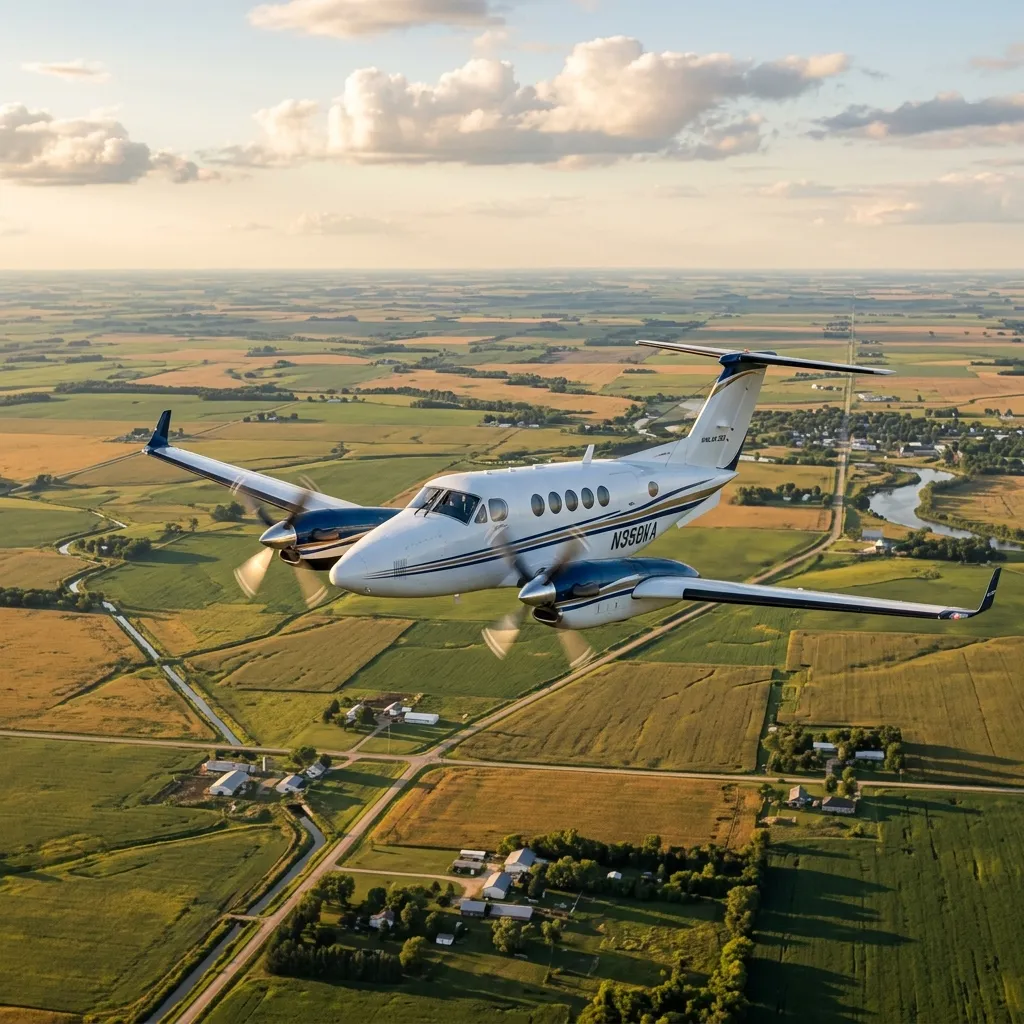
The King Air 350 is the flagship: two Pratt & Whitney PT6A-60A engines, 312 knots cruise speed, 1,806 nm range, and a pressurized cabin seating 8-11 passengers depending on configuration. The aircraft has been in production since 1990 and the design lineage traces back to the 1964 King Air 90. Over 7,600 King Airs have been delivered, making it the most successful turboprop family in business aviation history.
The King Air 250 (formerly the B200) occupies the midrange: two PT6A-52 engines, 310 knots cruise, 1,580 nm range, and seating for 7-9. Slightly shorter and lighter than the 350, it operates from even shorter runways and costs approximately 15% less per hour to operate. The 250 is the most popular King Air variant for air ambulance, survey, and government special missions.
The King Air 90 series (C90GTx) is the entry point: two PT6A-135A engines, 272 knots, 1,260 nm range, seating for 5-7. Production ended in 2023, but hundreds remain in service. The 90 is a working airplane: ranch operations, pipeline patrol, air ambulance, and regional business travel where a 4-seat cabin is sufficient.
The Piaggio P.180 Avanti: The Turboprop That Acts Like a Jet
The Piaggio P.180 Avanti EVO cruises at 395 knots, faster than several light jets and only 20 knots behind the Phenom 100. Two PT6A-66B engines in pusher configuration (mounted behind the cabin, facing rearward) produce lower cabin noise than conventional tractor-configuration turboprops. The Avanti's three-surface design, with a forward canard, main wing, and T-tail, generates lift more efficiently than a conventional layout.
The Avanti seats 7-9 passengers in the widest cabin in the turboprop class: 6 feet 1 inch wide, wider than a Citation CJ3+ or Phenom 100. The cabin width and jet-like speed make the Avanti a unique proposition: turboprop fuel costs with light-jet performance and a midsize-jet cabin.
The Avanti is the aircraft that forces you to ask whether you actually need a jet. At 395 knots and $1,800/hr, it covers the same 500 nm mission as a Phenom 300 at $3,800/hr, arriving 15 minutes later. Those 15 minutes cost $2,000. Most clients do not value their time at $8,000 per hour.