What Qualifies as a Heavy Jet?
The heavy jet category encompasses large-cabin business jets with maximum takeoff weights above 40,000 pounds, cabin widths of 6.0 feet or greater, and transcontinental or intercontinental range. These are dual-pilot, two-engine aircraft designed for 8 to 16 passengers on flights of 5 to 14 hours duration.
The defining feature is stand-up cabin height. Every heavy jet offers a cabin height of at least 6 feet 1 inch, allowing most adults to walk the aisle without ducking. This is the dividing line between super-midsize and heavy. A Citation Longitude has a 6.0-foot cabin height and technically qualifies. A Challenger 350 at 6.0 feet does not, because its maximum takeoff weight falls under the threshold.
734
U.S. Charter Heavy Jets
$8,500-$14,000
Hourly Charter Rate
6.0-7.4 ft
Cabin Width Range
The category includes three generations of aircraft. Legacy heavies (Gulfstream GIV, Challenger 601) date from the 1980s and 1990s. Current-generation workhorses (G550, Global 6000, Falcon 900LX) dominate the charter fleet. Newest-generation flagships (G650, Global 7500, Falcon 8X) command premium rates and are covered separately in the ultra long range category.
The Six Models That Define the Category
Six aircraft represent the overwhelming majority of the heavy jet charter fleet. Each occupies a distinct market position.
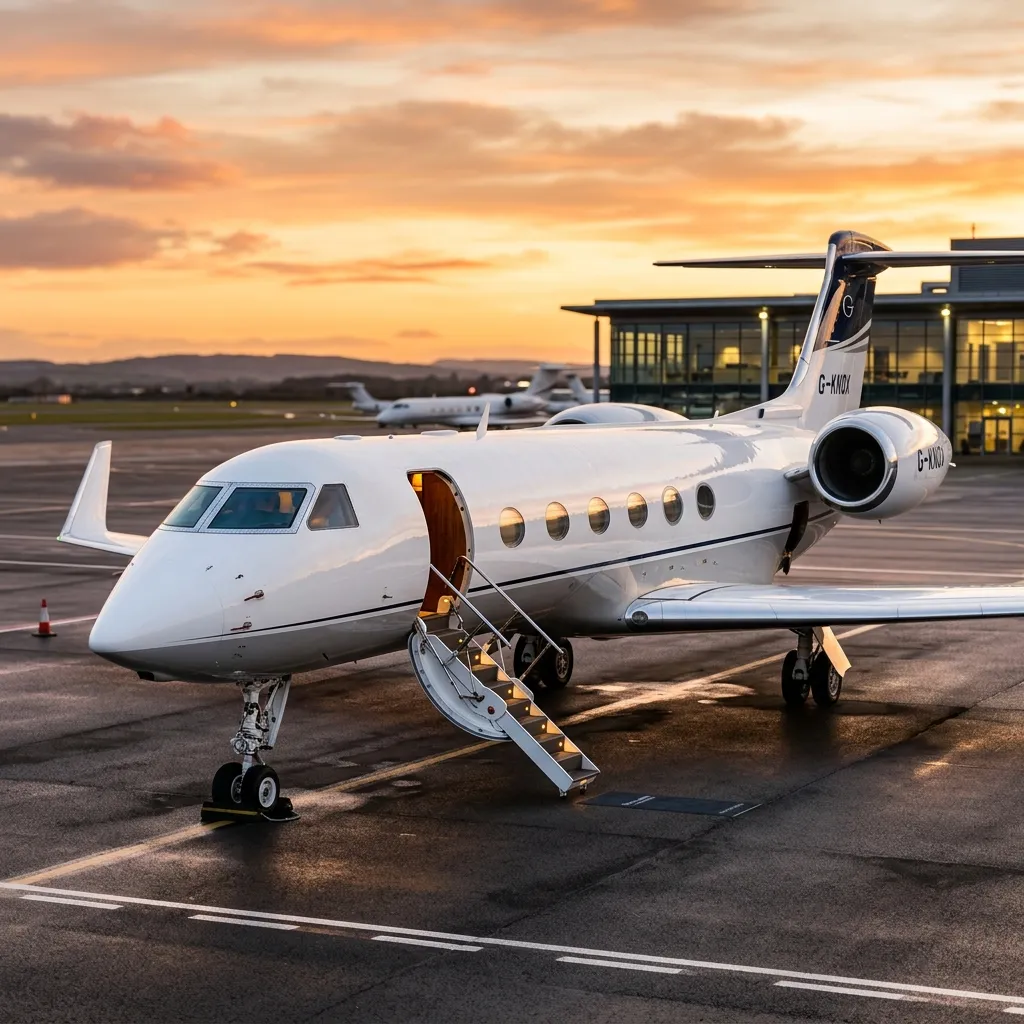
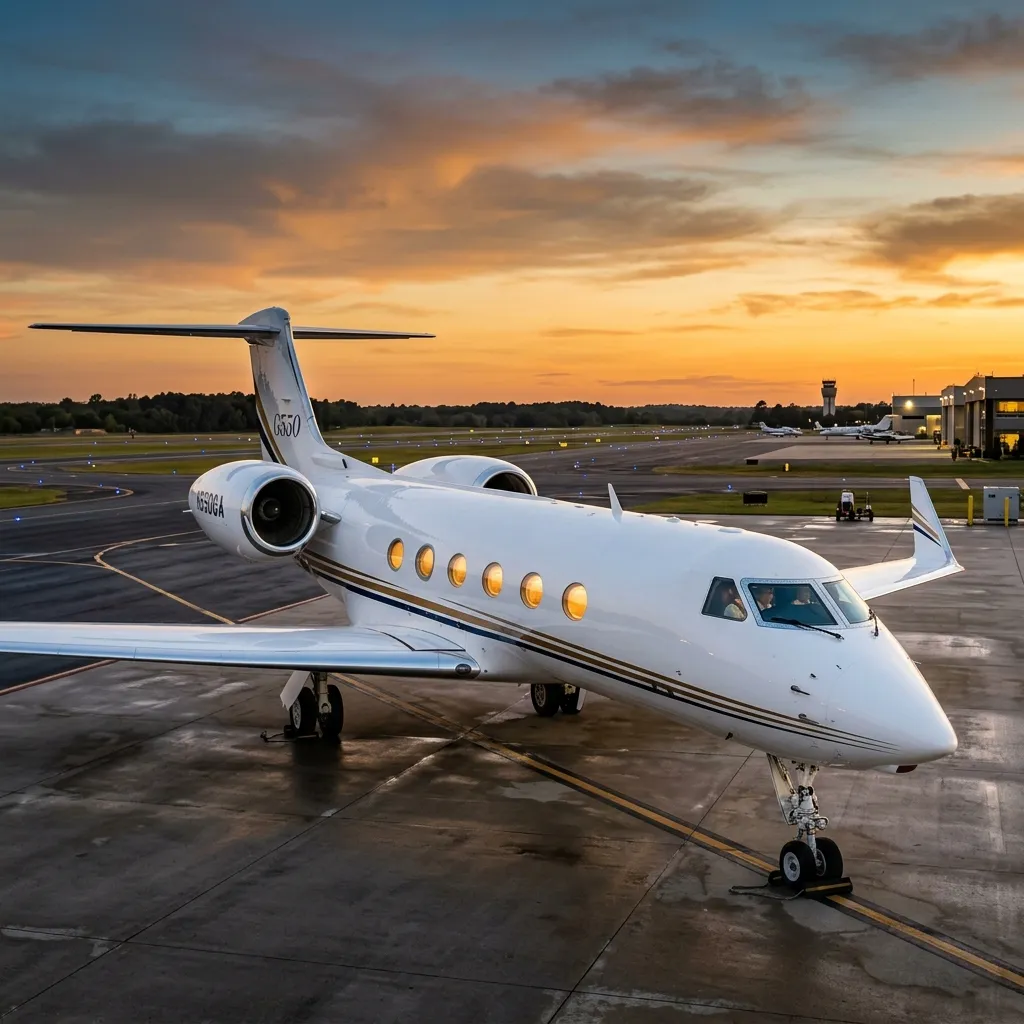
The Gulfstream G550 leads in charter demand because it combines 6,750 nm range with proven reliability, a cabin that seats 14 comfortably, and a global support network. The Bombardier Global 6000 counters with the widest cabin in the category at 7.2 feet, matching a narrow-body airliner in cross-section.
The Falcon 900LX deserves special attention. Its three Honeywell TFE731 engines enable steep approaches into challenging airports that twin-engine heavies cannot serve. London City Airport (LCY), Lugano (LUG), and Aspen (ASE) all favor the Falcon's short-field performance. The tradeoff: three engines mean higher maintenance costs, roughly 15 to 20% above comparable twins.
Cabin Reality: Where Heavy Jets Separate From Everything Else
The heavy jet cabin is the first size class that supports genuine productivity during flight. A 6.2-foot-wide cabin accommodates a conference table with four executives seated facing each other without shoulder contact. A 7.2-foot-wide Global or Challenger cabin adds enough width for a narrow aisle alongside the seating group, allowing crew to serve without disturbing the meeting.
- Enclosed lavatory: Every heavy jet has a fully enclosed, door-equipped lavatory. Most offer separate forward and aft lavatories on aircraft configured for 12+ passengers.
- Galley: Full-service galleys with ovens, coffee makers, and refrigeration. Catering for 10-hour flights is standard, not aspirational.
- Baggage: 150 to 200+ cubic feet of externally accessible luggage space. Golf bags, ski equipment, and multiple full-size suitcases per passenger.
- Connectivity: Ka-band high-speed Wi-Fi on most current-generation heavies (G550 post-retrofit, Global 6000, Falcon 7X). Streaming video and real-time collaboration are practical at 45,000 feet.
- Sleeping: Most heavy jet cabins convert to flat-bed sleeping configurations for 4 to 6 passengers. Transatlantic overnight flights become manageable rather than endured.
The cabin amenity gap between heavy and super-midsize is more significant than any other category transition. Moving from a Challenger 350 (5.9 ft wide) to a G550 (6.2 ft) adds only 3 inches of width. But it adds a proper galley, a second lavatory option, and 50% more cabin length for sleeping and working space.
Need a Heavy Jet for an International Trip?
We source heavy jet availability from vetted operators with transatlantic and transcontinental capability.
Request a Quote →When a Heavy Jet Is the Right Answer
Heavy jets earn their hourly rates on missions that smaller aircraft physically cannot serve. The decision to charter a heavy should be driven by one or more of these requirements: passenger count above 8, flight duration above 5 hours, baggage volume exceeding super-mid capacity, or need for a productive/sleeping cabin environment.
Core Heavy Jet Corridors
- Teterboro to London Luton (EGGW): 3,470 nm, approximately 7.5 hours eastbound. The benchmark transatlantic charter route. G550 and Global 6000 handle it nonstop with full passenger loads.
- Los Angeles (VNY) to Honolulu (HNL): 2,220 nm, roughly 5.5 hours. Super-mids can make it, but heavy cabins are preferred for groups of 8+ crossing the Pacific.
- Miami (OPF) to São Paulo (CGH): 4,100 nm, approximately 9 hours. Requires a heavy jet or ultra long range. The Falcon 900LX can make it with reduced payload; the G550 does it without compromise.
- Dallas (ADS) to Paris Le Bourget (LFPB): 4,800 nm, roughly 10 hours eastbound. Pushes mid-range heavies to their limits. Strong tailwinds help; headwinds may require a fuel stop in Newfoundland.
For domestic flights under 3 hours with 4 to 6 passengers, a heavy jet is economically wasteful. The cabin is underutilized, and the hourly rate premium of $4,000 to $6,000 over a midsize jet buys amenities that short flights do not exploit.
What Heavy Jets Cost to Operate
Direct operating costs for heavy jets range from $5,500 to $8,000 per flight hour for owner-operators. The gap between heavy jet categories is smaller than most buyers expect.
Charter rates include the operator's margin, FBO fees, positioning costs, and overhead. The spread between variable operating cost ($3,360 to $5,150/hr) and charter rate ($8,500 to $14,000/hr) reflects the operator's business model, fleet utilization, and competitive positioning.
Annual fixed costs for a heavy jet run $800,000 to $1.5 million, covering crew salaries, hangar, insurance, management fees, and scheduled inspections. At 400 flight hours per year, that adds $2,000 to $3,750 per hour on top of variable costs. This is why fractional and charter access dominate the heavy category; only owners flying 300+ hours annually approach cost parity with charter.
Pre-Owned Heavy Jet Pricing in 2026
The pre-owned heavy jet market offers significant value compared to new aircraft. A new Gulfstream G700 lists at $78 million. A 2015 G550 with 3,000 hours trades for $28 to $34 million. A 2008 G550 with 6,000 hours can be acquired for $18 to $22 million. The capability difference between a 2008 and a 2015 G550 is almost entirely avionics vintage and cabin condition, not performance.
Challenger 604 and 605 aircraft represent the entry point to the heavy category at $5 to $12 million depending on vintage and hours. The 604 debuted in 1996, making the youngest examples nearly 30 years old. Maintenance costs increase with age, and buyers should budget $1 to $2 million for avionics upgrades to bring older Challengers to current ADS-B, WAAS, and FANS compliance.
The Falcon 900 series offers a middle ground. A 2010 Falcon 900LX with 4,000 hours trades for $12 to $16 million. The tri-engine configuration appeals to operators serving airports with stringent approach requirements, and the Falcon's maintenance network through Dassault is responsive globally.