The Jet That Changed What 'Long Range' Meant
In 1993, Bombardier announced the Global Express with a specification that the industry considered aggressive: 7,700 nautical miles of range at Mach 0.80. That was enough to fly nonstop from New York to Tokyo, Chicago to Hong Kong, London to Buenos Aires. No purpose-built business jet had done this before. The Gulfstream GV, announced the same year, targeted similar range with a different design philosophy. The two aircraft launched the ultra-long-range category and reshaped how corporations thought about global aviation.
Bombardier delivered 242 Global Express aircraft between 1999 and 2005 before transitioning production to the XRS variant. The original BD-700-1A10 airframe was powered by two BMW Rolls-Royce BR710A2-20 turbofan engines, each producing 14,750 lbs of thrust. The aircraft introduced the Honeywell Primus 2000XP flight deck with six CRT displays, making it one of the most advanced cockpits of its era. Many of those original airframes remain in service today, a testament to the structural robustness of the design.
The published 7,700 NM range comes with an asterisk: it assumes long-range cruise speed (Mach 0.80-0.82), 4 passengers, and NBAA IFR reserves with a 200 NM alternate. With 8 passengers and baggage at Mach 0.85, realistic range drops to approximately 6,000-6,200 NM. That still covers New York to London (3,450 NM), Los Angeles to Paris (4,900 NM), and Chicago to Dubai (6,150 NM) nonstop.
The Global Express proved that ultra-long-range capability changes the calculus of corporate aviation. Before this aircraft, a Fortune 500 CEO traveling from New York to Shanghai took two commercial flights or chartered a jet with a fuel stop in Anchorage or Fairbanks. The Global Express eliminated the stop. That operational simplicity, one takeoff, one landing, one crew, altered the ROI calculation for corporate flight departments worldwide.
The Cabin: 40 Feet of Flat Floor
The Global Express cabin measures 48 ft 4 in long, 7 ft 11 in wide, and 6 ft 2 in tall with a flat floor from the forward galley to the aft lavatory. The wide cross-section allows three-zone configurations: forward club, mid-cabin conference grouping, and aft berthing or divan area. With 19 windows per side, the cabin feels open despite its tube-and-wing construction.
Standard configurations seat 13-19 passengers. Long-range missions typically carry 8-12 passengers with berthing for 4-6. The forward galley accommodates full-service catering for 12-hour flights. A vacuum-flush enclosed lavatory in the aft cabin includes a vanity counter. Some operators have installed shower facilities in the aft section, although this reduces baggage volume by approximately 30 cubic feet.
Baggage and Cargo
The external baggage compartment provides 195 cubic feet of pressurized, heated storage accessible through a large door on the aft fuselage. This is among the largest baggage volumes in the ultra-long-range class. For missions requiring additional cargo, an in-cabin cargo barrier (STC available) converts the aft cabin section into a freight area, useful for corporate events, trade shows, or relocations where equipment accompanies passengers.
Need a Charter Quote?
Contact our team for a personalized quote.
Get a Quote →The BR710 Engine: BMW Rolls-Royce Partnership
The BR710 was a joint venture between BMW and Rolls-Royce (later acquired entirely by Rolls-Royce). It produces 14,750 lbs of thrust with a bypass ratio of 4.2:1, providing the thrust-to-weight ratio necessary for the Global Express's high-altitude, high-speed performance envelope. The engine's wide chord fan and single-stage HP turbine design prioritized fuel efficiency at cruise altitudes above FL400.
Fuel consumption at long-range cruise is approximately 380-420 gallons per hour (total, both engines). At 2026 fuel prices ($6.50-$8.00 per gallon), that translates to $2,470-$3,360 per hour in fuel cost alone. The engines are on the Rolls-Royce CorporateCare program for most managed aircraft, which covers scheduled and unscheduled maintenance events for a fixed hourly rate of approximately $700-$900 per engine flight hour.
- Hot section inspection (HSI): Typically at 4,500-5,000 hours, costing $450,000-$600,000 per engine
- Overhaul: At 8,000-10,000 hours, costing $1.2-$1.8 million per engine
- CorporateCare enrollment: Reduces financial unpredictability; most pre-owned buyers insist on enrolled engines
- Non-enrolled engines reduce aircraft value by $800,000-$1.5 million on the pre-owned market
Pre-Owned Market: Where the Global Express Sits in 2026
The original Global Express (serial numbers 9001-9242) ranges from $5.5 million to $12 million on the 2026 pre-owned market depending on total time, interior condition, avionics upgrades, and engine program enrollment. Aircraft with InSight (Collins Pro Line Fusion retrofit) avionics and fully enrolled CorporateCare engines command the top of the range. Aircraft with original Primus 2000XP flight decks and non-enrolled engines sit at the bottom.
The Global Express represents exceptional value for operators who need ultra-long-range capability on a realistic budget. A $9 million Global Express delivers 90% of the mission capability of a $62 million Global 7500 at 14% of the acquisition cost. Annual operating costs run $1.2-$1.8 million for 400 hours (crew, maintenance, insurance, hangar, management), making total cost of ownership approximately $2.5-$3.5 million in the first year.
Legacy: From the Express to the 7500
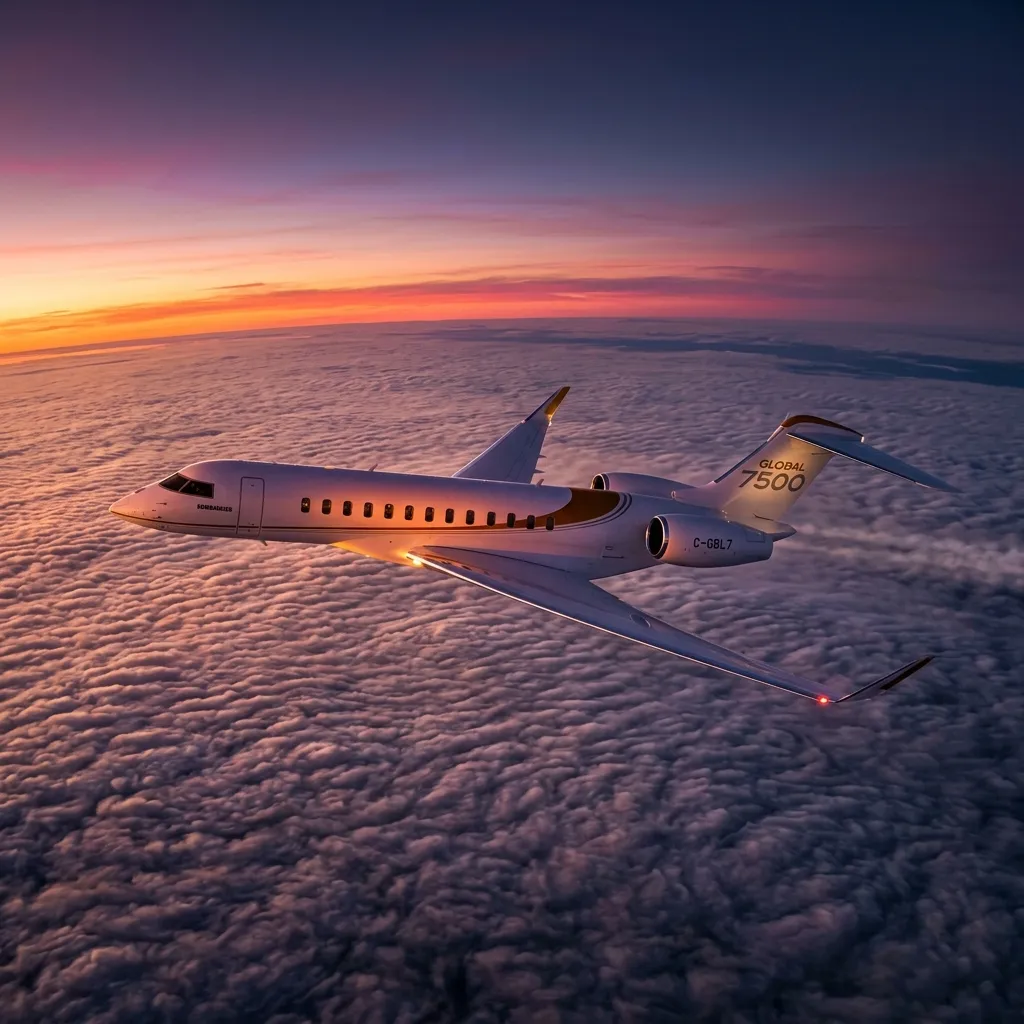
The Global Express launched a product family that now includes five variants: the original Express (1999), the XRS (2005, extended range), the Global 5000 (2005, shortened fuselage), the Global 6000 (2012, XRS rebrand with upgrades), and the Global 7500 (2018, clean-sheet successor). Every subsequent Global aircraft owes its design DNA to the BD-700 platform that Bombardier committed to in 1993.
Approximately 190 of the 242 original Global Express aircraft remain in active service as of early 2026. Attrition has been low because the airframe is robust, the engines have strong support, and the mission capability remains relevant. Several have exceeded 15,000 flight hours and 5,000 pressurization cycles with no structural service bulletins of concern. The aircraft has a structural design life of 50,000 flight hours.
The Global Express did not just compete with the Gulfstream GV. It established that Bombardier could build a flagship aircraft that corporate flight departments would trust for transoceanic operations. Before the Express, Bombardier was the Challenger company. After it, Bombardier was the Global company. That brand repositioning, more than any single specification, is the aircraft's most enduring contribution to the manufacturer's trajectory.