How Bombardier Built the Longest-Range Jet
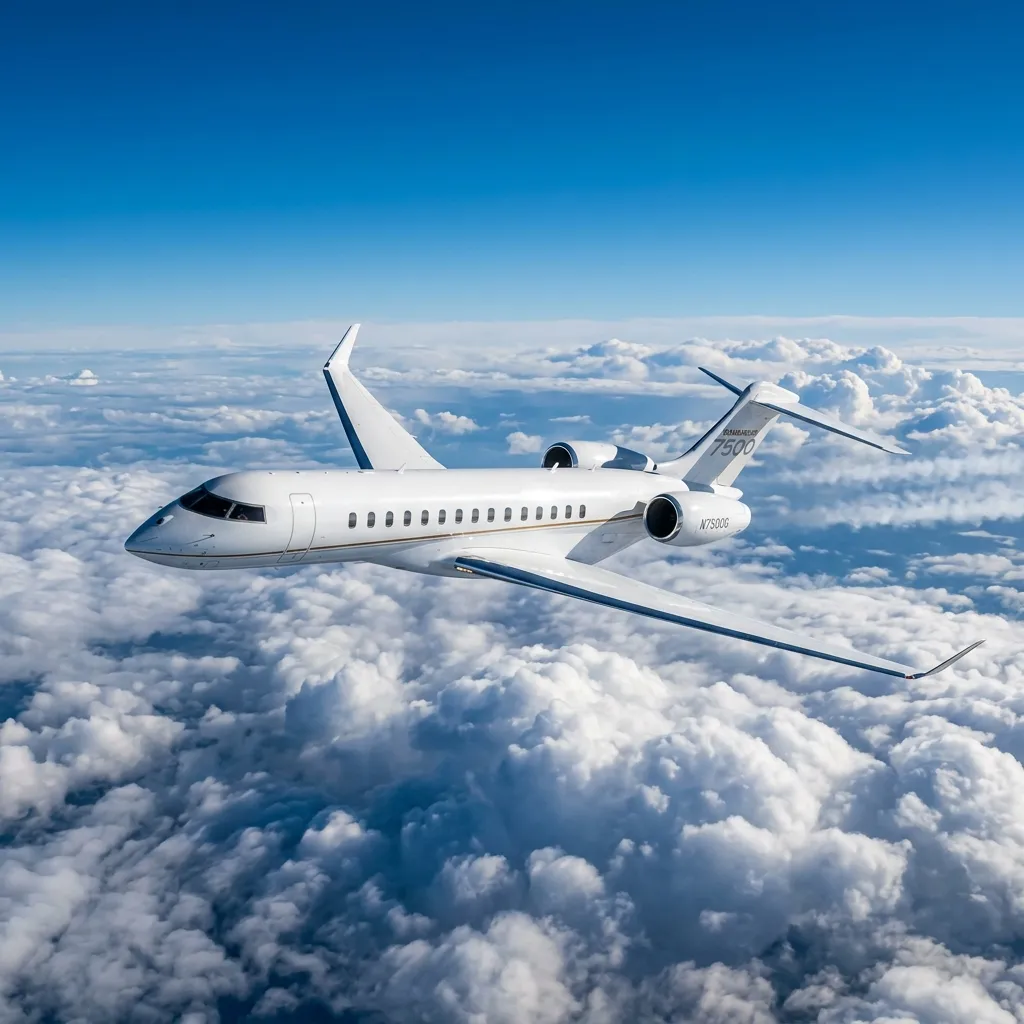
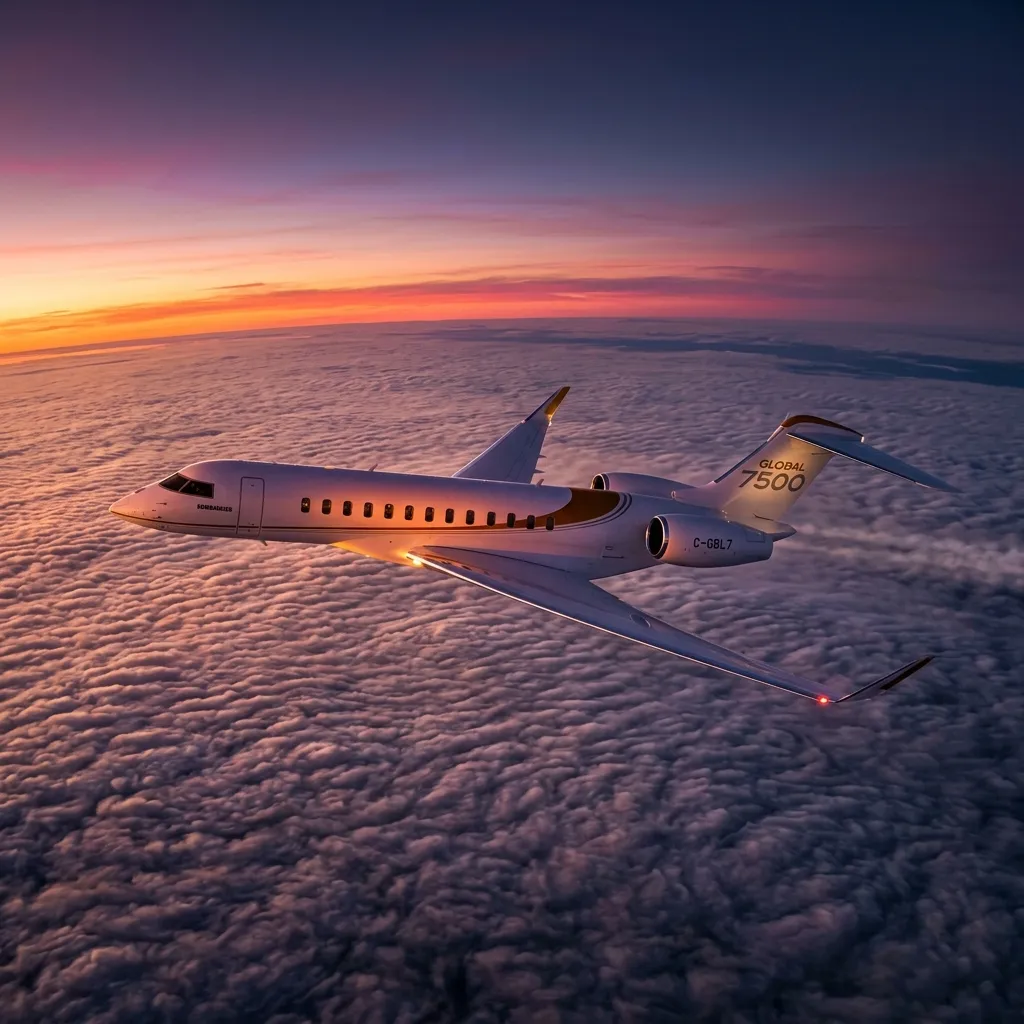
The Global 7500 entered service in December 2018 after a seven-year development program that cost Bombardier approximately $7 billion. The aircraft was announced in 2010 as the Global 7000 with a projected range of 7,400 nautical miles. By certification, performance exceeded projections: the production aircraft demonstrated 7,700 NM range and a maximum speed of Mach 0.925, making it both the longest-range and fastest serial-production business jet in the world. Bombardier has delivered approximately 200 airframes through early 2026.
The Global 7500's range means it connects any two cities on Earth with at most one fuel stop. New York to Singapore (8,700 NM) requires one stop; New York to Hong Kong (8,000 NM) requires one stop. New York to Dubai (5,800 NM), Singapore to London (5,900 NM), Los Angeles to Sydney (6,500 NM) — all nonstop. No other purpose-built business jet matches this geographic reach.
The Four-Zone Cabin: 54 Feet of Living Space
The Global 7500's cabin measures 54.4 feet long, 8.2 feet wide, and 6.2 feet tall. This is not comparable to other large-cabin jets; it is a different category entirely. The G650's cabin measures 46.8 feet long and 7.4 feet wide. The Falcon 8X reaches 42.8 feet at 7.7 feet wide. The Global 7500's 54-foot cabin is closer in length to a regional airliner than to its business jet competitors.
The four-zone configuration typically includes an entertainment suite forward, a conference and dining zone, a private suite with a credenza and divan, and a full master stateroom aft with a permanent bed and dedicated lavatory. Some operators configure the forward zone as a working office with a large-screen monitor and conference seating. The aft stateroom on most Global 7500s includes a stand-up shower, a feature that no other business jet in current production offers as standard.
The cabin altitude at cruise is one of the Global 7500's least discussed but most significant features. At FL410, the cabin pressurizes to 3,900 feet equivalent, lower than any competitor at the same cruise altitude. Lower cabin pressure means higher oxygen saturation, less dehydration, and measurably reduced jet lag on flights exceeding 10 hours. Passengers stepping off a 14-hour Global 7500 flight report feeling noticeably better rested than after similar durations on older ultra-long-range types.
Engine Technology and Operating Economics
The Global 7500 is powered by two GE Passport engines, each producing 18,920 pounds of thrust. The Passport was developed specifically for the Global 7500 and is not used on any other aircraft. This single-application status is a double-edged sword: the engine was optimized precisely for the 7500's mission profile, but it lacks the broad operator base that drives down maintenance costs for widely-used engines like the Rolls-Royce BR700 series.
Fuel burn averages 340-380 gallons per hour at typical long-range cruise settings (Mach 0.85 at FL430-FL470). At high-speed cruise (Mach 0.90), fuel burn increases to 400-420 GPH. Annual operating costs for an owner-operator flying 400 hours run approximately $4.5-$5.5 million, including crew, insurance, maintenance reserves, hangar, and management fees. This cost structure positions the Global 7500 as the most expensive business jet to operate outside of converted airliners.
Charter Rates in 2026
The Global 7500 charters between $14,000 and $20,000 per flight hour when available. Charter availability is extremely limited: only 15-20 Global 7500s operate on Part 135 certificates in the United States. Most owners purchase the aircraft for personal or corporate use and do not make it available for charter. When a Global 7500 does appear on the charter market, demand typically exceeds supply, and operators have little incentive to discount.
Need a Charter Quote?
Contact our team for a personalized quote.
Get a Quote →Avionics and Flight Systems
The Global 7500 features Bombardier's Vision Flight Deck with four 15.1-inch touchscreen displays, the largest screens in business aviation. The avionics suite is built on the Rockwell Collins Pro Line Fusion platform with synthetic vision, enhanced vision (infrared camera), and combined vision capabilities that overlay real-time camera imagery on synthetic terrain displays. Head-up displays (HUD) are standard equipment.
The fly-by-wire flight control system provides ride-quality improvements similar to those pioneered on the Falcon 7X but implemented with Bombardier's proprietary control laws. The system includes active turbulence dampening, envelope protection (preventing the aircraft from exceeding structural limits), and autothrottle integration that maintains speed within 2 knots of the target during approach regardless of wind conditions.
- Combined Vision System (CVS) merges synthetic and enhanced vision for low-visibility approaches
- Autothrottle maintains speed within 2 knots during approach, reducing go-around rates
- Four 15.1-inch touchscreen displays replace legacy mechanical gauges and switches
- Dual HUD (Head-Up Display) enables Cat IIIa approaches in near-zero visibility conditions
- Ka-band satellite Wi-Fi capable of supporting multiple simultaneous video streams
Market Position: Who Buys a Global 7500
The Global 7500's $72 million new list price and $4.5-$5.5 million annual operating budget place it firmly in the UHNWI and Fortune 100 category. Approximately 60% of deliveries have gone to individual buyers and family offices. The remaining 40% serve corporate flight departments, heads of state, and government VIP transport programs. Several Middle Eastern and Asian governments operate Global 7500s as official state transport aircraft.
On the pre-owned market, early 2019-2020 Global 7500s trade between $55 million and $62 million, reflecting approximately 15-20% depreciation over 5-6 years. This is shallower depreciation than most business jets experience in their first half-decade, driven by the type's limited production (approximately 35-40 deliveries per year) and sustained demand. Bombardier's order backlog for the Global 7500 extends approximately 2-3 years, meaning new aircraft are not immediately available.
The Competitive Landscape
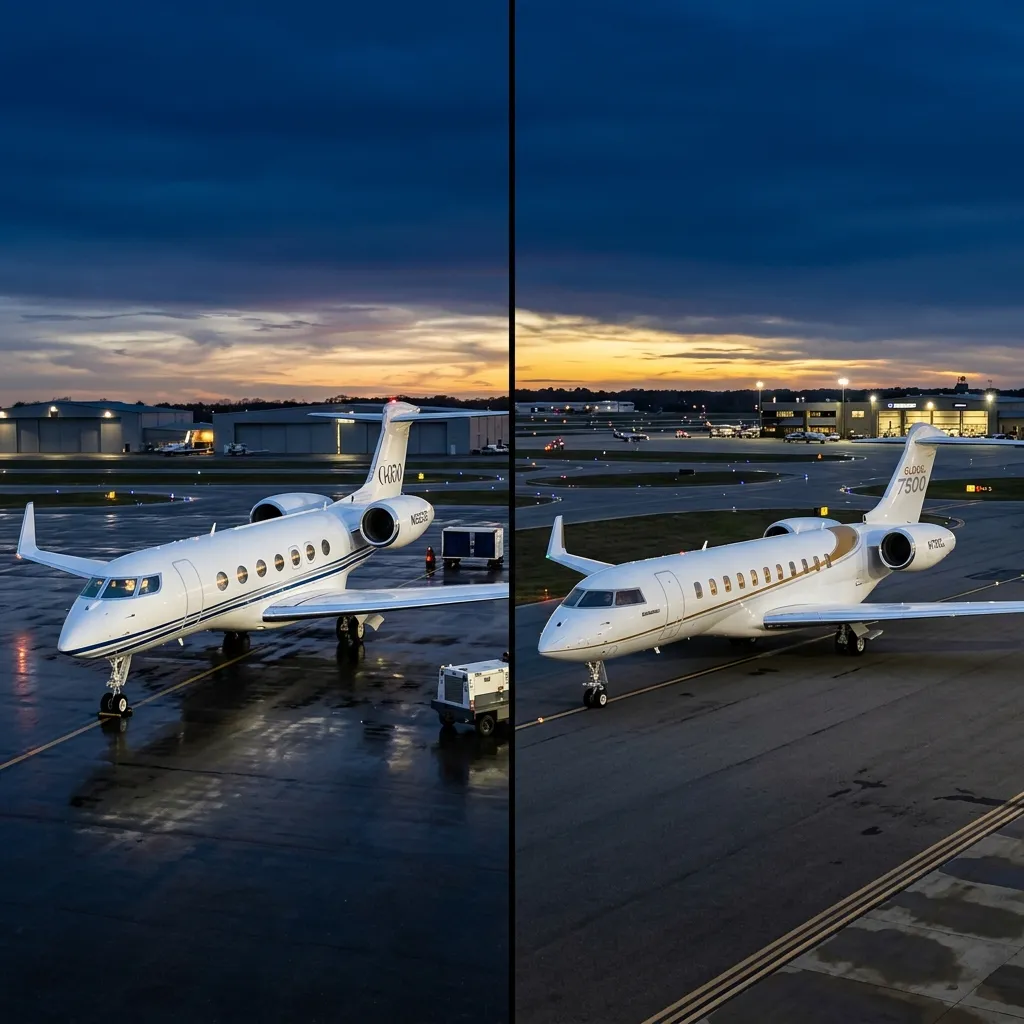
The Global 7500's primary competitor is the Gulfstream G700, which entered service in 2023 with a 56.1-foot cabin, 7,750 NM range, and Mach 0.935 maximum speed. The G700 matches or slightly exceeds the Global 7500 on every specification but carries a similar $75 million price tag. The G800 extends range to 8,000 NM but sacrifices 8 feet of cabin length. Dassault has no direct competitor in this segment, and the Falcon 10X remains in development.
Operational Realities and Airport Compatibility
The Global 7500 requires a minimum of 5,750 feet of runway for takeoff at maximum weight and 2,790 feet for landing. These figures are competitive with smaller long-range jets, partly because the wing's carbon-fiber composite construction and advanced slat/flap design generate lift efficiently at low speeds. The aircraft fits on most business aviation ramps and can operate at every major private jet airport in the United States and Europe.
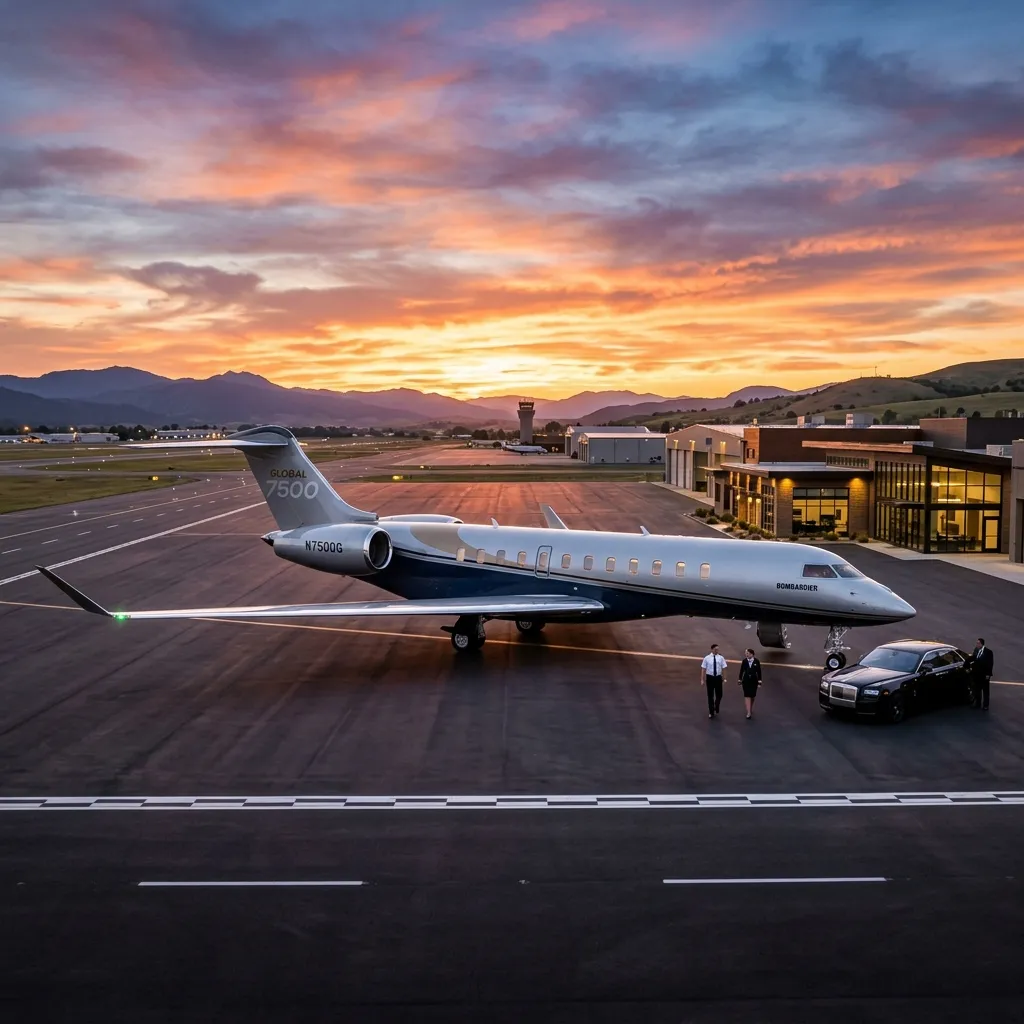
Hangaring is the primary ground infrastructure constraint. The Global 7500's wingspan of 104 feet exceeds the door width of many older business aviation hangars. Purpose-built hangars with 110+ foot door openings are required, and at some airports, hangar availability for the Global 7500 is limited to one or two facilities. This is a consideration for based owners and for charter operators planning overnight stops at smaller airports.
The aircraft's noise footprint is Stage 5 compliant, the quietest certification category. This allows unrestricted operations at noise-sensitive airports including London City, Teterboro (during nighttime curfew hours by exception), and European airports with strict noise budgets. The GE Passport engine's bypass ratio and acoustic treatment contribute to a significantly quieter ground footprint than previous-generation ultra-long-range jets.