Jackson Hole Airport: The Only Airport Inside a National Park
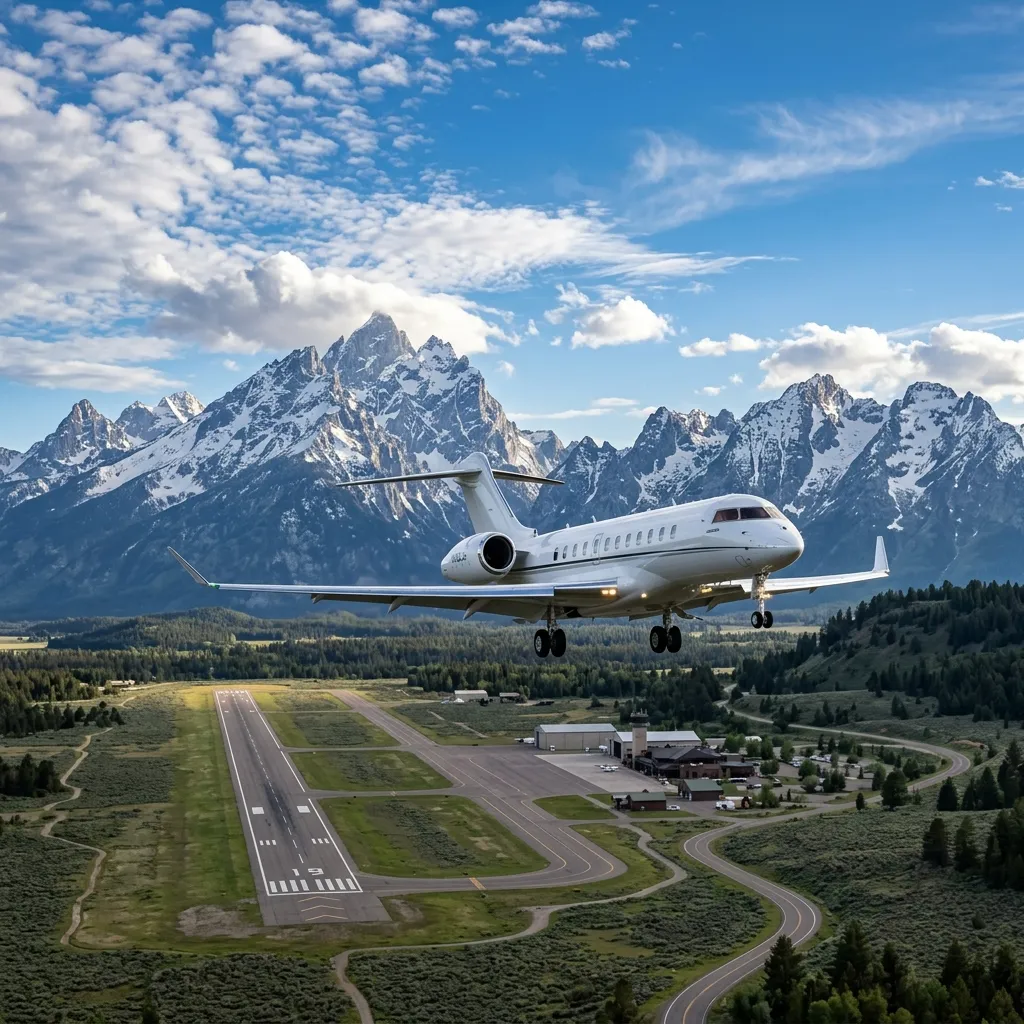
Jackson Hole Airport (JAC/KJAC) is the only Part 139 certificated airport in the U.S. located entirely within a national park. Grand Teton National Park surrounds the field on all sides. The airport sits at 6,451 feet MSL on a single runway (01/19) measuring 6,300 feet by 150 feet. Those numbers dictate everything about private jet operations here. Density altitude in July routinely exceeds 9,000 feet. Approach procedures require terrain awareness that most domestic airports never test.
Runway Constraints
Runway 19 is the primary instrument approach direction. The RNAV (GPS) Rwy 19 approach requires 2.5 miles visibility and a 400-foot decision height. There is no ILS. In winter, braking action reports drive operational decisions more than ceiling and visibility. At 6,300 feet, the runway accommodates most light and midsize jets at standard conditions, but heavy jets face payload restrictions at high density altitudes. A Gulfstream G550 can operate into JAC but may require a reduced fuel load or passenger count during summer months.
Curfew and Noise Abatement
JAC enforces a nighttime curfew. No jet operations between 10:00 PM and 7:00 AM local time. The National Park Service lease requires this restriction, and there is no waiver process for private aviation. This means late arrivals from the West Coast require schedule planning. A departure from Van Nuys at 6 PM PT arrives in Jackson Hole after curfew. Plan accordingly or overnight in Salt Lake City.
Jackson Hole is the only airport in the lower 48 where your approach clearance includes instructions about elk migration patterns. Controllers will occasionally advise of wildlife on or near the runway. It is not unusual.
FBO Options at Jackson Hole Airport
JAC has two FBO providers. Both are small operations by major-market standards, but they handle the seasonal volume efficiently. During ski season (late December through March) and summer season (July through August), ramp space becomes limited. Pre-arrangement is not optional. It is required.
Jackson Hole Aviation
Jackson Hole Aviation is the larger of the two facilities. They offer a heated hangar (limited availability, reserve weeks in advance during winter), a passenger lounge, crew lounge, catering coordination, ground transportation arrangement, and de-icing services. Fuel is Jet-A only. Ramp fees apply but are typically waived with fuel purchase. During ski season, they staff additional line service personnel to handle the surge in arrivals between 10 AM and 2 PM on Fridays and Saturdays.
Teton Aviation Center
Teton Aviation Center operates the second FBO on field. Smaller facility, similar services. They handle overflow traffic during peak periods and maintain a ground handling agreement with several charter operators. Hangar availability is more constrained than Jackson Hole Aviation. Both FBOs coordinate directly with the airport authority on parking allocation during high-traffic periods.
- Heated hangar: Reserve 2-4 weeks in advance during winter. Overnight hangar rates run $800-$1,500 depending on aircraft size.
- De-icing: Available at both FBOs. De-icing costs $500-$2,000 per application depending on aircraft size and conditions.
- Ramp parking: Limited to 15-20 positions. During peak ski weekends, overflow aircraft are repositioned to Idaho Falls (IDA) or Driggs (DIJ).
- Ground transportation: Both FBOs arrange SUV transfers to Teton Village (12 miles) or Jackson town square (10 miles).
Seasonal Demand: Two Peak Windows and Two Quiet Ones
Jackson Hole operates on a bimodal demand curve that creates two distinct charter seasons. Winter season runs from mid-December through early April, driven by Jackson Hole Mountain Resort. Summer season runs from late June through early September, driven by Grand Teton and Yellowstone National Park access. The shoulder seasons (April-May and October-November) see dramatically reduced traffic. Charter rates reflect this pattern precisely.
Peak season premiums range from 30% to 45% above standard rates. The premium reflects not just demand but also repositioning costs. During ski season, most charter aircraft that fly into JAC reposition empty to Salt Lake City or Denver. Operators cannot leave aircraft parked at JAC overnight without a hangar reservation, and hangar space is effectively sold out from December 20 through January 5.
Need a Charter Quote?
Contact our team for a personalized quote.
Get a Quote →Aircraft Selection: Which Jets Work at Jackson Hole
Not every aircraft in a charter fleet can operate at JAC safely and efficiently. Altitude, runway length, and terrain constraints narrow the field. The 6,300-foot runway at 6,451 feet elevation creates performance challenges that sea-level operators sometimes underestimate. Here is what works and what does not.
Optimal Aircraft for JAC
- King Air 350: No altitude restrictions. Full payload. Can use the full runway with margin. Ideal for Salt Lake City or Denver connections.
- Citation CJ3/CJ4: Light jets with strong high-altitude performance. CJ4 handles density altitude up to 10,000 feet without significant payload reduction.
- Pilatus PC-12: Turboprop designed for mountain operations. Regularly flies into higher-altitude airports than JAC.
- Phenom 300: Light jet that performs well at altitude. 2,100 NM range handles East Coast positioning.
Capable with Restrictions
- Challenger 350: Can operate at JAC but faces summer density altitude limitations. Payload reduction of 2-4 passengers during July and August.
- Gulfstream G550: Technically capable but requires reduced fuel or passenger loads in summer. Pilots need mountain qualification.
- Citation Latitude: Adequate performance. The 6,300-foot runway is within its operating envelope at most conditions.
Not Recommended
- Global 7500: The 6,300-foot runway is below the Global 7500's preferred takeoff distance at this density altitude. Technical stops are safer.
- Boeing BBJ or Airbus ACJ: Runway length is insufficient. Period.
- Any aircraft without RNAV (GPS) approach capability: JAC has no ILS. GPS approach is the only instrument option.
For passengers arriving from the East Coast on heavy jets, the standard routing is to fly into Salt Lake City (SLC) or Idaho Falls (IDA) and connect to Jackson Hole via turboprop or helicopter. The helicopter option from IDA takes 45 minutes and costs approximately $3,500 per person each way.
On the Ground: Transfers, Lodging, and the Jackson Hole Ecosystem
Jackson Hole Airport is 10 miles from the Jackson town square and 12 miles from Teton Village, the base area for Jackson Hole Mountain Resort. The drive takes 15-25 minutes depending on traffic and weather conditions. During ski season, the highway between the airport and Teton Village can ice over. Four-wheel-drive SUV transfers are standard.
Ground Transportation
Both FBOs coordinate private SUV transfers. Typical transfer cost is $150-$250 each way. During peak season, pre-arrangement is essential. Walk-up availability is unreliable. Helicopter transfers to Amangani, Four Seasons Teton Village, or Caldera House are available through Teton Aviation but require 48-hour advance booking.
6,451 ft
JAC Field Elevation
2 FBOs
Private Aviation Facilities
The lodging ecosystem in Jackson Hole ranges from Four Seasons Resort at Teton Village ($1,500-$4,000/night in ski season) to Caldera House ($2,500-$8,000/night for suites) and Amangani ($1,200-$3,500/night). All three properties coordinate directly with charter operators on ground logistics and can arrange FBO meet-and-greet services.
Charter Planning Checklist for Jackson Hole
Jackson Hole requires more advance planning than most domestic charter destinations. Between the curfew, FBO capacity constraints, seasonal rate premiums, and aircraft performance limitations, the margin for last-minute decisions is thin. Here is what to lock down before confirming your trip.
- Confirm arrival time allows landing before 10 PM curfew. Factor in ATC delays, weather holds, and time zone changes.
- Reserve hangar space 2-4 weeks in advance during winter season. Without a hangar, overnight parking in sub-zero temperatures requires engine preheating and de-icing before departure.
- Verify your aircraft is approved for JAC at the expected density altitude. Ask your operator for the takeoff and landing distance calculations at current temperature and pressure altitude.
- Book ground transportation through the FBO at least 48 hours in advance during peak season.
- Consider positioning costs. Most charter aircraft reposition empty from JAC to SLC or DEN after dropping passengers. This repositioning fee is typically $5,000-$12,000 and is included in the quoted charter rate.
- For summer trips, build in a weather buffer. Afternoon thunderstorms in July and August can close the airport for 1-3 hours. Morning arrivals avoid most convective weather.