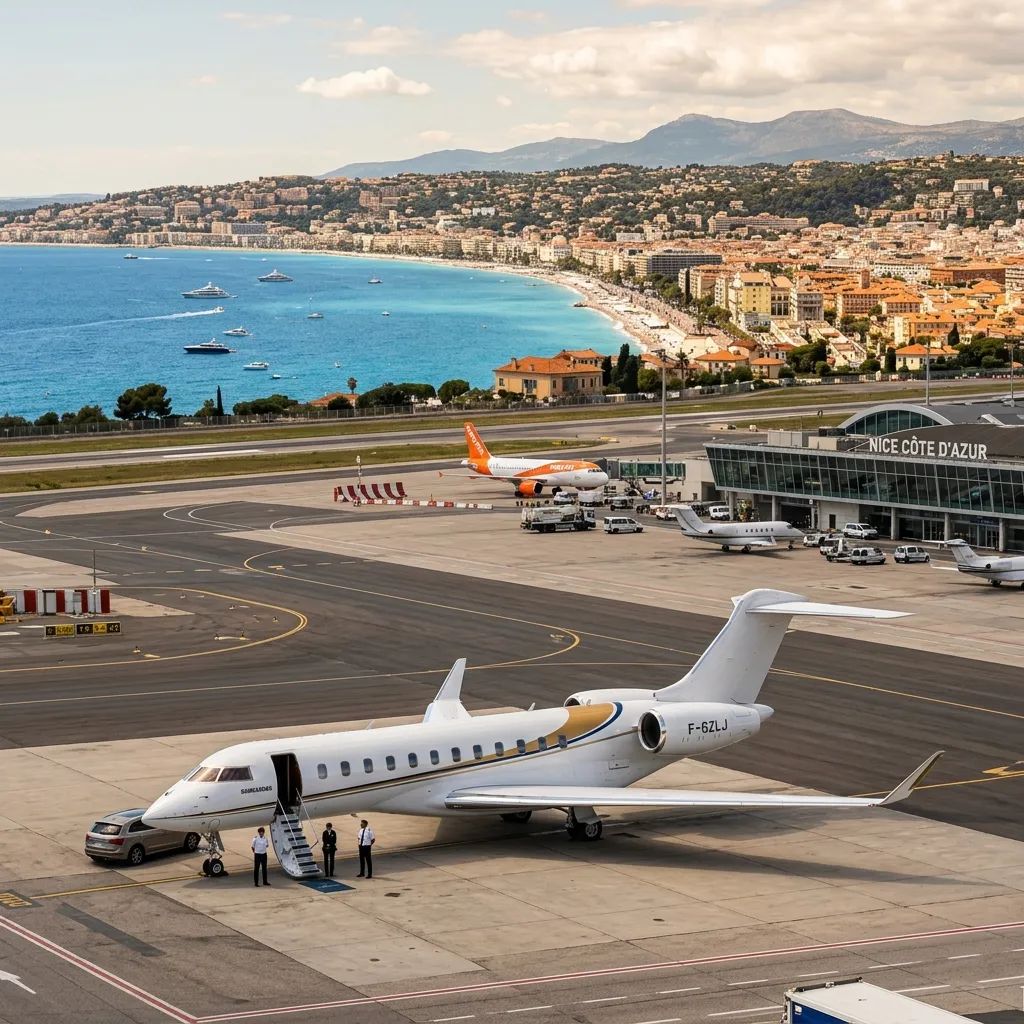
Private jet on the tarmac at Nice Cote d'Azur Airport with the Mediterranean Sea and French Riviera hills in the background

Flying Private to Monaco: Nice Cote d'Azur, Helicopter Transfers, and Grand Prix Season

undefined

In This Article

Why Monaco Requires Nice Cote d'Azur FBO Facilities at Nice Cote d'Azur Helicopter Transfers: Nice to Monaco Customs, Permits, and European Flight Operations Seasonal Pricing and Event Demand Frequently Asked Questions

Why Monaco Requires Nice Cote d'Azur

At 2.02 square kilometers (0.78 sq mi), Monaco processes 1,500+ helicopter arrivals per month but zero fixed-wing aircraft operations. It has no airport and no possibility of building one. All fixed-wing access routes through Nice Cote d'Azur Airport (NCE/LFMN), located 22 kilometers (14 miles) northeast. The drive from Nice to Monaco takes 25-45 minutes depending on traffic along the A8 autoroute and the Lower Corniche. The helicopter takes 7 minutes.

Nice Cote d'Azur is the third busiest airport in France and the primary private aviation gateway to the entire French Riviera. The airport handles 2,000-3,000 private jet movements per month during peak season (May through September), with the Monaco Grand Prix weekend in late May being the single busiest period for general aviation traffic anywhere in Europe. Four dedicated FBOs serve private aviation on the airport's west side, separated from the commercial terminals.

FBO Facilities at Nice Cote d'Azur

Universal Aviation and ExecuJet handle the majority of U.S.-origin private jet traffic. Both offer VIP terminals with customs and immigration processing, crew lounges, catering coordination, and ground or helicopter transfer booking. Fuel is supplied by TotalEnergies at European market rates ($8.50-$10.50 per gallon equivalent for Jet-A1). Contract fuel programs can reduce pricing by 5-15%.

During Grand Prix weekend and the Cannes Film Festival, FBO ramp space at Nice fills completely. Aircraft may be required to reposition to Cannes-Mandelieu (CEQ), Saint-Tropez-La Mole (LTT), or Toulon-Hyeres (TLN) after passenger drop-off. Ramp reservations for Grand Prix weekend should be made 3-6 months in advance. The FBOs charge premium parking rates during events: €500-€1,500 per day depending on aircraft size, compared to €150-€400 during normal operations.

Helicopter Transfers: Nice to Monaco

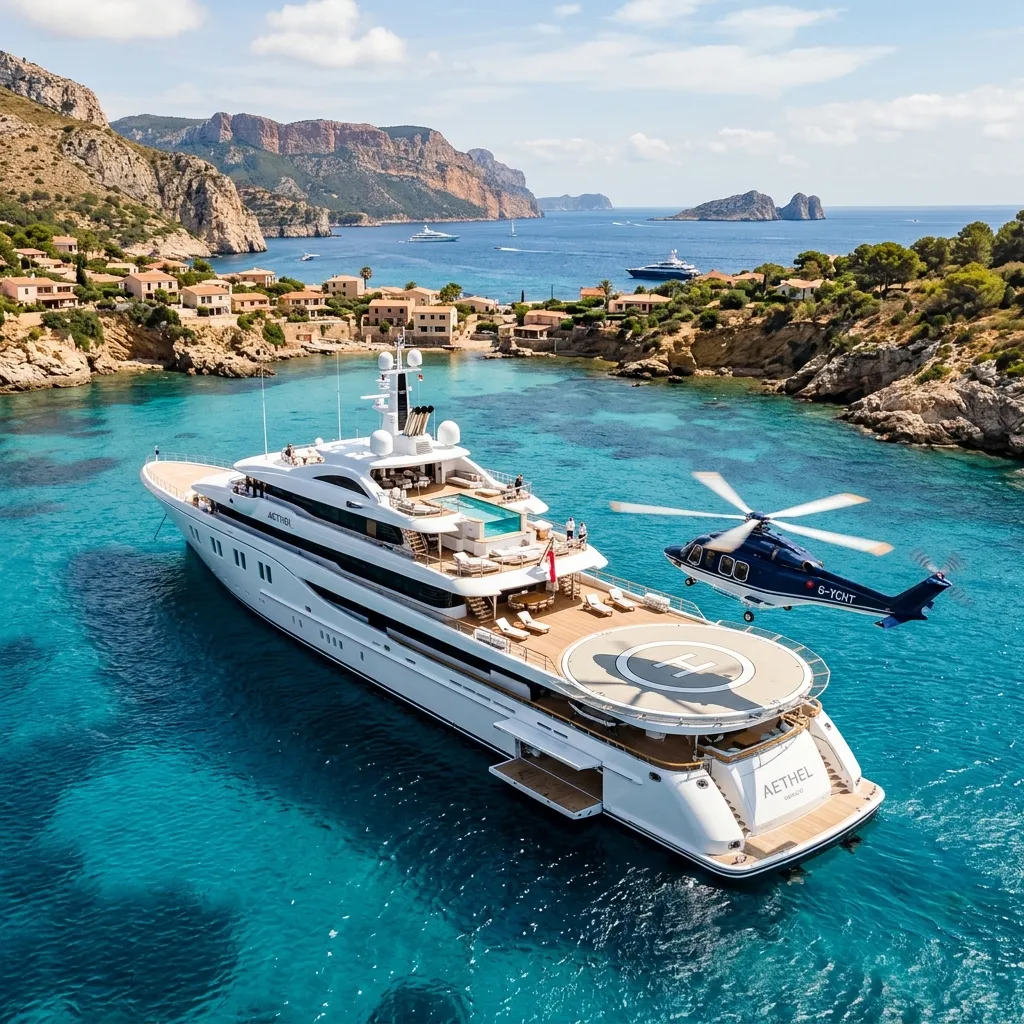
Monacair operates the scheduled helicopter service between Nice Cote d'Azur and Monaco Heliport (MCM). The flight takes 7 minutes. Scheduled departures run every 20-30 minutes during the day, with fares of approximately €160-€200 per person one-way. Private helicopter charters (Airbus H130 or H135, 4-6 passengers) cost €1,500-€3,000 per one-way transfer with timing coordinated to match your jet's arrival.

The Monaco Heliport sits on the waterfront near Fontvieille, a 5-minute drive from Monte-Carlo, Port Hercule, and the Casino district. Most Riviera-based hotels and residences are within 10-15 minutes by car from the heliport. For passengers proceeding directly to a yacht in Port Hercule, the heliport is adjacent to the port. The helicopter transfer is the defining logistics element of Monaco private jet travel: it converts a 25-45 minute car ride with Riviera traffic into a 7-minute flight over Cap d'Ail.

Need a Charter Quote?

Contact our team for a personalized quote.

Get a Quote

Customs, Permits, and European Flight Operations

Nice is a Schengen zone airport. Flights arriving from other Schengen countries (Germany, Italy, Spain, etc.) clear customs and immigration informally; passengers walk from the aircraft to the FBO terminal without border processing. Flights from non-Schengen countries (UK, U.S., UAE, etc.) require full customs and immigration processing at the FBO. The process takes 10-20 minutes for most groups.

  • Overflight and landing permits: required for non-EU-registered aircraft, 72 hours advance notice
  • Noise certificate: required, must comply with ICAO Chapter 3 or 4 standards
  • Slot request: Nice operates slot coordination during peak periods; request through the FBO or handler
  • Night operations: Nice has noise curfew restrictions between 23:30-06:00 local for certain aircraft types
  • Customs: Schengen arrivals require no processing; non-Schengen arrivals processed at FBO
  • French Civil Aviation Authority (DGAC) governs GA operations in French airspace
  • VAT implications: international operators should consult on fuel VAT exemptions for commercial flights

For U.S.-registered aircraft crossing the Atlantic to Nice, the typical routing follows the North Atlantic Organized Track System to Shannon (EINN) or Faro (LPFR) for a fuel stop, then proceeds to Nice. Direct transatlantic flights from the U.S. East Coast to Nice are 3,600-3,800 NM, achievable by ultra-long-range jets (G650, Global 7500, Falcon 8X) but requiring a fuel stop for most other business jets. The most common staging airports for fuel stops are Shannon (Ireland), Santa Maria (Azores), and Faro (Portugal).

Seasonal Pricing and Event Demand

Grand Prix weekend (typically the last weekend of May) is the peak of global private aviation demand. Nice handles over 1,000 private jet movements during the 4-day event period. Every ramp position is spoken for. Helicopters to Monaco run continuously from 6 AM to midnight. Charter rates from London Luton or Paris Le Bourget spike 50-100% above normal. Transatlantic rates from New York or Miami command $150,000-$250,000 one-way on heavy jets. The premium reflects genuine scarcity: there are simply not enough aircraft or ramp positions to meet demand.

The Monaco Yacht Show (late September) produces a secondary surge in private aviation traffic. The event draws 30,000+ attendees over 4 days, with 500+ superyachts docked in Port Hercule. Private jet demand during Yacht Show week is 30-50% above baseline, lower than Grand Prix but still requiring advance booking. For brokers, Yacht Show week is strategically important: clients attending are precisely the demographic who purchase and charter jets.

Brian Galvan

Written By

Brian Galvan

Founder, The Jet Finder · Private Aviation Operations & Technology

Former Director of Technology at FlyUSA (Inc. 5000 fastest-growing private jet company). Decade of hands-on experience across Part 135 operations, charter sales, fleet management, and aviation data systems.

LinkedInRead Full Profile →
Common Questions

Frequently Asked Questions


8 questions about chartering this aircraft

Monaco has no runway and no possibility of building one due to its 2.02 square kilometer size and dense urban development. The Monaco Heliport (MCM) accepts only helicopters. All fixed-wing aircraft must use Nice Cote d'Azur (NCE), Cannes-Mandelieu (CEQ), or other regional airports. Nice is the preferred gateway because of its 2,960-meter (9,711 ft) runway, 4 FBOs, and direct helicopter connection to Monaco. Cannes has a shorter runway (1,610 m / 5,282 ft) that limits operations to light and midsize jets.

Nice has two runways. The primary runway (04R/22L) is 2,960 meters (9,711 feet), accommodating all business jet types including ultra-long-range aircraft like the G700, Global 7500, and Boeing BBJ. The secondary runway (04L/22R) is 2,550 meters (8,366 feet), suitable for most business jets but requiring weight calculations for heavy jets. The airport sits at sea level (12 feet elevation), so density altitude is not a factor. Both runways have full ILS approach capability.

3-6 months minimum. Charter aircraft availability for Grand Prix weekend sells out quickly, especially for large-cabin and heavy jets on routes from London, Geneva, and the Middle East. Ramp parking at Nice FBOs must be reserved separately and fills up 4-6 months in advance. Helicopter transfers should be booked 2-3 months ahead. Hotels in Monaco during Grand Prix sell out 6-12 months in advance. For the best selection of aircraft type, departure times, and FBO ramp positioning, book 6 months ahead and confirm all logistics 90 days before the event.

Nice enforces noise restrictions between 23:30 and 06:00 local time. During this curfew, only aircraft meeting ICAO Chapter 4 noise standards may operate, and certain departure and arrival procedures are modified to reduce noise over populated areas along the coast. Older jets meeting only Chapter 3 standards (some pre-2006 Challenger 600s, older Gulfstreams) may be denied night operations. Current-production business jets (G650, Global 7500, Phenom 300, etc.) all meet Chapter 4 or 14 standards and are unaffected by the curfew restrictions.

Cannes-Mandelieu (CEQ) is closer to Cannes, Saint-Tropez, and western Riviera destinations. However, its runway is only 1,610 meters (5,282 feet), limiting operations to light and midsize jets (Phenom 300, Citation XLS, Learjet 75). Heavy jets and ultra-long-range aircraft cannot operate at Cannes. For Monaco-bound passengers, Nice is the clear choice due to the helicopter connection. For Cannes Film Festival attendees on light jets, Cannes-Mandelieu saves 30-40 minutes of ground transfer compared to Nice.

New York to Nice (3,600 NM) requires a heavy jet or ultra-long-range aircraft for nonstop operation. A G650ER or Global 6000 charters at $160,000-$220,000 one-way. A Global 7500 or G700 runs $200,000-$280,000. With a fuel stop in Shannon or the Azores, a super-midsize jet (Challenger 350) can make the trip at $100,000-$140,000 one-way. During Grand Prix weekend, add 50-100% to these figures. Round-trip pricing includes repositioning costs unless the operator has a matching return trip.

The FBOs at Nice coordinate directly with yacht captains and management companies. Passengers disembarking from a yacht in Port Hercule Monaco can helicopter from Monaco Heliport to Nice (7 minutes) and board their aircraft at the FBO within 20-30 minutes of leaving the yacht. In reverse, passengers arriving by jet transfer by helicopter to Monaco Heliport, where a yacht tender or car meets them for transfer to the vessel. For yachts anchored off Villefranche or Beaulieu-sur-Mer, tender transfers to Nice port connect with ground transportation to the airport (15-20 minutes).

Yes. U.S.-registered aircraft operating in French airspace require: (1) DGAC overflight and landing permit (arranged through a handler, 72 hours notice), (2) valid aircraft insurance recognized under EU/EASA requirements (verify with your broker that your policy meets EU liability minimums), (3) noise certificate compliance (ICAO Chapter 3 or 4), and (4) EASA-recognized pilot licenses (U.S. ATP certificates are recognized under bilateral agreements for private operations). Commercial operations (charter flights carrying passengers for hire) may require additional authorization depending on the regulatory interpretation.

Continue Reading

Related Articles


Your Next Mission

Ready to Fly?


Whether you need a charter quote or want to explore aircraft options, our team is here.

Contact Us