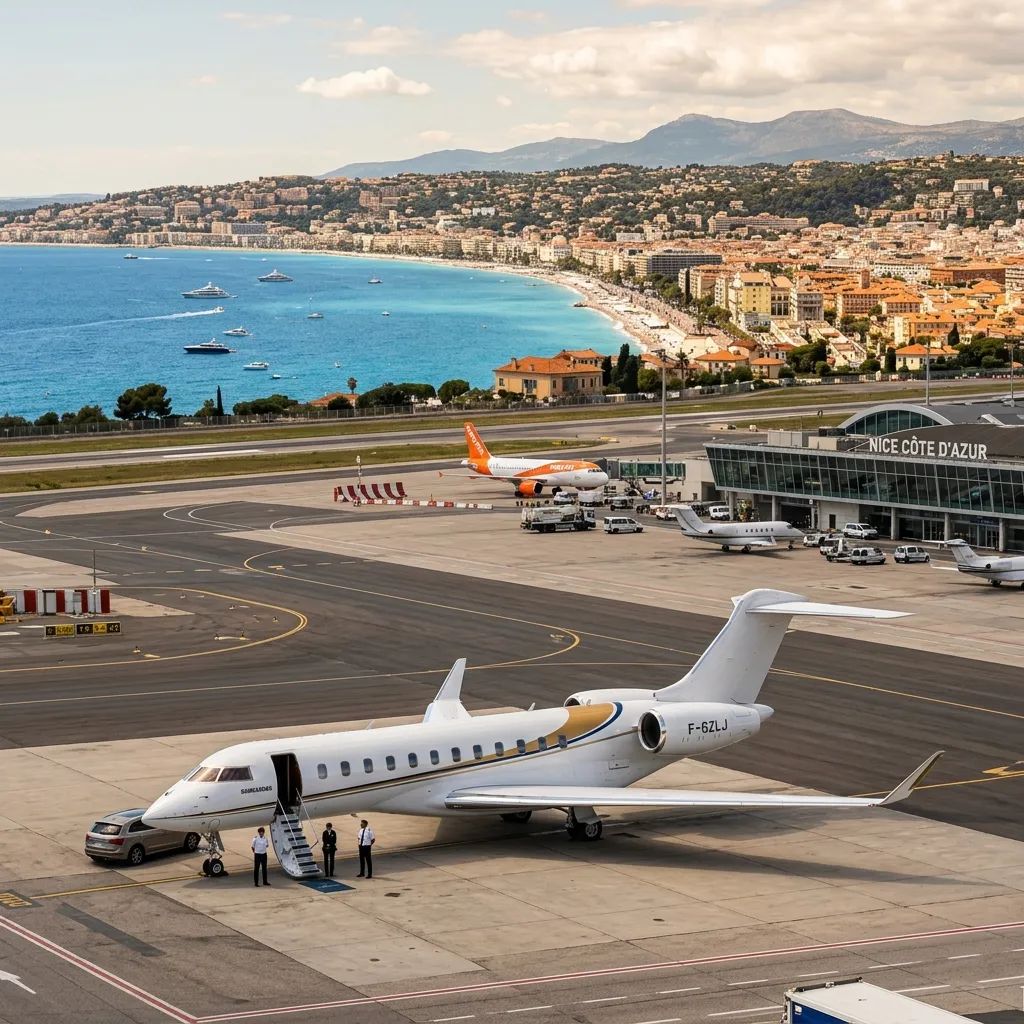
Business jet parked on the tarmac at Nice Cote d'Azur Airport with the Mediterranean in the background

European Business Aviation: EASA Regulations, Market Trends, and What U.S. Operators Need to Know

undefined

In This Article

3,800 Business Jets and a Regulatory Framework Unlike America's EASA vs FAA: Key Regulatory Differences for Aircraft Operations Slot Restrictions: Europe's Biggest Operational Constraint Market Segments: Where European Business Aviation Is Growing What U.S. Operators Need for Transatlantic Operations Frequently Asked Questions

3,800 Business Jets and a Regulatory Framework Unlike America's

Europe's business aviation fleet includes approximately 3,800 fixed-wing business jets and turboprops as of early 2026, representing roughly 15% of the global fleet. The market is concentrated in five countries: the United Kingdom (28%), France (15%), Germany (14%), Switzerland (10%), and Italy (7%). Unlike the U.S. market, where private aviation operates with minimal slot restrictions and unified FAA oversight, European operations navigate 44 national civil aviation authorities coordinated (but not unified) under the European Union Aviation Safety Agency (EASA), plus slot constraints at over 90 airports.

Business aviation movements in Europe grew 4.2% in 2025 versus 2024, recovering past pre-COVID levels in most markets. The UK and France lead in absolute movements, while Turkey, Poland, and Saudi Arabia-to-Europe routing show the fastest growth rates. The market structure differs from the U.S.: approximately 60% of European business aviation flights are charter (operated under Air Operator Certificates, Europe's equivalent of Part 135), compared to roughly 40% charter in the U.S. Owner-operated Part 91-style flying is proportionally smaller in Europe due to regulatory complexity and cost.

EASA vs FAA: Key Regulatory Differences for Aircraft Operations

The most significant operational difference is cabotage. A U.S.-registered (N-number) aircraft cannot carry passengers for hire between two European points. A charter from London to Nice on an N-registered jet with paying passengers violates EU cabotage rules. The aircraft must be on a European registry (or operating under bilateral agreements for specific transatlantic positioning flights) to conduct intra-European charter. This is why most charter operators serving European routes operate EU-registered aircraft under EASA AOCs.

The pilot license issue catches many operators off guard. An FAA Airline Transport Pilot certificate is not valid for European operations. EASA requires its own ATPL, with different theoretical knowledge exams, different medical standards, and different proficiency check requirements. A U.S. pilot operating an N-registered aircraft in European airspace under Part 91 can use an FAA license, but the moment the aircraft operates commercially under European oversight, EASA credentials are required.

Slot Restrictions: Europe's Biggest Operational Constraint

Over 90 European airports require landing and departure slots, allocated through the IATA Worldwide Slot Guidelines (WSG) system. At fully coordinated airports like London Heathrow (LHR), Paris Le Bourget (LBG), Nice (NCE), and Geneva (GVA), business aviation operators must request slots through national slot coordinators, sometimes weeks in advance. During peak periods (Monaco Grand Prix weekend at Nice, ski season at Geneva, Cannes Film Festival), slot availability drops to zero and operations are diverted to alternate airports.

Le Bourget (LFPB), Europe's busiest dedicated business aviation airport with 50,000+ annual movements, is fully slot-coordinated. Operators must request slots through COHOR (the French slot coordinator) at least 5 days before the intended operation, and 15 days during peak events. Geneva (LSGG) requires 48-hour advance slot requests for business aviation. London Biggin Hill (EGKB) and Farnborough (EGLF) are less restrictive but still require prior permission.

  • Le Bourget (LBG): 5-day advance slot request, 15 days during Paris events
  • Nice (NCE): Slots required year-round; near-impossible during Grand Prix and Film Festival
  • Geneva (GVA): 48-hour advance request; WEF Davos week requires 2+ weeks notice
  • London Luton (LTN): Slots required; heavy airline traffic limits GA access
  • Zurich (ZRH): Business aviation slots limited to 2-3 per hour at peak
  • Farnborough (FAB): Prior permission required, less restrictive than coordinated airports

Need a Charter Quote?

Contact our team for a personalized quote.

Get a Quote

Market Segments: Where European Business Aviation Is Growing

The UK remains the largest market by both fleet size and movements, driven by London's role as a global financial center. Farnborough, Biggin Hill, and Luton serve as London's primary business aviation airports. Post-Brexit regulatory independence has not significantly changed operations: the UK CAA maintains standards aligned with EASA through bilateral agreements, and UK-registered aircraft operate freely across Europe under existing air services agreements.

Turkey and Poland represent the fastest-growing markets in percentage terms. Istanbul's position as a hub between Europe, Central Asia, and the Middle East drives charter demand. Poland's growth reflects rising corporate travel demand from Warsaw and Krakow to Western European financial centers. Both markets are starting from small bases, so percentage growth overstates absolute fleet additions. Italy's 5.2% growth is notable because it represents a genuine expansion in a mature market, driven by Milan's role in fashion, design, and luxury goods.

What U.S. Operators Need for Transatlantic Operations

U.S.-registered aircraft entering European airspace require: a valid FAA airworthiness certificate, RVSM approval (mandatory above FL290 in European airspace), overflight and landing permits from each country's civil aviation authority, noise certificate compliance (ICAO Chapter 4 minimum at most European airports), third-party liability insurance meeting EU minimums (higher than FAA requirements for several aircraft categories), and eAPIS filing for return to the U.S.

  • Overflight permits: Required from each country entered; most European countries participate in IFPS (Eurocontrol) for en-route management
  • Landing permits: Required at most European airports; secured through handling agents or trip support companies
  • Insurance: EU/EEA minimum third-party liability is typically higher than U.S. requirements; verify coverage with insurer
  • Noise compliance: ICAO Chapter 4 standard required; some airports (London City, Zurich) have additional noise limits
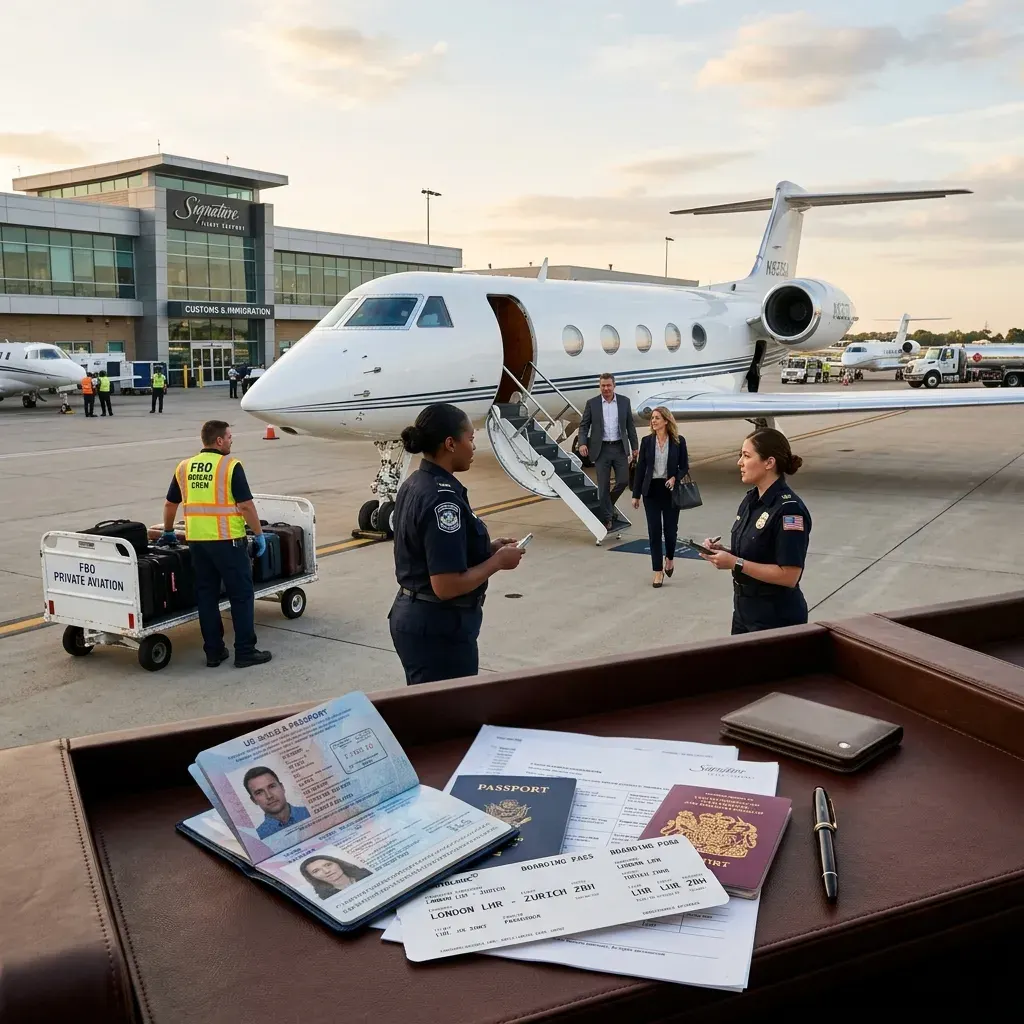
  • Customs: EU Schengen entry requires clearance at first landing point in Schengen zone; UK has separate entry requirements post-Brexit
  • Fuel VAT: Business aviation fuel in EU countries carries value-added tax (15-27% depending on country); trip support companies arrange exemptions for international flights
  • Carbon emissions: EU ETS (Emissions Trading System) applies to flights within the European Economic Area; reporting required for operators exceeding 10,000 tCO2/year

Trip support companies (Universal Aviation, World Fuel Colt, FuelerLinx) are essential for European operations. They handle slot requests, overflight permits, landing permits, ground handling coordination, fuel arrangements, and customs documentation. Attempting European ops without a trip support partner is possible but inadvisable. The regulatory and logistical complexity is an order of magnitude greater than domestic U.S. operations.

Brian Galvan

Written By

Brian Galvan

Founder, The Jet Finder ยท Private Aviation Operations & Technology

Former Director of Technology at FlyUSA (Inc. 5000 fastest-growing private jet company). Decade of hands-on experience across Part 135 operations, charter sales, fleet management, and aviation data systems.

LinkedInRead Full Profile →
Common Questions

Frequently Asked Questions


8 questions about chartering this aircraft

No. EU cabotage rules prohibit N-registered aircraft from carrying paying passengers between two points within the European Economic Area. A charter from London to Geneva on an N-registered jet with fare-paying passengers violates cabotage regulations. The aircraft must be registered in an EU/EEA member state and operating under an EASA Air Operator Certificate (AOC) for intra-European commercial flights. N-registered aircraft can position empty between European airports and can carry owner-passengers on Part 91 flights without issue.

Le Bourget requires slot requests through COHOR (the French slot coordinator) at least 5 business days before the intended operation. During peak events (Paris Air Show, Roland Garros, Fashion Week), the advance notice requirement extends to 15 business days, and slot availability may be limited to zero during specific time windows. Operators should request slots as early as possible; Le Bourget handles 50,000+ annual business aviation movements and capacity is constrained, particularly on weekday mornings and Friday afternoons.

For Part 91 (private, non-commercial) operations with an N-registered aircraft, an FAA ATP and a valid FAA medical certificate are sufficient for European airspace under ICAO rules. For commercial operations under EASA oversight (EU-registered aircraft operating charter flights), the pilot needs an EASA ATPL with type rating on the specific aircraft. EASA and FAA pilot certificates are not mutually recognized for commercial operations. Converting an FAA ATP to an EASA ATPL requires passing EASA theoretical knowledge exams (14 subjects), meeting EASA medical standards, and completing a proficiency check.

Operationally, the impact has been moderate. UK-registered aircraft still operate freely across EU airspace under the UK-EU Trade and Cooperation Agreement's air transport provisions. However, UK Air Operator Certificates are no longer automatically valid in the EU; UK operators need specific authorization for intra-EU commercial flights. UK-based pilots holding EASA licenses had to exchange them for UK CAA licenses. Customs and immigration now apply at the UK-EU border, adding 30-60 minutes of processing time at airports that previously had no passport control for Schengen-to-UK flights.

The EU ETS covers CO2 emissions from flights within the European Economic Area. Operators exceeding 10,000 tonnes of CO2 per year (equivalent to roughly 1,000+ flight hours in a heavy jet) must monitor, report, and surrender emission allowances. Most business aviation operators fall below the threshold due to lower annual flight hours. For operators above the threshold, allowance costs add approximately $15-$40 per tonne of CO2, translating to $30-$120 per flight hour for a midsize jet. SAF usage can reduce the ETS obligation. CORSIA (ICAO's Carbon Offsetting and Reduction Scheme for International Aviation) covers international flights separately.

When Le Bourget is full, operators divert to Pontoise (LFPT, 35 km north of Paris) or Toussus-le-Noble (LFPN, 20 km southwest). When Nice runs out of slots during events, Cannes-Mandelieu (LFMD, 6 km from Cannes, 3,281 ft runway, turboprops and light jets only) absorbs overflow. When Geneva is saturated during WEF or ski season, Chambery (LFLB, serves Courchevel/Meribel) and Bern (LSMB) serve as alternatives. London overflow goes to Oxford-Kidlington (EGTK) or Bournemouth (EGHH). These alternates have fewer services but guaranteed availability.

EU Regulation 785/2004 mandates minimum third-party liability insurance for all aircraft operating in EU airspace. For business jets in the 6,000-20,000 kg MTOW range (most midsize and super-midsize jets), the minimum third-party coverage is approximately 7 million SDR (Special Drawing Rights), equivalent to roughly $9.5 million. For larger aircraft (20,000-50,000 kg), minimums increase to 18 million SDR ($24.4 million). U.S. policies typically meet or exceed these minimums, but operators should verify with their insurer and carry proof of coverage in the aircraft for ramp checks.

Jet fuel purchased in EU countries carries value-added tax ranging from 15% (Luxembourg) to 27% (Hungary). International flights are VAT-exempt under EU Directive 2003/96/EC, meaning operators pay only the base fuel price without VAT for flights departing to a non-EU destination or arriving from one. Domestic flights within a single EU country are not exempt and carry full VAT. Trip support companies and FBO handlers file the exemption paperwork on behalf of the operator. The exemption must be documented with flight plan evidence showing the international nature of the operation.

Continue Reading

Related Articles


Your Next Mission

Ready to Fly?


Whether you need a charter quote or want to explore aircraft options, our team is here.

Contact Us