The Technology That Arrived a Decade Early
Dassault had been building fly-by-wire fighter jets since the Mirage 2000 in 1982 and the Rafale in 1986. When the company announced that the Falcon 7X would use the same digital flight control architecture, the business aviation market treated it as a curiosity rather than a revolution. Gulfstream was selling the G550 with conventional hydraulic controls. Bombardier's Global Express used hydro-mechanical systems. Both sold well. Nobody was asking for fly-by-wire.
Dassault built it anyway. The Falcon 7X's fly-by-wire system replaces mechanical linkages between the cockpit controls and the flight surfaces with electrical signals processed by three independent flight control computers. The pilot inputs a command. The computers calculate the optimal surface deflection to execute that command, factoring in airspeed, altitude, angle of attack, and atmospheric conditions. The surfaces move. The result is a jet that corrects for turbulence before passengers feel it, prevents the pilot from exceeding structural limits, and handles 40 control surface adjustments per second.
Every other fly-by-wire business jet that followed (the 8X, Falcon 6X, Citation Longitude, Gulfstream G500/G600/G700) owes its existence to Dassault proving the concept on the 7X. The industry said business jets did not need fighter jet controls. Dassault said they did, built the jet, and waited for the market to catch up.
Three Engines: Redundancy That Stops Being Theoretical Over Water
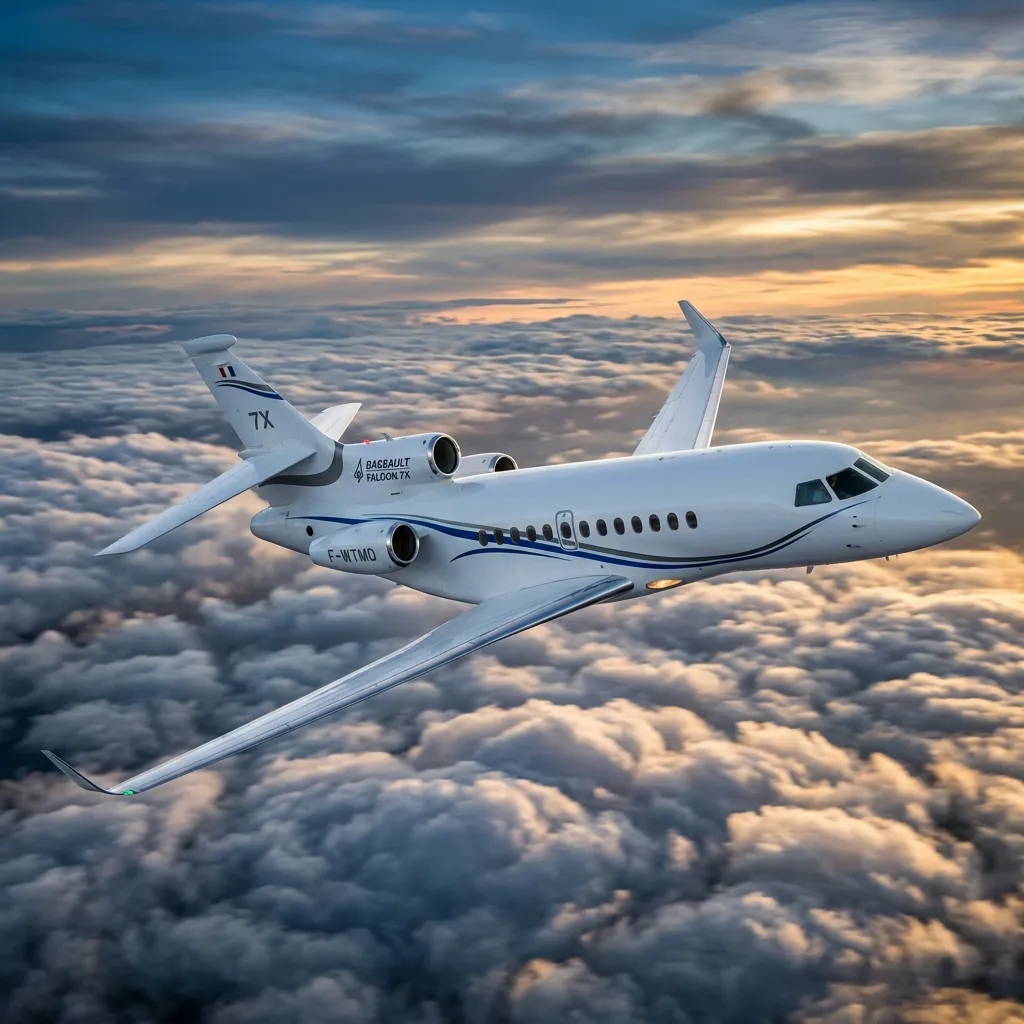
The Falcon 7X is powered by three Pratt & Whitney Canada PW307A engines, each producing 6,402 pounds of thrust. Total thrust: 19,206 pounds. This tri-engine configuration is not about raw power. A twin-engine configuration could produce the same total thrust with two larger engines. The third engine exists for one reason: overwater redundancy.
On a transatlantic crossing from Teterboro to London, the Falcon 7X spends approximately 2.5 hours with no suitable divert airport within 60 minutes. If a twin-engine jet loses an engine over the mid-Atlantic, the pilot must descend to a lower altitude, increase thrust on the remaining engine, and divert to the nearest suitable airport (Iceland, Greenland, the Azores, or Shannon). Cabin altitude rises during the descent. Range decreases. Fuel management becomes critical.
If the Falcon 7X loses one of its three engines at cruise, it maintains altitude and cabin pressure on the remaining two engines. There is no emergency descent. No divert. The jet continues to destination on 66% of its powerplant. This is not a hypothetical safety scenario. It is a structural redundancy that allows the 7X to fly routes that twin-engine jets can fly only with formal ETOPS certification and specific divert airport planning.
The Cabin: Large Enough for Most Missions, Smaller Than You Expect
The Falcon 7X cabin measures 39.1 feet long, 7.7 feet wide, and 6.2 feet tall. Compared to its direct competitors at the time of introduction, the 7X's cabin falls between the Gulfstream G550 (43.8 ft long, 7.3 ft wide) and the Global Express (48.4 ft long, 8.2 ft wide). The 7X is wider than the G550 but shorter. It is narrower than the Global Express but offers a more refined interior per square foot.
Typical three-zone configurations include a forward four-seat club arrangement, a mid-cabin conference group or additional club seating, and an aft divan that converts to a berthing area. Maximum seating is 16 passengers, but comfortable long-haul configurations seat 10-12. The aft lavatory is a full-size enclosed compartment with a vanity and mirror, larger than the G550's aft lav and comparable to the Global Express.
Cabin Altitude and Passenger Comfort
At FL510 (51,000 feet), the Falcon 7X maintains a cabin altitude of approximately 4,400 feet. At FL410 (a more common cruise altitude for Atlantic crossings), cabin altitude drops to approximately 3,000 feet. For comparison, the G550 holds 4,000 feet at FL510 and a commercial airliner typically maintains 6,000-8,000 feet. Lower cabin altitude translates to less dehydration, fewer headaches, and better sleep quality on flights over 6 hours.
Baggage capacity is 140 cubic feet, accessible in flight through a compartment at the rear of the cabin. This is slightly less than the G550 (170 cu ft) but more than adequate for 8-10 passengers with standard luggage. The external baggage door is large enough for golf bags, skis, and oversized items.
Performance: 5,950 NM and the Routes It Opens
The Falcon 7X carries 5,950 nautical miles of range at long-range cruise (Mach 0.80, approximately 459 knots). Maximum speed is Mach 0.90. High-speed cruise at Mach 0.86 reduces range to approximately 5,200 NM, which still covers transatlantic routes nonstop.
The 7X's sweet spot is the transatlantic corridor. For buyers and charterers whose missions are primarily between North America and Europe, the 7X covers every relevant city pair nonstop at a charter rate ($5,500-$7,500/hr) that undercuts the G650 by $1,500-$3,000 per hour. The G650's additional 1,300 NM of range matters only if you routinely fly segments exceeding 5,900 NM.