The Numbers That Matter Before Everything Else
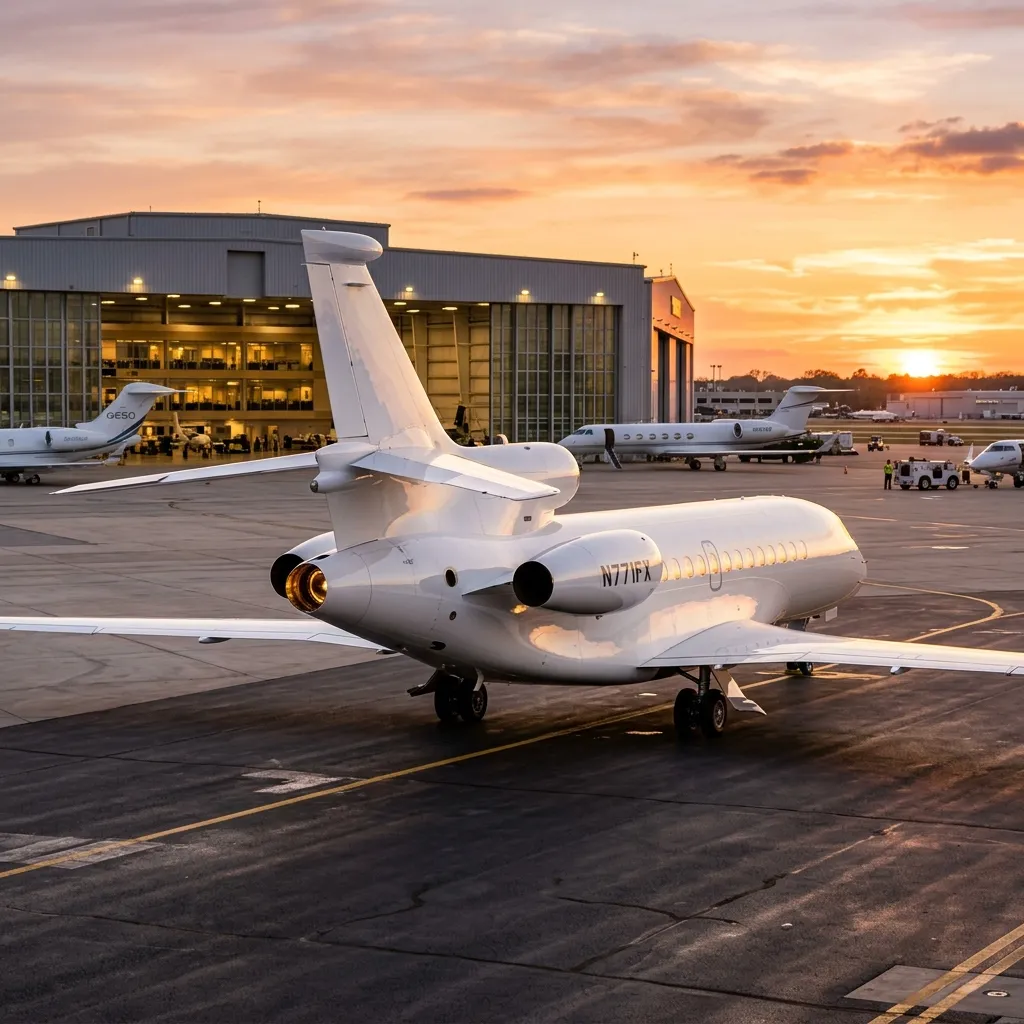
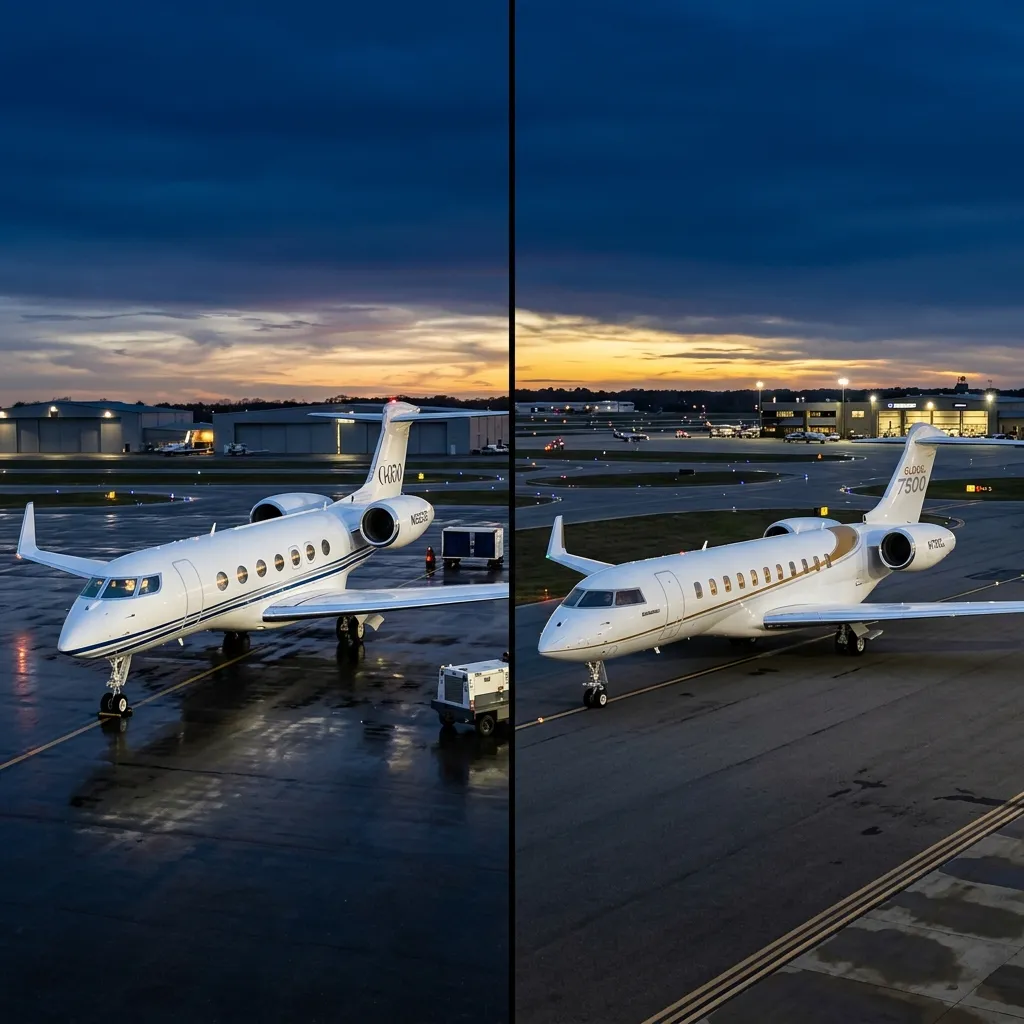
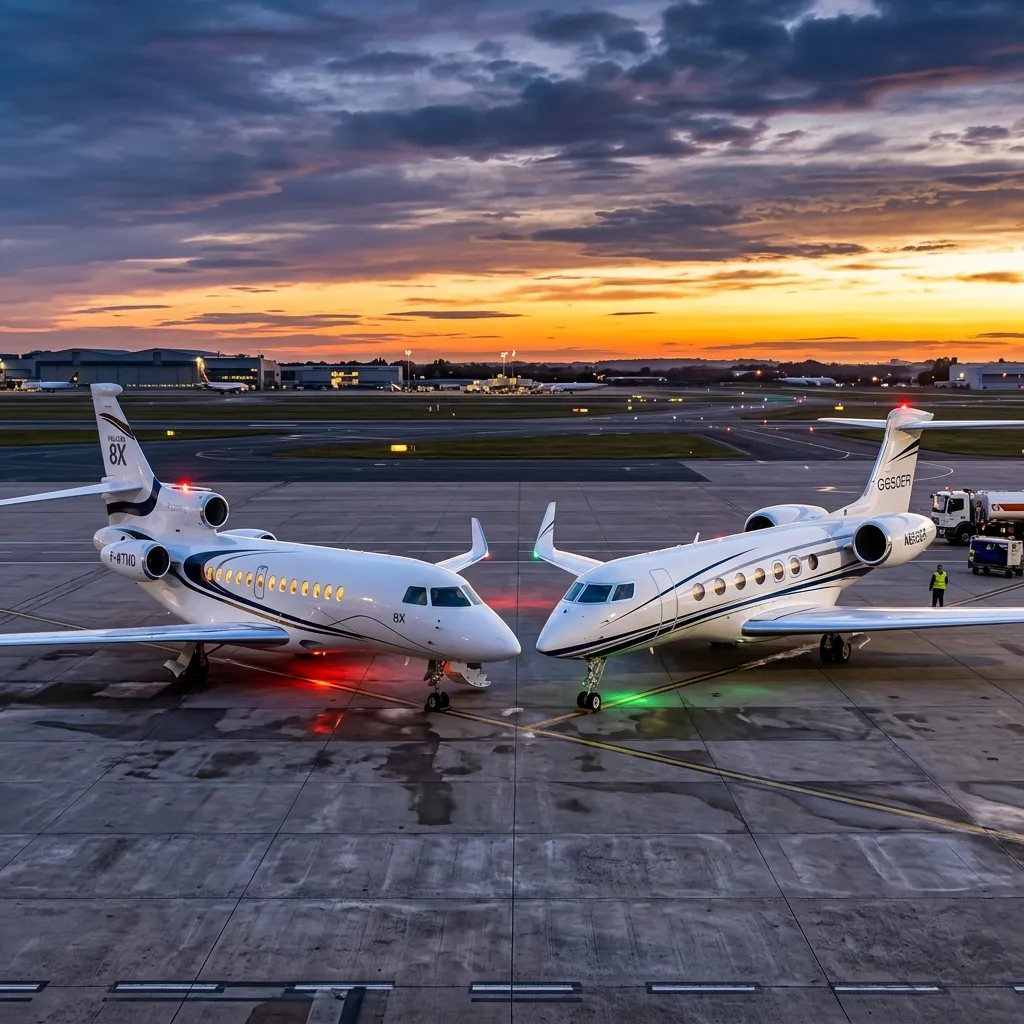
The Gulfstream G650ER holds 7,500 nautical miles of range. The Dassault Falcon 8X holds 6,450. That 1,050-nautical-mile gap looks decisive on paper. In practice, it determines exactly two things: whether you can fly nonstop from New York to Hong Kong (the G650ER can, the 8X cannot), and whether your positioning options on ultra-long segments leave room for headwinds (the G650ER has more margin). On 95% of routes charter passengers actually fly, both jets arrive at the same time, at the same airport, with no fuel stop.
The G650ER wins every cabin dimension and both speed metrics. The 8X wins on takeoff distance and charter pricing. Neither of those summaries tells the real story.
Three Engines vs Two: What Passengers Actually Get
Dassault's tri-engine configuration on the Falcon 8X is not a marketing exercise. Three Pratt & Whitney PW307D engines, each producing 6,722 pounds of thrust, provide a specific operational advantage: the 8X can lose an engine at cruise altitude and maintain cabin pressure and flight level without an emergency descent. Twin-engine jets, including the G650ER, must descend to a lower altitude following an engine failure. Over the North Atlantic or the Pacific, that descent means diverting to a suitable airport.
The practical difference for charter passengers: on overwater routes, the Falcon 8X does not require formal ETOPS certification because the tri-engine configuration already exceeds the redundancy standard that ETOPS was designed to ensure. The G650ER holds ETOPS-120 certification, adequate for most Atlantic crossings, but routing flexibility near the Pacific Rim is more constrained.
Fuel Burn: The Third Engine's Price Tag
Three engines burn more fuel. The Falcon 8X consumes approximately 280 gallons per hour at long-range cruise. The G650ER burns approximately 450 GPH, but its two Rolls-Royce BR725 engines produce significantly more total thrust (33,800 lbs combined vs 20,166 lbs). Per pound of thrust, the 8X is more fuel-efficient. Per nautical mile flown, the G650ER's higher cruise speed partially offsets its higher burn rate. On a 4,000 NM transatlantic leg, the 8X burns roughly 2,600 gallons; the G650ER burns roughly 3,800. At $6.50 per gallon, that is a $7,800 fuel cost difference on a single leg.
The Cabin Gap Is Real
The G650ER's cabin is 46.8 feet long, 8.5 feet wide, and 6.4 feet tall. The Falcon 8X measures 42.8 feet long, 7.7 feet wide, and 6.2 feet tall. Those differences are not marginal. The G650ER's extra 0.8 feet of width means the difference between a three-across seating configuration and one where the third seat feels squeezed. The 4 feet of additional length allows a full fourth cabin zone in most G650ER layouts, typically a private stateroom or dedicated crew rest area.
Where the 8X closes the gap: cabin altitude. At FL510, the Falcon 8X maintains a cabin altitude of approximately 3,900 feet, one of the lowest in any business jet. The G650ER holds 4,100 feet at FL510 and can achieve 3,000 feet at lower cruise altitudes (FL410). Both are dramatically better than a commercial aircraft at 6,000-8,000 feet cabin altitude. Over a 10-hour flight, the lower cabin altitude translates to measurably less fatigue, fewer headaches, and better sleep quality for passengers.
Route-Specific Verdicts
The comparison changes depending on where you are going. Some routes clearly favor one aircraft. Others are a wash.
The G650ER's range advantage is decisive for true ultra-long-haul: Singapore, Sydney, or the Pacific Rim from the U.S. East Coast. The Falcon 8X's short-field performance is decisive for airports with runway constraints, steep approaches, or high-elevation operations. London City Airport, St. Moritz/Samedan, and most mountain airports in the western U.S. favor the 8X.