Falcon 2000 Hourly Charter Rates in 2026
The Dassault Falcon 2000 charters between $5,800 and $7,500 per flight hour. The spread covers five distinct variants spanning a 30-year production run, from the original GE-powered Falcon 2000 (1995) to the current Pratt & Whitney-powered Falcon 2000LXS. That rate positions the Falcon 2000 family below the Challenger 604 ($7,500 to $9,500) and above the Citation Sovereign ($5,200 to $6,800), placing it in a contested corridor where cabin width and short-field access drive the pricing conversation.
These figures cover flight time only. Repositioning fees range from $3,500 to $6,000 per leg depending on operator base location. Crew overnight charges add $2,200 to $3,500 per night for trips requiring outstation stays.
Five Variants, Five Price Points
The Falcon 2000 family is not one aircraft. It is five distinct variants that share a cabin cross-section but differ meaningfully in powerplant, range, and avionics. Charter rates reflect these differences directly.
The original CF34-powered variant and the DX trade range for lower operating cost. The EX, LX, and LXS variants use Pratt & Whitney PW308C engines with progressively refined FADEC software and improved fuel efficiency. For passengers, the cabin is identical across all five. The difference sits behind the cockpit door and on the fuel invoice.
Operating Cost Anatomy: Where the Money Goes
The original Falcon 2000 burns approximately 210 gallons per hour of Jet-A at long-range cruise. At $6.50 per gallon, fuel costs $1,365 per flight hour. The PW308C-equipped variants (EX through LXS) burn slightly less, approximately 195 gallons per hour, reducing the fuel line to $1,268. Fuel represents 18 to 22 percent of the total charter rate.
Cost Stack per Flight Hour
- Fuel (variable): $1,268–$1,365/hr depending on variant and Jet-A pricing at departure FBO
- Crew compensation (semi-fixed): Two pilots, fully burdened at $1,100 to $1,400 per flight hour
- Maintenance reserves (fixed): $1,200 to $1,600/hr covering engine HSI, 12/24-month inspections, and landing gear overhaul
- Insurance (fixed): Hull and liability on a $10–18 million aircraft, $110,000 to $180,000 annually
- Hangar and management (fixed): $10,000 to $18,000 monthly for hangar, tracking subscriptions, and management overhead
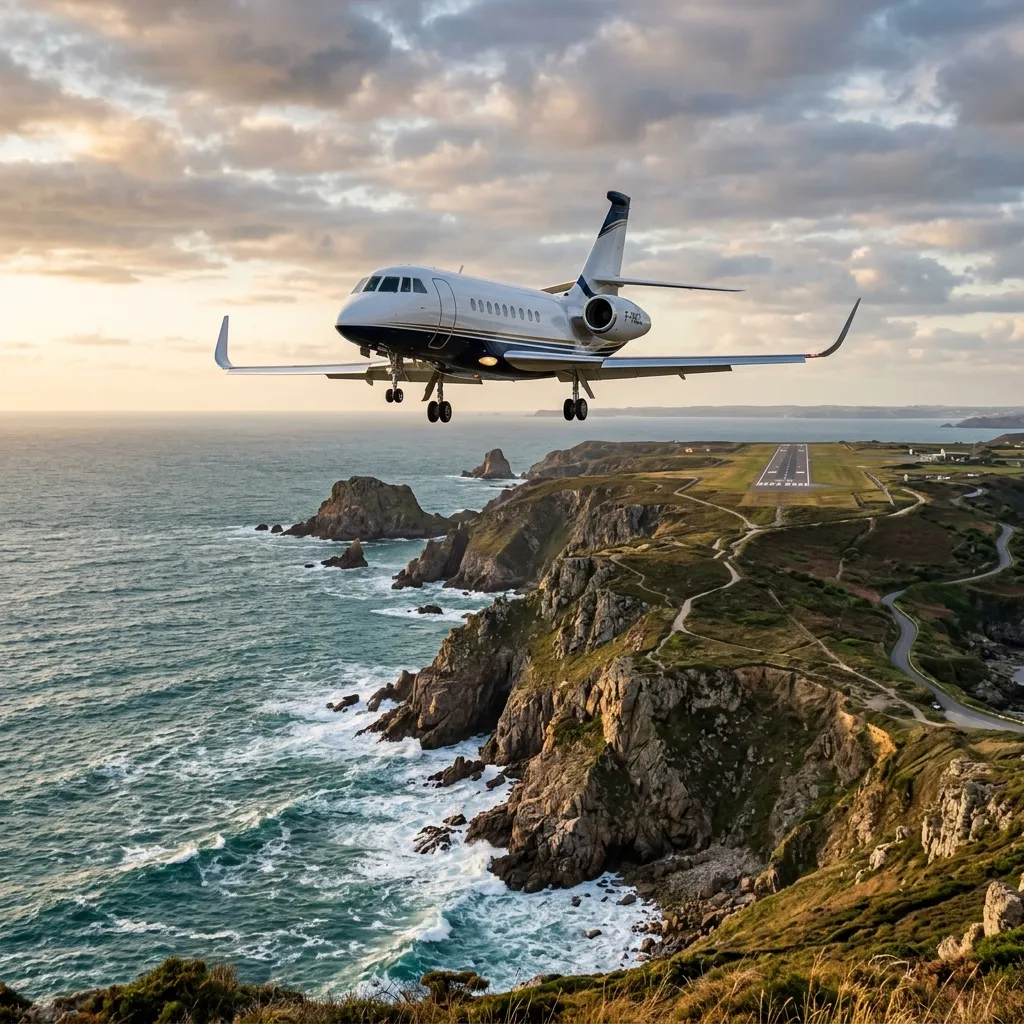
Dassault designed the Falcon 2000 around a 4,675-foot takeoff roll. That number opens airports the Challenger 604 and Gulfstream GIV cannot reach. Aspen, Telluride, and Sun Valley all become direct options. When your mission includes short runways, the Falcon 2000 does not just compete on price. It competes on access.
Need a Charter Quote?
Contact our team for a personalized quote.
Get a Quote →The Short-Field Advantage No Competitor Matches
The Falcon 2000's defining characteristic is not speed or range. It is runway performance. At maximum takeoff weight, the aircraft needs 4,675 feet. Reduce payload to 8 passengers with 3-hour fuel, and that number drops below 4,200 feet. This is a wide-body heavy jet that operates from runways designed for midsize aircraft.
Airports the Falcon 2000 Opens
- Aspen-Pitkin County (ASE): 8,006-foot runway, but the Falcon 2000's short-field performance provides critical safety margins at 7,820 feet elevation
- Teterboro (TEB): No runway restrictions; the Falcon 2000 fits comfortably within TEB's 7,000-foot main runway
- St. Barths (SBH): 2,133-foot runway; not recommended, but the Falcon 2000 has operated here under specific weight-restricted conditions
- Sun Valley/Friedman Memorial (SUN): 6,604-foot runway at 5,318 feet elevation; the Falcon 2000 clears this with margin the Challenger 604 cannot match
- Eagle County (EGE): 8,150-foot runway at 6,548 feet; density altitude in summer challenges larger jets, but the Falcon 2000's thrust-to-weight ratio handles it cleanly
For charter clients whose itineraries include mountain airports or island strips, the Falcon 2000 reduces the need for ground transfers from larger airports. That saves two to three hours per trip segment, which is worth more than the hourly rate difference against a lower-priced midsize jet flying into a different airport.
Falcon 2000 vs Competing Wide-Body Jets
The Falcon 2000 competes in a segment where buyers weigh cabin width against range and speed. It occupies the entry point of wide-body heavy jet territory, offering Falcon-family cabin dimensions at midsize pricing.
The Falcon 2000 offers 7.7 feet of cabin width, identical to the Falcon 900 and wider than the GIV-SP's 7.3 feet. Against the Challenger 604, the Falcon 2000 concedes half a foot of cabin width but gains over 1,100 feet of runway advantage. For operators serving mountain and island destinations, that runway margin is not a minor detail.
When to Charter the Falcon 2000 (and When Not To)
The Falcon 2000 fits a specific mission profile. Recognizing where it excels and where it falls short prevents mismatched bookings.
Charter the Falcon 2000 When:
- Your route includes short-runway destinations (under 6,000 feet) that disqualify the Challenger 604 and GIV-SP
- You need wide-body cabin comfort for groups of 8 to 10 but your trip length stays under 3.5 hours
- You want Dassault build quality and the 7.7-foot-wide cabin at a rate $1,500 to $2,000 below the Challenger 604
- Your departure or arrival airport has noise restrictions; the Falcon 2000 meets Stage 4 standards with lower approach speeds
Choose Something Else When:
- Your route exceeds 3,000 nautical miles and you are quoting the original Falcon 2000; the EX or LX variants add range, or consider the Falcon 900 for 4,000+ NM missions
- You are flying 12+ passengers with heavy luggage; the Falcon 2000 seats 12 but is most comfortable with 8 to 10
- You need transcontinental nonstop range from West Coast to East Coast against headwinds; the Challenger 604 and G550 handle this with more margin
- Your trip budget is below $5,500 per hour; consider the Citation Sovereign or Hawker 800XP