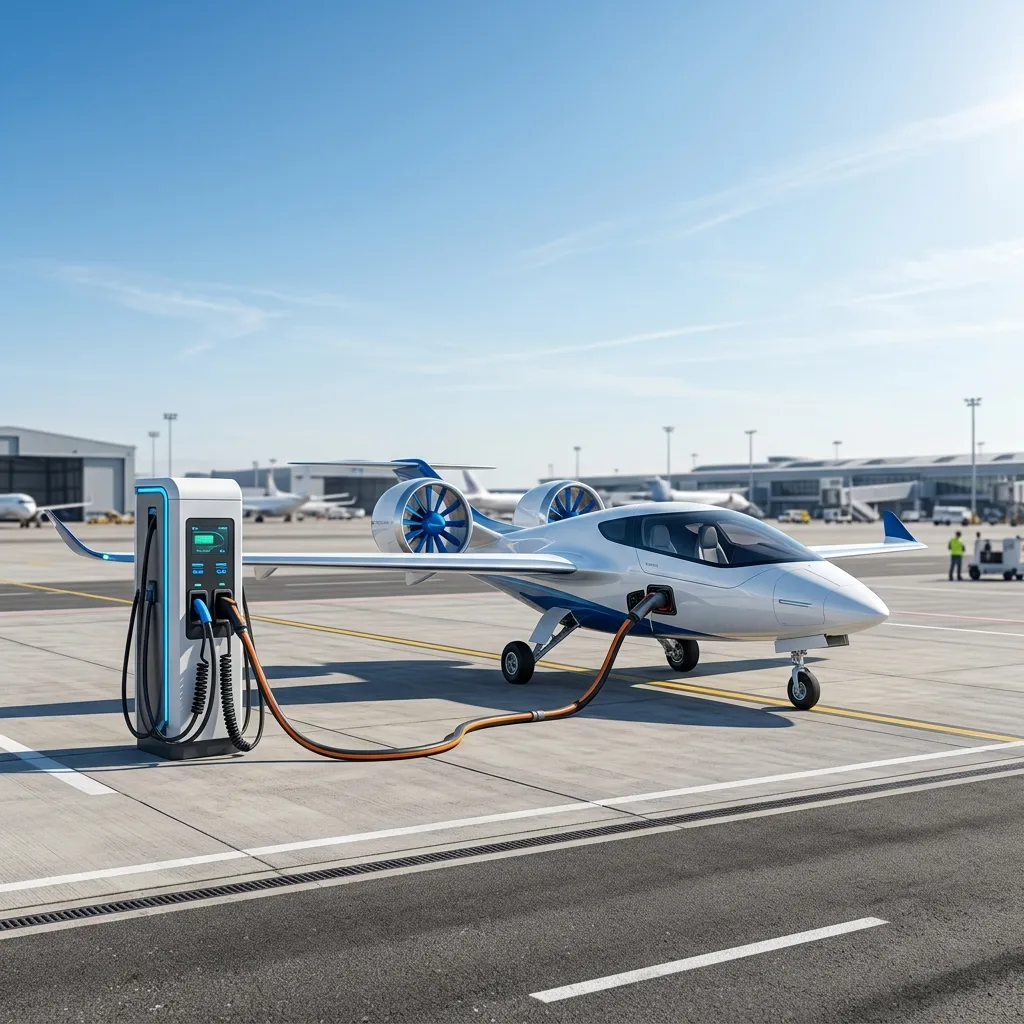
Futuristic electric aircraft concept on a runway with charging infrastructure visible

Electric and Hybrid Business Aircraft: Where Things Actually Stand in 2026

The press releases promise electric business jets by 2028. The physics says something different. Battery energy density is the bottleneck, and it is not being solved on anyone's announced timeline.

In This Article

The Fundamental Physics Problem What Is Actually Flying: The Commuter and Trainer Segment Hybrid-Electric: The Bridge That Might Be the Destination eVTOL: The Adjacent Market That Gets All the Headlines Sustainable Aviation Fuel: What Works Right Now Realistic Timeline: When Electric Business Jets Might Fly Frequently Asked Questions

The Fundamental Physics Problem

Jet-A fuel contains approximately 11,900 Wh/kg of energy. The best lithium-ion batteries available in 2026 deliver approximately 250 Wh/kg. That is a 48:1 energy density gap. A Citation CJ3 carries 3,700 lbs of fuel for a 1,875 NM range. To achieve the same range with batteries at current energy density, the aircraft would need 176,000 lbs of batteries, roughly 25 times the aircraft's maximum takeoff weight. The math does not work. It is not close to working.

Solid-state batteries, the most promising near-term advancement, project 400-500 Wh/kg by 2030 in laboratory conditions. Production-scale solid-state cells will likely deliver 350-400 Wh/kg. Even at 500 Wh/kg, the battery weight required for a 1,000 NM business jet mission exceeds 40,000 lbs. The energy density gap needs to shrink from 48:1 to at least 15:1 before all-electric business jets become physically possible. That requires 800+ Wh/kg batteries that do not exist in any laboratory today.

What Is Actually Flying: The Commuter and Trainer Segment

Electric propulsion works at the small end of aviation. Pipistrel (now Textron eAviation) received EASA type certification for the Velis Electro, a two-seat trainer, in 2020. The Velis Electro has a 50-minute flight endurance (plus 10-minute reserve) and costs approximately $0.70 per flight hour in electricity versus $30+ in fuel for a comparable piston trainer. It is a genuine, certified, flying electric aircraft. It is also 1,212 lbs MTOW with two seats and zero luggage capacity.

  • Pipistrel Velis Electro: EASA certified 2020. Two seats. 50 min endurance. 1,212 lbs MTOW. Flying and in production.
  • Eviation Alice: Nine-passenger commuter. First flight September 2022 (8 minutes). FAA certification originally planned 2024, now targeting 2027. Magni500 electric motors. 250 NM range target.
  • Heart Aerospace ES-30: 30-seat hybrid-electric regional. Concept stage. Targeting 200 NM all-electric range, 400 NM in hybrid mode. Entry into service target 2028, likely 2030+.
  • Bye Aerospace eFlyer 800: Eight-seat turboprop replacement concept. Projected 320 NM range. Certification timeline undefined.

Eviation Alice's September 2022 first flight lasted 8 minutes. The aircraft flew a traffic pattern at Moses Lake, Washington and landed. Since that flight, Eviation has restructured, changed leadership, and adjusted its certification timeline twice. The Alice will eventually fly. It will not fly 250 NM with 9 passengers before the end of this decade. Anyone building a fleet plan around it is planning around a press release, not a product.

Hybrid-Electric: The Bridge That Might Be the Destination

Hybrid-electric propulsion combines a conventional turbine engine with an electric motor and battery system. The turbine provides primary power. The electric motor assists during takeoff and climb, when fuel burn is highest. During cruise, the turbine operates alone or with minimal electric assist. Regenerative systems recover energy during descent to partially recharge the batteries. The fuel savings are real but modest: 10-15% on a typical mission profile.

The weight penalty is the problem. A hybrid-electric system adds 400-600 lbs to a light jet and 800-1,200 lbs to a midsize jet in batteries, electric motor, power electronics, and thermal management. That weight reduces payload, range, or both. On a Citation CJ3-sized aircraft, 500 lbs of hybrid-electric systems costs 2 passengers or 200 NM of range. The 12% fuel savings does not offset the 200 NM range reduction for most mission profiles.

0
Certified Electric Business Jets
250 Wh/kg
Current Battery Density
800+ Wh/kg
Density Needed for Biz Jet
2035+
Realistic Certification Date

Need a Charter Quote?

Contact our team for a personalized quote.

Get a Quote

eVTOL: The Adjacent Market That Gets All the Headlines

Joby Aviation, Archer Aviation, Lilium, and Vertical Aerospace are not building business jets. They are building urban air mobility vehicles: 4-6 seat, 60-150 NM range, battery-electric vertical takeoff and landing aircraft intended for airport-to-city-center and intercity shuttle routes. Joby received its FAA type certificate for the S4 in early 2026 after spending $2+ billion in development. The S4 carries 4 passengers at 200 mph for approximately 100 miles.

eVTOL aircraft solve a different problem than business jets. They replace helicopter or ground transportation for distances under 100 miles. They do not replace a Citation CJ3 for a 500-mile business trip. The confusion arises because eVTOL companies use the phrase 'air taxi' and the media conflates air taxis with private jets. They are categorically different products serving different missions. An eVTOL will take you from Manhattan to JFK in 7 minutes. It will not take you from JFK to Chicago.

Sustainable Aviation Fuel: What Works Right Now

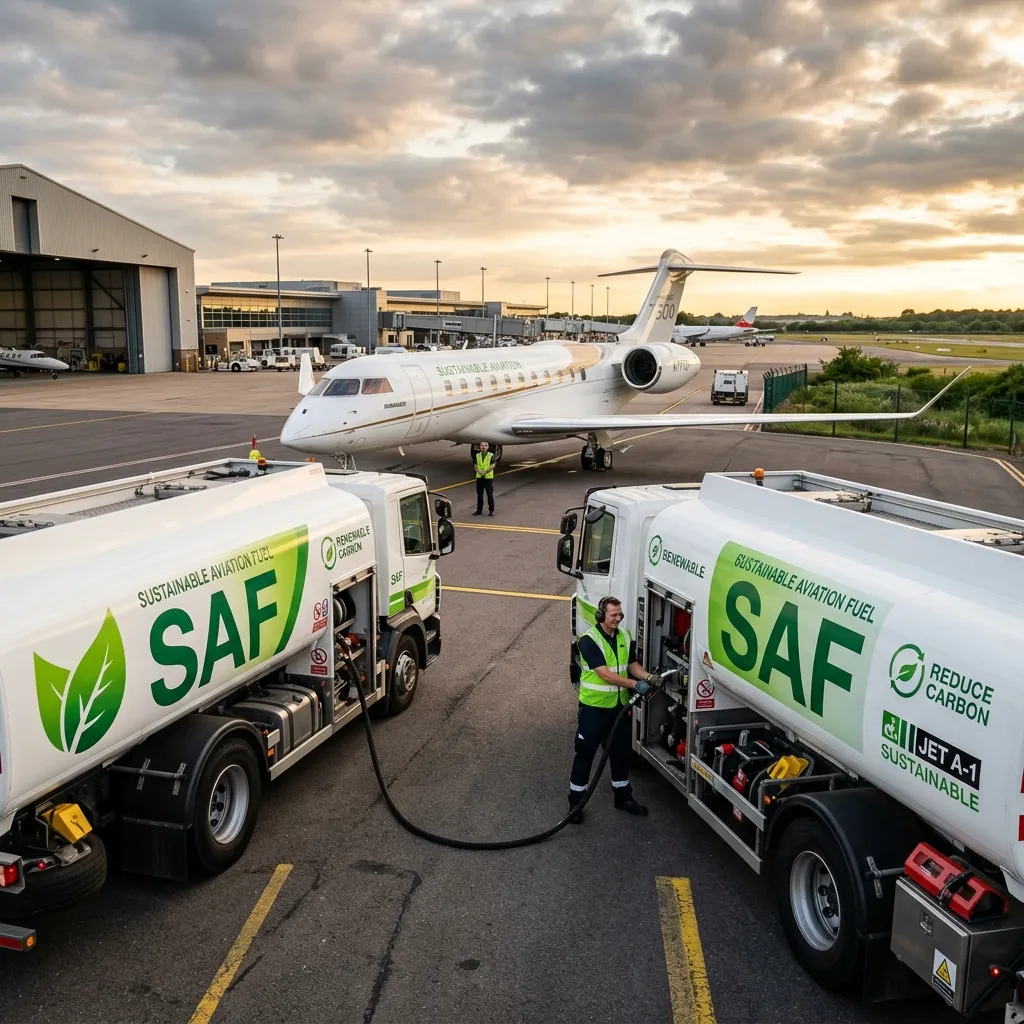
While electric propulsion remains 10-15 years away from business jet viability, Sustainable Aviation Fuel (SAF) is available today and reduces lifecycle carbon emissions by 50-80% compared to conventional Jet-A. SAF is a drop-in replacement that requires no aircraft modification. Every business jet flying today can burn SAF. The constraint is supply, not technology.

SAF production in 2026 covers approximately 0.5% of global jet fuel demand. Price premiums range from 2-4x conventional Jet-A, adding $1,000-$3,000 per flight hour on a midsize jet. Availability is concentrated at 50-60 airports worldwide, primarily in California, the EU, and Singapore. For operators who want to reduce emissions now rather than wait for electric propulsion, SAF is the only scalable option. Carbon offset programs are a financial mechanism, not an emissions reduction. SAF is actual chemistry.

Realistic Timeline: When Electric Business Jets Might Fly

Based on current battery technology trajectories, published OEM roadmaps, and FAA certification timelines, here is an honest assessment of when electric propulsion reaches each aviation segment:

  • eVTOL air taxis (4-6 pax, 60-100 NM): 2026-2028. Joby is certified. Archer is close. Limited commercial operations beginning.
  • Electric trainers and light GA (2 pax, 100 NM): 2025-2027. Pipistrel is certified and in production. The segment is real.
  • Electric commuter aircraft (9-19 pax, 200-300 NM): 2028-2032. Eviation Alice and competitors. Certification likely by 2030.
  • Hybrid-electric business jets (4-8 pax, 1,000+ NM): 2032-2037. Requires 500+ Wh/kg batteries at production scale and new airframe designs.
  • All-electric business jets (4-8 pax, 1,000+ NM): 2035-2045. Requires 800+ Wh/kg batteries. No current technology path delivers this by 2035.

Any OEM announcing a certified all-electric business jet before 2035 is making a marketing statement, not an engineering commitment. The physics establishes the floor. Human ambition can accelerate the timeline by a few years. It cannot accelerate battery chemistry by decades.

Brian Galvan

Written By

Brian Galvan

Founder, The Jet Finder ยท Private Aviation Operations & Technology

Former Director of Technology at FlyUSA (Inc. 5000 fastest-growing private jet company). Decade of hands-on experience across Part 135 operations, charter sales, fleet management, and aviation data systems.

LinkedInRead Full Profile →
Common Questions

Frequently Asked Questions


7 questions about electric and hybrid-electric business aircraft development

Several companies have announced concept aircraft but none have committed to a specific FAA or EASA certification target with funded development programs. Bye Aerospace's eFlyer 800 is the closest to a business aircraft concept at 8 seats and 320 NM projected range, but its certification timeline remains undefined and funding status is uncertain. Zunum Aero, which had Boeing backing for a hybrid-electric regional aircraft, ceased operations in 2021. The gap between announcement and funded development in this segment is substantial.

Hydrogen fuel cells offer approximately 1,000-1,300 Wh/kg at the cell level, which is 4-5x better than current lithium-ion. However, hydrogen storage tanks are heavy and voluminous. Gaseous hydrogen at 700 bar requires tanks weighing roughly equal to the hydrogen mass. Liquid hydrogen requires cryogenic tanks at -253C. When you account for the full system weight (fuel cell, hydrogen, tank, thermal management), the effective energy density drops to 400-600 Wh/kg, competitive with projected solid-state batteries but far below Jet-A. Airbus is exploring hydrogen for narrow-body commercial aircraft by 2035. Business jet applications would follow, not lead.

Not in the propulsion path. Some recent business jets incorporate electrically driven systems that previously ran off engine bleed air or hydraulic power, such as cabin pressurization, anti-ice, and flight control actuation. The Gulfstream G700 uses an electric environmental control system, reducing engine bleed air extraction and improving fuel efficiency by 1-2%. This is not hybrid propulsion; it is electrification of accessories. The propulsion chain itself remains exclusively turbine-powered on every certified business jet in 2026.

Carbon offsets are a financial transfer, not an emissions reduction. Buying offsets funds projects (reforestation, methane capture, renewable energy) that theoretically neutralize the emissions from your flight. The quality and permanence of these offsets varies enormously. Some programs have been shown to overstate their impact by 50-80%. SAF, by contrast, reduces the actual CO2 emitted during combustion by 50-80% depending on feedstock. If the goal is genuine emissions reduction rather than accounting neutrality, SAF is the only mechanism that works at the point of combustion today.

Not with any currently known battery chemistry. Jet-A at 11,900 Wh/kg sets a physical ceiling that batteries approach asymptotically. Theoretical lithium-air batteries project 3,500 Wh/kg at the cell level, but lithium-air technology has remained in the laboratory stage for 20+ years with fundamental challenges around cycle life, energy efficiency, and oxygen management. Even at 3,500 Wh/kg (a breakthrough not yet achieved), the effective system energy density would be approximately 2,000-2,500 Wh/kg after accounting for packaging. That closes the gap from 48:1 to approximately 5:1, which makes a 500 NM electric business jet feasible but not a 2,000+ NM one.

Investment is minimal and concentrated in the eVTOL segment, not business jets. Signature Aviation and Atlantic Aviation have both signed infrastructure agreements with Joby and Archer to provide vertiport charging stations at select FBO locations. These are designed for eVTOL aircraft with 50-150 kWh battery systems, not business jets that would require 5,000-20,000 kWh battery systems. The electrical infrastructure upgrade needed to support business jet-scale charging at a single FBO would cost $5-$15 million in transformer and grid capacity, which no FBO operator has committed to.

The SAF blenders tax credit ($1.25-$1.75 per gallon depending on lifecycle emissions reduction) has stimulated production commitments from several refiners. World Energy, Montana Renewables, and Neste have announced capacity expansions that would increase SAF supply to 1.5-2% of U.S. jet fuel consumption by 2028. The credit narrows the price premium from 3-4x to 1.5-2.5x conventional Jet-A, making SAF economically viable for operators who value emissions reduction. The credit is currently authorized through 2027 with potential extension discussions underway.

Continue Reading

Related Articles


Your Next Mission

Ready to Fly?


Whether you need a charter quote or want to explore aircraft options, our team is here.

Contact Us