What SAF Actually Is
SAF is jet fuel produced from non-petroleum feedstocks. The most common production pathway in 2026 is HEFA (Hydroprocessed Esters and Fatty Acids), which converts used cooking oils, animal fats, and waste greases into a drop-in jet fuel. Fischer-Tropsch synthesis from biomass and alcohol-to-jet pathways are scaling but account for a smaller share of current production.
Once refined, SAF is chemically indistinguishable from petroleum Jet-A in the ways that matter to an engine: flash point, freeze point, thermal stability, and energy density are all within ASTM D7566 specification. SAF is approved for use in all turbine engines at up to 50% blend ratio with conventional Jet-A. No engine modifications required. No airframe modifications. No maintenance interval changes.
The environmental benefit is lifecycle carbon reduction: SAF reduces net CO2 emissions by 50 to 80% compared to conventional jet fuel, depending on feedstock and production pathway. The reduction is measured across the full lifecycle, from feedstock cultivation through combustion. Tailpipe emissions during combustion are essentially identical to Jet-A. The savings come from the carbon absorbed by the feedstock during its growth phase.
Current Pricing and Availability
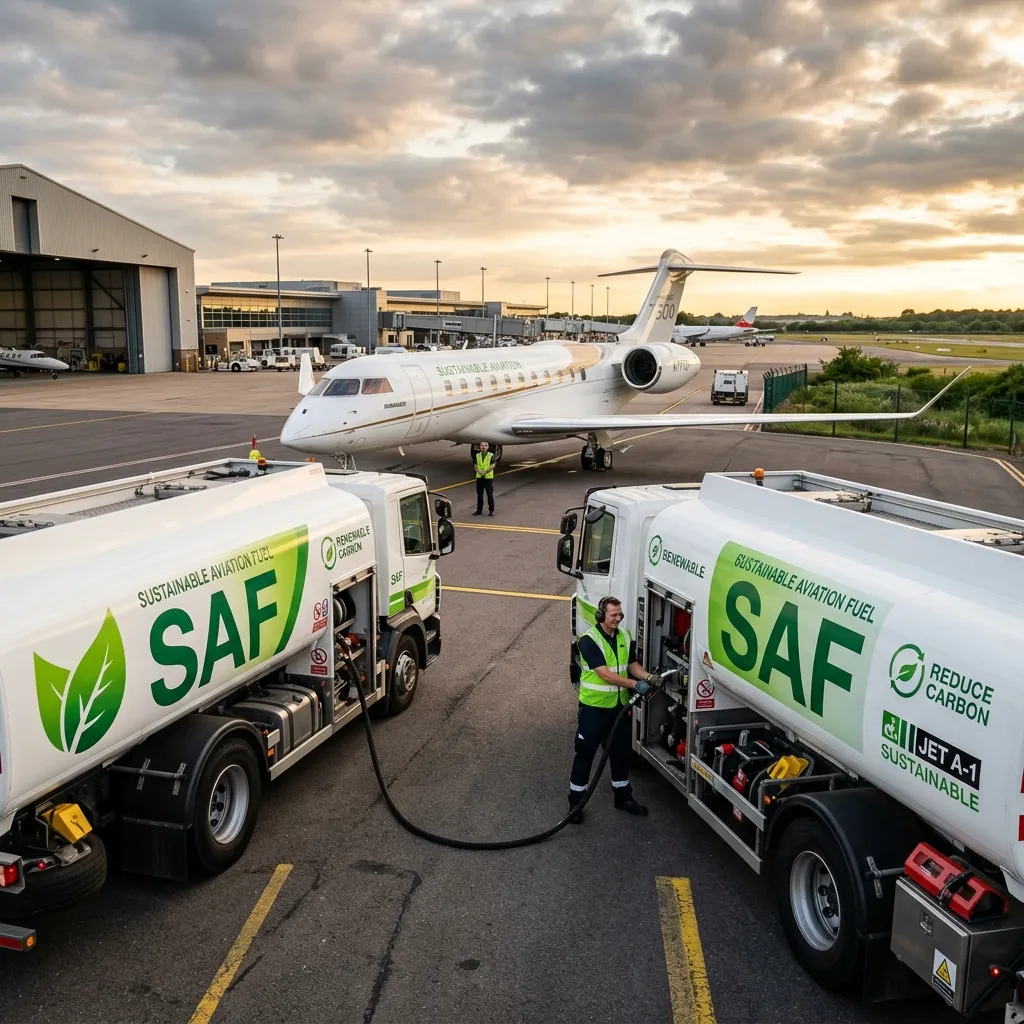
SAF availability in the United States is concentrated at approximately 30 airports, primarily in California, the Pacific Northwest, and select East Coast hubs. Los Angeles (LAX/VNY), San Francisco (SFO/SQL), and Seattle (BFI) have the most consistent SAF supply. On the East Coast, Teterboro has offered SAF intermittently through Signature and Atlantic. Most FBOs outside these markets cannot source SAF at any price.
Book-and-claim programs allow operators to purchase SAF credits without physically uplifting the fuel. The operator pays a premium above conventional fuel price, and the equivalent SAF volume is injected into the fuel supply chain at a participating refinery. The environmental benefit is attributed to the purchaser through a certificate. This is the most accessible way for private jet operators to participate in SAF without limiting their fuel uplift options. Programs like Neste MY SAF and World Energy SAF certificates are available through most major charter brokers and aircraft management companies. Documentation suitable for corporate sustainability reporting is provided with each purchase.
Why SAF Costs More
Three factors drive the premium. First, feedstock cost: used cooking oil trades at $0.40 to $0.65 per pound, and global demand from both aviation and renewable diesel production has inflated prices significantly since 2020. Second, refinery capacity: fewer than 10 refineries worldwide produce ASTM-certified SAF, creating supply constraints that keep pricing at the mercy of limited competition. Third, the refining process itself is more energy-intensive than conventional jet fuel production, adding $1 to $2 per gallon in processing cost.
Government incentives partially offset the premium. The U.S. Inflation Reduction Act provides a SAF tax credit of $1.25 to $1.75 per gallon for fuel meeting a 50%+ lifecycle emissions reduction threshold. California's Low Carbon Fuel Standard adds additional value. These credits bring the effective cost of SAF closer to $6 to $9 per gallon in favorable regulatory environments, narrowing the gap to $1 to $3 above conventional Jet-A.
SAF will not reach price parity with Jet-A through feedstock innovation alone. It will reach parity when petroleum extraction costs increase, government subsidies mature, and refinery scale economics bring production costs down. Most industry projections place parity somewhere between 2035 and 2045.