Dassault Built the Cabin First and Wrapped the Airplane Around It
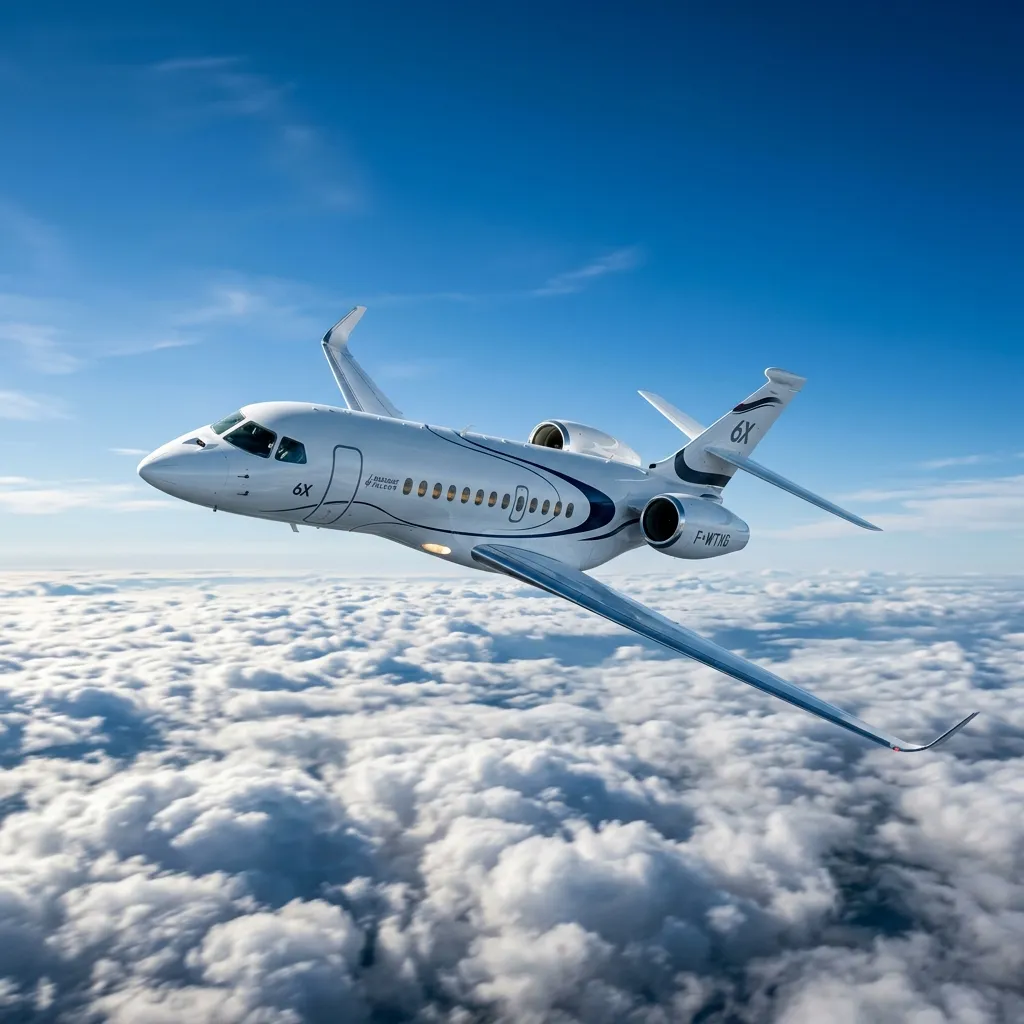
The Falcon 6X has the widest cabin in business aviation. Not the widest in its category. The widest, period. At 102 inches (8.5 feet) across, the 6X is wider than the Gulfstream G700 (8.2 feet), wider than the Global 7500 (8.0 feet), and wider than every other business jet in production or development. Dassault started the 6X program with a cabin cross-section and built the rest of the aircraft to serve it.
That width is not a marketing number. It translates to three specific things. First: the widest individual seats in the category, at approximately 28 inches across (versus 22-24 inches on competitors). Second: a flat floor with no step between cabin zones, which allows unrestricted movement throughout the 40.4-foot cabin. Third: the ability to install a three-zone cabin (lounge, conference, private suite) without any zone feeling compressed. The Falcon 6X's interior designer is not fighting the fuselage for space.
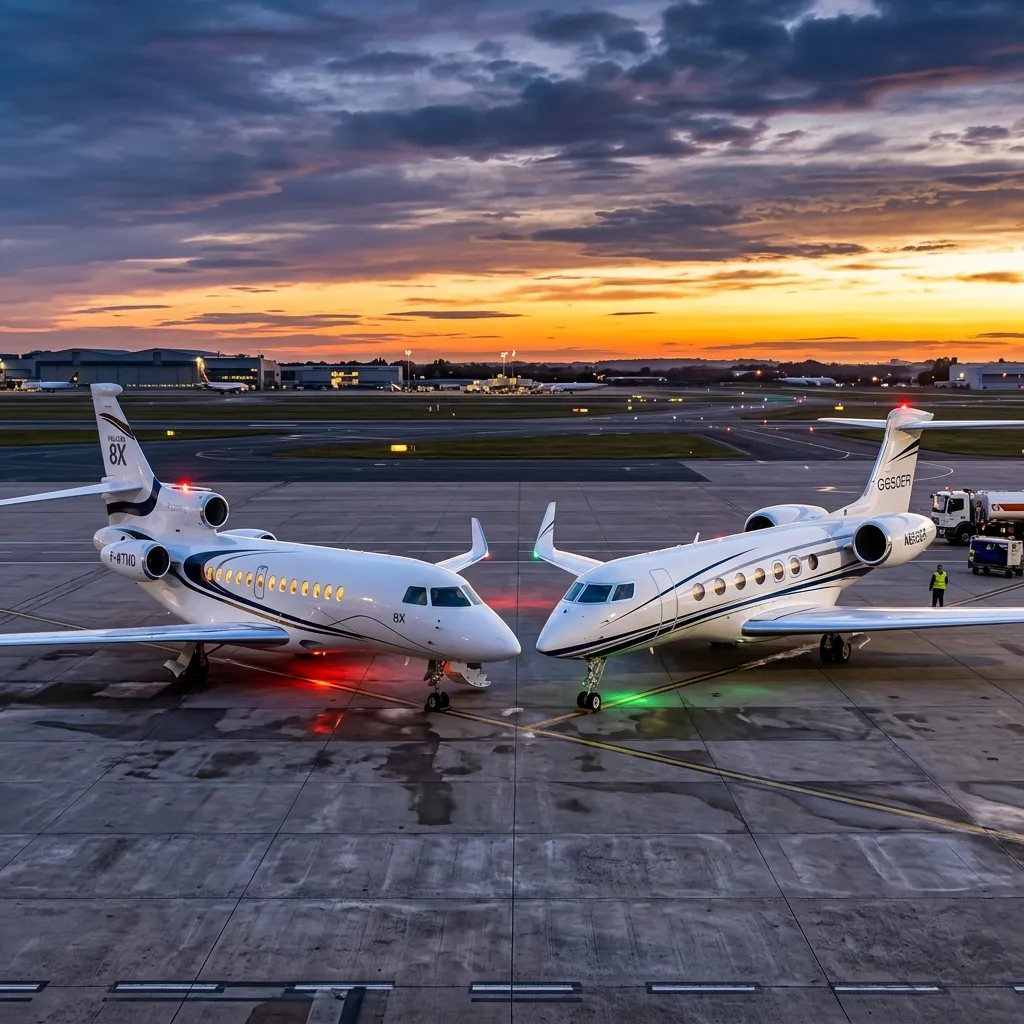
At 5,500 nm, the Falcon 6X covers New York to Dubai, Los Angeles to London, and Miami to any European capital nonstop. It does not match the G600's 6,600 nm or the Global 6500's identical range, but the 6X costs $10-15 million less and offers a wider cabin than either competitor. The range trade-off is strategic: Dassault calculated that the vast majority of ultra-long-range missions fall under 5,500 nm, and sized the 6X accordingly rather than chasing the range crown and compromising the cabin.
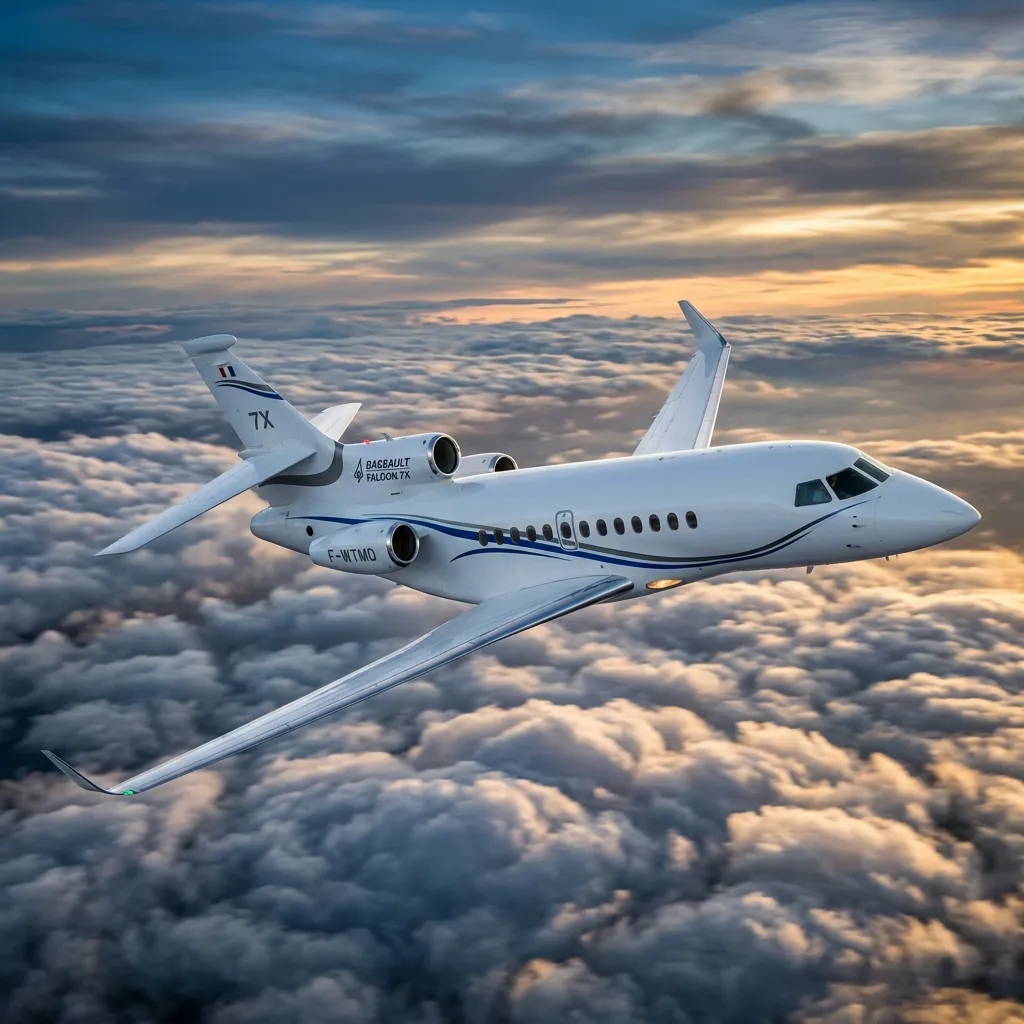
Dassault has never chased the longest-range specification. The Falcon 6X, like the 7X and 8X before it, covers the routes that matter and invests the remaining engineering budget into handling, cabin experience, and short-field performance. The 6X lands on runways that a G600 avoids. That is a Dassault design decision, not a limitation.
The PW812D: New Engine, New Risk Profile
The Falcon 6X is powered by two Pratt & Whitney Canada PW812D engines, each producing 13,500 lbs of thrust. The PW800 engine family was originally developed for the Cessna Citation Hemisphere (cancelled in 2019) and the Falcon 5X (cancelled in 2017 due to engine issues with the earlier PW810GA variant). The PW812D is the mature version of this engine family, and Dassault's confidence in it reflects years of testing and Pratt's redesign work after the 5X cancellation.
The PW812D offers 15-20% better specific fuel consumption than the engines on previous Falcon models. It runs quieter than the Rolls-Royce BR710 engines on the Global 6500 and the Pratt PW815GA on the G600. Dassault reports carbon emissions per nautical mile that undercut every large-cabin competitor.
The risk: the PW812D does not yet have the 20+ million flight hours of track record that the Rolls-Royce BR700 or GE CF34 families carry. Early adopters are trading proven reliability for next-generation efficiency. Pratt's engine health monitoring and the PW800 family's operational data from the G500/G600 (PW814GA/PW815GA) reduce this risk, but do not eliminate it. Operators enrolling in Pratt's ESP (Eagle Service Plan) hedge maintenance cost uncertainty.
Need a Charter Quote?
Contact our team for a personalized quote.
Get a Quote →Dassault's signature capability across the Falcon family is short-field performance, and the 6X maintains the tradition. The 6X needs approximately 5,480 feet for takeoff and can land in under 2,400 feet. Compare that to the G600 (5,900 ft takeoff) or the Global 6500 (5,858 ft takeoff). The difference is enough to open airports that competitors cannot use.
The 6X uses Dassault's digital flight control system (fly-by-wire) with automatic low-speed envelope protection, which gives pilots confidence in short-field approaches. Combined with the aircraft's leading-edge slats and large fowler flaps, the 6X delivers steep approach capability that puts it on the same short-field list as the smaller Falcon 900 series.
London City Airport (LCY) certifies jets for 5.5-degree glideslope operations. The Falcon 6X meets this requirement. The G600 does not. For clients who need large-cabin comfort with direct access to the heart of London, the 6X is one of the few options. That single capability justifies the purchase for a segment of buyers who operate primarily into European city centers.
The Cabin: Three Zones, No Compromise
The Falcon 6X cabin is 40.4 feet long, 8.5 feet wide, and 6.5 feet tall. Standard configurations include three zones: a forward club section (four seats), a mid-cabin conference/dining area (four to six seats), and an aft private suite or additional club seating. The cabin volume allows Dassault to offer a crew rest area, a full galley, and a walk-in baggage compartment accessible in flight.
Natural light enters through 30 windows, the largest in any Falcon. The skylight over the galley area is a Dassault-specific feature that creates an open feeling in what would otherwise be a utilitarian space. Cabin altitude at FL410 is 3,900 feet, lower than the G600's 4,850 feet at the same flight level. Lower cabin altitude means less fatigue on long-haul flights, though the difference is marginal for flights under 8 hours.
The wide cross-section allows lie-flat beds that are genuinely flat and wide enough for a 6-foot passenger to sleep without contact with the cabin wall. In the aft suite, the bed spans 6.5 feet with a 30-inch width. This is not an aircraft where sleeping is an afterthought.
Who Buys a Falcon 6X Instead of a G600 or Global 6500
Three buyer profiles select the 6X. First: operators who fly into short-field or steep-approach airports regularly (London City, Lugano, La Mole/St. Tropez, Cannes-Mandelieu). The 6X's approach performance is unique among large-cabin jets. Second: buyers who prioritize cabin width above all else, particularly those carrying passengers who spend 8-12 hours in the cabin on regular transatlantic routes. Third: fleet operators with existing Dassault relationships who want commonality with Falcon 7X/8X maintenance programs, pilot type ratings, and parts inventory.
The 6X does not make sense for buyers who need 6,000+ nm range nonstop (choose the G600 or Global 6500 instead), who need the prestige association of a Gulfstream nameplate (that is a real factor in certain markets), or who want the deepest worldwide service network (Gulfstream's support footprint is larger than Dassault's). The 6X is not trying to be the best jet for everyone. It is the best jet for a specific mission set.