Two Entirely Different Reasons to Exist
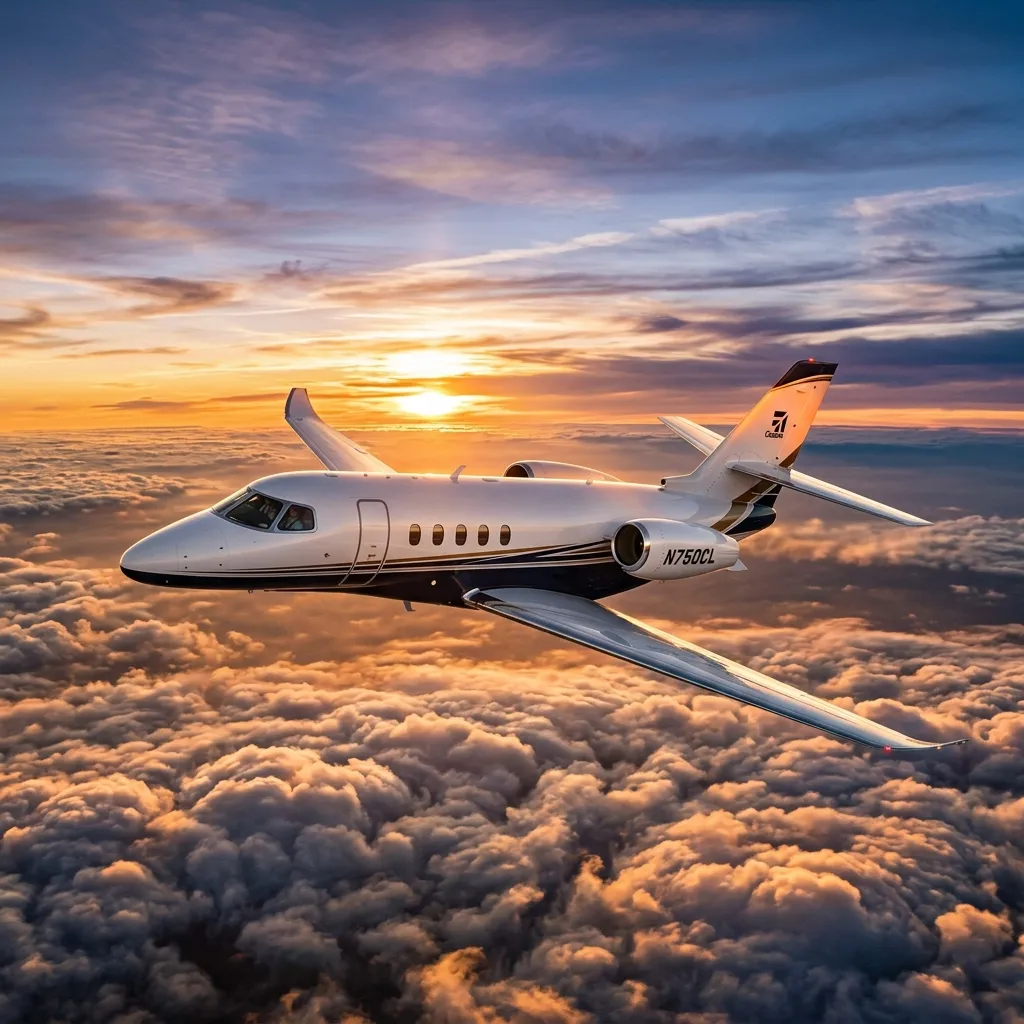
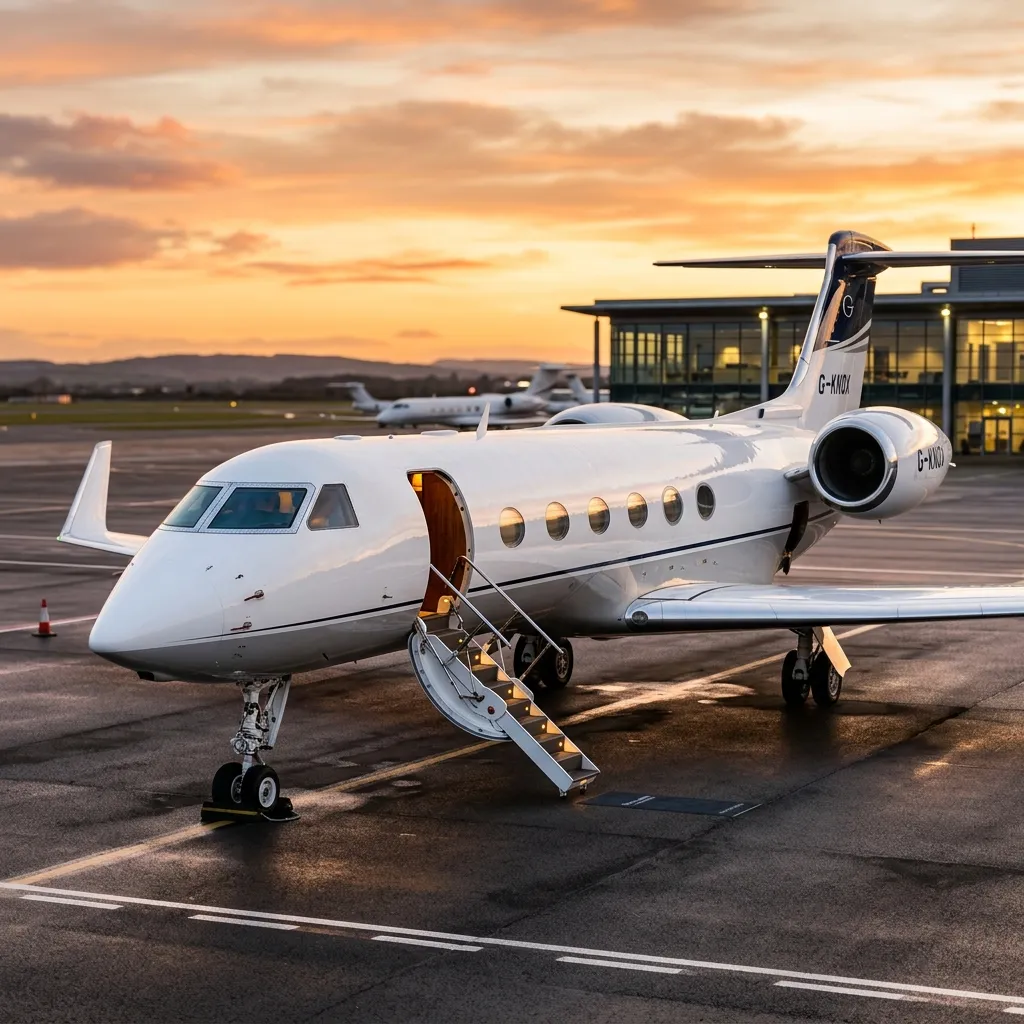
Comparing the Citation X to a Gulfstream G550 requires acknowledging that these jets were engineered for fundamentally different missions. The Citation X, produced from 1996 to 2012 (and as the X+ through 2018), was built to be the fastest civilian aircraft in the world. At Mach 0.92, it held that distinction for over two decades. The G550, produced from 2003 to 2021, was built to go far. Its 6,750 NM range connects New York to Tokyo, London to Singapore, or Teterboro to Dubai without stopping for fuel.
The comparison exists because buyers in the $5-$12 million pre-owned market regularly cross-shop these aircraft. A 2008 Citation X and a 2008 G550 can occupy the same price bracket. One delivers a cross-country sprint in under 4 hours. The other delivers intercontinental nonstop capability with a cabin that seats 16. The choice depends entirely on what problem you need solved.
The Citation X's speed advantage is not marginal. At Mach 0.92, it covers 525 knots true airspeed versus the G550's typical Mach 0.80 cruise at 481 knots. On a New York to Los Angeles leg (roughly 2,150 NM), the Citation X arrives 25-35 minutes ahead of the G550. On a 3-hour domestic flight, that time savings represents a meaningful reduction in block time, particularly for same-day round trips where the return leg runs against a clock.
The Citation X at Mach 0.92 operates in a regime where fuel burn increases exponentially with speed. At its maximum cruise, fuel flow approaches 280 GPH. At its long-range cruise of Mach 0.76, fuel flow drops to around 185 GPH. The G550 is more efficient at its design point because it was optimized for range, not speed. Most Citation X operators cruise at Mach 0.82-0.85 in practice, trading some speed for fuel savings.
Cabin: Midsize Speed Versus Heavy Jet Space
This is where the comparison breaks down in raw numbers. The G550's cabin is nearly double the length and significantly wider. It accommodates three or four distinct living zones: forward galley, forward lounge, mid-cabin conference group, and aft stateroom. The Citation X's cabin is a single-zone environment with club seating for 6-8 passengers. At 5.5 feet wide, the Citation X's cabin is narrower than most current super-midsize jets, a consequence of its 1990s design and fuselage optimized for transonic aerodynamics.
For a solo traveler or a couple making a 3-hour domestic dash, the Citation X's cabin is entirely adequate. For groups of 6 or more, flights exceeding 5 hours, or any mission requiring privacy zones, the G550 is in a different category. The G550's cabin supports sleeper configurations, dedicated work areas, and crew rest facilities for ultra-long-range flights. These are not comparable interior experiences at any passenger count above 4.
Need a Charter Quote?
Contact our team for a personalized quote.
Get a Quote →Charter and Operating Costs
The Citation X costs significantly less to charter and operate. Its hourly charter rate runs $4,000-$5,500 versus $5,500-$8,000 for a G550. The fuel savings are substantial: at $7.00 per gallon, the Citation X burns $1,680 per flight hour versus $2,730 for the G550, a difference of $1,050 per hour. Over 400 annual flight hours, that translates to $420,000 in fuel savings alone.
Pre-owned prices overlap only at the extremes. A well-maintained 2008 Citation X with 4,000 hours trades in the $4-$6 million range. An equivalent-vintage G550 trades at $10-$16 million. The G550 is a more expensive asset in every dimension: acquisition, operation, hangar, insurance, and crew training. Whether the extra capability justifies the premium depends on mission profile, not general preference.
Pilot Perspective and Type Rating Considerations
From the cockpit, these aircraft inhabit different worlds. The Citation X requires a CE-750 type rating, which takes approximately 14-18 days of ground school and simulator training. The aircraft's transonic flight regime demands pilot awareness of Mach tuck, compressibility effects, and speed management at altitude. At Mach 0.92, the margins between maximum operating speed (VMO/MMO) and buffet onset narrow considerably, requiring precise energy management during descents and speed changes.
The G550 requires a Gulfstream GV/G550 type rating, typically a 21-day program at FlightSafety International in Savannah or Dallas. The G550's PlaneView cockpit provides head-up display (HUD) integration as standard equipment, a feature the Citation X lacks unless retrofitted. Gulfstream's cockpit commonality program means G550-typed pilots can transition to the G450, G500, G600, or G650 with abbreviated training, creating career flexibility that Cessna's Citation line does not offer to the same degree.
Insurance costs reflect the aircraft's complexity and value. Annual hull and liability premiums for a Citation X typically run $35,000-$55,000 for experienced crews. G550 insurance runs $65,000-$120,000 depending on hull value and pilot experience. The G550's higher premiums reflect its greater hull value, not a higher accident rate. Both aircraft have excellent safety records across decades of service, with the G550 benefiting from Gulfstream's Enhanced Vision System (EVS) and the Citation X benefiting from its lighter weight and responsive handling.
Which Jet Matches Which Mission
The Citation X Makes Sense When...
- Your routes are domestic: coast-to-coast, hub-to-hub, and same-day round trips
- Time matters more than cabin size: a 25-minute advantage on a 3-hour flight is meaningful when the return leg has a deadline
- Passenger counts are 4-6, not 10-14
- Budget matters: $4,000/hr versus $7,000/hr is a $12,000 savings on a 4-hour flight
- You want Mach 0.92 because it exists and commercial aviation does not offer it
The G550 Makes Sense When...
- Routes cross oceans: the G550 flies New York to London, Moscow, Tokyo, or Dubai nonstop
- Passenger counts exceed 8 or groups need privacy zones
- Flights exceed 5 hours and the cabin must serve as an office, bedroom, or both
- Charter operators need fleet versatility: the G550 covers every domestic and international mission
- Resale matters: the G550 holds value better than any large-cabin jet in its generation
The cross-shop scenario most commonly involves a business executive flying 300-400 hours per year, primarily domestic, asking whether the Citation X's speed justifies buying smaller. If the majority of missions are Teterboro to Palm Beach, Van Nuys to Aspen, or Midway to Teterboro, the Citation X performs the mission faster and cheaper. If even 10% of the annual missions go transatlantic or require a cabin that accommodates 8+, the G550 is the only option.