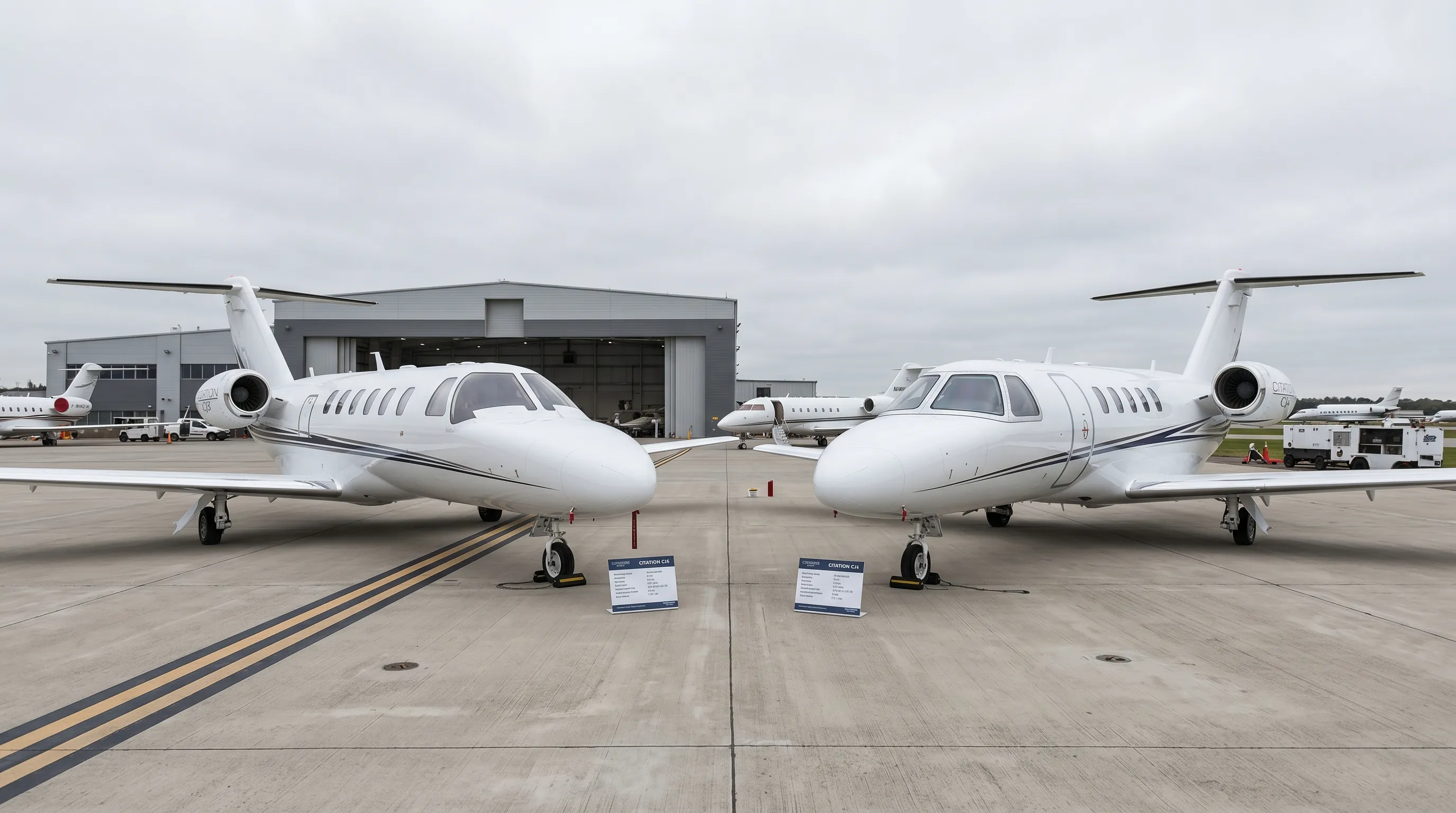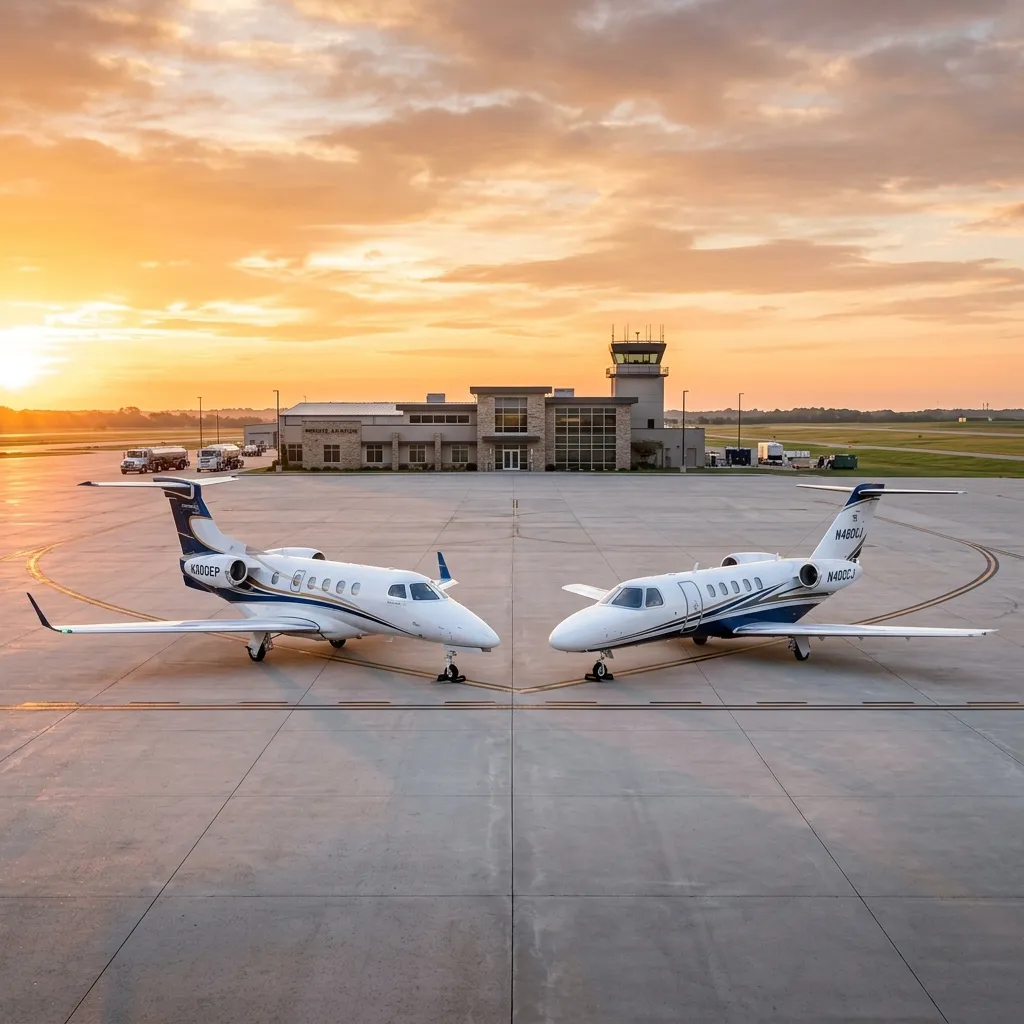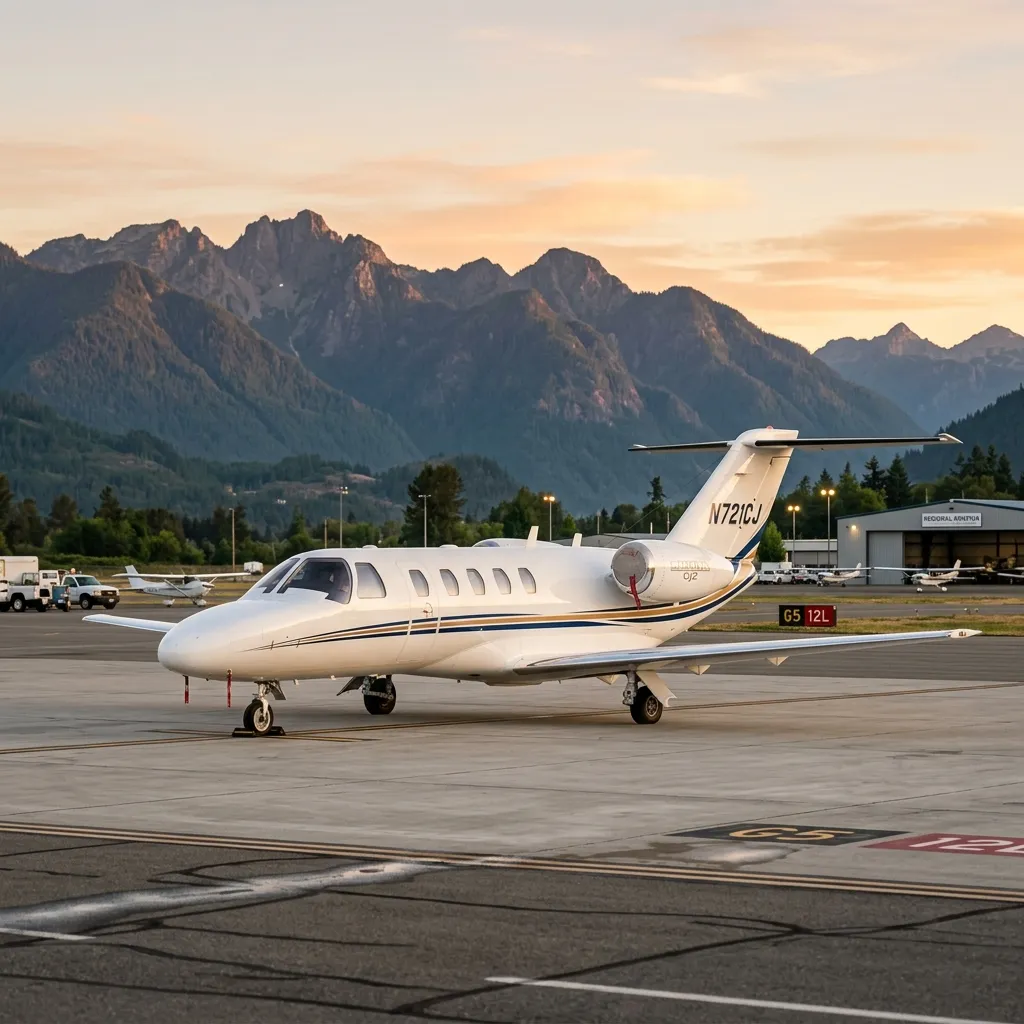
Cessna Citation CJ2 parked on ramp at a regional airport with mountains in background

What a Citation CJ2 Actually Costs to Charter

The Citation CJ2 charters for less than almost any light jet in the Part 135 fleet. Production ended in 2006, but the economics still work. Here is what it costs.

In This Article

The CJ2's Charter Economics in 2026 What Specific Trips Cost on a CJ2 Performance: What 418 Knots and 45,000 Feet Get You Inside the Cabin: Honest Assessment CJ2 vs CJ2+: Is the Upgrade Worth the Rate Premium? When to Skip the CJ2 Fleet Status and Charter Availability Frequently Asked Questions

The CJ2's Charter Economics in 2026

A Citation CJ2 charters for $1,800 to $2,600 per flight hour. That makes it one of the cheapest light jets available under Part 135, slotting below the CJ3 ($2,200-$3,100) and well below the Phenom 300 ($3,000-$4,200). Cessna built 308 CJ2s between 2000 and 2006 before replacing the line with the CJ2+. Most of the fleet is now 18-24 years old. Old enough to depreciate into favorable charter rates. Young enough to be well within structural limits.

Nobody brags about chartering a CJ2. That is part of why it works. Operators who fly them carry lower acquisition costs, which translates directly to lower hourly rates. The Williams FJ44-2C engines are proven, parts are available, and overhaul shops know the powerplant inside out. A full hot section runs roughly $180,000 per engine. Compare that to $240,000+ on a Pratt PW535E in a Phenom 300, and the rate spread makes sense.

What Specific Trips Cost on a CJ2

These are one-way estimates. The positioning fee, if the jet has to reposition to your departure airport, adds roughly $800-$1,500 depending on where the aircraft is based. Round-trip bookings cut the per-leg cost by 15-20% because the operator eliminates a deadhead segment. For trips under 1,000 NM, the CJ2 is hard to beat on cost per seat mile among jets.

A four-passenger trip from Addison Airport to Aspen on a CJ2 costs roughly what two first-class commercial tickets cost after you factor in the ground transportation, hotel layover, and time lost connecting through Denver. The math is closer than most people assume.

Performance: What 418 Knots and 45,000 Feet Get You

The CJ2 cruises at 418 knots at FL410-FL450. That is fast for a light jet built in the early 2000s. The 1,613 NM range covers most of the continental U.S. on a single fuel stop at most. New York to Miami, nonstop. Chicago to Aspen, nonstop. LA to Seattle, nonstop. Where it runs out of gas: coast-to-coast. TEB to VNY is 2,150 NM. The CJ2 needs fuel in Dallas or Denver.

Runway Capability

Balanced field length is 3,440 feet at sea level. That opens up airports the Phenom 300 (3,138 ft) can also reach, but the CJ2 operates comfortably into strips that give larger light jets pause at higher density altitudes. At Aspen's 7,820 feet elevation on a 25°C day, the CJ2 departs with 6 passengers and bags without sweating runway length. The Rockwell Collins Pro Line 21 avionics handle ILS, RNAV, and LPV approaches, keeping the CJ2 current with modern airspace requirements despite its vintage.

Climb rate averages 3,400 feet per minute at max takeoff weight. The CJ2 reaches FL410 in about 22 minutes. Once there, it sits above most weather and most turboprop traffic. Fuel burn at high cruise settles around 140 gallons per hour. At long-range cruise (389 knots), that drops to 115-120 GPH, which is where operators set power for legs over 2.5 hours.

Inside the Cabin: Honest Assessment

The CJ2 seats 8 in the brochure. In practice, 4-6 is the realistic charter configuration. The cabin is 12.9 feet long, 4.8 feet wide, and 4.8 feet tall. Anyone over 6 feet will duck getting in and sit slightly hunched if they draw the aft-facing seats. This is a light jet cabin. It is not the place for 8-hour transatlantic flights. It is exactly right for 1-3 hour domestic missions with a small group.

$1,800-$2,600
Hourly Rate Range
1,613 NM
Max Range
418 kts
Max Cruise Speed
8
Passenger Seats

Baggage is 65 cubic feet in the external compartment. Four roller bags and a set of golf clubs fit. Skis fit if they are under 6 feet. The lavatory is an enclosed belted seat at the rear with a curtain divider. Functional, not elegant. No one charters a CJ2 for the powder room. The redeeming quality is the large cabin windows and relatively quiet cabin at cruise, both Cessna signatures that hold up well even on airframes built two decades ago.

Need a Charter Quote?

Contact our team for a personalized quote.

Get a Quote

CJ2 vs CJ2+: Is the Upgrade Worth the Rate Premium?

Cessna introduced the CJ2+ in 2006 with the same fuselage and engines but added 180 NM of range (pushing to 1,793 NM), improved climb performance, and a slightly updated avionics suite. On charter, the CJ2+ runs $200-$400 per hour more than the original CJ2. For missions under 1,200 NM, which covers the vast majority of domestic charter trips, the original CJ2 does the same job for less money. The plus model earns its premium on longer legs where the extra range eliminates a fuel stop.

Operators sometimes list both variants under 'CJ2' without distinguishing. If range matters for your specific route, ask which variant you are booking. On a 900 NM trip from PDK to TEB, it makes zero difference. On a 1,500 NM trip from MDW to SJD, the CJ2+ can do it nonstop while the original CJ2 stops for fuel in San Antonio or El Paso.

When to Skip the CJ2

The CJ2 is not the right jet for every mission. These situations call for something else:

  • More than 6 passengers with luggage. The cabin gets tight and the weight limits get real.
  • Coast-to-coast nonstop. Book a CJ3+ or a Phenom 300 if you cannot stomach a fuel stop.
  • International trips requiring customs clearance at small airports. Larger jets with more fuel and range simplify the logistics.
  • Flights over 3 hours where cabin comfort matters. The 4.8-foot width wears thin after hour two for broader passengers.
  • High-density-altitude departures at max weight. The FJ44-2C engines produce 2,490 lbs of thrust each. At Telluride (9,070 ft elevation), payload restrictions get aggressive.

For everything else, the CJ2 quietly does the job at a rate that makes the per-seat economics competitive with first-class commercial on many routes. It is the jet for people who have done the math.

Fleet Status and Charter Availability

Of 308 CJ2s built, approximately 200-220 remain on the FAA registry. Roughly 40-50 operate under Part 135 certificates for on-demand charter. The fleet is concentrated in the Southeast, Texas, and the Midwest, where light jet demand is steady and operating costs are lower. Finding a CJ2 for charter in the Northeast or West Coast may require 48-72 hours of lead time and a repositioning fee from its home base.

Pre-owned CJ2 acquisition prices range from $1.8 million to $2.8 million depending on total airframe time, engine program enrollment, and avionics upgrades. Several operators purchased CJ2s specifically because the acquisition cost allows them to offer charter rates under $2,000 per hour while maintaining margins. As CJ3 and CJ4 rates climb, the CJ2 becomes a more compelling value proposition for cost-conscious charter buyers.

Brian Galvan

Written By

Brian Galvan

Founder, The Jet Finder · Private Aviation Operations & Technology

Former Director of Technology at FlyUSA (Inc. 5000 fastest-growing private jet company). Decade of hands-on experience across Part 135 operations, charter sales, fleet management, and aviation data systems.

LinkedInRead Full Profile →
Common Questions

Frequently Asked Questions


8 questions about chartering a Cessna Citation CJ2

Near the bottom, which is exactly where cost-conscious buyers want it. Only the Citation Mustang ($1,500-$2,200/hr) and the HondaJet ($2,000-$2,800/hr) consistently price below the CJ2, though neither offers the CJ2's 1,613 NM range. The CJ2 undercuts the CJ3 by $400-$500 per hour on average and the Phenom 300 by $1,200-$1,600 per hour. For a two-crew light jet that can fly TEB to OPF nonstop, no other type touches its rate floor.

Cessna designed the Citation 525A airframe for 20,000 flight cycles or 30,000 flight hours, whichever comes first. Most CJ2s on charter have accumulated 4,000-7,000 hours, well within structural limits. The Williams FJ44-2C engines have a 4,000-hour TBO. Operators enrolled in Williams TAP (Total Assurance Program) pay a fixed per-hour rate that covers all scheduled and unscheduled engine maintenance, which smooths cost variability and keeps the fleet current.

Yes, the CJ2 meets all Teterboro requirements. It operates under the airport's noise restrictions as a Stage IV-compliant aircraft. The practical challenge is not the jet but the slot: TEB limits operations to 40 per hour and Friday afternoons from 3-7 PM often hit capacity. An operator will file and hold, but expect 20-40 minute delays in the pattern during peak periods. The CJ2's low fuel burn (140 GPH) makes holding less expensive than it is on a G550 burning 280 GPH.

The CJ2 has an enclosed belted lavatory seat at the rear of the cabin with a privacy curtain. It is not a standalone lavatory room. The enclosure includes a flushing system and waste containment. Functional for short flights, adequate for 2-3 hour legs, but not the kind of facility anyone would choose for a 4-hour mission. Operators generally recommend limiting legs to under 3 hours if lavatory comfort is a priority.

The CJ2 operates into East Hampton (HTO, 4,242 ft), Sun Valley (SUN, 6,556 ft), Telluride (TEX, 6,870 ft at 9,070 ft MSL), and dozens of uncontrolled municipal strips with 4,000+ feet of pavement. At sea-level airports, the CJ2 needs 3,440 feet to clear a 35-foot obstacle. At density altitudes above 8,000 feet, that number stretches, and payload restrictions tighten. Operators planning mountain departures calculate performance for the specific day's temperature and pressure altitude before accepting the trip.

Somewhat. Roughly 40-50 CJ2s operate under Part 135 certificates nationwide compared to 150+ Phenom 300s. In the Southeast, Texas, and Midwest where CJ2s concentrate, 24-48 hour booking is routine. On the West Coast or in the Northeast corridor, operators may need to reposition from further away, adding $800-$1,500 to the quote. During holiday peaks, the limited fleet tightens availability faster than more numerous types. Calling a broker with CJ2 experience helps surface aircraft that are not listed on public platforms.

A 300-mile CJ2 charter runs approximately $1,650 one-way (45 minutes at $2,200/hr) plus positioning. Round-trip with the aircraft waiting: roughly $4,500-$5,500 total. Four first-class commercial tickets on the same route average $600-$900 each round-trip, totaling $2,400-$3,600 before ground transport. Add two $80 car services on each end, two hours of airport wait time per direction, and the connection risk of a delayed return flight. For four people doing a same-day business meeting, the CJ2 saves approximately 6-8 hours of collective travel time at a $1,500-$2,000 premium.

Most charter CJ2s are enrolled in the Williams TAP (Total Assurance Program), which charges a fixed hourly rate covering all scheduled and unscheduled engine maintenance including hot sections and overhauls. TAP enrollment costs approximately $200-$250 per engine per flight hour. Operators who are TAP-enrolled can price charter rates more predictably because engine maintenance is a fixed cost rather than a variable surprise. Non-enrolled aircraft may offer slightly lower hourly rates but carry the risk of an unscheduled $180,000 hot section appearing in the next quarter.

Continue Reading

Related Articles


Your Next Mission

Ready to Fly?


Whether you need a charter quote or want to explore aircraft options, our team is here.

Contact Us